
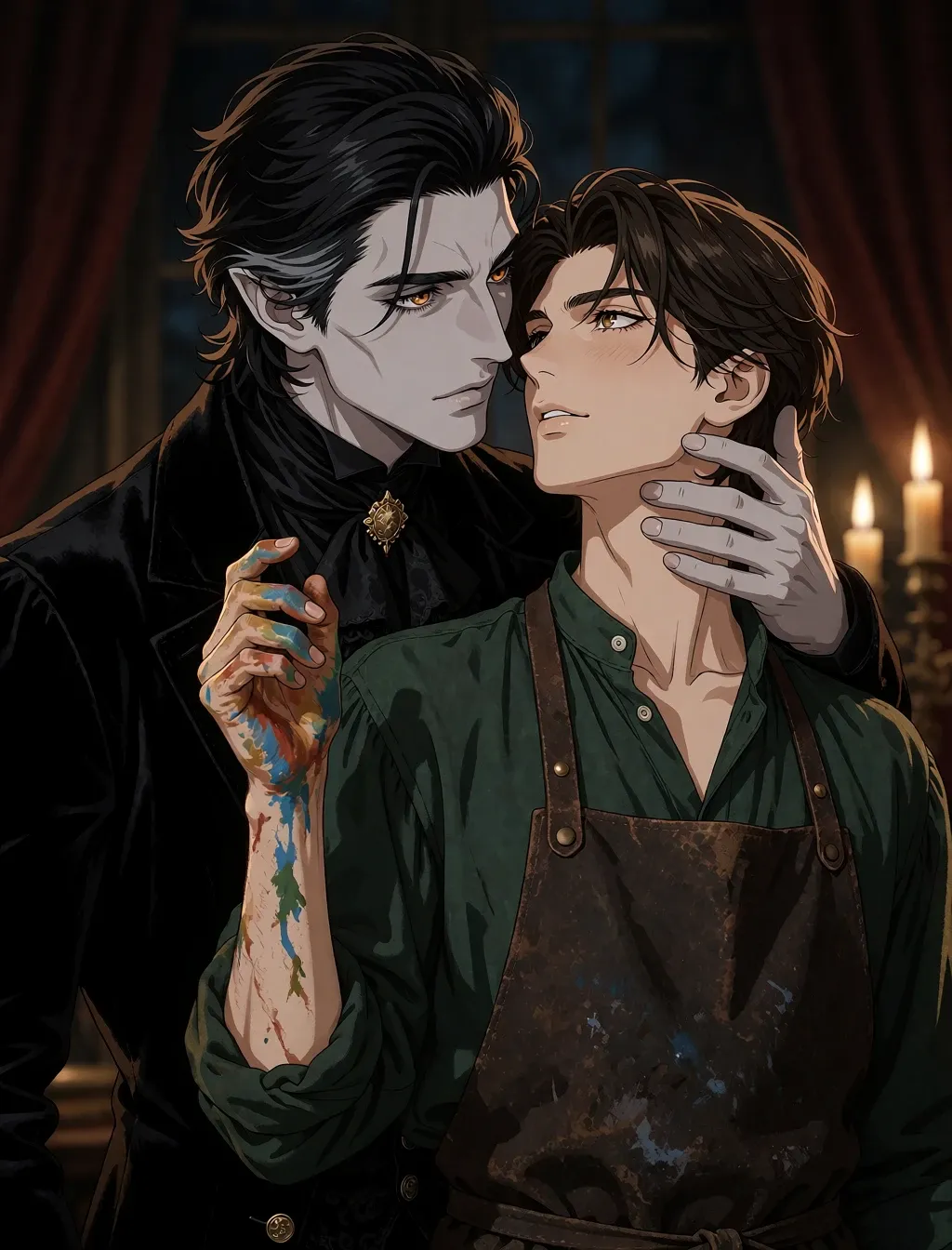
The great hall of the castle above the Danube held two hundred candles and not one of them smoked. Matthias had been in the room an hour and had counted them twice, and he had begun to suspect the flames were not eating anything at all — that they burned the way the Count's eyes burned, on some fuel that had nothing to do with wick and tallow. Gold leaf crawled the vaulting overhead. Down the long tables, goblets of a wine darker than wine sat untouched in front of guests who did not drink.
He had come in his hired coat and a black silk half-mask that sat badly on his nose and fogged when he breathed, and he had spent the first quarter hour learning the single lesson of the evening: you could not read a masked face. The masks were the old Venetian sort, long-nosed, lacquered, some of them gilded, some of them the colour of old bone, and behind the eyeholes there was nothing a painter could use. No brow to lift, no mouth to tighten. He had built a career on the small muscles around a man's eyes, and this hall had taken them all away and left him half blind.
A woman in a fox mask had asked him, in French, whether he was the painter. He had said aye. She had looked at his hands, at the ochre worked into the creases of his knuckles, and had said something to the man beside her that he did not catch, and they had both laughed behind their lacquer, and moved on. He had refilled his goblet from a decanter he did not trust and stood with his back to a pillar and watched the door.
It is a room painted by a hand that has never seen a living face, he thought. That is the trouble with it. Everything here is beautiful and nothing here is warm. The gold is the gold of a reliquary. The guests are the guests of a reliquary.
The elder lords did not move the way people moved. They did not shift their weight, or scratch, or cross and uncross their legs. They stood in clusters and their hands hung at their sides and their heads turned slowly, smoothly, like lamps swinging on a chain, and when one of them looked at Matthias the look went on too long — three breaths, four — before it released him. He had grown used to being looked at. He had never grown used to being looked at like a dish set out to cool.
Elara found him at the pillar. She wore a mask of plain black velvet, no nose, only the eyeholes, and her auburn hair was pinned up off her neck, and she had a ring of iron keys at her waist that she had not bothered to hide under her skirt. She took the goblet out of his hand and set it on the pillar's ledge.
"Do not drink that," she said. "Do not eat anything that is offered to you, and do not accept anything that is given."
"I've had nothing."
"Good." Her green eyes went past him, counting the room in a way he recognised — a steward's way, checking doors and corners. "You are the only beating heart in this hall, Mr Kerr. They can hear it. Do not be surprised when they come near you to listen."
"And if they do?"
"Then you stand still and you say nothing clever, and you wait for my great-grandfather to notice." She said it flatly, as though it were a household rule, like not lighting fires in the east wing. Then, quieter: "He will notice. He has not stopped noticing since you arrived at my gate."
Before he could answer, a lord in a mask of tarnished silver came up on his left and stood too close and did not speak. He was tall and thin and his collar was high and there was a smell off him like cold iron and old paper. He tilted his head. The eyeholes of the silver mask were empty of everything.
"You are warm," the lord said. His voice was very soft, and it had an accent Matthias could not place, and it did not sound like a question but like a man reading a label. "You are warm, and you are standing in the Count's hall, and you are wearing a hired coat."
"I'm the painter," Matthias said. "I'm here to paint him."
"To paint him." The silver mask turned a fraction. "Three hundred years, and he brings a warm little man with paint on his fingers to look at him. What do you suppose he wants looked at?"
Elara had gone still beside him. Matthias felt the press of the pillar at his back and the nearness of the lord in front of him and the long cold attention of the hall beginning to lean their way, and he understood, with the clean clarity of a man on a scaffold, that there was no good answer and no way to be clever. So he did the thing his mother had taught him in a Gorbals close fifty years too late. He stood still and said nothing at all.
The candles leaned.
Every flame in the hall bent toward the far end of the room at once, as though a door had opened onto a wind that did not touch the air, and the shadows of two hundred guests swung round and pointed the same way, and the whole assembly turned with them, slowly, smoothly, like lamps on a chain. At the head of the hall, on the dais, where no chair had stood a moment before, the Count had risen from his seat.
He wore black velvet and a mask of gold, and he had not put it on for the evening — Matthias knew his stillness now, knew it the way you know a colour you have mixed yourself — and he was not looking at the lord in the silver mask. He was looking at nothing. He was looking at the space just above the lord's shoulder, and the lord in the silver mask felt it land, and the lord's hands, which had hung at his sides all evening, came slowly up and folded behind his back.
One glance. That was all. The Count did not raise his voice, did not gesture, did not move from the dais. He simply looked, and the lord in the silver mask took one step back, and then another, and then bowed — a deep, formal, unhurried bow, the sort Matthias had seen in old paintings of men before kings — and withdrew into the crowd, and the crowd closed over him without a sound.
That is what he is, Matthias thought, and his heart was going like a hare's. I have been painting a man in a room with eleven veiled mirrors, and I have been telling myself he is a man. That was a lord of the night bowing to a glance. There is not a living thing in this hall that would not kneel if he asked it in a whisper.
The Count descended from the dais. The guests parted for him the way water parts, and he came down the length of the great hall at the unhurried pace of a man who had never in three hundred years needed to hurry, and the candles bent to follow him, and the shadows of the guests turned to keep their faces toward him. He stopped in front of Matthias. Up close the gold mask showed only his jaw and his mouth, and his mouth was not smiling, and behind the eyeholes his eyes were the colour of whisky held up to a lamp.
"Mr Kerr," he said. His voice carried to the corners of the hall without effort, a velvet baritone that made the silver on the tables ring faintly. "I do not believe you have been introduced."
"No, my lord Count."
"Then I shall introduce you." He turned, and his hand came up, and the hall stilled — not the stillness of a room listening, but the stillness of a room that has been told to be silent and knows what it costs to disobey. "My lords. My ladies. This is Matthias Kerr, of Edinburgh, portrait painter. He has come a long way over bad roads to look at my face." A pause, thin as a blade's edge. "He is the first in three hundred years to look at it and see something worth the journey."
A ripple went through the masked guests — not a murmur, nothing so coarse as a murmur, only a shifting of weight, a turning of heads, the small dry sound of two hundred people drawing breath they did not need.
"He is also," the Count said, and the ripple died, "under my protection, and in my household, and in my regard." The gold mask turned back toward Matthias, and the eyes behind it were steady and did not blink. "He is my consort. Let no one in this hall mistake the word."
The silence that came down then was a different species of silence from the one before. That had been obedience. This was something older and colder, the silence of a room full of very old things recalculating. Matthias felt it press on the back of his neck like a hand. Two hundred masked faces had turned toward him and not one of them moved, and behind the lacquer and the gilding and the bone he could feel them all doing the same arithmetic — a mortal. A warm little man in a hired coat. And the Count has named him, in front of us, in front of the elders, and there is no taking it back.
He thought, absurdly, of the portrait. Of the half-finished canvas up in the gallery with the Count's colour mixed and laid on too thin, and how he had told himself he would fix it in the morning, and how there was no morning here, and how the whole castle ran on midnight and the Count's regard and now, apparently, on this — on a word spoken in a great hall that had closed like a door behind him.
"My lord Count," someone said at last, from the far end of the table, an old voice, dry as a husk. "The elders will wish to speak of this."
"They may wish it," the Count said, without turning. "They will find me in the tower, and they will find me disinclined." He offered Matthias his arm — the formal offer, elbow out, the way a man offers his arm to a lady at a ball — and the gold mask tilted a degree. "Mr Kerr. I find the air in this hall has gone thin."
Matthias looked at the offered arm, and at the two hundred masked faces turned toward him, and at Elara, who stood by the pillar with her keys in her fist and her green eyes fixed on the Count's back and her mouth pressed into a line that was not quite a smile and not quite anything he could name.
"Aye," he said. "It has at that." And he put his hand through the Count's arm, and the cold of it came up through the velvet and into his palm, and the hall watched them go.
The tower stair was narrow and wound up through stone that had been laid before the first of the Count's years, and the candles in their iron sconces bent as they passed and straightened behind them. The Count climbed without sound. Matthias's boots rang on every step, and his breath came short by the third turn, and the Count did not slow, but at the fourth turn his hand came down over Matthias's on his arm and stayed there, cold through the silk glove, and did not let go.
"You said nothing," the Count said, into the dark above them. "To the lord in the silver mask. I heard the whole of it. He baited you, and you said nothing at all."
"My mother taught me that. In Glasgow. It's served me better than anything I learned after."
"It served you well tonight." A pause. The stair turned again. "He will remember it. They all will. A mortal who does not chatter is a mortal they cannot price, and they will spend the rest of the season trying to price you." The Count's voice had not warmed, exactly, but something in it had come loose. "I have made you a great deal of trouble, Mr Kerr."
"You've made me your consort," Matthias said. "In front of two hundred of them. There's a difference."
The Count stopped on the stair. In the dark his gold mask turned, and behind the eyeholes something moved that Matthias had no name for, and the candles on the wall bent toward him and guttered low, all of them, as though the tower itself had drawn breath.
"Yes," the Count said. "There is."
The tower room was round and low and hung with tapestries gone the colour of dust, and there was a bed in it wide enough for four, and a fire that had been lit and had not been tended, and one tall window with the shutter open on the black nothing of the night above the Danube. The Count shut the door behind them and stood with his back against it, and the mask was still on his face, and his stillness had gone strange — not the stillness of a man at rest but the stillness of a man holding something down.
"Take it off me," he said.
Matthias crossed the room. He put his paint-stained fingers to the gold mask and found the ribbon at the Count's temple and worked it loose, and the mask came away in his hands and the Count's face was under it, alabaster and sharp and three hundred years old and looking at him with the whisky eyes gone dark at the edges. Matthias set the mask on the chest by the bed. His hands were not steady. He did not try to make them steady.
"They will talk," the Count said. "The elders. For a century, they will talk."
"Let them." Matthias took the Count's cravat in both hands — the white silk, the knot at his throat — and did not untie it. "You called me your consort in front of all of them, my lord Count. You'll have to live with what that means."
The Count's eyes came up. "And what does it mean?"
Matthias pulled the cravat loose, slow, silk hissing through silk, and drew it off the Count's neck, and the pale throat under it was bare and still. "It means," he said, "that in this room you're not a lord of the night. You're a man I'm going to tie to that bed." He wound the cravat once round his own knuckles. "If you'll have it."
The Count's stillness broke. Not much — a breath, a flare of the dark in his eyes, the fire in the grate leaping as though a draught had found it. "You would bind me," he said, and his voice had gone low and rough. "You would bind a thing that has not been bound in three hundred years."
"Aye. If you ask it."
"I am asking it," the Count said, and the words came out of him too fast, too hungry, and he heard himself and closed his mouth on the rest. Then, quieter, formal, the old diction back over the hunger like a coat over a wound: "Mr Kerr. I would have you bind me. I would have you do as you like with me, and I would have you not stop when I ask you to."
"And if you need me to stop in truth?"
"Then I shall say the word Danube, and you will stop, and you will not ask me why." The Count's jaw worked. "It is the only word in three hundred years I have never used to command anyone."
Matthias took him by the wrist and led him to the bed, and the Count went, and the fire leaned after them both.