
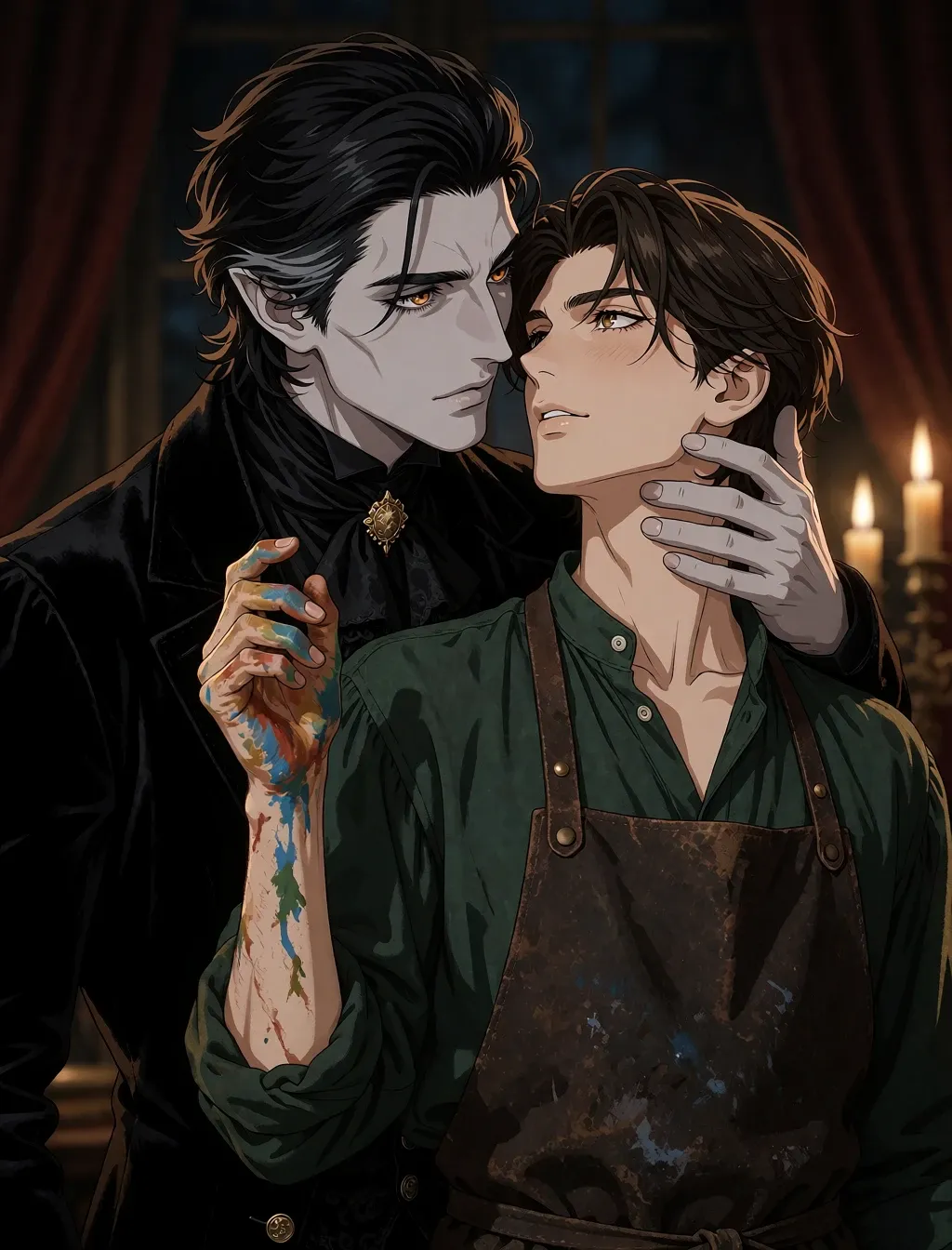
The crypt library smelled of cold stone and old paper and the wax of a hundred years of candles, and the Vasse crest was carved over every shelf — a hand holding a mirror, the mirror blank — and the candlelight caught in the blank of each carved mirror as the Count walked past them, one by one, and did not look at any.
Matthias Kerr was thirty-five years old and had spent most of them looking at faces, and he had never in his life been so aware of the back of a man's neck.
"You asked me a question at the window," the Count said. He did not turn. His voice came off the stone the way it came off everything — unhurried, velvet, three hundred years of not needing to raise it. "About what the glass would not show. I have been thinking on it since, and I find I would rather answer you here than there."
"Here" was the crypt. Matthias had followed him down the spiral stair past the kitchen and the wine and the deeper dark, and the air had gone from cool to cold, and the Count had lit the candles with a taper and no match, and the flames had bent toward him as he passed and then straightened behind him like a congregation sitting down.
"I know what the glass won't show," Matthias said. "I saw it. That's not the question I came down here with."
The Count turned then. Amber eyes in a face like aged marble, black hair slicked back, the high collar white as a bone. Alabaster and old varnish, Matthias thought, the painter's eye going before the man could stop it. Lead white, and a little umber in the hollows, and that impossible warm thing under the jaw that is not in any palette I own.
"Then ask it," the Count said.
Matthias put his hand flat on the reading table between them. The wood was older than Scotland's claim to it, black with age, and his fingers left their faint print on the dust — ochre and umber, the stains in the whorls of his skin, the oldest paint on him the colour of dried blood. "Upstairs," he said, "you put your mouth on my thigh and drank, and you were — careful. Careful the way a man is careful with a thing he wants to keep. And I've been sitting with that an hour now, and what I want to know is what it would be like if you weren't careful. If it happened in the middle of the other thing. Whether the bite is — whether it's the same hunger or a different one."
The Count was still for a moment. Matthias had learned the stillness by now, had learned to read it the way he read a sitter's mouth: it was not the stillness of a man thinking. It was the stillness of a man deciding how much to give.
"You are asking," the Count said slowly, "whether I would take you while I had you. Whether the blood and the body are one appetite in me or two."
"Aye. That's the question."
"Then I will answer it," the Count said, "but not with words, and not until you have understood the terms. Come here."
Matthias came around the table. The Count did not move to meet him; he waited, and the waiting was its own instruction, and Matthias stopped a pace away with the cold of the crypt coming up through his boots and the crests watching from their shelves.
"The first term," the Count said, "is this. At any moment you may say stop, and I will stop. Not because you have persuaded me, not because I am in a merciful humour. Because it is the term. You will not need a reason and I will not ask for one." His eyes came down Matthias's face and rested somewhere near his mouth. "Do you accept it?"
"I accept it."
"The second term. The bite is not the price of the night. It is a separate thing, and it is a gift, and you must ask me for it by name before I take a drop. If you do not ask, I will not take it, and the night will be the night and no more than the night. Do you understand the difference?"
Matthias's mouth had gone dry. "The difference between being owed and being given."
"Yes." The Count's voice dropped, and the candles nearest him leaned. "I have taken a great deal in three hundred years. I will not take you by default."
"Then I understand it."
"Good." The Count's hand came up and did not touch him — hovered a breath from his jaw, close enough that Matthias could feel the cold coming off it like the cold off a windowpane. "The third term is the one men find hardest. You must say what you want. Aloud. In your own words, and plainly, and I will wait however long it takes, and I will not help you find the words."
"You'll wait."
"I have waited three hundred years for a man to look at me and see me," the Count said. "I can wait through a silence."
And he did. He stood with his hand a breath from Matthias's face and his amber eyes steady and let the silence run, and the crypt was so quiet Matthias could hear the wax guttering in the nearest candle and the tick of something deep in the stone, and his own breath going out of him and not coming back in. Say it, he told himself. You've said worse to lesser men. Say it.
"I want you to fuck me," Matthias said. His voice came out lower than he meant it to, scraped. "There. That plain enough for you?"
"It is plain." The Count's mouth curved, just, and it was the first time Matthias had seen him smile that was not cruel. "It is not complete. What do you want done to you, and where, and how hard. I am not going to guess at the shape of your wanting and get it wrong. Tell me."
Matthias laughed — one breath of it, cracked. "Christ. You'd have me draw you a diagram."
"If you like. You are the painter."
The hand withdrew. The Count turned and walked the length of the reading table, and the candles bent and straightened as he passed them, and he set his palm flat on the far end of the wood and looked back along it at Matthias. "Here," he said. "Bent over this. Hard enough that you will feel it tomorrow in every stroke of the brush, and think of me, and have to keep your hand steady anyway. That is what I would give you. But I will not give it to you until you say that it is what you want."
The cold of the crypt had got into Matthias's forearms where they braced on the table, and he felt it now like a fact he could hold. This is the thing, he thought. This is the thing I came down the stair for and did not know the name of. "That's what I want," he said. "Bent over this table, and you behind me, and hard. And I want to know what the bite is like in the middle of it. But I'll ask you for that separate, the way you said, when I want it."
"Then turn around," the Count said, "and put your hands on the wood, and do not move them until I tell you."
Matthias turned. He laid both hands flat on the black old wood, the paint-stained fingers spread, the ochre and umber bright against the dark, and he heard the Count come up behind him — not the sound of footsteps but the sound of the air changing, the candles drawing their flames thin — and then the Count's hands were at his hips, and cold, and sure, and drew him back a step so that he was bent and braced and could feel the whole length of the table taking his weight.
"You are trembling," the Count said against his ear.
"I'm cold."
"You are not cold." The Count's hand came around and undid Matthias's belt, and the leather whispered out of the loops, and the trousers went down over his hips, and the cold of the crypt found the backs of his thighs and the small of his back. He made a sound he was not proud of. "I am going to open you with my fingers first. It will be cold. It will not be gentle at the start. Tell me if it is too much."
"It won't be too much."
"You do not know that yet." The Count's fingers, cold and slick with something from the shelf — oil, old and faintly of resin — pressed against him, and Matthias's whole body went tight and then, by degrees, let go, and the Count worked him open slow and thorough and without any hurry at all, one finger and then two, and the wet sound of it was loud in the stone room, and Matthias's fingers went white on the wood. "There," the Count said. "You take it well. You were made to be opened, I think."
"Flatterer."
"I do not flatter. I have not flattered anyone in two hundred years." The fingers curled, and found the place, and Matthias's hips jerked against the table and a sound came out of him that was not a word. "Ah. There." The Count's voice had gone rough at the edges, the velvet worn through in one place. "Again?"
"Again — God — again."
The Count gave it to him again, and again, until Matthias was pushing back onto his hand, shameless, and the candlelight had gone strange and thin, and then the fingers withdrew and something blunter and harder pressed where they had been.
"Say it once more," the Count said, low. "What you want."
"Fuck me," Matthias said. "Hard. Now. Please."
"Good," the Count said, and pushed into him.
It was cold, and it was thick. It went into him slow and relentless and did not stop, and Matthias's breath went out of him in a long ragged rush and his forehead came down onto the wood. The Count's hands closed on his hips and held him there, sheathed to the root, and did not move, and the waiting was worse than the moving, and Matthias heard himself say, "Move, damn you," and the Count said, "Since you ask so sweetly," and pulled back and drove in.
Hard. He had asked for hard and he was given it. The table took the force of it and did not shift, old and black and heavy, and the slap of skin came back off the carved shelves and the blank crests, and Matthias's hands slid on the dust. He braced and pushed back to meet it and the Count's fingers dug into his hips hard enough to bruise. "Is it what you wanted?" the Count said, on a thrust, the words broken up. "Tell me."
"Yes — Christ — yes, harder—"
"Greedy," the Count said, and gave him harder.
The candle on the table guttered and nearly went out, and Matthias felt the Count's body come down over his back, felt the cold of him through the shirt, felt the breath at his ear that was not breath, and the Count's voice was at his throat, low and frayed. "The bite. Do you want it? Ask me for it by name, or I will not take it."
Matthias's mind had gone to colour and light, the way it did — red, the whole room gone red at the edges, the candles like struck matches, the dark behind them like varnish — and he got his mouth to work. "Bite me," he said. "Aurelien. Bite me."
The name did something. The Count made a sound against his neck, low, hungry, a sound no living man makes, and then his teeth were in Matthias's throat and the pain was a bright line. Then it was not pain, it was the red at the edges of everything, it was heat going out of him and pleasure coming in on the same current, and the Count was still moving in him, fucking him through it, and Matthias's cock was hard and untouched and aching against the cold wood. He was going to come, he was going to come with the Count's mouth at his throat and his cock deep in him and —
"Aurelien—" he said, and it broke. He came, and his whole body clenched around the Count and the Count groaned into his neck and drank, and the candles went out, all of them, one after another down the length of the room like a wave going out.
In the dark the Count held him, and the mouth came off his throat, and the Count's tongue traced the wound once, closing it, and his voice was wrecked. "There. That is the answer to your question. The blood and the body are one appetite. You have felt it now."
Matthias got his breath back by degrees. His hands were still flat on the table, the paint-stains dark and invisible now, and the whole crypt was black and smelled of smoke and iron and the both of them. "The candles," he said. "Did I do that?"
"I did that." The Count withdrew, slowly, and Matthias felt the loss of him like a step off a stair into nothing. "I am not always careful of the room."
"Light them again." Matthias turned, and his legs were not entirely his own, and he found the Count by the sound of him and put a hand flat on his chest, on the cold linen of the high collar, and pushed, not hard, and the Count went back a step, and another, and Matthias followed him down onto the rug that lay before the shelves, the old worn rug with the crest in it, and the Count let himself be put down on his back on it and looked up at Matthias in the dark with his amber eyes the only light left in the room.
"You have not finished," the Count said. It was not quite a question.
"I've not finished," Matthias said. "You said the terms. You never said you were the only one allowed to give." He was already hard again, or still, and he got his hand on the Count's hip and turned him, and the Count turned, and the pale marble of his back came into the dark like the moon coming out. "You asked me what I wanted. I told you half of it. Here's the other half."
"Then say it," the Count said, into the rug, and his voice was not steady now, and Matthias heard it and felt the whole three hundred years of him go taut.
"I want to fuck you," Matthias said. "On this rug. And come inside you. And hear what sound a three-hundred-year-old count makes when he's had enough."
The Count's breath went out of him — he had breath, then, when it was taken from him — and he said, "Then do it," and it was not a command, it was the whole of the terms answered.
Matthias spat in his palm and slicked himself and pressed into him, and the Count's body took him the way the table had taken the force of it, cold and yielding and with a sound that came up out of the rug, and Matthias got his hands on the marble hips and set a rhythm and did not go easy. The rug burned his knees. The dark was total and warm and full of the two of them, and the Count's fingers clawed into the worn pile and his back arched. He said Matthias's name once, only once, as though it were the last of something.
"Again," Matthias said. "Say it again."
"Matthias."
"Aye." He drove in harder, and the Count's whole body shook with it, and the sound he made was not dignified and was not meant to be, and Matthias felt the crest under his knee, the carved mirror blank beneath them both. "That's it. That's the sound." And then he was coming, buried to the root, spilling into the cold body under him, and the Count went rigid and made a sound that was almost a snarl and pressed back against him and took it all.
After, in the dark, Matthias lay half across him on the old rug with his cheek on the cold marble of the Count's shoulder blade, and his spent cock still half in him, and neither of them moved. The candles were out. Somewhere far above, a door opened and closed — Elara, up in the waking castle, going about the morning — and the sound of it came down through the stone and settled in the black room with them.
"The hour," the Count said at last, into the rug. His voice was ruined. "It is near dawn."
"Aye." Matthias lifted his head. In the dark he could see nothing at all, and he found the Count's hand by touch and put his own paint-stained fingers over it, and the cold of it was the cold of the whole castle. "Then light the candles, my lord Count. I'd see your face before I sleep."