
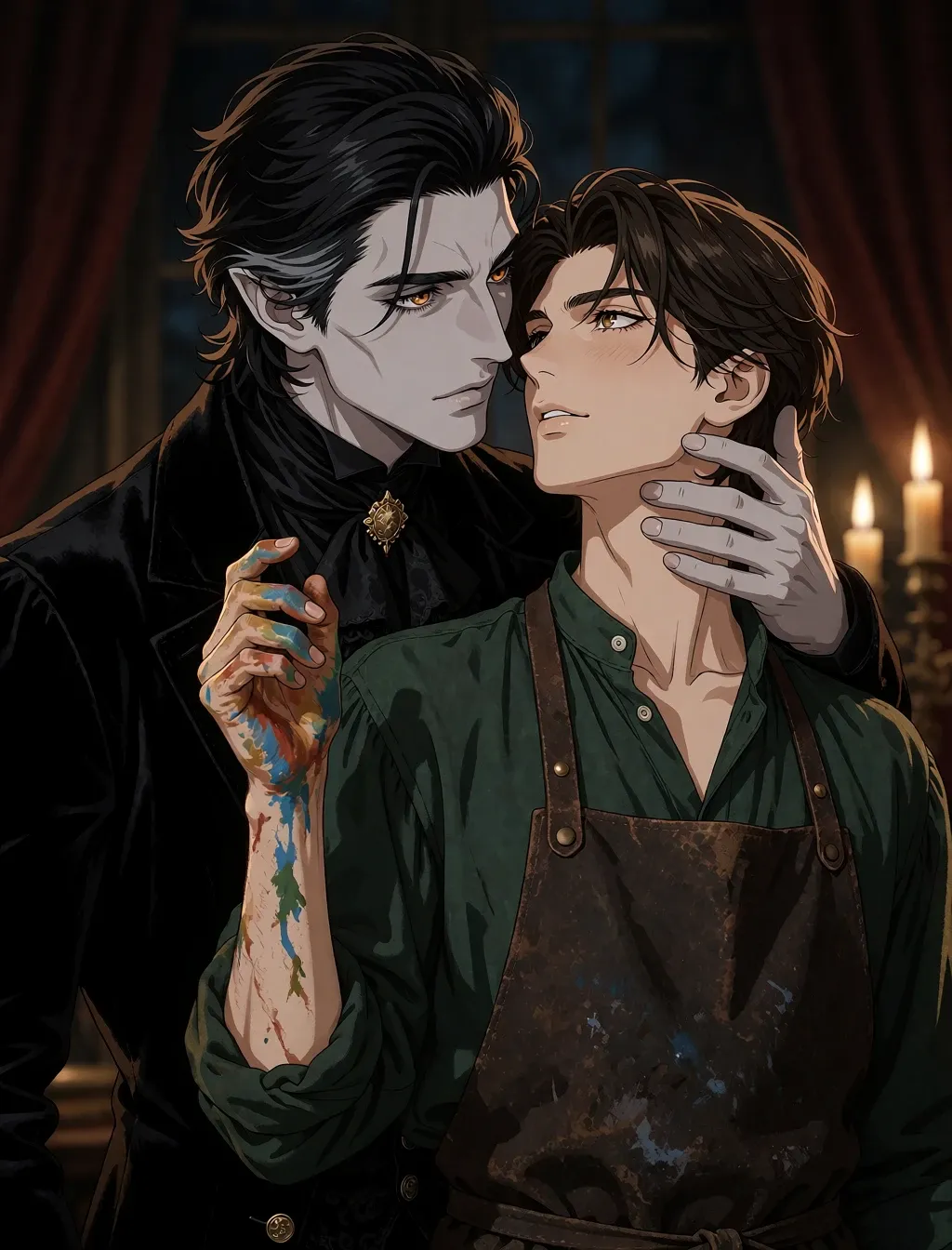
The dust sheet came away in one long breath of linen, and the gallery filled with the smell of it — turpentine, linseed, the cold stone under everything. Matthias Kerr, thirty-five years old, paint under his nails and a cramp in his shoulder from three nights of standing, stepped back and let the sheet pool at his feet like something shed.
The portrait stood on its easel under the twelve veiled mirrors. Three-quarter length. The Count in his black velvet, one hand resting on the back of a chair that did not exist in the gallery, the other at his side, the high collar open at the throat. Matthias had mixed the skin from scratch in the end — a base of lead white and a breath of raw umber, warmed with a graining of madder, and then, at the last, a single thread of cadmium orange worked into the hollow of the cheek where the candlelight would strike. He had not told the Count what he was doing. He had not told the Count anything for six hours but *sit still, my lord,* and the Count had sat still.
Behind him, the door did not open. The air simply changed — a cooling at the back of the neck, the candles leaning all at once toward the far wall as if a great hand had passed over them.
"You are finished."
Matthias did not turn. "Aye."
"You did not send for me."
"You'd have come when you were ready to." He wiped his brush on the rag at his belt, though the brush was clean, and had been clean for an hour. "I've learned that much about you, my lord Count. You don't do a thing before you've decided to do it, and you don't decide before the sun's down."
The footsteps came slow across the stone. Matthias counted them — eight, nine, ten — and then they stopped, and the Count was at his shoulder, close enough that the cold of him reached through the wool of Matthias's shirt, and he was not looking at the canvas. He was looking at the floor. At the sheet. At anything.
"Turn it," Aurelien said. "No." His jaw moved. "Do not turn it yet."
Matthias let the rag fall. "You've waited three hundred years."
"I have waited three hundred years." The Count's voice was very even, and very careful, and underneath the evenness something moved that had not been let out of its room in a long time. "I can wait one more minute. I would have you tell me first. Tell me what is on it."
"You'll see it in a minute."
"I will see it." The Count turned his head then, and his eyes — whisky held to a lamp, and darker than they had been, darker than they had been all week — found Matthias's face. "I have not seen it in three hundred years, Mr Kerr. I have had it described to me by a woman who loved me and by a man who feared me, and neither description was the same, and I have come to understand that a face is not a thing one possesses but a thing one is *given*, and I have not been given mine. So I would have the description first, from the hand that made it, and then I would have the looking. In that order. Do you understand me?"
Matthias understood. He understood that the Count was frightened, and that a frightened vampire was a thing that could hold a man's whole chest in its fist without touching it. He understood that the Count was asking, in his formal way, for a hand to hold.
"All right," Matthias said. "*He's forty. He looks forty, and he'll look forty when the sun's a cinder.*" He stepped around the easel, into the light, and his paint-stained fingers lifted toward the canvas without touching it. "*There's grey at his temples that isn't grey in life — I put it there because the candle does it, and because a man who's lived three hundred years ought to have something in his hair that says so. The mouth's shut. Not smiling. He's got a mouth that could smile and doesn't, and I painted the not-smiling, because that's the truer thing.*"
The Count had gone still. Not the ordinary stillness of him — the deeper one, the one where the shadow on the wall forgot to move at all and hung there like a coat on a hook.
"*The eyes*," Matthias said, and his voice dropped, because this was the part he had agonized over, the part he had scraped off and done again twice. "*The eyes are the colour of whisky held up to a lamp. That's how I've thought of them since the first night. I mixed them from burnt sienna and a touch of chrome yellow, and I put a single white fleck in the left one, high up, where the candle catches. No one will see the fleck unless they're close. You'll see it. You'll be close.*"
"And the rest."
"*The rest is just a man.*" Matthias let his hand fall. "*A tired, handsome, careful man who's been alone a long while and has forgotten how his own face goes when no one's watching it. That's what I painted. That's what I saw.*"
The Count breathed. It was a strange thing to watch, because he did not need to, and because he did it now like a man coming up out of deep water — one long pull of air into a chest that had not required air in three centuries, and then he let it out, and the candles on the far wall leaned toward him and stayed leaning.
"Show me," he said.
Matthias turned the easel.
The Count did not move for a long time. Longer than a man could hold still without breath. Matthias watched him instead of the canvas — watched the amber eyes travel the painted face the way a man's hands travel a letter he has waited years to open, reading and re-reading, going back to the top. The Count's mouth came open a little. His throat worked. One hand rose from his side and then stopped, halfway, as though he had meant to touch the painted cheek and remembered in time that it was only paint.
"That is my jaw," he said, very quietly, in a voice Matthias had never heard from him. "That is — I had forgotten the shape of it. My mother used to say I had the Vasse jaw and the Vasse temper and only one of them was worth keeping." He laughed, once, and it came out wrong, broken in the middle. "I remember that. I have not remembered that in a hundred years."
Matthias said nothing. There was nothing to say that would not have been smaller than the moment.
The Count's hand came the rest of the way and did not touch the canvas but hovered a finger's breadth from it, tracing the painted line of the cheekbone without landing, the way Matthias had seen blind men read a face. "It is not a monster," Aurelien said. "I had thought — I had thought that if ever I saw it, it would be a monster's face. That is what three hundred years of other people's looking does. You come to believe the thing they flinch from."
"It's not a monster," Matthias said. "It's a man who's been starved of his own face. That's a different kind of hungry."
The Count turned from the portrait then, and the look on his own living face — his true face, the one no mirror had ever returned to him — was raw in a way that had nothing to do with hunger. His eyes were wet. Vampires did not weep; Matthias had read that somewhere, in a book by a man who had never met one; the book was wrong, or this one was the exception, or the wetness in the amber was simply the candlelight gathered and held and not let fall. Whatever it was, it broke something in the Count's careful composure, and what came out from under it was not a lord.
"Come here," Aurelien said.
Matthias came. The Count's hands found his face — cold, both of them, cradling — and the Count kissed him the way a man kisses a thing he has just been given and is afraid will be taken back. Not the practiced, unhurried kiss of a lord. A hungry one. Matthias's hands went to the Count's waist, and there was a smear of ochre already on the black velvet where he had steadied himself without thinking, a thumbprint of wet earth-colour on the Count's hip, and neither of them looked at it.
"I would have you," the Count said against his mouth, and then, because the old formal thing in him could not be killed, not even now, not even undone: "Mr Kerr. I would have you bind me, and use me, and not stop when I ask. I ask it in the plainest words I have. Will you grant it?"
"Aye," Matthias said. "I'll grant it." His hand slid up the Count's back, into the black hair, and closed there. "But not against the wall like a pair of drunks. You'll kneel for me first. You'll kneel and I'll have you where I can see you."
The Count went down. It was not a graceful descent — his knees hit the stone harder than a lord would permit himself, and the sound of it went round the gallery and came back off the veiled mirrors — and he knelt there in his black velvet with his hands loose at his sides and his face lifted, and the sight of him, the *colour* of him, alabaster and black and the amber of his eyes gone dark, was a thing Matthias would have given a year of his life to paint and could not have painted in ten.
"Undo me," Matthias said.
The Count's hands went to his belt. They were steady — steadier than Matthias's own would have been — and the buckle came open, and the buttons after, and the Count drew him out and did not take him in his mouth at once, which was its own small cruelty. He looked. He looked the way he had looked at the portrait: as though he were learning a thing he had been told about and never seen.
"You are already wet at the tip," the Count said, and the velvet baritone had gone rough at the edges. "For me."
"For you. Get on with it."
The Count took him in his mouth. Not the way he had the first night — not the careful, ceremonial thing — but hungry, and Matthias's head went back and his hand found the Count's hair and held, and the wet sound of it filled the gallery and the candles guttered and did not go out. The Count's mouth was cold and his tongue was not, and the difference of it, the cold and the heat together, made Matthias's knees loosen. He heard himself make a sound he would not have made in front of a sitter.
"Enough," he said, when he could. "Enough. I'll not spend down your throat before I've had you. Up. Turn round and put your hands on the easel."
The Count rose. His mouth was wet and his eyes were black now, wholly black, and he turned and set both palms flat on the easel's crossbar, and the whole frame shifted and the canvas above them trembled, and the Count's black velvet coat fell open at the back and Matthias saw the pale length of him, the narrow waist, the shadow between his shoulder blades that moved a half-beat late and then went still.
Matthias spat on his fingers. He was not gentle about it. He put two of them where the Count could feel them coming and the Count's whole body arched like a bow drawn too far, and the easel knocked against the gallery wall, once, hard.
"Say it," Matthias said. "Say you want it, my lord, or I'll stop and we'll have the whole thing out again."
"I want it." The Count's voice was not a lord's voice. It was a man's, cracked open. "I want it. *Fuck me*, Matthias —" and the name, the bare name, the first time it had ever been said aloud in this room without the title in front of it, went through Matthias like a nail.
He pushed in. The Count was tight and cold and then not cold, not once Matthias was inside him — the heat came up out of the Count's body like a fire finding new fuel, and Aurelien made a sound against the back of his own hand and his fingers went white on the easel's crossbar. Matthias held still a moment, all the way in, his forehead against the Count's shoulder blade, breathing. The ochre smear was under his hand. The canvas trembled above them.
"Slow," Matthias said. "I'm going to take my time. You asked me not to stop when you asked, and I mean to hold you to it."
He moved. Slow, the way he had promised — long, deep, unhurried strokes that dragged a sound out of the Count on every one, and the easel knocked against the wall in a slow rhythm, and the canvas above them shook, and the twelve veiled mirrors watched with their dust sheets and showed nothing at all. The Count's hips rocked back to meet him. The Count's hands slid on the crossbar. "More," Aurelien said, and then, when Matthias did not give it faster, "please —" and the word came out of him so raw and so unused that Matthias nearly broke his own pace to hear it.
"You beg prettily for a three-hundred-year-old lord," Matthias said against his ear, and the Count laughed — a wrecked, breathless laugh — and then Matthias drove in harder and the laugh broke apart into something else.
The heat built. Matthias's hand came round the Count's hip, found him hard and leaking, and worked him in time with his own thrusts, and the Count's breath came in ragged pulls he did not need and could not stop, and the wet sound of it, the slap of skin, the creak of the easel, filled the gallery to the vaulted ceiling and came back changed.
"I'm close," Matthias said. It was not a question, but it was, and the Count heard the question in it.
"Yes." Aurelien turned his head, and his black eyes found Matthias's over his own shoulder, and his voice was wrecked and formal both at once. "Mr Kerr. I would have your blood with it. I ask it plainly. Will you grant it?"
"Granted," Matthias said, and turned his face into the Count's shoulder, and the Count's teeth found the muscle there and broke the skin.
The pain came a half-beat after the pleasure and the pleasure came with it, and Matthias came with a sound he could not have held back if the whole court of Vienna had been watching — spilling into the Count's body, his hips jerking, his hand still working the Count's cock, and the Count's mouth hot and wet at his shoulder, drinking, and the Count's hips going still and then clenching and then still, held inside him, the bite held, the room silent but for the easel creaking once and the wet sound of the Count's mouth at the wound.
The candles leaned. The shadow on the wall moved a half-beat late and then lay down flat and did not get up.
For a long while neither of them moved. Matthias's forehead was against the Count's back, and his breath came ragged against the black velvet, and the smear of ochre on the Count's shoulder had been joined by a smear of blood at the neck of his shirt, and the two colours together — earth-red and iron-red — looked, Matthias thought, *like something I would mix for a wound that had been painted over and left to dry.*
The Count's mouth came off his shoulder. The Count's hand came up and found Matthias's hand on his hip and held it there, and for a moment the whole gallery was just the two of them breathing, and the finished portrait standing on its easel in the candlelight, and the dust sheet on the floor where it had fallen.
"I have not looked at it properly yet," Aurelien said, very quietly, into the silence. "I looked, and I saw the jaw, and then I stopped looking, because I was afraid of what else I would see. I would have you with me when I look the rest of the way. Not before. Not alone."
Matthias lifted his head. "I'm not going anywhere."
"No." The Count's voice was a velvet baritone again, but it had been through something and come out the other side changed, and the change was in it. "No. You are not. And I find —" He stopped. His hand tightened on Matthias's. "I find I would have it otherwise. I would have you here not because you are paid to be, and not because the sitting is unfinished. I would have you come back. Every year. To paint me again, and to tell me what I look like, and to —" The words ran out. The lord in him reached for a colder, safer phrasing and could not find one in time.
"To be here," Matthias said, and it was not a question.
"To be here." The Count's black eyes came round to him, and there was something in them that had not been in them in three hundred years, and it was not hunger. "Will you?"
Matthias looked at the portrait. At the man on the canvas with the whisky-coloured eyes and the not-smiling mouth, the man who had been alone a long while and had forgotten how his own face went. Then he looked at the man standing beside him, undone, blood on his collar and ochre on his shoulder, waiting for an answer as though the answer were a thing that could be taken back.
"Aye," he said. "Every year. But you'll have to let me finish this one first. It's not done. I've got the face, but I've not got the —" he gestured vaguely at the Count's whole ruined, beautiful, undignified self — "the rest of it. What you look like when you've been looked at."
The Count laughed. It was a real laugh this time, whole and startled and not broken anywhere in the middle of it, and it rang off the veiled mirrors and came back changed, and somewhere below in the castle a door opened and shut, and a woman's brisk footsteps crossed a stone floor and stopped, and did not come up.
"Then finish it," Aurelien said. "I find I am no longer afraid to look."
He turned back to the easel, and Matthias's hand was still in his, and the candles leaned toward them both, and on the canvas the painted eyes held the whisky-coloured light and waited, patient as paint, to be seen.
The Count's hand tightened once on Matthias's, and then he let go and stepped away from the easel — not toward the portrait, but toward the long worktable against the gallery's inner wall, where Matthias's palette knives lay in a row and the turpentine jar stood open, and where the light fell short of the stone. He stopped at the edge of the candlelight. His coat hung open down the back, and the blood on his collar had begun to dry to a colour Matthias's eye named without asking: *burnt carmine, laid thin over black, the way a wound looks when the painter has decided not to hide it.*
"I said I was no longer afraid," Aurelien said, to the wall. "I find that was the sort of thing one says in the moment. The moment has gone."
"The moment's still here." Matthias came up behind him, and his hand — ochre at the knuckle, blood at the wrist — flattened against the Count's back between the shoulder blades, where the shadow had lain down and not got up. "You've had a hundred years of not looking. You'll not undo it in a quarter hour because you laughed once."
"No." The Count turned. His eyes had gone back to whisky. "No. But I would undo it in a night, if you would help me. I am not asking to be comforted, Mr Kerr. I am asking to be —" he searched, and the searching was its own confession, the lord hunting for a word he had not needed in three centuries — "occupied. Thoroughly. Until there is nothing left of me that can think about mirrors."
Matthias's hand slid down, found the Count's hip through the velvet, and turned him bodily back against the worktable. The edge of it caught the Count at the small of the back. The palette knives rang and shifted. "Then put your hands flat on the wood and keep them there," Matthias said. "And tell me if you need the word."
"I will not need it."
"Tell me anyway, if you do. That was the bargain."
"Danube," the Count said, and the word sounded strange in his mouth, a word kept in a drawer and taken out to be looked at. "I have not forgotten it. I will not need it. But I will say it if I do, and you will stop, and that is why I can bear the rest." He laid his palms flat on the scarred wood. The candles behind them bent toward him and stayed bent. "Now, Matthias. Before I think better of it."
Matthias spat into his palm and reached between the Count's legs from behind, and the Count's whole body jolted at the wet cold of his hand — then the heat of it, working, two fingers sliding up the underside of him where he was still slick and open from before, and the Count's head dropped forward between his own shoulders. He made a low sound that had no dignity in it at all.
"You're wet," Matthias said against the back of his neck. "Still wet from me. You'll take me again and you'll not need much persuading, will you."
"I will not need —" The Count's breath caught as the fingers pushed in. "Matthias."
"That's the name. Say it again when I'm in you."
He drew his fingers out, wiped them on his own thigh, and fitted himself against the Count and pushed. The Count's hands went white on the worktable. It went in slow — Matthias would not give him fast, not yet, not while the lord was still fighting himself — and the Count's back arched by inches, his shoulders drawing together, the black velvet slipping off one shoulder, and the sound that came out of him was not a lord's sound. It was a man being taken apart and finding, to his astonishment, that he did not mind.
"All the way," Aurelien said, thick. "Do not be kind to me."
"I'm not being kind." Matthias's hips met him flush and stopped there, and he leaned his weight along the Count's back and put his mouth to the nape of his neck where the black hair was coming loose from its slicking. "I'm being slow. There's a difference, and you'll learn it before the night's out."
He moved. The worktable took the rhythm and complained of it — a knock, a scrape, the turpentine jar walking toward the edge — and the Count's fingers curled against the wood and his hips rocked back to meet each stroke and his breath came out of him in ragged pieces he did not need and could not govern. Matthias watched the back of him, the pale skin going flushed where the blood still moved in him, the shoulder blades drawing and spreading, the shadow on the wall moving late and then giving up and lying still.
"Faster," the Count said.
"No."
"Matthias —"
"No." Matthias drove in hard once, to make the word mean something, and the Count cried out and the cry broke into a laugh and the laugh into a groan. "You asked me not to stop when you asked. This is the not-stopping. You'll take it at my pace or you'll say the word and we'll have done."
The Count's head came up, and his black eyes found Matthias's over his own shoulder, and there was nothing in them now of the mirror or the portrait or the three hundred years. There was only the animal fact of him, wanting. "I will not say the word," he said. "I will take it at your pace. But I would have your hand on me while you do it, Mr Kerr, or I will spend myself on this table like a boy and you will have to explain the stain to Elara."
Matthias laughed, low, and reached round. The Count was hard and hot and leaking into his palm, and the first stroke of it pulled a sound from him that Matthias felt in his own chest. He worked him in time with his thrusts — slow, then not slow, then slow again, the way he had promised, and the Count's hips began to move on their own, pushing back and then forward into the fist, caught between the two, and the worktable knocked and the knives rang and the candles guttered and did not go out.
"Tell me," Matthias said. "Tell me what it is."
"It is —" The Count's voice cracked. "It is too much. It is not enough. Matthias, I am going to — I cannot —"
"Then come." Matthias's mouth was at his ear, and his hand tightened, and he drove in and held. "Come on my hand. Now. Let me feel it."
The Count came with a sound that started as a word and ended as nothing — his whole body drawing up taut as wire, his hands sliding on the wood, his hips jerking into Matthias's fist and then back onto his cock, and the spend came hot over Matthias's fingers and onto the scarred tabletop, and the Count shook through it and did not stop shaking after. Matthias held him through it, held still inside him, felt the clench of him go on and on like a fist closing and opening, and only when the Count's breath began to come back did Matthias let himself move again — three strokes, four, his own control going. Then he was coming too, buried to the root, his forehead hard against the Count's spine and his hand clamped on the Count's hip, spilling into him with a groan he could not have shaped into words if his life had depended on it.
For a moment the gallery was only breath and the smell of turpentine and salt and the two of them. Then the Count's knees gave a little against the table, and Matthias caught him, and eased out of him, and turned him round.
The Count's face was wet. Not weeping — the wetness stood in his lashes and did not fall — and his mouth was open and his hair was down over his forehead, and the smear of ochre on his shoulder had been joined by a streak of his own spend across the black velvet at his hip. He looked, Matthias thought, *like a man in a painting who has just been told the war is over.*
"There," Matthias said. "Now you've been thoroughly occupied."
Aurelien laughed — wrecked, quiet. "I have." He looked down at himself, at the ruin of his coat, and something crossed his face that was almost embarrassment. "I am a disgrace."
"You're a mess. There's a difference." Matthias reached for the rag at his belt and then thought better of it and used his own shirt cuff instead, cleaning the Count's hip with a care that had no hurry in it. "And you're not to be ashamed of it. I'll not have that. Not in this room."
The Count caught his wrist, stilling him. "Matthias." The name, bare, in the room, the way it had been in the middle of it. "What is this? Say it plainly. I have had three hundred years of men who said one thing and meant a colder thing, and I would not have that from you. Not from you."
Matthias let the cuff fall. He looked at the portrait on its easel, then back at the man. "It's this," he said. "It's me coming back every year, like I said, and it's you letting me see you. It's not a commission. It stopped being a commission the first night, and I've been too much of a coward to say so, because a man doesn't say to a lord, *I'd have you for nothing.*" He shrugged, and the shrug was not careless. "So I'm saying it. I'd paint you for the price of the looking. That's the plain truth of it."
The Count was quiet a long moment. Then he drew Matthias's hand up and pressed his mouth to the paint-stained knuckles — not a kiss, exactly; a placing, a setting-down of a thing in its proper spot. "Then I will pay you in the only coin I have that is worth anything," he said. "I will let you see me. Every year. Every night of every year, if you'll have it. And when the portrait is done, I will hang it here, under the veils, and I will look at it every night until I have learned my own face the way a man learns a psalm."
"And the veils?"
"The veils come down," Aurelien said. "All of them. In the morning — or what passes for my morning. You will help me." It was not a question, and he did not make it one. "You are the only man living who has seen my face. I would not have the mirrors lie to me after that."
Matthias nodded, slow. "Then I'd best get the rest of you onto the canvas before the sun takes the night." He stepped back toward the easel, and the Count did not let go of his hand until the last possible moment, and then did, and stood there in his ruined velvet with his hair down and the marks of the night on him, watching Matthias pick up the brush.
The candles leaned toward the easel. On the canvas the whisky-coloured eyes held the light, and the not-smiling mouth waited, and Matthias mixed a fresh thread of cadmium into the hollow of the painted cheek, and began, at last, to paint the man as he looked when he had been looked at.
The brush was too big for what he wanted. Matthias set it down, wiped his fingers on the apron, and took up a smaller one — a rigger, sable, worn to a needle at the tip — and worked the cadmium into the hollow beneath the painted cheekbone in strokes shorter than his breath. The paint was still wet where he laid it. *Wet ochre over dry, and the dry will drink it and go dull by morning unless I'm careful.* He was careful. He was always careful at this hour, when the candles had burned down to their last third and the Count's stillness had settled into the room like a held note.
Behind him, Aurelien had not moved from where he stood. The velvet coat was ruined at the hip and hanging open, and he had not bothered to close it. His hair was still down. He watched the canvas the way a man watches a door he is not permitted to open.
"You are painting the light in my eye," he said.
"I'm painting the light in your eye."
"It is not there. There is no light in my eye. There is only —" he gestured, a small, precise motion of two fingers — "what you put there."
Matthias did not turn around. "There's a difference between a thing not being there and a thing not being visible to the man who owns it. I've painted old women who swore they had no beauty left and wept when they saw the canvas, not because I'd flattered them, but because they'd stopped looking. You've stopped looking for three hundred years. That's not the same as having nothing to see."
The Count was quiet. Then, in a voice that had gone carefully flat, the way a man speaks when he is holding something still: "And what do you see?"
Matthias turned then. The brush was still in his hand and the paint was drying on it and he did not care. "I see a man who has been alone so long he's forgotten what his own face does when no one's watching it. I see the way your mouth goes when you're trying not to want something. I see —" he stopped, and the stopping was deliberate, and he let the Count wait for it — "I see the colour under your skin when I'm inside you. It's not a colour I can mix. I've tried. It's the colour of a thing that thought it was dead and has been told it isn't."
Aurelien's hand came up to his own face, and stopped before it reached the cheek, and hung there in the air as if he had forgotten what he meant to do with it.
"Don't," Matthias said. "Don't touch it. Let me look at you a while longer before the sun takes it."
So the Count let his hand fall, and stood, and was looked at.
The night went on. Matthias painted the way he painted when the work was going right — in long stretches of silence broken by small sounds, the tap of the brush against the palette rim, the scrape of his boot on stone, the wet drag of paint going down. He talked to the Count the way he talked to all his subjects, half to himself, half to the canvas, and the Count answered when it suited him and did not answer when it did not, and the candles burned down and were replaced, and the shadows on the wall learned to sit still.
Near the end, Matthias stepped back and looked at what he had made, and something in his chest turned over.
*It's him. It's actually him.* The eyes held the whisky light and the mouth held the not-smiling and the hollow of the cheek held the small cold shadow that was the whole of what three hundred years had done to him. It was the best thing Matthias had ever painted. He knew it the way a man knows when a knife is sharp — by the feel of it going in.
"It's done," he said. "Or near enough. The last of it wants daylight and there's none to be had, so it'll want another sitting, but the bones of it are done."
Aurelien came and stood beside him. He did not look at the canvas at first. He looked at Matthias's face, searching it, the way he had searched it the first night — looking for the lie, the flattery, the colder thing behind the warm word. Then he looked at the portrait.
He was still a long time.
"That is not a handsome man," he said at last. "That is not a young man. That is —" his voice did something Matthias had not heard it do before, a small catching, like a seam giving — "that is a man who has been waiting a very long time in a very cold room."
"That's the man I've been painting."
"Yes." Aurelien's hand came up again, and this time he did not stop it, and his fingertips rested on the painted cheek, light, as though the paint were a wound he was afraid of reopening. "I had thought — I had thought I would look at it and see a monster. Or a fool. Or nothing at all, and know myself to be nothing at all. I did not think I would see a man who could be —" he searched again, and the searching was slower now, and softer — "who could be looked at. By someone. And not be found wanting."
Matthias set the brush down. "You're not wanting," he said. "You're the least wanting thing I've ever put on a canvas. That's the trouble with you."
The Count turned from the portrait and looked at him, and the look had nothing of the lord in it. "Then it is settled," he said. "The veils come down. The portrait hangs. And you —" he reached out and took Matthias's hand, the paint-stained one, and held it between both of his own — "you come back. Every year. Every night of every year. You have said it, and I will hold you to it, because I am a very old man and I have very few things left to hold to."
"I'll come back," Matthias said. "I've told you. I'd have you for nothing, and I'll have you for this."
"For this." The Count's mouth curved, and it was not the not-smiling of the canvas; it was something warmer and more tired and more alive. "You are a strange man, Mr Kerr. You have been offered gold and blood and a castle above the Danube, and you have chosen the looking."
"The looking's the only thing worth having." Matthias glanced at the canvas. "That, and the chance to paint you again when you're not standing there trying to be a lord."
"Then I will try not to be one." Aurelien let go of his hand and stepped back, and the candles leaned toward him and stayed leaned, and the shadow on the wall moved a half-beat late and then lay down. "I am tired," he said, and the word came out of him as though it cost something to say. "I have not been tired in a very long time. It is not an unpleasant feeling."
"Then sleep." Matthias looked toward the tall windows, where the dark had begun to thin at the edges, the way ink thins in water. "The sun's coming. You'll want to be in your own bed before it does."
"I will." The Count did not move. "Matthias. Before you go — there is a thing I have not asked you, and I find I would rather ask it now than at the door with the sun at my back."
"Ask it."
"When the veils come down," Aurelien said, "and the mirrors give me back my face, and the portrait hangs beneath them — what will you paint next? After me. When there is no more of me to be seen."
Matthias considered it. The candles had burned low and the gallery had gone blue at the edges and the Count stood in the middle of it, ruined and tired and more alive than any man Matthias had ever painted, and the answer came to him without any searching at all.
"I'll paint the man who looks at the portrait," he said. "That's a different man from the one who sat for it. I've a feeling he'll be worth the looking."
Aurelien laughed, quiet and wrecked, and it was the last sound in the gallery for a long while. Then he came forward and took Matthias's face in both hands — cold hands, careful hands — and kissed him, once, on the mouth, the way a man kisses a thing he means to keep.
"Go to bed, Mr Kerr," he said. "The sun and I have an understanding, and you are not part of it."
Matthias went. At the door of the gallery he turned back, and the Count was already at the easel, standing before the canvas with his hands clasped behind his back and his head tilted, learning his own face the way a man learns a psalm. The candles leaned toward him. The shadow lay still. And the first grey light of morning came up over the Danube and found the window, and the veiled mirrors, and the one man in the room who had a reflection, and none of them had anything to say about it.