
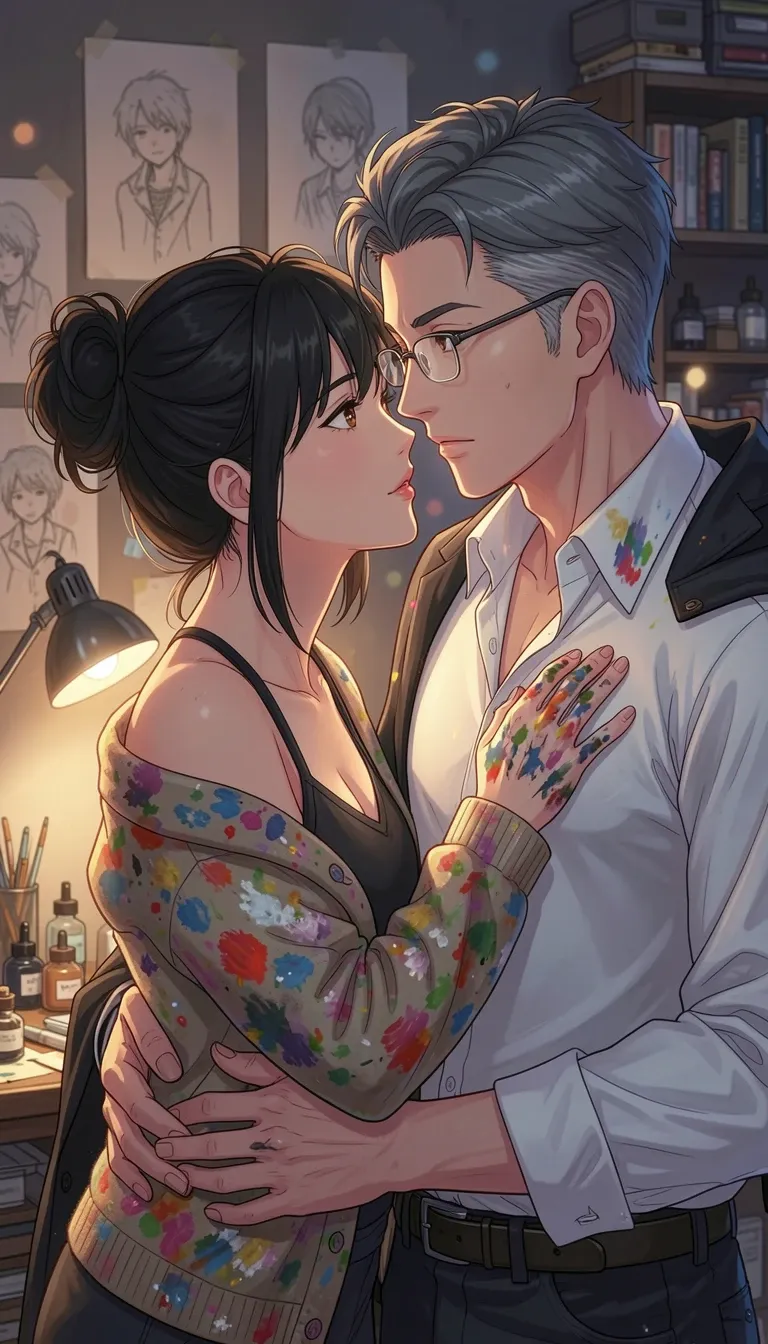
The publisher's meeting room on the sixth floor of the Jimbocho building smelled of toner, cold coffee, and the ghost of somebody's menthol cigarette from the balcony. Chiharu Ogata, thirty-eight, had been staring at the same proof page for eleven minutes. The overhead lights had been shut off at seven; only the desk lamp at the head of the table burned now, throwing a yellow cone across the laminate and leaving the rest of the room in a hush of grey.
Kenta Ueda, forty-one, sat two chairs down with his jacket off and his sleeves rolled to the elbow, working through the back half of the proofs with a red pen. He turned pages at a rhythm she could set a clock by. Every so often the pen stopped. Every so often it made a small dry sound against the paper, and she felt it somewhere behind her sternum.
The sticky note was stuck to page fourteen. It had been there since the chief left, and neither of them had touched it, as though it were still warm from his thumb. Blocky handwriting, the pen pressed hard enough to emboss the sheet beneath: MORE HEAT. The corner had begun to curl up in the damp of the room. Under it, in smaller letters, underlined twice: this is a love scene, not a handshake.
"He could have just called," Chiharu said.
"He did call. Four times." Kenta turned a page. "You let it ring."
"I was drawing."
"You were avoiding him."
She took her glasses off and pressed the bridge of her nose where the plastic had left two small dents. Without them the room went soft at the edges, the proofs becoming white rectangles, the lamp a smear of gold. Eleven years. Two hundred and fifty chapters. She had drawn women undressing at the top of a staircase and men reaching for them with their gloves still on, and not once had a chief editor left her a note that said handshake.
"I don't draw handshakes," she said.
"I know." Kenta set the red pen down parallel to the table's edge. "That's why it stings."
Down in the street, the shutter of a closing shop rattled, and then nothing. The last train out of Jimbocho went at eleven fifty-two. She had heard it go. She had been aware of hearing it go, had felt the small drop in her stomach that came with the sound, and had chosen, in the way she chose everything, to keep her eyes on the page.
The proof under her hand was the new chapter. The first one for the adult magazine. Page fourteen was the scene she had redrawn nine times, and it still read like two people agreeing to a business arrangement. The woman's hand on the man's chest. His mouth at her throat. Anatomically correct. Utterly dead.
She stood up.
"Ogata-san."
"The chair." She walked the length of the table, past the empty seats, past the water pitcher beaded with condensation, and stopped at the head of it. The chief's chair was high-backed leather, the armrests worn pale where his elbows went. She turned it out from the table and looked at it, then at Kenta. "Sit here."
"Why?"
"Because on page fourteen he's sitting and she's standing, and I've drawn it from the wrong angle for two weeks." She pulled the chair out another inch. "The chief's chair is the right height. Sit down, Ueda-san."
He looked at her for a moment — the flat, patient look he gave a storyboard that had not yet confessed what was wrong with it — and then he stood, and crossed the room, and lowered himself into the chief's chair. The leather creaked under him, a long complaining sound that went on a beat too long. His shoulders filled the back of it. His knees came up higher than the chief's ever had.
Panel one. Low angle, from her eye-line. The chair is too small for him and that is the whole point — a man who has been put somewhere he does not quite fit, waiting to see what she'll do about it.
"Now what," he said.
"Now take your glasses off."
He did. Folded them at the hinge, set them on the table beside the proofs, temple arms aligned. Without them his face was different — the eyes less defended, the grey streak at his temple catching the lamp. He had a way of looking at her that had not changed in six years and had, in the last week, begun to mean something entirely different.
"The note," she said. "Read it out."
"Ogata-san."
"Read it out. I want to hear what the chief thinks of eleven years of my work in his handwriting."
Kenta peeled the sticky note off page fourteen — it came up with a soft tearing sound, the corner leaving a faint grey shadow on the paper — and held it at arm's length, because he was farsighted and too stubborn to put the glasses back on. "'More heat,'" he read. "'This is a love scene, not a handshake.'" He turned it over. "There's more on the back."
"Of course there is."
"'Ueda — make her draw it from life.'" He lowered the note. "'She's been faking it for a decade.'"
The room got very quiet. Somewhere below, a door closed in the stairwell and the sound traveled up through the floor. Chiharu felt her face go hot from the collar up, the way it did when a reader guessed a plot twist three chapters early.
"He doesn't know," she said. "About us."
"He doesn't know about us," Kenta agreed. "He knows about you. He's been your editor-in-chief for nine of the eleven years. He's watched you draw around the same panel every time."
"And you agreed with him."
"I've agreed with him for six years." He folded the note once, creased it, and set it down on the proofs. "I just never had a way to say it that you'd hear."
She came around the chair. Her cardigan was buttoned wrong — she noticed it now, the second button in the third hole, a thing she had done at four in the afternoon and not corrected — and she left it. Her fingers found the top of the chair back, closed on the leather, and she stood behind him with her hip against the armrest and looked down at the grey streak and the broad line of his shoulders and the collar of his shirt, which was open one button because it was past eleven and the day had been long.
"The anatomy on page fourteen is wrong," she said.
"It is."
"Show me the right one."
He turned his head. The lamp caught the side of his face and one eye, and the eye was steady, and she understood that he had understood the moment she'd said sit here and had been waiting for her to arrive at the rest of it in her own time, the way he waited for every page.
"You're asking me as your editor," he said. Not quite a question.
"I'm asking you as my reference."
"And after."
"And after," she said, "we'll see what the page looks like in the morning."
She came around the arm of the chair and put her knee on the seat beside his thigh, and then the other knee, and the chair took her weight with a creak, and she was above him with her skirt pulled tight across her thighs and the ceiling light behind her head. He looked up. His hands came to rest on the armrests, not on her — waiting, the way he waited for a sentence to finish.
"Hands stay there," she said, "until I know what I'm drawing."
"That's not how the scene goes."
"It's how this one goes." She reached down and found his belt. Her ink-stained fingers were not steady; the buckle took her two tries, and the leather slid through the loop with a sound she felt in her teeth. "The chief wants more heat. The chief has never once had to get a man's trousers off at midnight in his own meeting room."
"He'd be insufferable about it."
"He'd be unbearable about it." She got the button. The zipper came down. Her knuckles brushed the front of his trousers and he made a low sound in his chest that he did not quite let out, and she filed it away — panel three, the sound he doesn't let out, the jaw held tight — and then she got her hand inside and found him hard and hot and heavy in her palm, and her own breath went out of her in a rush.
"Ogata-san."
"Don't." She closed her fingers around him and felt him jump. "Don't say my name like that, I'll lose the angle."
"What angle."
"The one where I'm not a thirty-eight-year-old woman who's been faking it for a decade." She worked him slowly, watching his face, watching the grey streak and the line between his brows deepen. "The one where I'm the woman on page fourteen and I know exactly what I'm doing."
He laughed — a short, rough breath through the nose — and his hand came off the armrest before he remembered and put it back. "Your anatomy's still wrong."
"Then correct it."
"Come here."
She rose up on her knees and he got his hands under her skirt — he had permission now, he had taken it. She let him — and pulled her underwear aside. She felt the cool of the room on the wet of her and then the heat of him, the head of his cock sliding against her, finding her. She reached down between them and held him and sank.
The stretch went through her like a held note. She stopped halfway, her hands braced on the chair's arms outside his, her forehead down against his hair, and breathed. He was big and she was tight and the angle was wrong for a moment, and then she tilted her hips and the angle was right and she took the rest of him in one long slide and heard herself say something that wasn't a word.
"All the way," he said, low, against her throat.
"I know." She was full of him. The chair creaked. His hands were on her hips now, thumbs in the crease of her thighs, and he was holding still, letting her set it, and she loved him for that — for the editor's patience, for the way he would not spend the scene before she'd found her line. "Hands on the arms, Ueda-san. I said."
"You said until you knew what you were drawing."
"I know now."
He put his hands back on the armrests. She watched him do it — the obedience of it, a forty-one-year-old man with his trousers open in his boss's chair putting his hands where she'd told him — and something in her chest turned over and settled, and she began to move.
Slow at first. Up until he almost slipped out of her and then down, the whole length of him, her thighs burning, the leather creaking under them both. She watched his face. She watched the way his jaw worked and his eyes went from her face to the ceiling and back, the way the grey streak moved when he tipped his head. She was drawing him. Even now, even with him inside her, she was drawing him — panel four, his hands white on the armrests, panel five, the tendon in his neck — and it was the best reference she'd ever had, and she hated and loved that it was him.
"Faster," he said.
"I'm setting the pace."
"You're setting it too slow." His voice had gone rough at the edges. "I'm not going to last if you keep—"
"Then don't last." She leaned down over him, her mouth at his ear, her hips working. "That's the page, Ueda-san. The man who loses control. I've never drawn it because I've never seen it."
He made a sound that came from somewhere under the floor of him.
"Show me," she said.
His hands came off the armrests. He caught her by the hips and drove up into her, hard, once, and the chair slammed back against the table edge and the water pitcher rocked and the proofs slid an inch. She gasped and her glasses — she was still wearing her glasses, she had forgotten she was wearing her glasses — slipped down her nose. He did it again. Again. The rhythm was his now and it was not patient and it was not an editor's rhythm, it was a man's. She braced her hands on his shoulders and let him have it and the room was full of the wet sound of him and the slap of her thighs against his and the creak of the chief's chair taking a beating it had not been built for.
"Look at me," she said.
He looked. His glasses were on the table and his eyes were dark and wide and there was nothing defended in them at all, and she thought, wildly, this is the panel, this is the whole chapter, this is the face I've been trying to draw for eleven years and it was two chairs down from me the entire time.
"That's it," she said. "That's—" Her voice broke. "Don't stop."
"I'm not stopping."
"Don't stop, don't—"
The lamp. The proofs. The last train gone. His hands hard on her hips and the heel of his palm pressed to the front of her and the angle changing again. She felt it start somewhere deep and low. It climbed, and she put her forehead against his and her mouth open against his mouth and came with a sound she could not have drawn, her cunt clenching around him in a rhythm she had no control over. She heard him say her name — her name, not Ogata-san, her name — and then he pulled her down hard onto him and held her there. She felt him spill into her, hot, in pulses that went on and on, and the chair groaned and settled and the room came back one sound at a time.
She stayed where she was, forehead to forehead, breathing his breath. His hands had not let go of her hips. Her glasses were fogged. Somewhere in the building a fluorescent tube hummed the way they did when they were dying.
"The chair," she said, when she could.
"What about it."
"It's going to smell like us."
"It's going to smell like the chief." His thumb moved once against her hip, a small unconscious thing. "It already did."
She laughed, and the laugh turned into something else halfway through, and she got off him on unsteady legs and stood in the lamplight with her skirt falling back into place and her underwear somewhere it shouldn't be. He was still in the chair, trousers open, catching his breath, and he looked up at her with the flat patient look he'd been giving her for six years, and it was not flat at all now, it was the furthest thing from flat.
"Page fourteen," he said. "The woman's hand on his chest."
"What about it."
"She's still dressed." He got up. He was taller than the chair had made him look, and the room had changed shape around them, the way a room does when you've stopped pretending. "The chief's wrong about the heat. The heat's not the problem. The problem is she's been dressed the whole time."
She turned toward the table, toward the proofs, toward the red pen lying parallel to the edge — and his hand came flat between her shoulder blades.
"The chief's chair," he said, "is the wrong height for the rest of it."
He pressed her down. Her hands caught the table's edge and the proofs fanned out under her, page fourteen sliding away from her face, and her cheek came down onto the cool laminate and the whole room went sideways and small and sharp, and she heard him behind her, and then his hand was at her hip and the first full stroke came down and landed and she bit the inside of her cheek to keep from crying out in a building that still had a night guard two floors below.