
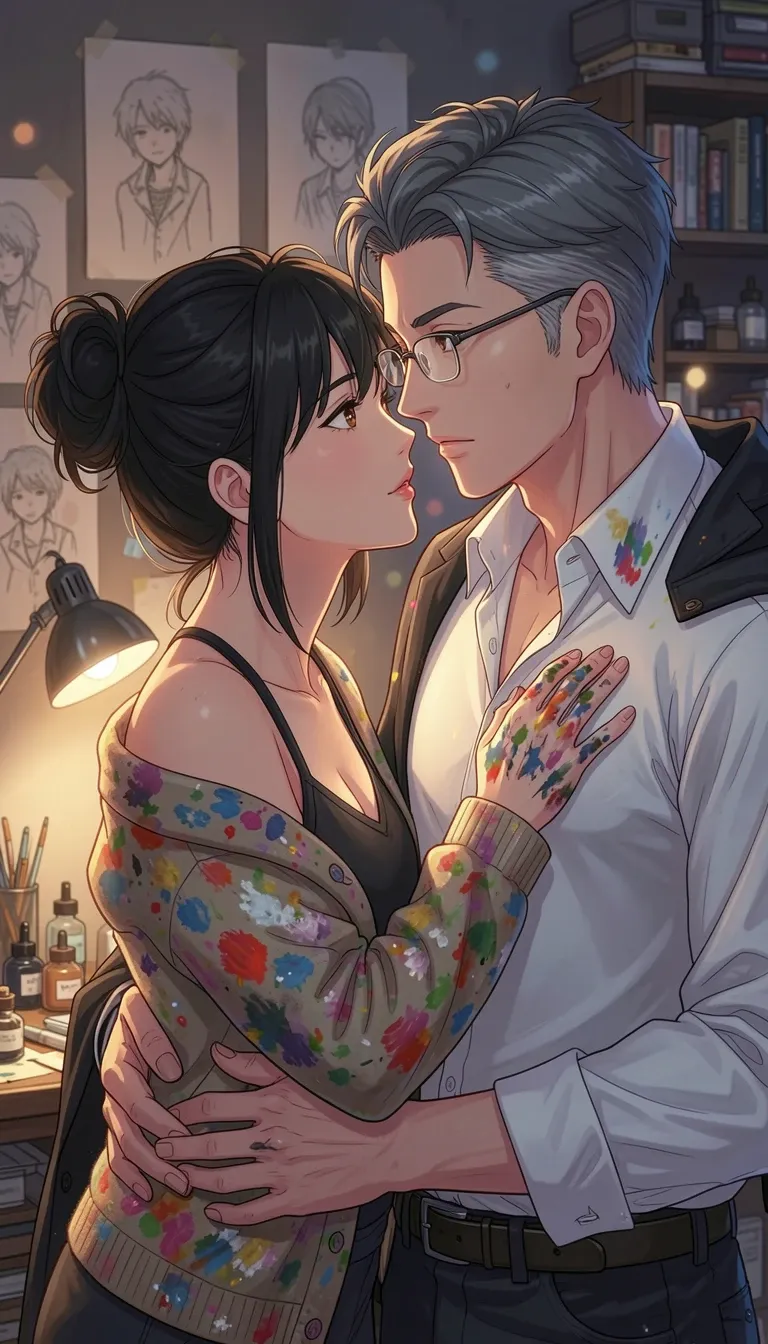
The studio at three in the morning smelled like cold coffee and eraser crumbs. Chiharu Ogata, thirty-eight years old, sat cross-legged on her chair with a mechanical pencil in her teeth and stared at the storyboard pinned to the wall until the lines went soft at the edges.
Panel three. That was the problem. The heroine, sprawled across a desk in the draft, one leg hooked over the edge, the hero's head between her thighs — the composition was fine. The anatomy was fine. The angle of the heroine's spine was a lie Chiharu had been telling herself for six pages.
She had drawn it eleven times. Eleven versions of the same panel. It looked like two people doing gymnastics. It did not look like anyone was enjoying it.
"The weight distribution's wrong," said Kenta Ueda from the corner, without looking up from the proofs he was marking.
She jumped. The pencil dropped out of her teeth and rolled under the desk.
"You're still— I thought you left an hour ago."
"The last train's at one-forty. It's three." He turned a page. The grey streak at his temple caught the desk lamp, silver against the black. "I told you I'd stay while you worked."
"You told me that a week ago."
"And I'm still here."
She got down on her knees to fish the pencil out from under the desk, and her cardigan sleeve came up smeared with graphite, and her face was hot in a way that had nothing to do with the two konbini coffees she'd drunk. A week. A whole week since the agreement, since she'd pressed her palm flat over his heartbeat and said she'd have the page inked by morning. A week of him coming to the studio after work with a suit jacket folded over his arm and sitting in the corner like furniture, and she had not asked him for anything.
She had drawn him, though. That was the thing she wasn't going to say out loud. Every reference page in the new chapter — the hero's shoulders from behind, the hero's hand on a door frame, the hero's jaw in profile — every one of them had been pulled from the man in the corner, and she had inked them carefully and told herself it was professional.
"Panel three," she said, retreating to the chair. "It's not the weight. It's the — there's no version of this where she's lying on a desk and it looks like anything but a hostage situation."
Kenta set the proofs down. Took his glasses off. Folded them, one-handed, and laid them on the proofs like he was putting away a tool.
"Show me."
She pulled the storyboard off the wall and held it out. He crossed the room — the studio was small, seven mats and a wall of reference books and a desk that took up half of it — and looked at the panel over her shoulder, close enough that she could smell his shirt, cotton and the faint clean ghost of his soap.
"Her hip's too high," he said. "And her shoulders are braced. She's holding herself up."
"She has to hold herself up. She's on a desk."
"No." He tapped the panel with one finger, careful not to smudge the pencil. "She's holding herself up because she doesn't trust him to hold her. That's what you've drawn. Not a woman being eaten out. A woman doing a sit-up."
Chiharu stared at the panel. Then at him. Then at the panel again, because the alternative was to keep looking at his face and she did not trust what her own would do.
"It's a rough," she said. "It's not final."
"It's your third rough."
"It's my—" She took a breath. Set the storyboard down on the desk, face up, smoothing it flat with both hands. The paper was warm from her grip. "It's fine. I'll fix the hip. I'll bring her shoulders down. I don't need—"
"You do."
The silence after that was a full panel. Wide shot. Two figures, one desk, a lamp. Nothing moving.
"Poses first," she said, very quietly. "That's what we agreed. Poses, and then— whatever the pages need."
"That's what we agreed."
She picked up her coffee. It had gone cold an hour ago and left a sweating ring on the desk edge, a perfect brown circle on the wood, and she set the cup down inside the ring so it wouldn't make another. "I don't know how to ask for this," she said to the ring. "I've written it a thousand times. I've written the asking a thousand times. I don't know how to do it with my actual mouth."
Kenta pulled the chair out from the desk. Not his chair — hers. Turned it to face him and sat down in it, elbows on his knees, and looked up at her where she stood with her cold coffee and her ink-stained fingers and her face gone red to the ears.
"Then don't," he said. "Tell me what the panel needs."
She looked at the storyboard. At the heroine braced on her elbows, shoulders up, the lie of it. At the hero's head, drawn from memory, drawn from a man who sat in her corner every night and marked proofs and never once touched her.
"She needs to know he'll hold her," Chiharu said. "She needs — she's been holding herself up her whole life. The panel's about the moment she lets go. The moment she finds out she doesn't have to—" Her voice did something. Caught, cracked down the middle. "Ueda-san—"
The name died halfway through. She heard it die. Stood there with her mouth open on the rest of it and nothing coming out.
Kenta stood up. He was tall enough that standing from the chair put his chest at her eye level, and she watched the button of his collar and not his face.
"Say it," he said.
"I can't."
"You wrote six pages of a woman saying it."
"That's different. She's ink. She doesn't have to—" Chiharu pressed the heel of her hand against her forehead, smearing graphite, and laughed, one short ugly note. "She doesn't have to be afraid of the answer."
"Neither do you."
"That's a very editor thing to say."
"I'm not editing." He took the coffee cup out of her hand and set it down inside its ring. Then he took her hand, and his palm was warm and dry and enormous around her fingers. "Chiharu."
Her name. Six years of Ueda-san and Ogata-sensei and not once her name, and he said it low and level like he was reading it off a page he'd been holding for a long time.
"Ask me," he said.
She looked up. His glasses were on the proofs across the room and his eyes without them were dark and steady and patient in a way that made her want to scream and also to sit down on the floor.
"I need reference," she said. "For panel three. I need — I need to know what her face does. When she lets go. I can't draw it because I've never—" The rest of it wouldn't come. She pressed her lips together and breathed through her nose and finished, small: "I've never."
"I know," he said. No pity in it. Just the fact, set down like a proof.
"And you're all right with—"
"I've been all right with it for six years." He said it flat, an editor's note, and then his thumb moved across her knuckles and ruined the flatness entirely. "The desk. Is it stable?"
"What?"
"The desk." He let go of her hand and put both palms flat on the drawing desk, testing it, and it creaked and held. "It's a hundred and forty centimeters. You lie across it lengthwise, your shoulders here—" he touched the far edge, "—your hips here. It'll take your weight."
Chiharu's mouth had gone completely dry. "You're — we're doing this now? Tonight? Here?"
"You've got a deadline."
"Don't you dare—" She grabbed a stack of screentone sheets off the desk corner and dumped them on the floor, and then the ink bottles, capping them one by one with hands that were not entirely steady, setting them in a row on the reference shelf. "Don't you dare make this a deadline thing. This is not a deadline thing."
"What is it, then?"
She stood there with the last ink bottle in her hand. The studio was very quiet. Somewhere down the block a shutter was rattling in the wind, and the lamp hummed, and there were no trains at this hour, no staff, no one in the building but the two of them and eleven years of pages.
"It's the thing I've been drawing around for eleven years," she said. "And I'm tired of drawing around it."
Kenta took the ink bottle out of her hand and set it on the shelf beside the others. Then he cleared the desk. The tray of inking pens went to the corner, the nibs flashing, laid within reach the way she always laid them; the storyboard he lifted carefully, both hands, and pinned it back to the wall, back to the panel — as if it were going to be watching.
"Sit," he said, and she sat on the edge of the desk, and the wood was cool through her skirt.
"Ueda-san—"
"Kenta."
"Kenta." The name came out smaller than she meant it to. She looked at her knees, at the graphite smudges on her fingers, at the storyboard pinned to the wall with its lie of a panel. "If I say stop—"
"Then I stop." He said it like the first line of a contract. "If you want the pose and nothing else, I'll hold the pose and you'll draw it and I'll go home. Say that now, if that's what you want."
She looked up at him. Tall, grey at the temple, his suit jacket still folded over the chair, his collar open at the throat. Six years. Six years of this man reading her pages and telling her the anatomy was wrong, and every one of those six years she had drawn heroes with his shoulders and never once let herself write the panel where the heroine said the thing.
"I don't want the pose," she said.
He lifted her. That was the only word for it — one arm behind her back, one under her knees, and she was up off the desk and then down again, laid flat, and her spine settled against the pinned storyboard with a rustle of paper, the panel pressing into her shoulder blades through the cotton of her cardigan like a hand already at her back.
The ceiling of the studio. The lamp. His face above her, out of the shadow, close.
"Then let go," he said.
She did not, yet. She lay there with her heart going like a drum under the storyboard and her hands flat on the desk on either side of her head, and she thought, in panels, in the way she thought about everything: close-up. His mouth. The corner of it. The thing his mouth does when he's about to say something he's been saving.
"Kenta," she said. "The panel. Remember the panel. She has to know he'll hold her."
His hand closed over her hip, warm through the skirt, and pressed her down flat against the desk.
"I know," he said. "I'll hold you."
His hands left her for a moment — both of them, and the absence was its own pressure — and came back at her waist, gathering the wool of her cardigan and the blouse under it and peeling them up her ribs, one slow inch at a time, until the studio air found her stomach. She sucked in a breath and heard it shake. "Cold," she said, which was not what she meant.
"I'll be quick about it," he said, and did not sound like a man in a hurry at all. He folded the hem over itself at her collarbone, a tidy editor's fold, and set his palm flat on her bare stomach and just held it there, warm and heavy, and she felt her whole body go still under it the way a page goes still when the last line is ruled. Above her the lamp ticked. The shutter down the block rattled and stopped and did not start again.
She lifted her head off the desk to look at him and the storyboard rustled under her shoulder blades, the pinheads pressing small hard points through the paper and the cardigan both — she's lying on the panel, she thought, and something in her chest turned over at the wrongness of it, the heroine bent over a desk on the wall above her and Chiharu bent over one beneath it, and the drawing still a lie and the lying-down not a lie at all. "The pen tray," she said. "It's by my hand. If I need—"
"It's there." He turned her wrist over and set the flat of her own palm against the tray's edge so she could feel the pens lined up cold and precise against her fingers, the way she liked them, the way she always laid them out before a long night's inking. "Anything you want to hold on to, hold on to it."
"That's an editor's note."
"It's the only kind I've got."
He stepped back into the shadow at the foot of the desk and she lost his face, and then his hands were at her knees, easing them apart through the skirt, and the wool slid up her thighs and pooled at her hips and the air moved against the inside of her legs and she heard herself make a sound that had no business coming out of a woman of thirty-eight with eleven volumes in print. The storyboard creaked under her back. She fixed her eyes on the ceiling and counted the cracks in the plaster, because if she looked at him she would say something true and unrecoverable and the night would tilt and she would be lying on her own desk with her skirt around her waist and no way back to the chair and the cold coffee and the panel she could not solve.