
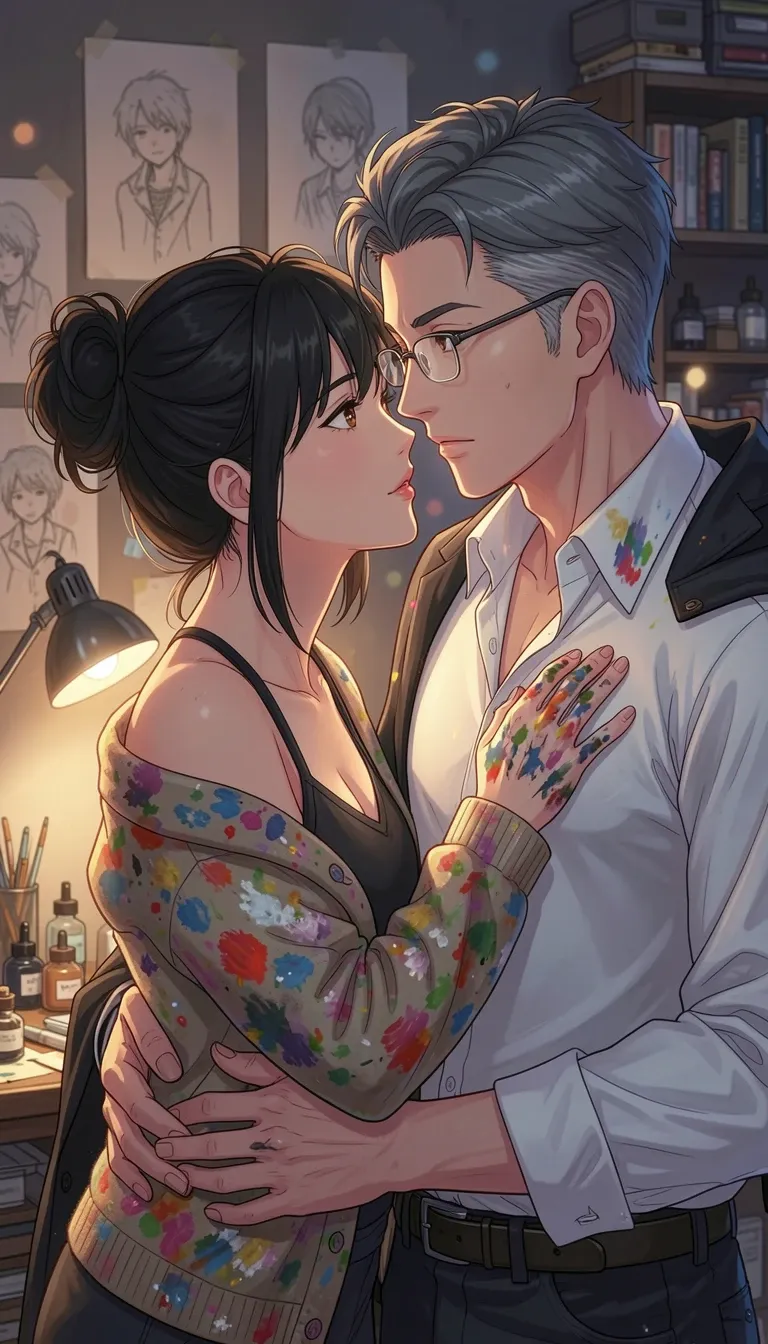
The elevator opened on the sixth floor and the corridor smelled like the inside of a new car — that particular love-hotel perfume, clean and chemical, doing its best over something older. Chiharu Ogata, thirty-eight years old and carrying her sketchbook against her chest like a shield, counted doors. Six-oh-three. The plaque beside it said Aqua in silver script, and beneath it a smaller card, laminated, listing the room's features in three languages.
"Mirror on the ceiling," Kenta Ueda read, forty-one, glasses already in his hand. "Mirror on the wall. Two hours, extendable." He slid the card back into its bracket. "The chief said the volume's climax needs a room the reader can feel. This is a room you can feel."
"It's a room you can see," she said. "That's the problem. There's nowhere to look that isn't us."
He keyed the door. The lock clicked over, and the room exhaled its cold breath onto them, and she stepped in past him because if she waited for him to go first she would have stood in the corridor all night.
It was smaller than the photographs and brighter than she'd feared. The bed took up most of it — a low platform, white sheets pulled tight enough to bounce a coin, pillows stacked in a fan. Above it, the ceiling was a single unbroken sheet of mirror, and along the far wall another, floor to ceiling, cut by a seam she could see herself in twice. The ventilation hummed at a pitch just under hearing. Somewhere down the corridor an elevator chimed and went quiet.
She set the sketchbook on the bed and opened it to the spread.
Two pages. Panel one, top left: the hero's hands at the heroine's wrists. Panel two: the scarf. She'd penciled it eleven times — the scarf, the wrists, the moment the fabric bites — and erased it eleven times, until the paper had gone grey and soft under the graphite and the eraser crumbs had collected in the gutter of the spread like sand. She brushed them out with the side of her hand and they scattered across the white sheet.
"Panel two's still open," Kenta said. He hadn't come closer. He stood at the foot of the bed with his jacket over his arm, looking at the spread the way he looked at proofs — from a slight angle, head tilted, finding the flaw before the shape.
"Panel two is impossible," she said. "I can draw a hand. I can draw a knot. I cannot draw the second before the hand moves, because I don't know what the body does in that second. Whether the wrist turns in or out. Whether the arm goes slack or pulls."
"Then we find out." He laid his jacket over the chair. "The scarf."
She had forgotten she was wearing it. It was the long one, the good one, charcoal wool that had been her grandmother's and had survived thirty years and eleven volumes of deadline sweat, and it was knotted loose at her throat because the studio got cold at three in the morning. Her hand went to it before her brain did.
"Ueda-san."
"You wrote the panel." He set his glasses on the nightstand, folded, lenses down, the way he always did, and the small domestic rightness of it in this room made her throat go tight. "The heroine's hands are tied. You can't draw it from the outside. You've been drawing it from the outside for six years and the chief can see it and so can I." He turned back to her. Without the glasses his face was different — younger, or older, she could never decide. "So we find out what the second before is. Give me the scarf."
She unwound it. The wool had gone warm from her neck and it held the shape of the knot, and she held it out to him across the white sheet with her arm straight, like a child handing over something broken. He took it. His fingers closed around the middle and the fabric went taut between them and she let go.
"Turn around," he said.
She turned. The wall mirror gave her back to her — her own shoulders in the paint-flecked cardigan, the bun coming loose at the nape, one strand stuck to her cheek — and behind her reflection, his. Taller. The grey streak at his temple caught the ceiling light and showed silver. He folded the scarf once, lengthwise, and the wool made a soft sound, and then his hands were at her wrists, drawing them together behind her back.
"Not too tight," she said, too fast.
"I know." The first loop went around both wrists and he held it there without pulling. "Tell me when."
"When what?"
"When it's the page." He drew the ends through the loop and the wool closed, and she felt the exact moment it stopped being loose — the give going out of it, her wrists meeting each other, the bones of one pressing the bones of the other. Her fingers flexed. The ink under her nails showed dark against the charcoal. "There," he said. "That's the second."
She looked at the mirror.
Her arms were drawn back and her shoulders had gone with them, pulled into a line she had never once drawn correctly — not the stiff heroic arch she'd been penciling, but something looser and more exposed, the spine curving forward to take the pull, the cardigan slipping off one shoulder. Her chin had come up. Her mouth was open a little. In the glass, her own eyes looked back at her with an expression she did not recognize and immediately wanted to draw.
Panel two, she thought. Panel two is the chin. It was never the wrists at all.
"The anatomy on page twelve," Kenta said behind her, dry as a margin note, "is wrong because you've been drawing the arms as if they're holding still. They're not holding still. They're holding on." The knot settled. He tugged the ends once, testing, and the tug went through her wrists and up her spine and arrived somewhere under her ribs. "There. That's the knot."
"It's not—" She swallowed. "It's not tight enough to hold a person."
"It's not meant to hold a person." He stepped back. The warmth of him left the back of her neck and the room's cold came in to take its place. "It's meant to hold a wrist. If you pull, it gives. If you pull hard, it comes undone. That's the whole design of it." A pause. "You asked what the body does. Ask it."
She pulled.
Not hard — testing, the way she tested a pen line before committing ink — and the wool bit down and held, and her whole body answered the small resistance, her weight going forward onto her toes, her breath catching at the top of her chest. The mirror caught it. All of it. The way her back hollowed. The way her bound hands came up behind her without her deciding to raise them.
"Oh," she said.
"Write that down," he said, "before you lose it."
She laughed — one raw note, entirely without dignity — and stepped toward the sketchbook, and the step pulled the scarf taut and stopped her, and the stopping was the strangest feeling she had ever had in her own body, because it was not a wall. It was a hand. It was the difference between being alone in a room and being in a room with someone who had agreed to hold the other end.
"Ueda-san, I can't draw like this."
"You don't have to draw it. You have to know it." He picked up the sketchbook himself and turned it toward her, holding it open at chest height so she could see the spread. "Look at panel two. Look at what you've got."
She looked. The penciled heroine stood with her arms behind her, chin down, jaw set — a woman enduring. A woman waiting for it to be over. Eleven years of love stories and every single one of them had been written by a person who thought being held was something you survived.
"It's wrong," she said.
"It's not wrong. It's scared." He set the book back on the bed, open, the spread facing up at the ceiling mirror so that the penciled panel and the real room lay one above the other. "The chief's note said the volume's climax has to be the first time she wants something and gets caught wanting it. Not the first time she's tied. The first time she's seen tied, and doesn't look away." He came around her, unhurried, and stopped where she could see him in the wall glass. "So. Do you look away?"
Her bound hands flexed behind her. The ink-stained fingers curled and opened, curled and opened, and the wool moved with them and did not give.
"No," she said.
"Say it to the mirror."
"That's—" Her face went hot from the collarbone up. "That's a terrible line. No reader would believe a man says that."
"Half the men in Tokyo say worse and mean it less." He was behind her again, close enough that his voice arrived at the back of her neck before it reached her ears. "Say it to the mirror, Ogata."
She looked at herself. The bun had given up entirely now, hair down one side of her face, glasses slipping, cardigan off the shoulder, wrists bound behind her in her grandmother's charcoal wool, and the woman in the glass was thirty-eight years old and had not been looked at properly in six years and was not looking away.
"No," she said, to the mirror. "I don't look away."
The room hummed. The elevator chimed, six floors down or six floors up, and someone laughed in the corridor and a door closed on it. Kenta's hand came to her shoulder — just the one hand, flat and warm over the slipping cardigan — and he turned her, gently, by that single point of contact, until she faced the long wall mirror with him at her back.
"Then here's the panel," he said. "Heroine's hands tied with her own scarf. Hero at her back. She's watching herself get looked at, and the thing she's feeling isn't fear, and the artist has to have the nerve to draw that on her face." His hand slid from her shoulder to the side of her throat, two fingers, no pressure, just there. "Can you draw it?"
"I don't know what it looks like."
"You're looking at it."
She was. Her own reflection, held, and the shine at the corner of her eye that she had spent eleven years drawing on other women's faces and had never once permitted on her own.
"Kenta," she said.
The name came out flat and quiet and it changed the room. His fingers tightened at her throat, once, a small involuntary thing, and in the mirror she watched his jaw work and his eyes close and open again.
"That's not the page," he said, low.
"I know what the page is."
"Then say it as the page." His hand stayed where it was. "Say it as the artist. 'Ueda-san, the next panel needs—'"
"The next panel needs you to stop being my editor for one hour." Her voice cracked on hour and she let it. "The next panel needs a man who's been waiting six years to put his hands on a woman and has finally been given permission, and I have never in my life drawn that face because I have never seen it, and I am looking at it right now in a mirror in Shibuya and I would like to finish the spread."
Silence. The ventilation. Her own breathing, too loud.
Then he laughed — not the dry editorial laugh, the other one, the one she'd heard maybe four times in six years — and his forehead came down against the back of her head, and his hand left her throat and slid down her arm to where the scarf held her wrists, and his fingers found the knot.
"If I untie this," he said into her hair, "you'll turn around and start apologizing."
"I will absolutely start apologizing."
"So I'll leave it." He straightened. In the mirror, his grey streak showed silver and his tie was already loose — when had he loosened it — and he drew the ends of the scarf once more, firm, seating the knot, and her wrists came up behind her and her shoulders went with them and her chin lifted all on its own. "The page needs a woman who can't reach for anything. So she has to ask for it." He stepped back. The warmth left her back again and she felt every centimeter of the leaving. "Ask."
She looked at herself in the mirror. Bound, watched, thirty-eight years old, ink on her fingers, a deadline in three weeks and a spread half-penciled on the bed behind her, and the room's cold air moving over her bare shoulder where the cardigan had slipped.
"Ueda-san," she said. "The next panel."
"Mm."
"The next panel is the heroine on her back." Her face burned. She did not look away from the glass. "With her hands still tied."
He didn't move for a moment. Then he reached past her, unhurried, and picked up the sketchbook from the bed, and closed it, and set it on the nightstand beside his folded glasses, out of the way of what came next.
"That's what the page needs," he said.