
“So how did you meet, then?”
Gunnhild Sall asked it with her mouth full of herring and her elbows planted either side of her plate. Half the long table went quiet to hear the answer.
The village hall was one room, low-beamed and roaring. Peat smoke curled from the hearth at the far end, sweet and brown. Thirty wet coats steamed on the pegs by the door, so the whole place smelled of wool and rain and boiled potatoes. Somebody’s grandfather was tuning a fiddle against the window, plucking the same sour string over and over.
Elsabet set down her fork. Under the table, Aske’s knee pressed against hers. It was either a warning or a hand on the tiller. She couldn’t tell which.
“He came to fix my boiler,” she said.
“Did he now.”
“In Tollvik. In January. The pilot light kept going out, and the landlord sent him, and he arrived with entirely the wrong spanner.”
Gunnhild’s eyebrows went up. Elsabet had nothing after the spanner. She had built the boiler and the landlord and the town, and then walked straight off the end of them.
“And she told me I was doing it wrong,” Aske said mildly, reaching for the bread. “Stood on a chair to supervise.”
“Why a chair?”
“Better view of my mistakes.” He tore the heel off the loaf and put it on her plate without looking. “She was right, as it happens. I came back the next week to tell her so.”
“And the week after,” Elsabet said.
“And the week after.”
Gunnhild laughed, a big wet bark, and slapped the table, and the conversation rolled on over them. Elsabet picked up the bread. Her hand was not quite steady. She told herself it was the wound.
“Wrong spanner,” Aske murmured.
“You were improvising too.”
“I was rescuing you.”
“I had it entirely in hand.”
“You had a boiler in hand.”
. . .
The fiddles started properly once the plates had gone round. There were two of them, with an accordion wheezing under both, and the benches scraped back to the walls.
“Newlyweds first,” Gunnhild announced. There was no arguing with a woman who gutted two hundred fish before breakfast. Hands pushed them into the cleared space under the beams. The tune slowed into a reel, old and lilting, the kind meant for couples who already knew where each other’s feet went.
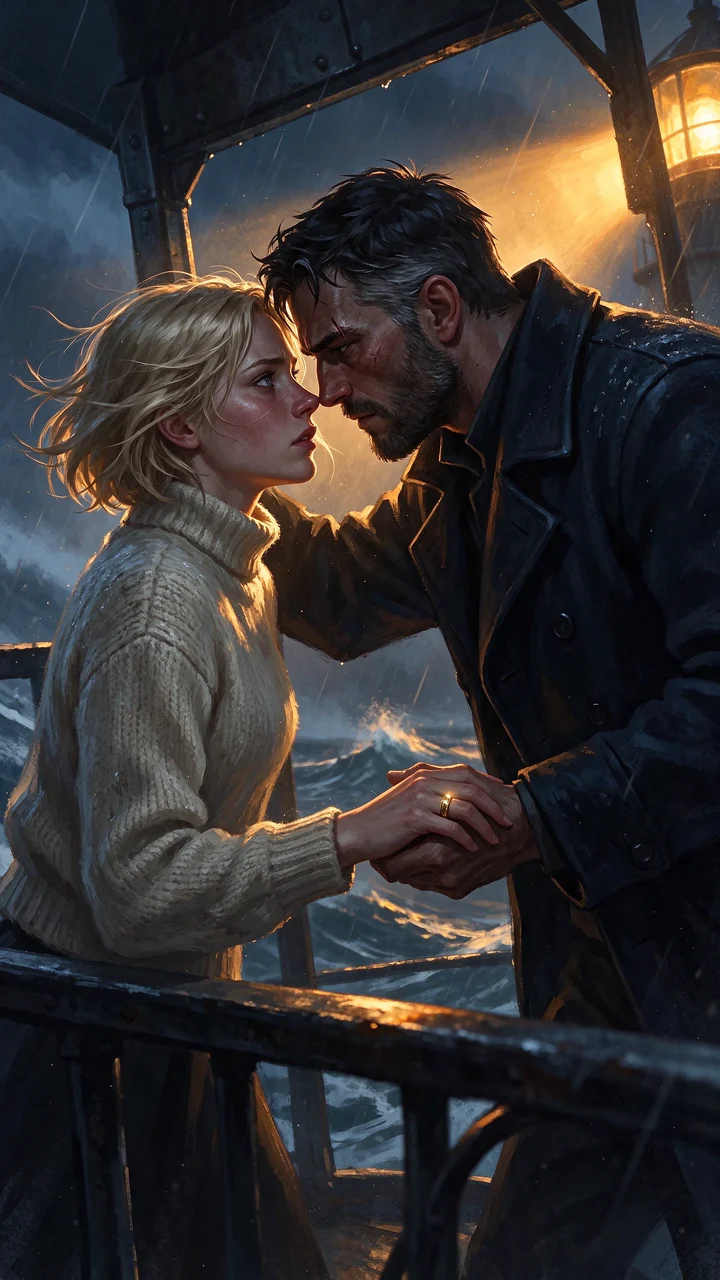
Aske’s right hand found her waist. It sat low, lower than a guard’s hand had any reason to go, his palm spread wide across the cable knit of her sweater. His left hand took hers, the ring between their fingers.
“Gently,” he said. “Your stitches.”
“I know where my stitches are.”
They turned. He moved better than she had expected, which was annoying. She kept her shoulders square for one pass of the hall, then two. Then the pull under her collarbone made the decision for her. She leaned in and let her cheek rest against the rough wool over his chest.
He stopped breathing.
She felt it. Beneath her cheek the rise of his chest simply ceased and held. His hand on her waist went very still while his feet kept dancing.
“Breathe, Vennor,” she said into his sweater.
“I’m working.”
“So am I.”
His breath came back, slow and careful, and stirred the hacked ends of her hair. Neither of them spoke again until the fiddles stopped.
. . .
It was raining when they walked home. It was the thin sideways rain that came in off the strait and found every gap in a collar. There were no lights on the cliff path. He walked on the seaward side, as he always did, as though he could put himself between her and the whole North Sea.
“The scar,” she said. “Over your eye. I’ve wanted to ask for four years.”
“Then you’ve waited well.”
“Where did it come from?”
He was quiet for ten steps. She counted.
“From the last person I failed to protect,” he said.
“Who?”
“Watch the step.”
There was a step. She took it. He didn’t say anything more, and she let him not say it, which was not like her at all.
. . .
At midnight Aske stood in the doorway of the radio room and did his job, which was to listen.
The voice from Esterhaven was good. He’d give it that. It was warm and unhurried, with the vowels of a man who had never had to raise them.
“Elsabet. You sound stronger.”
“The doctors are pleased with me.” She sat very straight in the chair, the headset pushing her cropped hair flat. “We were at clause nine.”
“We were, and we’ll get there. Indulge me first. I had the chapel at Varenhold measured this week, for spring. The bishop wants lilies.”
“I hate lilies.”
“I know. I told him so.” There was a smile in it, practised and real enough. “I pay attention to you.”
Aske watched her left hand. Her thumb found the ring he’d given her and turned it, once, twice, and stopped.
“Clause nine,” she said.
“Clause nine.” Papers turned at the far end of three hundred miles. “Odd. I’d have sworn I heard gulls just then.”
Her thumb did not stop on the ring. Her voice did not change at all. “It’s the ventilation in this place. It shrieks all night.”
“Of course,” said Teodric Halloway pleasantly, and went on to the fishing rights.
Aske set his jaw and kept it set. He was going to hand her to that voice in April. He would stand at the back of that measured chapel in dress uniform and watch her walk past him, and he would be glad she was alive to do it.
That was the job. He held on to it with both hands.
. . .
The kitchen smelled of black coffee and the stove. Rain drummed on the tin roof of the lean-to, as loud as gravel thrown by the handful.
“Sit,” Aske said. “It needs changing.”
She sat at the scarred table and rolled the high collar of the sweater down. She drew the neck aside until the dressing showed, square and grubby, below her collarbone. He had done this four times now. He had a bowl of boiled water, a roll of gauze, and the deliberate hands of a man who had once stitched a diver’s leg on a heaving deck.
He peeled the tape slowly. She watched the stove.
“He measured the chapel,” she said.
“I heard.”
“You were listening.”
“It’s what I’m for.”
He cleaned the wound. It stung, and she let it. He laid the new gauze and smoothed the tape flat with his thumb along each edge: top, side, bottom, side. Then he drew the wool of her collar back up over it, and his fingertips stayed there. They rested on the edge of the knit, a quarter inch from her skin.
She looked up.
He was already looking at her. He did not look away, and neither did she. The rain went on hammering the tin above them while the coffee went cold.
“Done,” he said.
He didn’t move his hand.
Neither did she. Out over the strait, low and far off, the first gust of the storm struck the lighthouse hard enough to rattle every pane.