
“Six minutes,” Ingvild said. “Listen to me, Bet. Tonight is the borders clause. Miss this call and Esterhaven’s council walks out, and they will not sit down again before spring. Do you understand?”
“I understand.”
“I patch him through at midnight exactly. Don’t—”
The light went out.
Everything went at once. The bulb above the shelf died, and the green glow behind the dial, and the faint hum in the headset that she had stopped hearing days ago and only noticed now that it was gone. Ingvild’s voice cut off on a consonant. Overhead, through the iron floor of the lamp room, the great lens ground slower, slower, and stopped.
The dark was total. Then the wind arrived in it, enormous, a roar around the tower that she felt in her teeth and in the stitches under her collarbone and in the chair beneath her.
“Ingvild.” She thumbed the handset. It was dead plastic. “Ingvild.”
A match scraped. Aske’s face came up out of the black, gold and hollow-eyed, as he touched the flame to the storm lantern’s wick and lowered the glass.
“Mains are down,” he said. “Whole island, probably. The generator’s under the lamp.”
“Then start it.”
“That’s the plan.” He put the lantern into her hands and closed her fingers round the wire handle. “You stay here. Away from the window.”
“The call is in six minutes.”
“Five.” He was already shrugging into the peacoat. “And it’s gone. I’m sorry.”
He took the stair two treads at a time, and the iron rang under his boots. She heard the hatch above bang open, and the wind came down through it howling.
She looked at her watch in the lantern light. Eleven fifty-six.
She looked at the stair.
. . .
The lamp room was a cage of glass and weather. Rain hit the panes in fistfuls, sheeting down so thick that the sea beyond was only noise. The great lens sat dead in its brass cradle, a huge cold eye. Below it the generator squatted green and stubborn, bolted to the floor, and Aske knelt beside it hauling on the pull cord.
It coughed. It died.
He looked up and saw her in the hatch.
“I told you to stay downstairs.”
“You told me a great many things.” She climbed the last rungs with the lantern held high and her other hand clamped to the dressing. “It’s midnight.”
He didn’t answer that. He yanked the cord again. Nothing happened. He swore quietly, the first time she had ever heard him do it, and got up.
“Intake’s blocked. The hood’s come loose outside.” He put his hand on the gallery door. “Hold that light on the frame. If I go over, you do not come after me.”
“Aske.”
“I mean it.”
He shoved the door open, and the storm came in like an animal. The lantern flame flattened and fought. She braced her shoulder on the frame and held the light out as far as her arm would reach. Through the rain she saw him on the iron gallery, bent double against the rail, wrenching at a torn steel hood that the wind kept slamming back down onto his hands.
Once. Twice. On the third pull it came free with a shriek of metal and went spinning off into the dark over the sea.
He came back in on his knees, soaked through, and she slammed the door on the gale with her whole body.
He pulled the cord. The generator caught, coughed, caught again, and settled into a rough, glorious roar. Above them the lens shuddered and began to turn, and the lamp sputtered into life. Slow amber light swung across the glass and out over black water, then came round again and laid itself across his face.
His hands were bleeding.
She set the lantern down and took them. Both palms were torn where the steel edge had bitten, and they were so cold they burned her.
“Give them to me.”
“They’re filthy.”
“I said give them to me.”
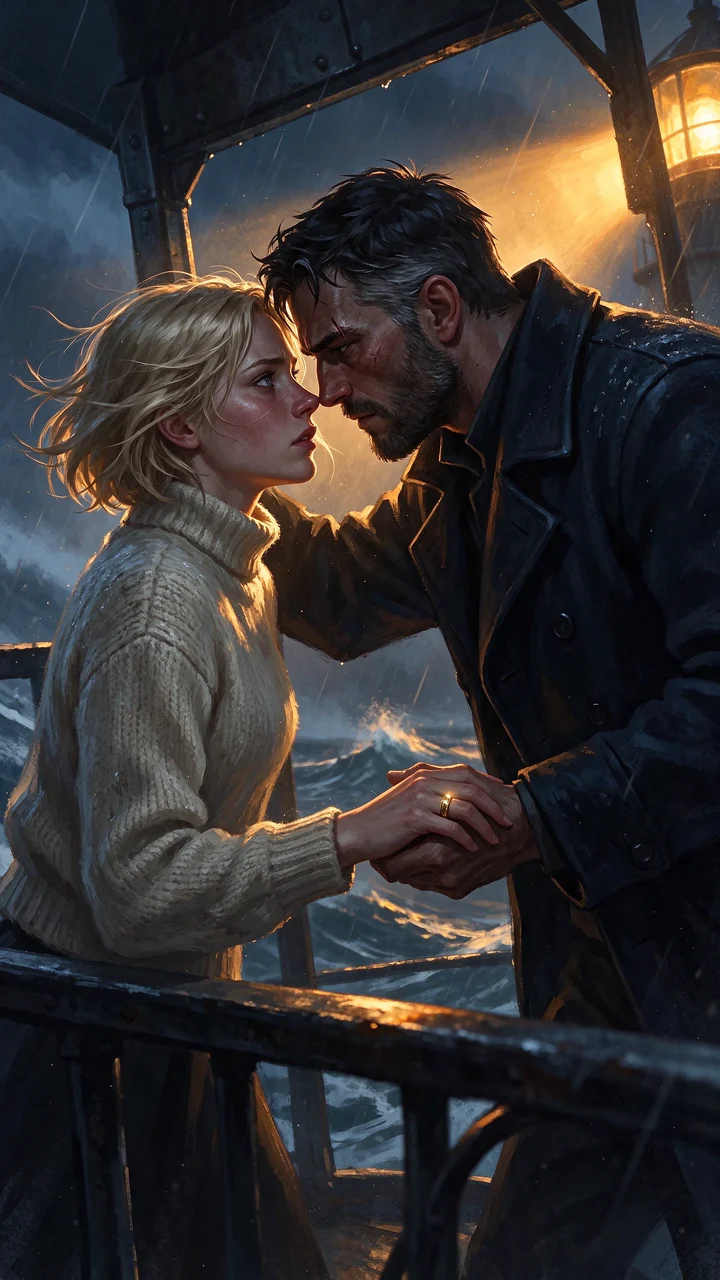
She folded his hands between her own and held them against the wool over her breastbone, below the wound. She breathed on his knuckles the way her nurse had done for her as a child in the palace snow. He was shaking. So was she. The beam came round, and round.
“You missed it,” he said.
“I know.”
“Because of me.”
“Because of the weather. Don’t flatter yourself.” She chafed his fingers. “Tell me about the scar.”
“Now?”
“You promised me the truth about threats. You are the threat tonight. Look at you.”
Water ran off his jaw. He watched her hands on his.
“My sister,” he said. “Hedda. She was eighteen, and she’d got herself in with a man who frightened her. She rang me. I was on a dive ship off Hessel, and I said I’d come when the contract ended.” The beam passed. “I came. It was ten days. He was still there, and she wasn’t.”
Elsabet’s hands stopped moving.
“I got this from him.” He tilted his head toward the pale line through his brow. “That part didn’t matter. I was too late for anything to matter.”
“Aske.”
“So I don’t fail. Not twice.” His voice roughened. “Not you.”
He leaned in slowly, giving her every chance to move, and rested his forehead against hers. His skin was cold and wet. His breath was warm. She could feel his lashes when he blinked.
“Elsabet,” he said.
In four years he had never once said it. He had called her ma’am, and Highness, and Signe in front of the village, but never her own name. Now he said it in the dark as if it had been in his mouth all along, waiting.
Her hands left his and closed in the front of his navy sweater, fists full of wet wool. She didn’t pull. She didn’t need to. One breath of space was left between his mouth and hers, and she could feel exactly how much of it he was holding back.
“Tell me to stop,” he said.
She didn’t.
Below them, through the open hatch, the radio crackled.
They both went still. The set had come back with the power. Static spilled up the stair, hiss and pop and the whine of a frequency settling. She waited for Ingvild’s crisp voice, for Linden, for the weather report that meant she was still safe.
It wasn’t Ingvild.
A man’s voice, unhurried and perfectly pleasant, said a word that only four people alive had ever used for her. It was her name from the nursery, and her name on the palace security sheets.
“Kestrel,” it said. “Kestrel, are you receiving?”
Aske’s hands closed over hers on his sweater.
The beam came round again, amber across the rain, and the voice smiled. She could hear it smile.
“Lovely lighthouse, Your Highness.”