
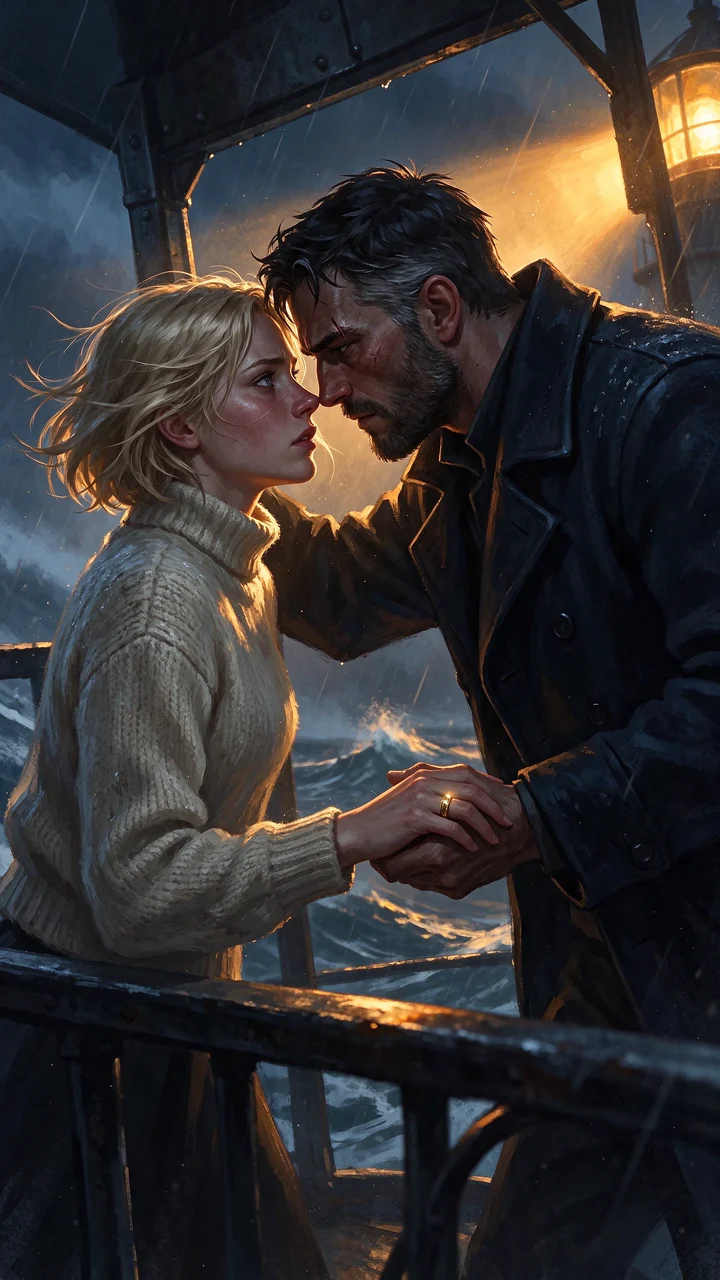
“Left foot first,” Aske said. “And don’t smile at anyone.”
“I wasn’t planning to.”
Elsabet set her left foot on the gunwale of the Marit. The borrowed boot, two sizes too big and stuffed at the toe with yesterday’s newspaper, skated on the wet wood. His hand closed around her elbow before she could go down. He held it until both her feet were on granite, and then a moment longer.
The quay was nine stones wide. She counted them because counting was easier than breathing. Every breath tugged the stitches under her left collarbone, a hot seam she could feel through three layers of wool. The wind off the harbour kept shoving the ragged ends of her hair into her mouth. Ingvild had cut it in the back of an ambulance with surgical scissors, apologising the whole time. Elsabet had told her to go shorter.
“They’re watching,” she said.
“They’re meant to.”
There were perhaps fifteen of them, strung along the harbour wall. Women in yellow oilskins. A boy with a bucket of shore crabs clicking against the tin. An old man with a net across his knees and a wooden needle in his fist, no longer mending. Gulls screamed over the gutting tables, and the whole place smelled of diesel and cold and fish blood rinsed into the cracks.
Aske turned her to face him.
She had known him four years. She knew the back of his head in a hundred doorways, his weight beside her in motorcades, the low word in her ear that meant step left. She had never seen his face this close in daylight. The scar through his left eyebrow was paler than his skin. He needed a shave.
He took her left hand.
The ring was warm from his pocket. It was plain gold and a little thin, the kind a fisherman’s mother might have worn and been buried without. He slid it over her knuckle and settled it at the base of her finger with his thumb. He said nothing. He wasn’t even looking at it. His eyes were on the crew of the Marit, on the wall, on the road behind the wall.
Then his palm came to rest at the small of her back, flat and heavy through her coat, and he walked her up the quay.
“You might have warned me,” she said, through teeth that wanted to chatter.
“You’d have argued.”
“I’d have negotiated.”
“With you that’s the same thing.”
The old man lifted his chin as they passed. “That the new keeper’s wife, then?”
“Signe,” Aske said. “She’s tired from the crossing.”
“She looks it.” The man went back to his net. “Feed her up. Wind’ll have her otherwise.”
His hand stayed where it was all the way up the cliff path, past the last cottage and the drying racks and the bent iron gate, as though she might blow off the island if he lifted it. She told herself it was the cover. She told herself that twice.
. . .
The lighthouse door had swollen in its frame. Aske put his shoulder to it and it gave with a groan, and the smell came out to meet them: lamp oil, damp wool, stone that had not been dry since it was quarried.
Inside were a stove, a table scarred with knife marks, and an iron stair winding up into the dark. She climbed with one hand on the rail and the other pressed flat over the dressing. He climbed behind her, close enough to catch her, not close enough to touch.
The room above was round and whitewashed and small. It had one window facing the sea and one chair. It had one bed, narrow, with a patched blue quilt and a single pillow sagging in the middle.
And under the window, on a plank shelf, sat a radio. Its grey steel case was dented at one corner, with a Morse key screwed to the wood beside it and a headset hanging from a nail. Someone had written frequencies in pencil on the wall above it, decades of them, crossed out and rewritten.
Elsabet went to it the way other women went to mirrors. She laid her palm on the case. It was cold.
“This is mine,” she said.
“It’s the station set.”
“It was the station set.”
He looked at the bed. She did not. She sat in the one chair, pulled the headset off its nail, and began turning the big dial with a click she could feel in her back teeth.
. . .
At midnight the pencilled numbers gave her what she wanted.
“Northwind to Linden,” she said into the handset. “Requesting weather for the Skarrow reach.”
Static answered, the long dry hiss of the sea between them. Then came a voice, thin and crisp and impossibly dear. “Linden. Skarrow reach is fair, swell from the south. You sound dreadful.”
“I was shot, Ingvild.”
“I’m aware. I was there. I’ve still got you down the front of my good cardigan.” A pause, a rustle of paper. “Listen to me. Talks resume tonight. I open with Esterhaven’s secretary at two, on the palace line. Halloway wants your voice himself, tomorrow at midnight, this hour.”
“And where does His Highness believe I am?”
“Haldegg. Mountain clinic. Room eleven. Sedated, very brave, surrounded by snow.”
“He’ll wonder why the snow sounds like gulls.”
“Then keep the window shut.” The voice tightened. “Someone gave them the seating plan, Bet. I’m finding out who. Until I do, you trust this frequency and you trust Vennor. Nobody else.”
“That’s a cheerful thought to sleep on.”
“I’m not paid to be cheerful. Linden out.”
The static came back. Elsabet sat with the headset warm against her ears until she heard the stair creak, and turned.
Aske stood on the top step with his coat off and the sleeves of his navy sweater pushed to the elbow. He had been listening. He always had.
“Terms,” he said.
“Go on.”
“As far as the village can tell, we share that bed. They’ll see one lamp, one window, one wife. I sleep on the floor.” He nodded at the glass behind her. “And you never stand in a lit window. Not once. Not to look at the weather.”
“Is that all?”
“That’s all I need.”
She took the headset off and hung it on its nail with great care. “Then here’s mine. If there’s a threat, any threat, you tell me. The truth. Not the version you’ve decided I can carry.”
He was quiet long enough that the lamp beam swept past the window twice, pale on the sea.
“That’s a large term.”
“It’s one term. You took three.”
“Fine.”
“Say it properly.”
His mouth moved, not quite a smile. “I’ll tell you the truth.”
“About any threat.”
“About any threat,” he said. She noticed that he did not say about anything, because noticing was her trade.
. . .
He made his bed from the peacoat and a grey navy blanket that smelled of the boat. He laid it out on the boards beside hers, close enough that she could have touched his hair if she let her arm hang. She did not let her arm hang.
The quilt was cold, and then it was not. The ring felt strange on her finger. She turned it with her thumb, over and over, in the dark.
Below her, Aske breathed. It was slow and even and deliberate, the breathing of a man keeping count, and after a while she understood that he was not asleep either. He was listening to her the way she was listening to him.
“Aske.”
“Ma’am.”
“Signe,” she corrected. “In case the walls talk.”
A long pause. “Goodnight, Signe.”
It should not have sounded like that. She lay very still and counted his breaths instead of her own. When she woke at grey dawn her hand was hanging over the edge of the bed. His fingers lay an inch from hers on the floorboards, curled, as if they had only just let go.