
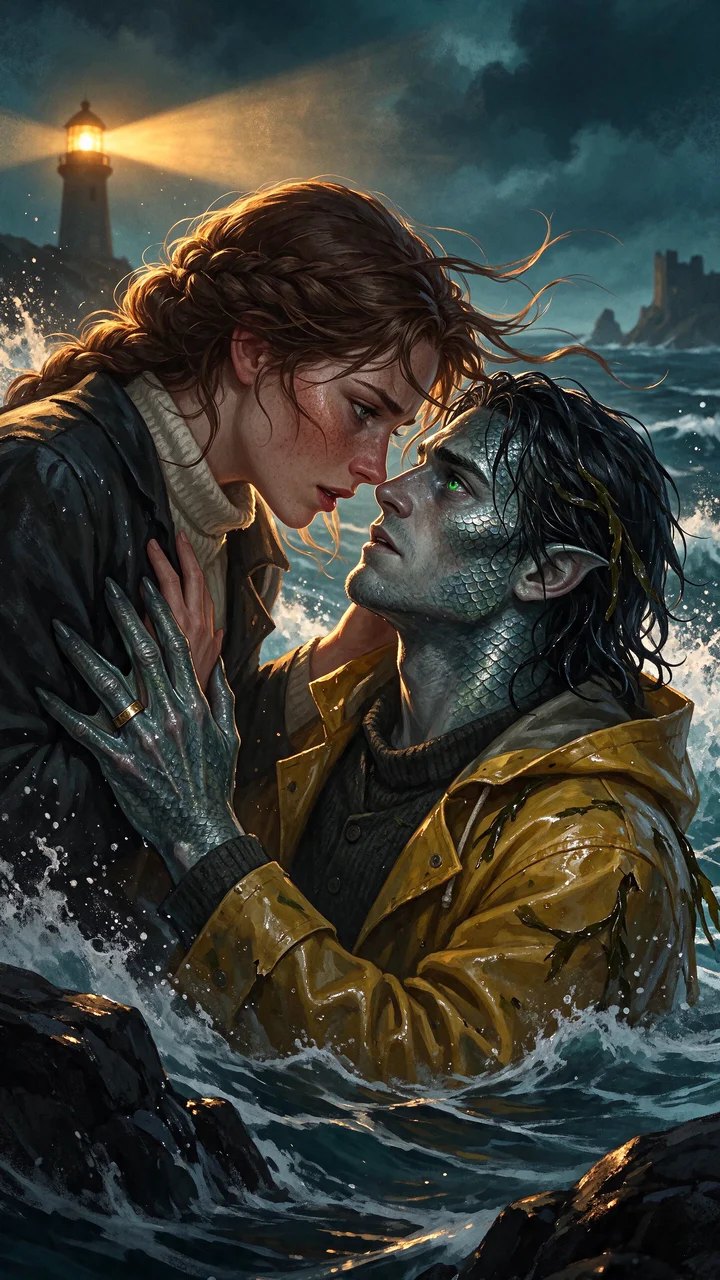
Effie Lindsay looked at the scarf on her table for a long time and did not touch it.
“Where?”
“The mooring post. Double-hitched.”
“Aye. He always did.” Effie poured tea the colour of creosote, stirred three sugars into Morven’s without asking and pushed it across. The peat in the grate settled and sent a thread of smoke into the low room. “Drink that.”
“I don’t take sugar.”
“You do today.”
It was foul and it was scalding, and by the second mouthful Morven’s hands had stopped shaking, which she supposed was the point.
“You’re not going to tell me I dreamed it.”
“Did you?”
“No.”
“Then I’m not going to tell you that.” Effie sat, her oilskin waistcoat creaking. Her red crew scarf hung on the chair back, faded to old brick. “Did he say anything?”
Morven set the mug down. “Why would you ask that?”
“Did he.”
“My name.”
Effie closed her eyes. When she opened them she looked every one of her sixty-seven years and a few she’d borrowed.
“The old coxswains had a rule,” she said. “My father had it off his, and his off a man who swore he’d pulled one in. The sea returns the men it loves.” She turned her mug a quarter turn on the oilcloth. “But it takes back their names. A little each night.”
“Whose names?”
“Theirs. Yours. All of it. He found your name because it’s the last thing he’s got hold of. Every night it’ll sit a wee bit deeper.”
“Then I’ll help him reach it.”
“That’s what they all say.”
“All?”
Effie got up and filled a kettle that didn’t need filling, and spoke with her back turned.
“Stay up your tower. Lock the door at three. Let him go where he’s gone.”
“He’s my husband.”
“He was your husband.” Effie turned. “I’m not saying what comes up those rocks doesn’t love you. I’m saying I’ve seen what’s left of a woman who went down to meet one.”
“And what was left?”
“A pair of boots on the slipway,” Effie said. “Neatly together.”
. . .
Fergus was at the lighthouse when she got back, a fortnight before he had any business there.
The board’s van sat on the hard standing and he was crouched at the foot of the tower with a laser level and a tripod, navy jacket zipped to his jaw. He rose and brushed off his knees.
“Thought I’d make a start on the survey.”
“You’ve thirty days.”
“Twenty-nine. The board likes us ahead of schedule.”
“The board likes a lot of things.”
She went to pass and he moved, not quite into her way. Just enough that she’d have to ask.
“Odd question,” he said.
“I’d expect nothing less.”
“Have you seen anything on the skerry these last nights?” He was scrolling his tablet as he said it, very casual. Too casual. A man reading a list he’d already learned by heart. “Debris. Lights. Anything out of place.”
The scarf was in her coat pocket. She could feel its wet weight against her hip.
“Why?”
“Insurance. A buoy’s been sending odd readings.” He looked up, pale eyes very clear. “Have you?”
“I’ve seen a lot of water.”
“That’s all?”
“It’s a lighthouse, Fergus. It’s mostly water.”
He held her gaze longer than he needed to. Then he nodded, as though she’d answered a different question, and bent back to his tripod.
She felt him watching all the way to the door.
. . .
At ten past three she was on the ledge with the logbook buttoned inside her coat and the tide ebbing under her, hissing back through the bladderwrack. The spray came freezing, needling her cheeks. The beam went over her head and lit the water and moved on.
03:12.
He came up out of the black without a sound.
Not climbing. Rising, water sheeting off his shoulders, the ruined oilskin plastered to him, the dark jumper beneath sodden to the throat. He stepped onto the rock and stopped a careful arm’s length from her.
Close enough to touch. Far enough that she would have to be the one who did it.
The beam came round and gave her his face.
The jaw she had kissed awake every morning for five years. The nose he’d broken at sixteen falling off the harbour wall. And across his cheekbones and down his throat, into his collar, fine scales that caught the light the way wet slate does, blue, green, gone. Kelp in his long black hair. His eyes still brown at the centre, but ringed now with a green that seemed to carry its own light.
He was looking at her the way you look at a word on the tip of your tongue.
“Hello, you,” she said.
The sea breathed in and out round his ankles.
So she told him.
“Our wedding. April, and it rained sideways, and we did it on the harbour wall because you said a church was no place for a fisherman to promise anything.” She heard herself laugh, wet. “My dress was see-through by the second vow. You pulled your jumper off in front of the whole island and put it over my head. I said my vows in that. Effie called it a disgrace.”
The light came round.
The green had drawn back a fraction. The brown was warmer. He was looking at her as if she’d only just walked into the room.
“You wore my jumper,” he said.
She could only nod.
He reached out and closed his hand round her wrist.
Cold. Colder than the sea. The webbing lay against the soft inside of her wrist, against her pulse, impossibly thin, and the ring was a band of ice beneath it. His thumb moved once over the bones there, slow, the way he used to do it under tables and in church and in the dark. Heat went through her so hard she had to lock her knees.
“Ruairidh. Do you remember the Seaman’s Hall? The ceilidh? You stood on my foot in the Strip the Willow and swore blind I’d stood on yours.”
He looked at her. Slowly the warmth went out of his face. Not anger, not grief. A polite, careful blankness. A man opening an empty drawer.
“No.”
“The red dress. You said I looked...”
“No.”
And she understood, with her wrist in his frozen hand, that it had been there yesterday. That she had given him the harbour wall and the sea had taken the hall in payment.
He let go. Before she could step back he caught her hand, turned it, and pressed her palm flat to his chest, under the open oilskin, over the soaked wool and the ridged edges of scales beneath. The breadth of him, that she knew. The cold, that she didn’t.
She waited.
Nothing moved under her hand. Nothing at all.
He held her there until she understood. Then he let her go.
“Spring low,” he said, dragging the words up from somewhere deep. “Third night. Come out to me. On the skerry.”
He stepped backwards off the ledge, and the sea closed over him without a ripple.
She sat down on the wet rock and opened the logbook. Under 03:12 she wrote: Harbour wall. Then: Seaman’s Hall, and drew a line through it. Then, with a hand that would not stay steady, she began to list everything she could afford to lose.
. . .
He took the jumper down with him.
He held it the whole way, through the pressure and the dark, held the rain and the harbour wall and her laughing inside his wool. The sea sang round him, wordless and patient, and he did not listen.
Somewhere there had been a hall. A red dress. He went looking and found only the shape where they had been.
Her name was still there. He touched it carefully, the way you’d touch a bruise. Two syllables. Warm.
Above him the light went round and round.
Below him the singing grew sweeter, and called him by a name that was not his.