
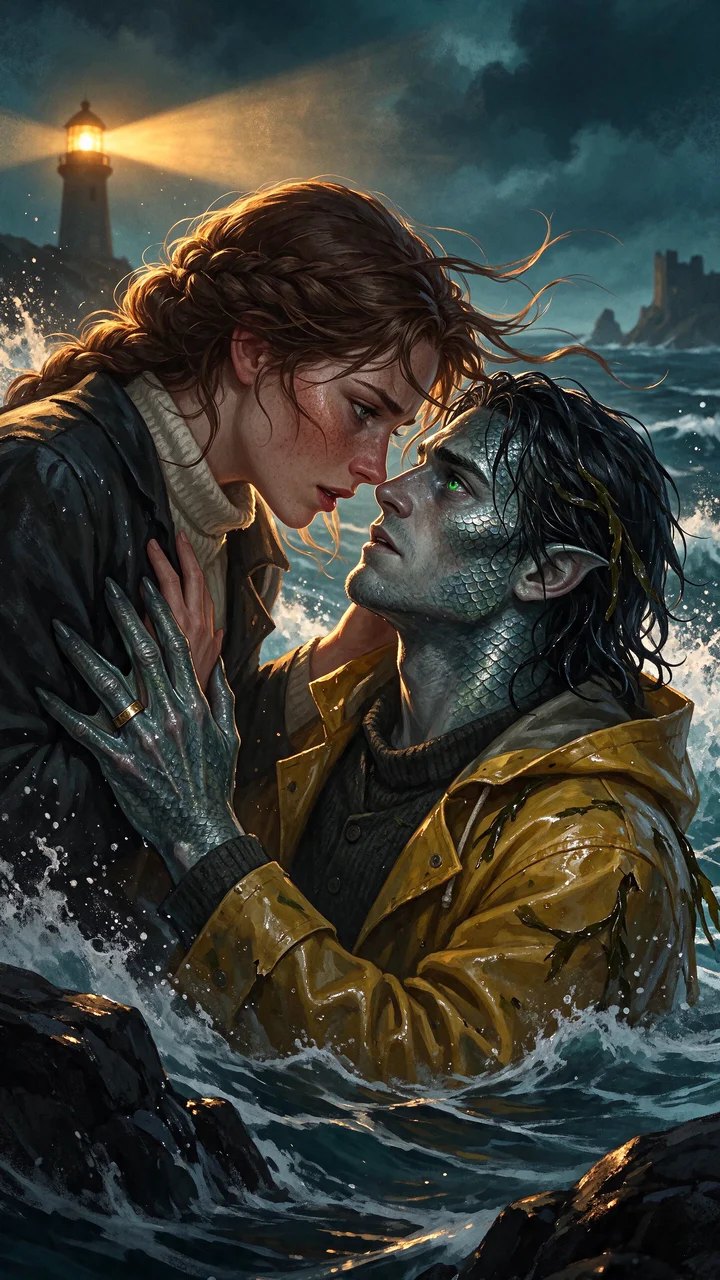
She left the logbook open on the kitchen table, at the list.
Nineteen lines in her square hand. The flat above the chandlery. His mother’s funeral. The dog. The night at anchor off Mingulay when the phosphorescence lit his hands green to the wrist. Two nights she’d sat over it, crossing out and writing back, pricing her marriage line by line.
Tonight she would spend none of it.
At spring low the sea drew off the causeway as if someone had whipped a cloth from a table, and left it bare: a spine of black stone running out to the skerry, every rock glistening with weed under a hard white moon. Overhead the beam swung out and back, out and back, the tower’s slow heartbeat.
She crossed in her boots with his navy scarf, dried stiff over the range, wound round her throat. The weed popped and slid underfoot. Pools held the moon. Twice she went down on one knee, and twice she got up and did not look back at how far it was to shore.
He was waiting where the causeway met the skerry, the yellow oilskin gone silver in the moonlight.
“You came,” he said.
“You asked.” She stopped an arm’s length off, the way he had. “I’m not telling you anything tonight. No stories. I’m just here.”
Something moved in his face. Relief, maybe. Or something older wearing it.
“Just here,” he said.
“Don’t sound so pleased.”
“I’m not pleased.” The corner of his mouth went, the old crook, there and gone. “I’m cold.”
“You’re always cold now.”
“Aye.” He held out his hand. “Come and see.”
She took it. The webbing closed over her knuckles, and he led her down a slope of rock to a cleft in the skerry’s flank, a narrow throat of stone half full of black water that slapped and sucked.
“Here,” he said. “I woke here.”
The walls of the cleft were scored with long parallel grooves. The marks fingers would make. Fingers that were too long.
“How long were you in there?”
“Don’t know. There wasn’t long. There was cold, and then there wasn’t.” He crouched and laid his palm flat on the water. “Then the singing.”
“What singing?”
He was quiet so long she thought he’d lost the word.
“It sings to me. Every night. Under.” He didn’t look at her. “I like it more every night, Morven.”
Her name came easier to him tonight. That frightened her more than the scales.
“Better voice than mine, is it?”
“You never could hold a tune.”
She went very still. “Don’t. Don’t you spend anything on me.”
“That one was free.” He rose, and he was close now, very close. “Some of them are.”
She heard it before she saw it. A sound under the sound, a drawing-in, and the skerry shuddered beneath her boots. Out of the flat calm of low water a wave stood up, white-crested and higher than the rocks.
He moved before she could. One arm round her waist, hauling her back against the rock face, turning so his body was between her and the sea, his other hand braced on the stone above her head. The wave hit him. She felt it go through him into her, the weight and the cold pouring over his shoulders and down round them both, and he did not give. Not an inch.
Then it was draining away, hissing back through the weed, and they stood in it to the shins, and he hadn’t let go.
Neither had she. Her fists were knotted in the wet wool of his jumper. Her cheek was pressed to his throat, to the scales, smooth one way and catching the other, and the whole cold length of him was against her, chest and hip and thigh, cold through every layer she had on.
She knew exactly how to step back. She didn’t.
He lifted his hand from the rock and brought it down, slowly, to her jaw.
The webbing cupped the line of her face. The ring lay cold against her cheekbone. He tipped her face up, and she let him, and he bent his head until his forehead rested on hers.
Salt. Kelp. Under it, faint, him.
Their mouths were a breath apart. His didn’t breathe. Hers did enough for both of them, quick and shaking.
“Morven. You don’t know what I’m...”
“I don’t care what you’re becoming.” She said it so close the words touched his mouth before she did. “I don’t. I don’t care.”
His thumb traced her jaw. His fingers slid into the hair at her nape and tightened, and she rose onto her toes for the last fraction of distance.
The light went out.
Mid-sweep. The beam had been crossing the water toward them and simply stopped, and the dark that dropped seemed to swallow even the moon, the dark of someone who has lived inside a lit room for a year.
And in it, inches from her, his eyes flooded.
The brown went first. Then the green ring swelled and burned, and black welled up through it from the centre until there was nothing but black, lit from inside, luminous, the deep-water glow of things that have never seen the sun.
He tore himself back so hard she staggered.
Up at the tower, where the lamp should have been, a thin white light began to wink. Fast. Cheap. Mechanical. The automatic beacon. And on the gallery beneath it, small and blue and steady, the square glow of a tablet screen.
Three weeks early.
He had asked what she’d seen on the skerry. He’d been on the Morning Star. And he had known, to the minute, when to put the light out.
He knows what the light does, she thought. Which means he knows what happened out here.
Ruairidh was against the rock, both hands flat to it, head down. When he lifted it the black eyes found her and searched her face, and she watched him not find her.
“Tell me your name again,” he said. “I can’t find it.” His voice cracked on something far older than him. “And don’t let me forget it.”
Behind her, cold water slid over the heels of her boots. The tide had turned, and the causeway home was going under.