
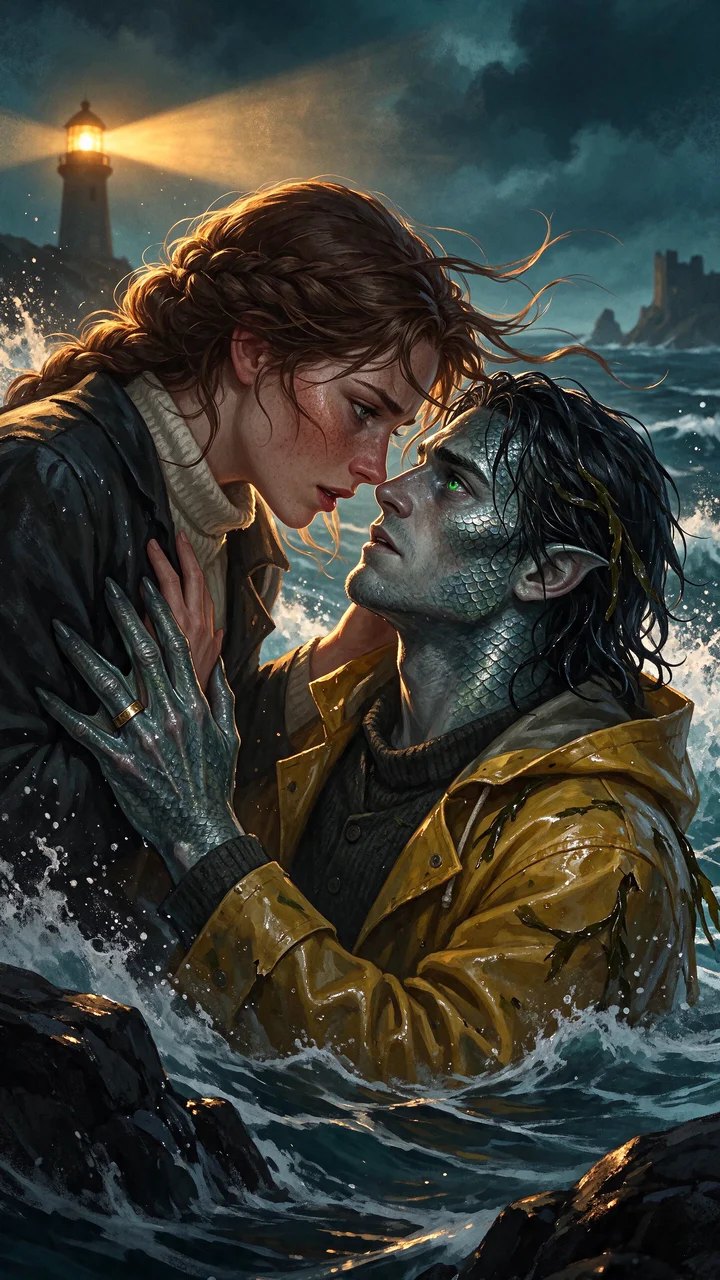
“Sign it or don’t, Mrs Gair. In thirty days the light runs itself either way.”
Fergus Strachan laid the envelope on her kitchen table, crest up, squared it to the edge with one finger and stepped back. He hadn’t taken his jacket off. He hadn’t been asked to.
Morven kept both hands round her mug. “You came across in this to hand me a letter.”
“The board felt it should be done in person.”
“The board felt.” The window rattled behind him, and above them the tower boomed in the wind. “Six letters, I’ve had. I was starting to think it didn’t have a face.”
“Well.” The tight smile. “Now it does.”
“I’ve seen better on a halibut.”
He let that go, which was worse than if he’d bitten. Fergus let a lot of things go and folded them away for later. He slid the tablet from under his arm and woke it, and the screen threw a cold light up his chin.
“Automation crew arrives the fourteenth of March. The lamp goes onto remote monitoring from the mainland. You’ll be offered a cottage in the village or a relocation package. The board is very grateful for your service.”
“Is it.”
“Very.”
“And who logs the hour?”
His eyes went past her to the dresser, where the keeper’s logbook sat between the tide tables and Ruairidh’s tobacco tin. “Nobody reads that log, Morven.”
“I read it.”
She slit the envelope with her thumb, read as far as the words final notice, and tore it cleanly in half. Then in half again, because the first tear had felt too polite.
Fergus watched the pieces settle on the oilcloth. “That’s a copy.”
“Bring me the original. I’ll do that one too.”
The kettle ticked as it cooled. He didn’t move to go.
“It’s a year today,” he said. “Isn’t it.”
She hadn’t expected him to know. “A year since we buried a box. Yes.”
“I was out there that night. On the Morning Star.”
“Half the island was out there.”
“I know.” He looked out of the window then, to where the skerry crouched black in the boiling white a quarter mile off, and he looked at it a moment longer than a man looks at rocks. Then he tucked the tablet back under his arm. “Thirty days. I’m at the hotel if you need anything.”
“I won’t.”
“You might.” He paused at the door. “Get some sleep. You look as if you live up that tower.”
“I do live up that tower,” she said, but the door had banged behind him and the wind took the words.
. . .
There were a hundred and twelve steps to the lamp room, and in a February gale every one of them sang.
She climbed them in her socks with the logbook under her arm and the storm lantern swinging from her fist, Ruairidh’s old grey scarf wound twice round her throat. The walls sweated. The iron rail was cold enough to burn. Outside, the wind screamed round the tower in one long note that rose and never broke, and under it came the deep, regular detonation of the sea on the skerry.
The lamp room smelled of brass polish and paraffin, though no paraffin had burned here in thirty years. It was in the stone. She hung the lantern on its hook, sat on the keeper’s stool with her back to the turning lens, and opened the book on her knee.
The coastguard report had given the last contact from the Siubhal at 03:12. One word on the radio, then hiss. Nobody had ever told her what the word was, and she’d stopped asking, because asking made Effie Lindsay put the kettle on and made everyone else study their boots.
So she logged it instead. 03:12. Light burning. Wind, sea, visibility. Nothing to report. Three hundred and sixty-five nights of nothing to report, in her square, stubborn hand.
His watch hung loose on her wrist, the strap punched with an extra hole. 03:10. 03:11.
The beam went out over the water, and came round, and went out.
03:12.
She looked up because she always looked up. The light swept the skerry and bleached it bone white, and there was a figure on the rocks.
Someone climbing out of the surf. Tall. Streaming. Hauling himself onto the ledge below the landing with the sea dragging at his legs, and on his shoulders, shredded and flapping, a yellow oilskin.
The beam moved on. The dark came back.
Morven was standing. The logbook was on the floor. She had no memory of dropping it.
Fifteen seconds for the light to come round. She counted them with her palms on the cold glass, and they lasted longer than the night the boats came home without him.
The beam swung in.
He was still there. Upright now, where nobody could stand in that sea, one hand braced on the stone. The light caught the hand and she saw it the way you see a thing you’ll keep seeing for the rest of your life. Fingers too long. Joined by something thin and pale that glistened. And on the fourth finger, sunk into that webbing as though the flesh had grown up round it, a gold ring.
She had paid for that ring. It was a size too big. He’d sworn he would grow into it.
He lifted his head and looked straight up at the lamp room.
At her.
Her hand found the gallery door before her mind did. The gale tore it out of her grip and slammed it against the rail, and she stepped out into noise so total it was nearly silence. Salt stung her face. The scarf whipped across her mouth.
Then the wind dropped, the way it sometimes did between gusts, a hole torn in the weather, and up through the hole came a voice.
“Morven.”
Slow. Testing. Each half of her name set down separately, a word from a language he used to speak.
Wrecked and wet and his.
She ran.
The stairs blurred. Two at a time, three, socks skidding, her shoulder striking the curve of the wall at every turn. The outer door fought her and lost, and the night came in screaming, and she went out into it and down the slick landing steps with the spray coming over in sheets.
“Ruairidh!”
The beam came round. The ledge was empty.
She stood on it anyway, where she should never have stood, the sea sucking at her ankles, and waited for the next sweep and the next. Black water. White water. Nothing.
When her hands would work she crouched and put her palm to the rock where he had braced himself.
There was a print there. Darker than the wet around it, slick, and when she laid her hand inside it her fingertips stopped a full knuckle short of his.
She kept her hand there until the cold reached her elbow.
Then she saw the mooring post.
Something was knotted round it, sodden and heavy, double-hitched the way he tied everything. She knew it before the light reached it. Navy wool gone nearly black, the cable she’d botched on the third row and never fixed. The scarf she’d knitted him their first winter. The one he’d worn the night the Siubhal went out.
Nothing of him had come back with the wreckage. Not this. Not anything.
She worked the knot loose with numb fingers and pressed the wool to her face. It smelled of the sea, and under the sea, so faintly she might have invented it, of him.
. . .
She did not go to bed. She sat in the lamp room with the navy scarf across her knees and the lantern burning, and the black outside went grey at the edges.
Tomorrow, at 03:12, she would not be up here behind the glass.
She would be on the rocks.
At twenty to six her phone lit on the stool beside her.
Fergus Strachan: Saw your lantern up the tower all night. Couldn’t sleep either? I’ve made a note.