
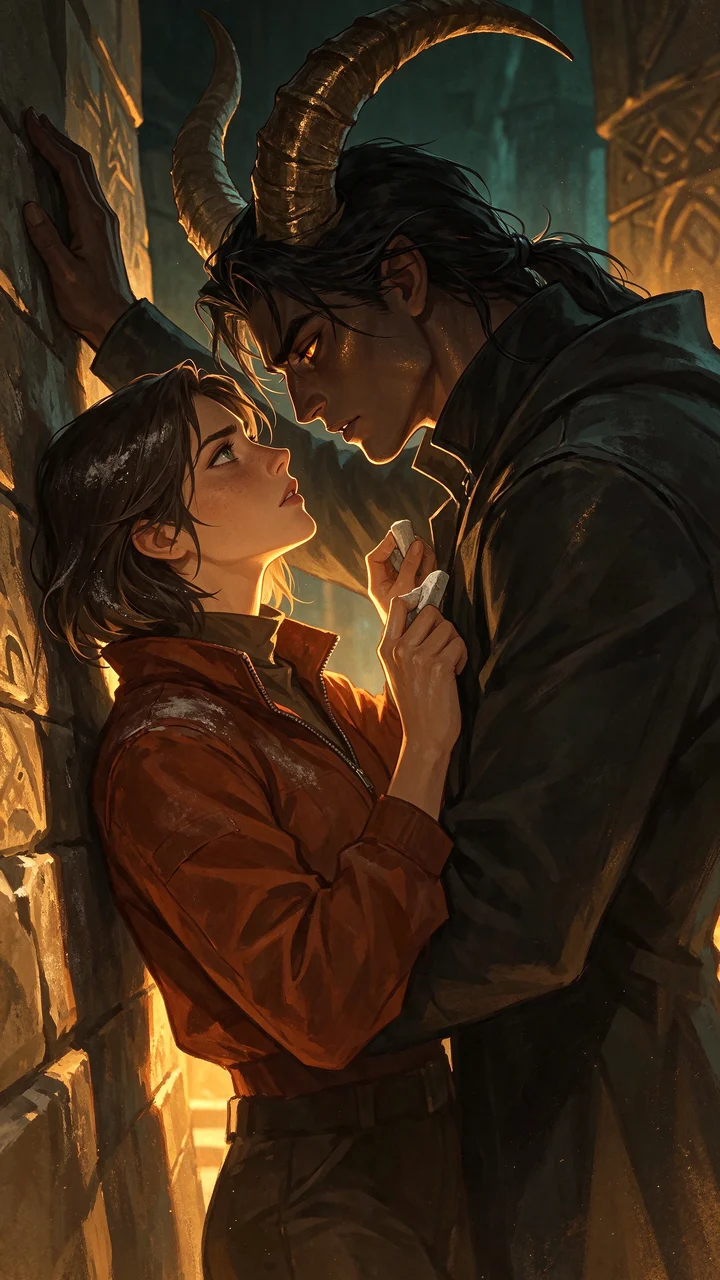
The terms went on graph paper torn from the back of her field book, written in small square capitals and weighted at the corners with four stubs of chalk.
The ledge was a natural shelf in the gallery wall, waist-high on her and somewhere around his hip. Lanterns hung in iron brackets along the passage, and their light lay amber over the spirals carved into the stone, hundreds of them, worn so smooth by hands that the grooves shone. Warm air drifted from somewhere deeper and moved her hair.
Ruvan read the page without touching it. He’d left his coat folded on the ledge tonight, and in the dark linen shirt, with leather bracers buckled on his forearms, he looked less like a gatekeeper and more like a man who had been working. It did not help.
“One,” he read. “You may tell me where to go, when to stop, and when to close my eyes.”
“Yes.”
“Two. Hands on my wrists, my shoulders, the small of my back. Nothing else unless I ask.”
“That’s what it says.”
“Three. North ends everything.” His voice did something to the word. “Always.”
“That one isn’t up for discussion.”
“I wasn’t going to discuss it.” He held out his hand. After a moment she understood and gave him the pencil. It vanished in his fingers, a splinter of yellow. He bent and wrote beneath her lines, his letters looped and old-fashioned, pressed hard enough to dent the paper.
Four. When I ask you a question, you tell me the truth.
She read it twice. The lanterns hissed.
“That’s a big clause.”
“It’s a small one. It only applies when I ask.”
“And if I don’t want to answer?”
“Then you say north.” He set the pencil down. “I won’t trick you with it, Sabine. I’m showing you where the edge is.”
In her pack, under the spare batteries, the Halvern contract sat in its plastic sleeve. Survey for the purposes of controlled demolition. She had initialled every page.
She signed the sheet. He signed under her, one word. Then he folded it and slid it inside his shirt, over his heart, and she had to look at the spirals for a while.
“Lamp off,” he said.
She switched it off. The gallery stayed gold.
“Eyes.”
She closed them.
His hand came around her wrist. Not tight. The whole of it, warm and dry, his thumb resting where her pulse was making a fool of her. “Forward. Seven steps.”
She counted them. Behind her, stone ground against stone, and the warm draught swung from her left cheek to her right.
“Stop. Turn.”
His other hand settled at the small of her back, over the rust canvas of her jacket, and turned her. It stayed one breath longer than it needed to.
“Duck.”
Something brushed the top of her hair. The air cooled. Her boots found a slope.
“You’re counting,” he said.
“I always count.”
“Stop counting.”
“That isn’t in the terms.”
“Clause one,” he said, and she could hear the smile. “Where to go. I’d like you to go somewhere without numbers.”
She stopped. It was the hardest thing she’d done all year. Without numbers there was only his voice and the pressure at her wrist and his palm arriving at every turn, steering, leaving. The walls moved and she let them. She did not know where she was, and for the first time in her life her chest was loose with it instead of tight.
The satellite phone buzzed against her hip.
She opened her eyes. They’d come into a narrow chamber where a shaft cut up through the rock to a coin of night sky, and the phone had found it.
“I have to take this.”
He let go of her wrist.
She walked to the far side, under the shaft, and turned her back. “Lenhart.”
“Sabine.” Harlan Blythe sounded the way he always did, a man smiling at his own reflection. “How’s my labyrinth?”
“Complicated.”
“Not for long. Board met this afternoon. We’re bringing the charges forward a week. Crews on the island by the twentieth.”
“The survey isn’t finished.”
“Then it’ll be finished by the nineteenth. You want your name on a building, send me a map.” The click of a pen. “Anything down there I should know about?”
She looked up at the coin of sky. “No.”
“Good girl.” He was gone.
. . .
He did not listen.
He could have. Every seam in that chamber was his, and he had only to lean a little of himself into the rock to hear her as the rock heard her. Instead he stood at the entrance with his hands folded behind him and watched the lantern.
Her shoulders had come up. That much he saw. Her voice had gone flat and pleasant, the voice people use on dogs they don’t trust.
The paper sat against his chest. Clause four. He could ask her now, and she would answer, or she would say the word and walk out of his walls for good.
He found he wanted her to stay more than he wanted to know. That was new. He did not like it.
He did not ask.
. . .
She was halfway back to him when the radio crackled.
“Sab. Sabine, check in, you’re forty minutes late. Are you safe?”
Ruvan went very still. Not the stillness of a man waiting. The stillness of the walls.
“Who is that?”
“Felix. My tech. He’s on the boat.”
“Who else do you belong to, Sabine?”
The lanterns hissed. She made herself hold his eyes.
“Nobody. I don’t belong to anyone.” She lifted her chin. “It’s my choice who I answer to.”
“And tonight?”
“Tonight I chose you. Inside the terms.”
Something in his face eased, slow as a tide going out. She thumbed the radio. “I’m fine, Felix. Signal’s bad. Running late.”
“You sound weird.”
“I’m in a hole in the ground. Out.”
Ruvan was watching her. “Is that true? That you’re fine?”
“Yes.”
“That part,” he said quietly, “I believe.”
She took a step toward him, and her boot came down on its own trailing lace. She pitched forward. His hand caught her elbow and held it until she had her feet.
Then he knelt.
Even kneeling he was nearly at her shoulder. He took the loose lace in two fingers, and his other hand stopped in the air above her ankle, not touching, the heat of it reaching her through the canvas.
“May I?”
Ankles were not on the list. She had written that list very carefully.
“Yes,” she said.
He drew the cuff of her cargo trousers up an inch and set his palm around the back of her ankle to steady it. His thumb rested on the bone. He retied the lace in a knot she didn’t know, double, tight, his head bent so the great curve of one horn passed close enough that she could have touched the ridges.
“That isn’t a climber’s knot,” she said. Her voice was wrong.
“Sailor’s. A man named Tomas taught it to me. He came down here in 1702.”
His thumb moved once over the bone, a slow half-inch. Then he let go, and the letting go was worse than anything he could have taken. She stood very straight and did not sway, and he saw that she did not, and she watched him decide not to mention it.
He rose. “Tomorrow I’ll show you the heart of the maze.”
“The big chamber.” She thought of the round shape on her screen, the one no plan had drawn. “Under the island’s centre.”
“If you can get there without saying north.”
“And if I say it?”
“Then the walls open, and you go home, and you never see it.” He was close now, closer than the terms required. “Your choice. It is always your choice.”
He walked her out through corridors that opened before her one by one, and she kept waiting for the old fear, of being lost, of not knowing the way. It didn’t come. What came instead was worse. Every opening wall felt like a door she didn’t want to go through.
At the tunnel mouth he stopped in the shadow.
“Clause four,” he said. “I haven’t used it yet.”
“Why not?”
“Because when I do,” Ruvan said, “I’d like you still to be here.”