
“Minotaur insurance,” Felix said in her ear, “is cheaper than you’d think. I’m looking at a quote right now.”
Sabine drew the arrow in three hard strokes, chalk squealing on the limestone. “Does it cover being gored, or just being eaten?”
“Gored is extra. Eaten counts as an act of God.”
“Then I want the premium plan.” She set the scanner on its tripod and stepped back while the head began its slow turn. The laser swept red across the wall, the ceiling, her boots. Far above, the sea hit the cliffs of Varrow, and the boom came down through the rock so deep she felt it in her molars.
Junction forty-one. Her arrows ran back behind her in a neat white thread, every one pointing home.
“You’re two hundred metres in,” Felix said. “Signal’s holding. How’s it smell?”
“Salt. Rust. Wet pennies.”
“Romantic.”
“I’ve had worse dates.”
“You’ve had worse dates with me sitting in the next booth.”
She smiled at the wall, because there was no one to see it. The passage ahead was barely wider than her shoulders, cut with tool marks so old they had softened into ripples. Her headlamp threw her shadow out long and thin, and when she moved, the shadow trembled half a step behind her, as if the light didn’t want to go any further. And the stone hummed. A low, steady note just under hearing, the sound a building makes when its pipes are full.
She logged it in her field book. Possible groundwater resonance. Check.
Halvern’s plans showed three concentric rings and a central void, the kind of Bronze Age folly that looked good in a resort brochure. By junction thirty she’d stopped trusting them. By junction forty she’d stopped expecting them to be right about anything.
“Talk me through the sensible plan,” Felix said. “The one where you come back up tonight.”
“The one where I finish the inner ring, camp in the centre, and do the north quadrant at first light instead of losing two hours on the climb.”
“I hate that plan.”
“Noted.”
“I’m writing it on a sticky note. Felix hated this plan. For the inquest.”
The passage opened, and her light went up and up before it found the curve of a dome, ribbed and pale and beaded with damp. A round atrium, twelve metres across. A smooth track was worn into the floor around its rim, as if something had walked that circle for a very long time. She set the scanner turning and stood in the middle while it painted her into the record.
“I’m in the void,” she said. “It isn’t a void. It’s a room.”
She ate half a protein bar that tasted of cardboard and almonds, wrote up the day’s figures, and found her chalk had worn down to a nub. She switched the lamp to red, told Felix goodnight, and lay listening to the sea until it took her under.
. . .
The radio was hissing when she opened her eyes. Flat grey static, no voice under it.
“Felix. Check.”
Hiss.
She clicked the lamp to white. Same dome, same damp, same worn track. Her scanner stood where she’d left it, its screen a patient green. She laced her boots and walked to the arch she’d come through to find her arrow.
There was no arrow.
There was no arch. The wall ran smooth and unbroken where it had been, and a new opening yawned two metres to its left, narrower, sloping down. She laid her palm flat on the stone. It was warm.
She went round the whole room. Five openings where there had been three. Not one chalk mark. She had drawn forty-one, and the rock held none of them, not a smear, not a grain of white in the joints.
“Okay,” she said aloud. “Moving walls. Fine.”
Her heart was going hard and she let it. She’d once spent six hours on a ledge in the Verdon with a jammed cam and the weather turning. Panic was something you scheduled for later.
“You aren’t running.”
The voice came from behind her, low and unhurried, rough at the edges. Sabine turned.
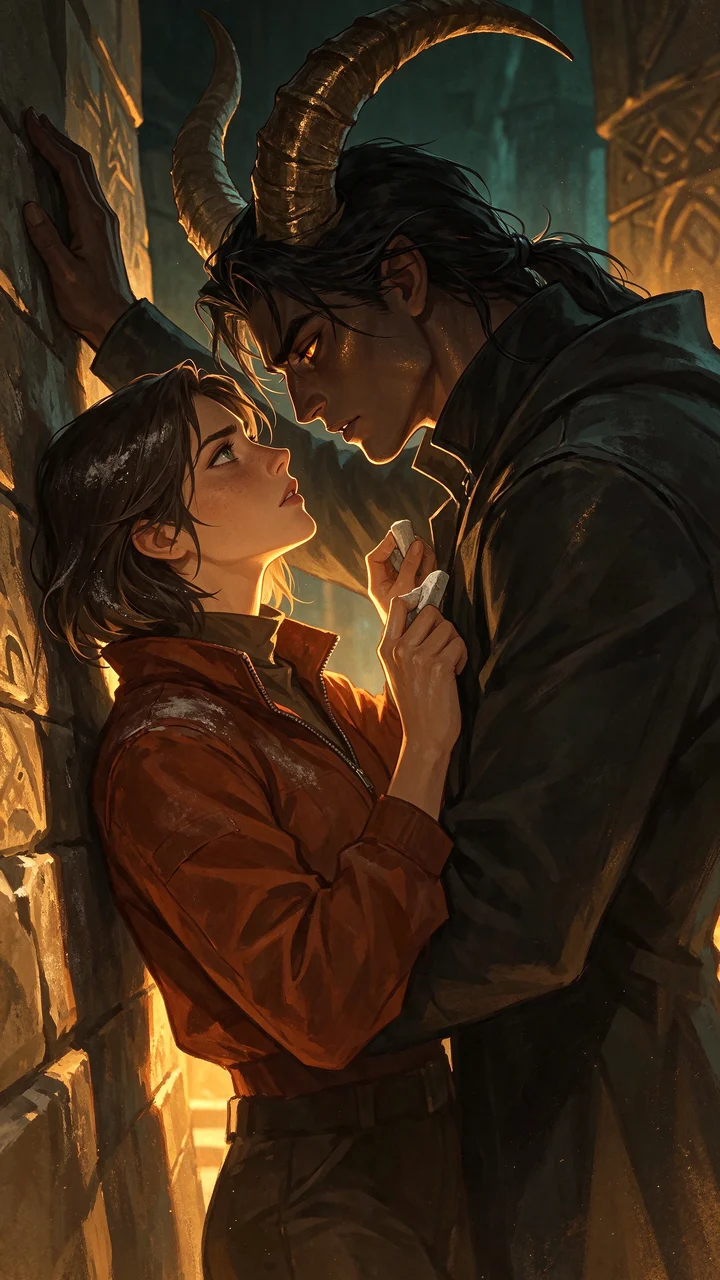
He stood in the widest archway, and he filled it. Seven feet at least, broad through the chest, in a long charcoal coat fastened to the throat. His skin was deep umber with a faint gold sheen where her light touched it, his black hair tied back at the nape. From his temples rose two great horns, curving back, ridged like weathered bronze. His eyes were amber, and they were not reflecting her lamp. They were lit from somewhere of their own.
He was looking at her the way she looked at a building she hadn’t measured yet.
“You did this,” she said.
“Yes.”
“The chalk.”
“Yes.”
“Why?”
He tilted his head, and the slowness of it made the skin on her arms tighten. “I wanted to see what you would do.”
“And?”
“You put your boots on first.” The corner of his mouth moved. “Most people run barefoot.”
The radio hissed against her hip. Her hands wanted to shake, so she pushed them into her jacket pockets, found the nub of chalk, and closed her fist around it.
“How many people have come down here?”
“Fewer every century.”
“And they ran.”
“They ran.” He didn’t say what happened after. He didn’t need to.
She thought about forty-one arrows, and how neatly he had taken them. You didn’t beat a building that rearranged itself. You negotiated with the architect.
“Here’s what’s going to happen,” Sabine said.
The amber eyes sharpened. It was interest, not anger.
“I’ll play. Your maze, your walls. Move them however you like, and I’ll find my way or I won’t.” She pointed the chalk at him. “But there’s one word. If I say north, every wall opens and you let me go. Straight out. No tricks, no questions.”
“North.”
“Nobody says it by accident down here.”
He came out of the archway, and the room got smaller. He moved quietly for something that size, and stopped an arm’s length away, which on him was a good deal of distance. She had to tip her head back. He smelled of wool and cold iron and, faintly, woodsmoke.
“You understand,” he said, “that you are offering me the game and its ending in the same breath.”
“I know exactly what I’m offering.”
“And if I refuse?”
“Then you’re just a man who moves walls to frighten women in the dark.” She shrugged. “Less interesting.”
The sound he made was low and delighted, and it went into the floor and up through her boots. “Agreed. Your word, Sabine Lenhart. Every wall.”
She hadn’t told him her name. She filed that under later, with the panic.
“Prove it,” she said, and before she could think: “North.”
He didn’t move. The labyrinth did.
A deep grinding rolled out of the walls. The far side of the atrium split along a seam she hadn’t seen and drew apart, and the wall beyond it parted, and the one beyond that, gate after gate, until at the very end of a long straight corridor a square of grey-blue light appeared and cold air rushed in smelling of rain and kelp.
Dawn.
She shut her mouth.
“Pack your machine,” he said.
She folded the tripod. He watched the scanner with frank curiosity. “What does it want with my walls?”
“Measurements.”
“For whom?”
“For people who like to know where things are.”
It wasn’t a lie. It sat in her stomach anyway.
He walked beside her down the corridor, keys chiming softly at his belt, the walls standing open on either side. She glanced at the scanner’s screen as they went. The point cloud had rendered overnight. Between junction thirty-nine and the atrium sat a chamber, huge and round, that she had never walked and no plan had ever drawn.
At the tunnel mouth the wind hit her face. Gulls. The survey boat a yellow smudge on slate water. The radio crackled and Felix burst through, swearing.
Ruvan had stopped just inside the shadow, where the light didn’t reach his feet.
“Ruvan,” he said, as if she’d asked. Then, lower: “Come back tomorrow. See how long you can go without saying it.”
She should have laughed. She should have walked down to the shingle and written a report about groundwater and very bad plans.
The stone closed behind him.
She stood on the cliff path with Felix shouting in her hand and knew, the way she knew a load-bearing wall, that she was going to.