
The lanterns were gone.
She’d known they would be. “Harder tonight,” he’d said at dusk, standing in the tunnel’s mouth, and then he had stepped back into the dark and taken the light with him.
Now there was only her headlamp and the stone, and the stone was not being kind. Corridors narrowed until she turned sideways and scraped through with her pack dragging behind her. A passage dead-ended in a sheer chimney and she climbed it, fingers in old tool marks, boots smearing on damp rock, the way she’d climbed a hundred cracks above a hundred valleys. At the top the floor dropped into black water to her ankles, so cold it ached.
Behind her the walls kept moving, grinding shut on every passage she’d left, steering her on.
“Bastard,” she told the dark.
“Colder,” his voice said, from everywhere at once.
She turned back. Took the left fork. Crawled through a slot so low her helmet clicked against the ceiling, her scanner bumping in her pack, its small fan whirring as it logged every inch.
“Warmer.”
She did not say north. She said a great many other things, some of them in German, but she did not say it.
The slot ended. She pushed through on her elbows, stood up, and stopped.
It was the chamber from her screen. Vast and round, the walls rising to a ceiling lost in shadow except for one shaft at the very top where the moon looked straight down. Its light fell in a single pale column onto a pool at the centre, black and perfectly still. The air was warm, and smelled of minerals, and was as quiet as an empty church.
Ruvan stood at the water’s edge in his long coat.
“I’m here,” she said. She was breathing hard, soaked to the shins, chalk dust in her hair, and she had never in her life felt so pleased with herself.
“You are.”
“No north.”
“Not once.” His eyes went over her, the scraped knuckles, the wet boots, and lingered. “I made it very hard.”
“I noticed.” She shrugged off her pack and set it by the pool, the scanner’s light still blinking green inside. “Was that you being cruel?”
“That was me hoping.”
She walked toward him and saw the walls.
Names. Every inch of stone she could see was carved with them, from the waterline to well above his head. Different hands, different scripts, letters she could read and letters she couldn’t. Dates. A ship drawn in six lines. Tomas Ferrier, 1702, cut deep and careful.
“Everyone who ever reached the heart,” Ruvan said. “Everyone who stayed long enough to want to leave a mark.”
“How many?”
“Two hundred and sixteen.”
“In four hundred years.”
“In four hundred and twelve.”
He went to the wall near the water, where the stone was darker, and laid his hand flat on a patch worn nearly smooth. She crouched beside it. Under his fingers were letters so faint she had to turn her head to catch them in the moonlight. RVAN. The U long gone.
“Yours.”
“I carved it when I still thought someone would read it.” He took his hand away. “I have been alone here longer than your country has existed, Sabine. I have watched the sea take half the island. I have heard every war come and go through the rock.” His voice did not change at all. “No one has ever set terms with me before.”
She stood up. The moon put a line of silver along one horn.
“Clause two,” she said.
He looked at her.
“I’m asking. Touch me.”
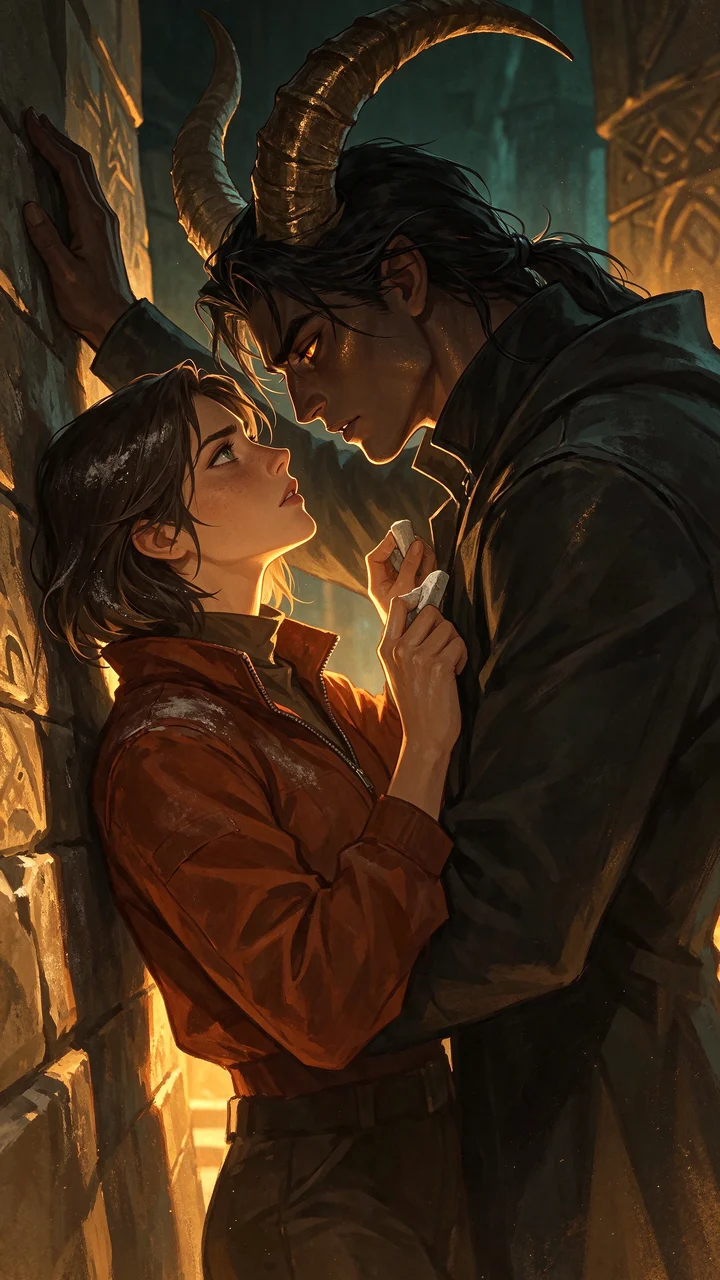
He came slowly. That was the worst of it, the slowness, giving her every inch of chance to change her mind. Her shoulder blades met the wall, and behind her the names were cool and ridged through her jacket. He set one hand on the stone above her head, braced there, his forearm and the leather of the bracer close to her temple. He was so large that he blocked the moon, and his horns threw two curved shadows down across her face.
The knuckle of his other hand found her jaw. He traced it from her ear to her chin, very lightly, as if he were reading one of the names.
She stopped breathing in any sensible way.
“Do you want to say anything?” he asked. His voice was low enough that she felt it more than heard it.
“Not north.”
His thumb came to rest under her chin and tipped it up. She could feel the warmth of his mouth an inch from hers, could smell woodsmoke and iron, could see the amber of his eyes go molten and close. The whole chamber leaned in with them. Even the water held still.
She lifted onto her toes.
The scanner chimed.
Three bright tones, cheerful and loud, ricocheting off two hundred and sixteen names. Then a fourth. Under the open shaft the unit had found the sky, and the auto-upload she’d meant to switch off for a week did exactly what it had been built to do.
Her radio crackled at her hip.
“Sab.” Felix, breathless. “Sab, the full map just landed on Halvern’s server. Blythe’s already got it. They’re loading charges onto the barge at the jetty, I can see the floodlights from here. Sabine, whatever you’re doing down there, get out.”
Ruvan lifted his hand from the wall.
He stepped back. The moon came down over her again, cold and white. He walked to her pack without a word, crouched, and drew the scanner out. It looked small in his hands. Its screen glowed up into his face, and she knew exactly what it showed, because she had loaded the template herself. The grey Halvern Group logo. Under it, in capitals: VARROW. SURVEY FOR DEMOLITION.
He read it. She watched him read it twice.
The walls of the chamber made a sound she had never heard from them. Not grinding. A long, low exhale through every seam.
Ruvan stood, and turned, and held the screen out so its light fell across her.
“Say north, Sabine,” he said quietly, “or tell me the truth.”