
The grey came up slowly over the Wiltshire downs, and with it the cold, and by the time the first light reached the stable roof the breath of every living thing in the yard hung white in the air. Lady Henrietta Ashcombe, thirty-four years old and dressed for riding in a dark green habit that had seen better seasons, stood at the rail of the paddock with her hands tucked into her sleeves and watched Captain Edmund Rowe, thirty-seven, walk his mare down the last furlong of the home field at a walk because the mare had decided, somewhere around the second jump, that she had done enough galloping for one morning.
"You said she was a goer," Henrietta called across the rail.
"She is a goer." Edmund swung down, and the mare put her head at once into the trough as though she had been the wronged party all along. "She goes exactly as far as she pleases and then she stops. It is a kind of going."
"It is a kind of losing, is what it is. I was three lengths up at the hedge and you never closed." Henrietta drew one hand out of her sleeve and looked at it, and then at him. "You owe me a forfeit, Captain."
He looped the reins over the rail and came toward her, and the cold had put colour in his weathered face, and the sun-bleached hair at his temple was damp with the morning. "I know what I owe you," he said. "I have been thinking on it since the hedge."
"Have you, indeed."
"You said, before we mounted, that the loser should pay in the same coin as before." He stopped a little short of her, the way he always did, as though he were still deciding whether he was permitted to come nearer. "I did not take it for a figure of speech."
Henrietta looked at him a long moment. Then she turned and walked toward the tack room, and she did not look back to see whether he followed, because she knew the sound of his boots on the cobbles well enough now to know that he did.
The tack room smelled of neat's-foot oil and cold leather and the dry sweetness of hay. Her groom had been sent down to the village on an errand at first light, and the yard was empty but for the horses, and the horses did not care what was done in the loose box at the end of the row. Henrietta went to the shelf where she had left it and took down the paddle.
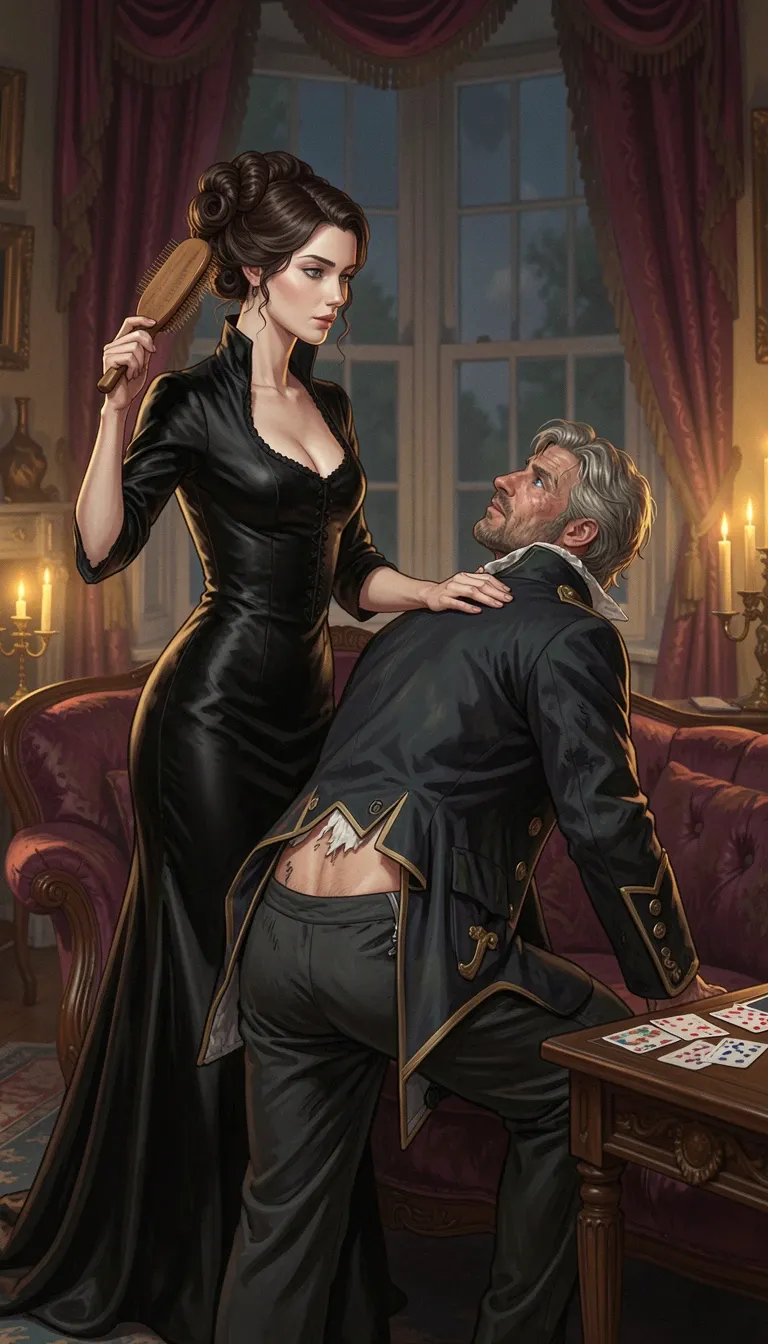
It was new. She had had it made by the saddler in the village, a man who knew better than to ask what it was for, and he had made it well: a flat blade of harness leather, a hand's breadth wide and a little longer than her forearm, the handle bound round in waxed cord so it would not slip in a wet palm. The leather was still pale and stiff, and when she flexed it between her hands it did not give.
"That is a serious piece of goods," Edmund said from the doorway.
"It is." She held it up so the grey light could fall along the blade of it. "The saddler asked me whether it was for a horse or a man, and I told him it was for a man who rides like a sack of turnips, and he said in that case he would make it a little heavier." She turned. "Come here."
He came. There was a bale of hay set against the wall where the groom had left it, and she pointed at it with the paddle and he understood, and he did not pretend not to. He took off his coat and folded it over the rail, and then he stood a moment with his hands at his waistband.
"The word," Henrietta said. "Say it."
"Halt."
"And if I hear it, what happens?"
"Everything stops." He said it without hesitation, the way a man says a thing he has said before and meant. "You stop. I am let up. No question asked, no account to be given after."
"Good." She laid the paddle flat against her palm. "Then take your breeches down and put yourself over the bale."
He did it. The buttons were cold against his fingers, and the wool was cold when it came away, and the air in the loose box was the air of a winter morning, and it found his bare skin and tightened it. He bent over the bale and gripped the far side of it, and the straw ends pricked at his forearms, and he set his feet apart as much as the breeches at his knees would allow and looked at nothing but the boards of the stall.
Henrietta stood behind him and let him wait. She had learned that much. The waiting was half of it, and she had learned it from him, from the way he had knelt in her drawing room and asked for what he wanted in a voice gone gravelly with the shame of asking. She laid the paddle once, lightly, across the back of his thighs, so he would know where it was.
"I am going to give you twelve," she said. "You will count them, and you will thank me for each one, and if you lose the count we begin again at one."
"Yes, my lady."
The first stroke came down flat and hard across the fullest part of him, and the sound of it went off the stall boards like a pistol crack, and the mare in the next box shifted her feet and blew out her breath. Edmund's whole body went taut and his knuckles went white on the straw, and he said, "One. Thank you, my lady."
The second fell a finger's breadth below the first, and the third below that, and by the third a band of red was rising on his backside, warm and even, the colour coming up through the cold white of his skin. He counted. He thanked her each time. His voice was steady at the third and less steady at the fifth.
Between the strokes there was only the sound of the horses and the small creak of the bale as his weight shifted on it, and the sound of his breathing, which was not steady either. Henrietta set the sixth stroke exactly where the red was deepest and he made a low sound in his throat and his hips moved against the bale before he could stop them. She saw it, and she did not remark on it.
"Six," he said. "Thank you, my lady."
"You are doing well," she said. "You are taking it like a man who has been flogged before."
"I have been flogged before." His voice was rough. "Never like this."
She paused with the paddle raised. "How, then?"
"By a bosun with a rope's end, because I was a midshipman who did not know his rigging. There was no counting to it and no thanking, and no one asked me first." He turned his head a little, and she could see the edge of his cheek and the colour in it. "This is a different thing entire."
"It is," she said, and laid the seventh stroke on him, and he counted it, and thanked her, and she found that her own breath had gone short and that she was standing with her weight forward on the balls of her feet, and that she had lost the thread of her counting and found it again.
Eight and nine she gave him slowly, letting the heat of each one settle before the next, and the leather of the paddle was warming in her hand now and the stiffness going out of it, and the marks of it were printing themselves one below another across him in a ladder of red. At the tenth he cried out, not loud, a sound pulled out of him against his will, and his head went down between his arms.
"Ten," he said, muffled. "Thank you, my lady."
"Two more."
"Two more," he agreed, and it was not insolence, it was the voice of a man steadying himself for something he meant to see through.
She gave him the eleventh where the skin was hottest, and the twelfth across the crease of him where the flesh was tenderest, and at the twelfth his whole back arched and he ground himself against the bale and made a sound that was not a word at all. Then he was still, breathing hard, and the red marks stood out on him in the cold air, and Henrietta set the paddle down on the shelf and stood looking at what she had done.
"Twelve," he said at last, when he had his voice. "Thank you, my lady."
"You may get up."
He straightened slowly, and the breeches stayed where they were at his knees. He did not pull them up, and she did not tell him to. He turned to face her and his cock stood up out of the open placket of his shirt, hard and flushed and wet at the tip, and there was straw in his hair and his face was open and shaken and wanting.
"I did not say you might touch it," she said.
His hands, which had started to move, stopped. "No, my lady."
"Put your hands behind your back."
He did. She came and stood close to him and looked at him, at the sweat at his temple and the marks of the bale on his forearms and the cock standing up between them. She let him stand there under her eyes until his breathing had gone ragged with the waiting.
"You lost the race," she said. "And now you have paid the forfeit, and you are still standing there with your breeches down and your hands behind your back like a man who hopes there is more."
"I do hope it."
"I know you do." She stepped back and set her hands to the skirt of her habit and drew it up, and drew it higher, and the cold air came in against her thighs. She felt the wetness of her own wanting cool on her skin. "Kneel down. Not on the floor. On your coat."
He looked at her, and then at the coat folded over the rail, and then at her, and he understood what she meant by it, and he went down onto his knees on the folded wool with his breeches still at his knees and his hands still behind his back, and she came and stood over him with her skirts gathered at her waist.
"Open your mouth," she said, "and put it to me. And keep your hands where they are, or I will paddle you again and you will not enjoy the second twelve half so well."
His mouth was hot and his breath was ragged against her and then his tongue found her. She took the rail behind her with both hands and held on. He was clumsy at first with his hands behind his back and his knees aching on the boards, and then he found his rhythm. She let her head fall back and looked up at the high grey windows and the dust turning in the light and felt his tongue work at her clit and the wet sound of it in the cold air of the stable.
"That is it," she said. "There. Do not stop."
He did not stop. His mouth moved on her and his tongue pressed and circled and his breath came hot through it, and she felt the heat gather low in her and spread, and her thighs began to tremble against his face, and she looked down at him and saw the crown of his sun-bleached head between her skirts and the red marks she had laid on him showing above the waist of his breeches, and the sight of it took her over. She came against his mouth with a sound she did not try to stop, and her hands went white on the rail, and he stayed with her through it, his tongue gentling, until she had to put a hand on his head to still him.
She stood a moment, breathing. Then she said, "Get up. Get up and put me against the stall door."
He got up, and his knees were stiff with the cold boards and he did not care. He took her by the waist and walked her back against the door of the loose box, and the boards were cold through the thin stuff of her shift where her habit had fallen away. He hitched her thigh up over his hip and she felt the head of his cock find her and push. She was so wet that he went into her to the root in one long stroke.
They both of them made a sound at that. He held still a moment with his forehead against hers and his breath coming hard. She felt him thick and hot inside her and the boards of the door at her back and the cold air on the wet of her thighs. She said, "Move, then. You have had your paddling. Now earn your keep."
He moved. The door rattled in its frame at each thrust and the horse in the next box shifted and stamped, and Henrietta got one hand into his hair and held his head down to her shoulder and the other braced against the boards. He fucked her against the stall door with his breeches at his knees and his backside still burning from her paddle, and she could feel the heat of the marks through his shirt where his hip met her leg.
"Harder," she said. "You are not a man who has rowed for twenty years. Harder."
"My lady—"
"I did not ask you to speak. I asked you to fuck me harder."
He did. The door cracked against the frame and the straw dust came down off the beams, and she felt the pressure build again inside her, different this time, deeper. She dug her nails into the back of his neck and heard him grunt and drive harder for it, and the wet sound of him pushing into her was loud in the cold air. She did not care who heard it, there was no one to hear it, there was only the horses and the grey light and the two of them.
She came the second time with her teeth set against his shoulder and her cunt clenching hard around his cock. She felt him feel it, felt him shudder and lose his rhythm and drive once, twice, three times more. Then he held himself deep in her and spent with a sound like a man going under water.
For a while neither of them moved. The door had stopped rattling. Somewhere down the row a horse blew out its breath and stamped, and the cold came in under the eaves, and Henrietta let her head rest back against the boards and looked at the ceiling of the stable and felt him still inside her, softening, and his breath hot and uneven against her throat.
"Well," she said at last, and her voice was not quite steady, and she did not trouble to hide it. "That is one race I am glad to have won."
He lifted his head and looked at her, and there was straw in his hair and his face was flushed and open and he was trying, she could see, to think of something to say that would be worthy of the moment, and failing.
"The saddle," he said. "It will need cleaning. The mare sweated under it."
Henrietta laughed — a real laugh, unguarded, the kind she had not let out of herself in years — and she put her hand flat on his chest and pushed him back a step so she could stand on her own two feet.
"Then clean it," she said, and gathered her skirts and stepped past him out of the loose box into the cold aisle, and left him standing there with his breeches still down around his knees and the marks of her paddle red on him in the grey morning light.