
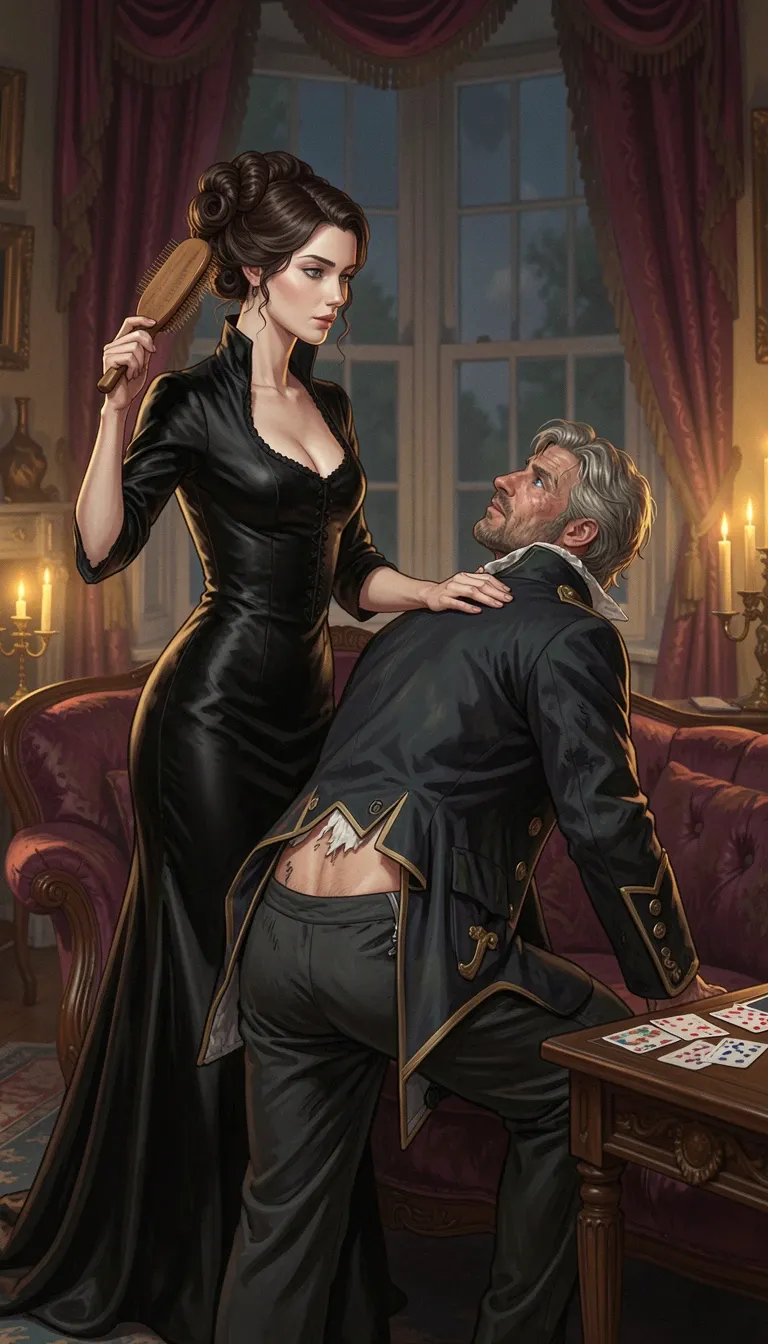
Rain came down on Bath like a sentence being carried out. It had started before noon and by three it had settled into the steady, remorseless rhythm that made the Abbey bells sound muffled and turned every street below the Circus into a channel of brown water. At Ashcombe House the windows of the first-floor bedchamber had fogged at the edges, and the fire, though well fed, could not quite keep the damp from the corners of the room.
Henrietta had chosen the room for the light. It was the only chamber in the house with windows on two walls, and on a wet afternoon the grey came in flat and even from both sides, no shadow anywhere, nothing hidden. She had drawn the curtains back to the hooks herself. She had dismissed the maid at two o'clock and told her not to come up again until the dinner bell.
Then she had taken three things from the locked drawer in her dressing room and laid them on the counterpane, side by side, an inch between them, like instruments on a surgeon's cloth.
The tawse first — a broad, heavy strap of oiled leather, split at the tip into two tongues, the colour of a chestnut in autumn. Then the riding crop, slim and black, its little leather keeper curled at the end, the handle wrapped in braided silk. Then the birch, a bundle of slender switches bound at the grip with red thread, the buds not yet stripped, pale as bone against the dark blue of the quilt.
She stood at the foot of the bed and looked at them for a long moment. Her hands were steady. She noticed this the way one notices a held breath — only when it ends.
At four o'clock exactly, the knock came at the street door below. She heard the housekeeper's voice, and then a man's voice, low and gravelly, saying something that made the housekeeper laugh. Henrietta's mouth tightened. He would charm the whole household before he had his coat off.
She heard the boots on the stairs. Measured. Not hurrying. A man who had learned long ago that hurrying was for men who had something to prove. Then the door opened, and Captain Edmund Rowe came in out of the wet with rain on the shoulders of his dark coat and his hair darkened to the colour of wet straw.
He was thirty-seven years old and he filled the doorway in a way that had nothing to do with his size. The coat was good but old, the cuffs worn soft, and he took off his hat and held it against his chest like a man entering a church.
"Lady Ashcombe," he said.
"You're prompt."
"A captain is either prompt or he is drowned." He glanced past her, and his eyes went to the bed. They stopped there. The hat turned slowly in his hands, once, and then was still.
"Ah," he said.
"Yes." She did not move from the foot of the bed, and she did not look at the counterpane herself. "Come in and close the door. The rain is getting on the floor."
He closed it. The latch went home with a small, definite sound, and the room became a room and not a passage between two others. The rain on the glass grew louder in the absence of the house.
"You've been to a deal of trouble," he said, and came forward until he stood at the other side of the bed, the three implements between them. He looked down at them with the sober, assessing attention he might have given a chart of unfamiliar waters. "The tawse. The crop." His eyes moved. "And the birch. You're not a woman who leaves things to chance."
"I am not."
"The birch is a hard instrument."
"It is." She folded her hands at her waist. "It is also not yet on the table. Sit down, Captain. You look as though you're about to be inspected."
He sat. The chair by the window was a small thing and he filled it, his knees apart, his hat balanced on one of them. The grey light fell across his weathered face and showed her the lines at the corners of his eyes and the small, old scar at his jaw that she had never asked about and never would.
"You'll want to hear the terms again," she said. "Before we begin. I'll not have you say afterward that you were hurried or swept along."
"I remember the terms."
"Say them back to me."
He did not look away from her. "You lead. I follow. I do nothing you have not bid me do, and I say nothing you have not asked me to say. If it becomes too much — if I want it stopped, for any reason, or for no reason at all — I say the word, and it stops, and there is no argument and no accounting afterward." He paused. "And the word is anchor."
"Anchor," she repeated. "Why did you choose it?"
"Because a ship's anchor is the only thing on board that is allowed to say no to the sea."
Something in her chest moved, and she did not permit it to reach her face. "Very good. Now stand up and take off your coat."
He stood. The coat came off and he folded it — carefully, the way a man folds a thing he has had a long time — and laid it over the arm of the chair. Beneath it he wore a plain dark blue coat, and beneath that a waistcoat, and beneath that the linen shirt she had seen last time with the firelight through it.
"The coat as well," she said. "And the waistcoat. And your neckcloth. Leave the shirt."
He undressed by degrees, unhurried, and she watched him do it with her hands still folded. The waistcoat went over the chair back. The neckcloth he loosened and drew off and wound once about his fingers before setting it down, and the gesture — that small, unnecessary coiling — told her more about his nerves than his face did.
"Now come here," she said, "and put your hands on the bedpost."
The bed was a great carved thing, four posts thick as a man's forearm, and the post at the foot nearest the fire was the one she had chosen. He came around the bed to it and set both hands upon it, and she saw his knuckles go pale almost at once, before she had even touched him.
"Higher," she said. "And further down. Bend at the hip, not the waist — I want your back flat and your weight forward. Yes. Like that."
He was bent now over the post, his feet planted, his back long and straight, the linen shirt hanging loose about his hips. She came and stood behind him and set her hand flat between his shoulder blades, and felt him breathe.
"Your breeches," she said.
"You'll have to do it. My hands are occupied."
"Then let go with one."
He let go with his right hand, reached back, and unfastened them, and shoved them down over his hips and thighs until they pooled at his knees. The shirt hung over him and she lifted it clear and laid it up over his back out of the way, and then he was bare from the small of his back to the tops of his thighs, and the grey light found him and showed her everything.
She looked at him for a while. She had not permitted herself to look, last time, in the firelight. Now she did. The broad back tapering to the waist. The pale, unweathered skin below the line of his collar, where the sun had never reached. The muscles of his thighs, standing out with the effort of holding the position. And his backside, pale and bare and steady, waiting.
"You're shaking," she said.
"I'm cold."
"You're not cold."
"No," he said. "I'm not cold."
She went to the bed and took up the tawse. The leather was cool and heavy in her hand, and she folded it once over itself and drew it through her fist to feel the weight of it, the way she had done a hundred times in her own room these past weeks, alone, practising her grip on nothing.
"I will give you twelve with this," she said. "You will count them. If you lose the count, we begin again at one. Do you understand?"
"Yes."
"Yes, what?"
A pause. She watched the back of his neck go red. "Yes, my lady."
"Good. Say your word."
"Anchor."
"Again."
"Anchor."
She set the tawse against his skin, laying it flat across both cheeks, letting him feel the cold of it and the weight of it and the width of what was coming. He went very still. She drew back her arm.
The first stroke landed with a sound like a wet sail cracking in wind, and a red bar came up across his backside before she had drawn her arm back. His whole body jolted against the post. His breath went out of him in a hard, ragged gust.
"One," he said, when he could. "My lady."
She waited. That was the thing she had learned, alone in her room with a strap and a bolster: the stroke was not the punishment. The waiting was. She counted to five in her own head, watching the red bar deepen and the muscles of his back stand out and then slowly, slowly ease.
"Two," she said, and struck.
This one crossed the first, and he made a sound low in his throat that was not quite a word. "Two," he said, after a moment. "My lady."
"You're gripping the post very hard."
"Yes."
"Good. Keep gripping it."
Three. Four. The pause between them grew longer each time, and she used it, watching him, watching the marks come up in parallel lines across his pale skin. By the fifth his breathing had changed — deeper, slower, something loosening in his shoulders that had been tight when he came into the room. By the seventh the sound he made when the leather landed was very nearly a groan of relief.
"Eight," he said, before she had asked. "My lady."
"You're eager now."
"I'm not—" He stopped. His forehead had come down against the post. "I'm not eager. I'm — it is easier, when it comes, than when it waits."
"I know," she said, and struck him again, and he counted nine, and ten, and his voice had gone rough. She laid the eleventh across the tops of his thighs, where the skin was softest, and he cried out — a short, sharp, unguarded sound — and then said, "Eleven, my lady," very fast, as though afraid of losing it.
She stood with the tawse raised for the last one and found that her own breath had gone uneven. She had not expected that. Her arm was trembling, faintly, and there was a heat in her face and between her legs that had nothing to do with the fire. She looked at the marks she had made on him — twelve red bars, some darkening already toward bruise — and at his hands, white-knuckled on the post, and at the back of his neck, bent, waiting, trusting.
"Twelve," she said, and struck, and it was the hardest of them all.
"Twelve." His voice cracked on it. "My lady. Twelve."
She lowered the tawse and stood still, and the rain filled the silence. He did not move from the post. His back was heaving, and his thighs were shaking, and he had not let go.
"You may stand up," she said.
"In a moment."
"No. Now. I want to look at you."
He straightened, slowly, one hand still on the post, and turned to face her. His breeches were still down about his knees. His cock stood out from the open fall of them, hard and flushed and wet at the tip. He did not try to hide it, and she did not pretend not to see it. His face was flushed and his eyes were bright and there was something in them she had not seen there before — not gratitude, not shame. Something quieter and more dangerous.
"Turn round," she said. "Hands on the post."
He turned. He bent. His hands closed on the wood again, and she saw the marks she had left and the way his shoulders had gone loose now, the way a man's shoulders go when he has stopped fighting something.
She went to the bed and set down the tawse and took up the riding crop. The black shaft was light in her hand, the keeper at the tip curled like a little tongue. She flexed it once, and it whistled faintly, and she saw him flinch at the sound of it — not from fear, she thought. From want.
"This is a different instrument," she said. "It bites. It will not leave you the way the strap does. Do you want it?"
"Yes."
"Say the whole of it."
"I want it, my lady."
She laid the keeper against the red marks on his backside, very lightly, and drew it down the length of him in a slow line. He shuddered. The crop left a thin white track through the redness that faded almost as soon as it appeared.
"You will not count these," she said. "You will tell me what you feel. If you cannot speak, you will say anchor and I will stop, and you will not be thought less of. Do you understand?"
"I understand."
"Then say your word."
"Anchor."
The first cut of the crop was a thin, bright line of fire across the fullest part of his backside, and the sound of it was nothing like the tawse — a sharp, small crack, like a twig breaking underfoot. He gasped. His hips jerked forward into the bedpost and he caught himself.
"It burns," he said. "God. It burns."
"Where?"
"Everywhere. It — it goes deeper than the strap. It's still burning."
She waited, and watched the thin line rise white and then red, and then she struck again, lower, across the tops of his thighs. His whole body bowed. He made a sound that was almost a laugh and almost a sob.
"That one was worse," he said. "My lady. That one — the skin is thinner there."
"Yes."
"You knew that."
"I knew that."
She gave him six more, spaced wide, and by the fourth his answers had stopped being words and had become something else — a low, continuous sound, a kind of humming under his breath that she recognized from the last time, from the moment before he had broken. His hands had gone from white-knuckled to simply holding on. His backside was a lattice of red lines now, the strap-marks and the crop-marks crossing one another, and it was the most beautiful thing she had ever made.
She set the crop down on the counterpane beside the birch, which she did not touch, and stood looking at him for a moment with her heart going hard in her chest. Then she came up behind him and set her hands on his marked skin, one on each cheek, and felt the heat of it against her palms. He hissed through his teeth.
"Too much?" she said.
"No." His voice was wrecked. "No. Don't take your hands away."
She did not take them away. She held him, and felt the heat of what she had done to him, and slid one hand down between his thighs from behind and found his cock. He was so hard that it jumped at the first touch of her fingers and he groaned and pushed back into her hand.
"You're dripping," she said.
"I have been since the first stroke."
"Then you may let go of the post and get on the bed."
He let go. He turned, and his breeches were still about his knees, and he kicked them off and got onto the bed on his hands and knees, and then she caught him by the hip and turned him onto his back, and he went willingly, his marked backside pressed into the quilt and his cock standing up from his belly.
She stood at the foot of the bed and looked at him — thirty-seven years old, weathered, scarred, a man who had commanded ships through cannon fire — lying open and waiting on her bed with her marks on his skin, and she felt the last of her composure go out of her like water out of a cracked jug.
"You will not come until I tell you," she said, and her voice was not quite steady, and she did not care.
"No, my lady."
She climbed onto the bed and straddled him, and her skirts were in the way. She cursed them under her breath and gathered them up and shoved them out of the way. He put his hands on her thighs and she let him. She reached down between them and took hold of his cock and guided it. She was so wet already that he slid into her at the first push, all the way to the root, and they both made a sound at once.
She sat still for a moment, full of him, her hands braced on his chest, and looked down at his face. His eyes were open and fixed on her. His mouth was open. His hands had come to her hips and were gripping them, hard, and she could feel the effort in them — the effort of not moving, of waiting for her.
"Good," she said. "You're learning."
She began to move. Slowly at first, rising and settling, feeling him stretch her and fill her, the wet sound of it loud in the quiet room. His hips came up to meet her and she stopped at once and he stopped, breathing hard. She said, "No," and he said, "I'm sorry, my lady," and she began again.
She rode him. She had not done this in seven years. She had forgotten — or she had not forgotten, she had simply not let herself remember — how it felt to have a man inside her and beneath her and entirely at her disposal. His hands stayed on her hips and his eyes stayed on her face and every time she came down he made a low sound in his chest that she felt in her own body. She found the rhythm she wanted and kept it, and her breath came faster, and her thighs began to burn.
"My lady," he said, and his voice was strained thin. "I cannot—"
"You can. You will." She leaned down over him, her hair coming loose from its pins, and put her mouth near his ear. "You will wait until I have finished, Captain, and then you may spend inside me, and not a moment before."
He made a sound like a man taking a blow. His hands tightened on her hips, and she felt him gather himself beneath her, felt the whole disciplined weight of him holding still, and it was that — the control, the obedience, the man holding himself back by main force for her — that tipped her over.
She came with her hands braced on his chest and her back arched and her mouth open, clenching tight around him, and the sound she made was not a dignified sound. His hips bucked up into her once, twice, and then he was coming too, his cock pulsing inside her, his hands hard on her hips, a broken, grateful noise tearing out of him. She rode it out on top of him until her thighs gave way and she came down onto his chest.
For a while neither of them moved. The rain went on against the windows. Somewhere below in the house a door closed. Her cheek was against his shoulder and she could hear his heart going under her ear, slowing, beat by beat, like a tide going out.
He cleared his throat. "My lady."
"Mm."
"I have come inside you."
"You have."
"I did not ask leave to do it in so many words."
She lifted her head and looked at him. His face was open and flushed and there was a small, anxious crease between his brows. She wanted, quite badly, to laugh, and she did not, because she understood what it had cost him to say it.
"You did not need to ask," she said. "I told you to. You did as you were told. That is the whole of it." She laid her head back down. "You did very well, Captain."
His arms came up around her and held her there, and she let him, and the rain went on, and the riding crop lay on the counterpane beside the birch rod she had not yet used.