
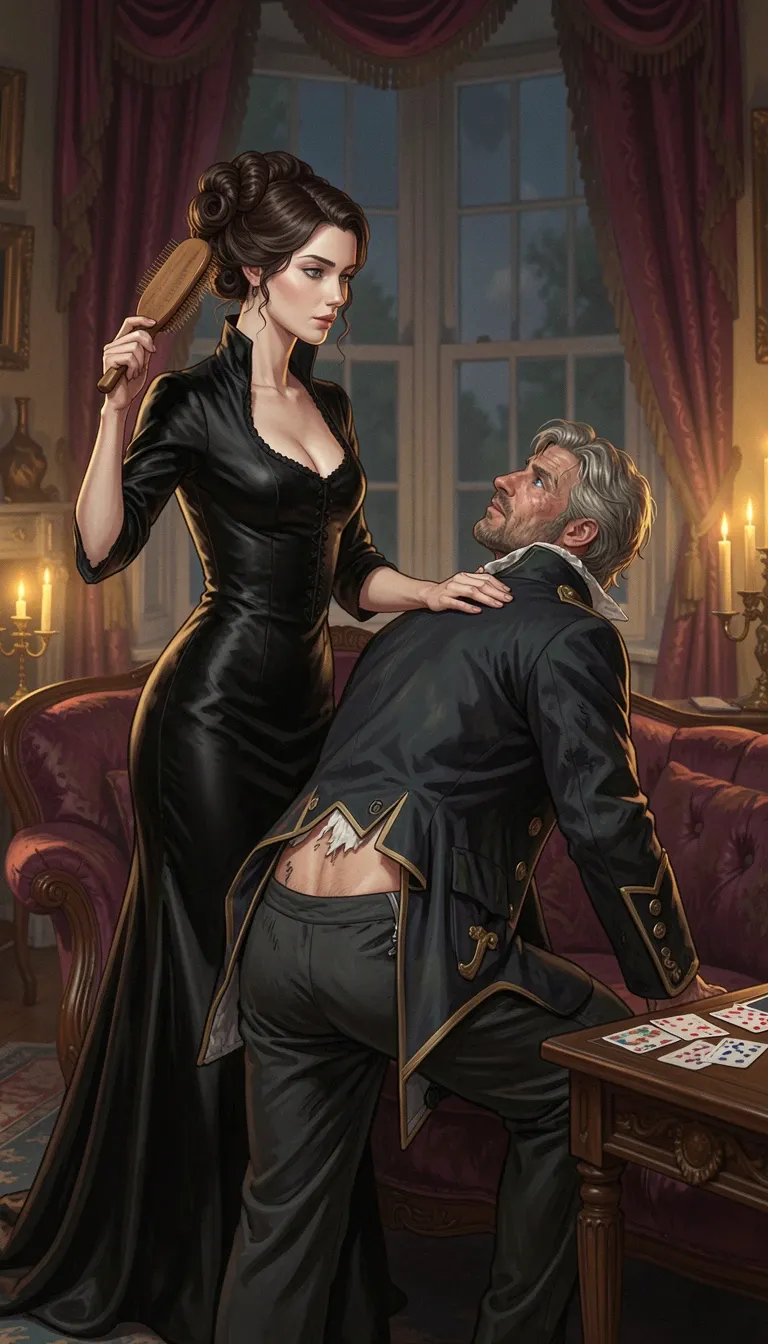
Lady Henrietta Ashcombe was thirty-four years old, and she had spent the better part of the evening pretending not to watch a woman from Brighton laugh.
The laugh carried — it was the kind that turned heads, high and musical and entirely too pleased with itself, and it had been carrying all night from the faro table where the widow Mrs. Pemberton sat with her fan and her dimples and her hand forever finding the sleeve of the captain beside her. Henrietta had borne it through two rubber of whist and a glass of ratafia she had not wanted, and she bore it still as she made her way down the corridor behind the ballroom, past the card room's open door, where that laugh rang out again like a dropped spoon.
She did not look in. She had looked in enough.
The retiring room off the Assembly Rooms' east corridor was meant for ladies — for the repair of hems and tempers, for the quiet minute a woman sometimes needed between one dance and the next. It was dark when Henrietta pushed the door open, the fire banked low, one branch of candles guttering on the mantel and throwing the rest of the small room into a brown hush. Chairs along the wall. A pier glass. A little table with a decanter and a clutter of pins.
And Captain Edmund Rowe, standing by the window with his back to her, his coat off, his cravat hanging loose.
She stopped with her hand on the door. Behind her, muffled through two walls, the Brighton laugh went up again.
"You are in the ladies' retiring room," she said.
"I am aware." He did not turn. "I checked first. It was empty. It has been empty for a quarter of an hour, which is how long I have been standing here, being a coward."
Henrietta closed the door behind her. The latch clicked, and the ballroom went away — the violins to a murmur, the laugh to nothing, the whole bright noisy world of Bath reduced to a line of light under the door. She crossed to the table and set down her fan, and only then did she look at him properly.
His shoulders were set the way they were set in a squall. His hands were clasped behind his back. He was thirty-seven years old and he stood like a boy sent to the headmaster, and she felt the old, familiar, dangerous stirring that had been her ruin and her pleasure since the first night he had sat down at her card table and lost.
"Mrs. Pemberton," she said, "has a very carrying voice."
"She does."
"She was on your arm at supper."
"She was on my arm because you were not." Now he turned. The candlelight caught the weathered plane of his cheek, the sun-bleached hair going grey at the temple, the dark blue eyes that had been looking at the sea for twenty years and now looked at her. "You sat at the other end of the table and dealt cards and smiled at Mr. Ellery, and I thought, she will not care. And then I thought, she will care. And then I did not know which I wanted, and so I—"
"Provoked me."
"Yes."
"With a widow."
"With a widow," he agreed, "who talks of nothing but her late husband's fortune and her little dog, and whom I could not have seduced if I had a year and a map." He let out a breath. "It worked, then. That you are here."
Henrietta took her time. She drew off one glove, then the other, and laid them on the table beside her fan — the silk still warm from her hands, the fingers curled as though she had just let go of something. Then she turned back to him and folded her bare hands at her waist.
"You are owed a debt," she said. "From the card table. I have not forgotten."
"Nor have I."
"And now you have added to it. You have made a scene in a public room and made me watch it, and you have come skulking into a ladies' room to be found, because you could not bring yourself to knock on my door like a man and say what you wanted." She let the silence sit. "That is two debts, Captain."
He swallowed. She watched his throat move above the loose cravat.
"Say the word," she said. "The one I taught you. Say it now, before we begin, and say it clearly."
"Halt." His voice was low and rough, and it did not waver. "If I say halt, everything stops. At once. No matter what."
"Good." She crossed the room to the chairs along the wall and drew one out — a plain thing, walnut, with arms worn smooth by a hundred ladies' hands. She set it in the middle of the floor, facing the pier glass, and turned it so that he would see himself in it when he was bent across her knee. "You will not say it unless you mean it. If you say it out of pride, I will know, and I will not forgive it. Do you understand?"
"I understand."
"Then take off your breeches and come here."
He did not move at once. He stood a moment with his hands at his sides. She saw him make the choice — saw the pride go through him like a swallowed stone, and the hunger rise up after it — and then his fingers went to his waistband. The buttons gave one by one. The wool slid down his thighs and pooled at his ankles. He stepped out of it, and stood in his shirt and stockings with his cock already half-risen against his belly, and the sight of it made her mouth go dry.
"To the chair," she said. "Bend over the arm. Palms flat on the seat."
He went. The chair creaked as he folded himself over it, his chest against the seat, his palms braced flat, his bare backside raised and offered to the dark room. In the pier glass she could see his face turned sideways — the candlelight on his cheekbone, his eyes fixed on her reflection. His breeches lay around his feet like shed skin.
Henrietta took her time coming to him. She walked around the chair once, slowly, and let him wait, and watched the muscles of his back go tight with the waiting. Then she set her bare palm flat on the small of his back, just above the curve of his arse, and felt him shiver under her hand.
"Count them," she said. "Out loud. If you lose count, we begin again."
"Yes."
"Yes, my lady."
She raised her hand and brought it down.
The sound was flat and sharp in the little room, and the red print bloomed up on the white skin of his left cheek before he had finished his breath. "One," he said, and his voice had already changed — lower, worked in his chest. She struck the other cheek. "Two." Then left, harder, and the print went darker. "Three." Her palm stung and she liked it; she liked the heat of it, the way the flesh gave and sprang back under her hand, the way his shoulders were beginning to shake. "Four."
She found a rhythm. Not fast — she had no wish to be done quickly — but steady, one cheek and then the other, her hand falling with a flat crack that made the guttering candles tremble, and between the blows she let her palm rest a moment on the hot, reddened skin, feeling it. "Five. Six. Seven." His voice was ragged now. His fingers had curled against the chair seat, white at the knuckles, and his breath came in short pulls through his nose, and in the pier glass she watched his face and saw his eyes had gone unfocused, half-closed, the way a man's eyes go when the pain has turned to something else.
"Eight." The crack of it. "Nine." Her own breath had quickened and she did not trouble to hide it. Under the thin lawn of his shirt his back was slick with a fine sweat, and lower, where the shirt had ridden up, his cock stood out from his body, hard and flushed and wet at the tip, and every blow made it jerk against his belly.
"Ten," he said, and his voice cracked on it.
She stopped. Her palm was burning, the skin of it hot and tender, and she laid it flat and still on the hottest, reddest part of him and felt him flinch and then press back into her hand.
"Look at me," she said. He found her in the glass, his eyes dark and dazed. "The spanking was the first payment. It is not the whole of the debt." She let her hand stay where it was, warm and heavy. "You will pay the rest before you leave this room. Do you understand me, Captain?"
He did not answer at once. His breathing was loud in the quiet, and the red print of her hand was rising on his skin, and his cock hung between his thighs, leaking, patient, and his eyes on her reflection said everything his mouth had not yet found.
"Yes," he said at last, hoarse. "My lady."
She let him have the silence a moment longer than was kind. Her hand stayed where it was, flat on the heat of him, and she could feel the pulse going through his skin — not the quick shallow beat of a frightened man but the slow heavy thud of one holding himself still by main force. Under her palm his back rose and fell. The candle on the mantel spat once and settled.
"Then stand up," she said, and took her hand away.
He came up slowly, one hand on the chair arm, and the chair scraped a half-inch on the boards. His shirt had rucked itself into a twist at his waist; he did not touch it. His breeches still lay in their pool at his feet and he stepped clear of them without looking down, and stood before her in his stockings with his shirttail hanging and his cock standing up ruddy and blunt from a nest of dark hair, and a sheen of sweat across his chest where the lawn clung to it.
Henrietta walked to the little table. The decanter stood there, and the clutter of pins, and her fan, and her gloves. She picked up the right-hand glove and turned it over, and the silk lay across her fingers, cool now, the wrist still faintly warm where it had held her pulse all evening. She considered it a moment. A glove was a small thing, and a woman's glove was smaller still, and there was a kind of arithmetic in it that pleased her.
"You will not spend on the floor," she said, without turning. "And you will not spend on yourself. You will spend in this, and then you will give it back to me, and I will keep it."
He made a sound low in his throat. "My lady—"
"Is that a protest?"
"No." The word came out fast and rough. "No. It is — I have been hard since you took off your first glove. Since before. Since you came through that door with your chin up and the Brighton woman's laugh still in the room behind you."
"I know when you have been hard, Captain. I am not blind." She turned. "Sit. The chair. Sit square, feet flat, hands at your sides, and do not move them unless I say."
He sat. It was a smaller chair than a man of his shoulders had any business in, and he looked enormous in it, his knees apart, his hands flat on the wood at his thighs as though he did not quite trust them. The red of the spanking showed at the edges where he had settled back against the seat. He shifted once, and his jaw tightened, and then he was still.
Henrietta came and stood between his knees. She had not put the glove on. She held it loosely by the fingers, and she looked down at him — at the sun-bleached hair, and the grey coming in at his temple, and the mouth that had been so careful all evening and was not careful now — and she felt the old fierce tenderness come up under her sternness like a tide under a boat, and she did not let it show.
"You will look at me," she said. "Not at the door, not at your own cock, not at the glass. At me. If you look away I will stop, and you will sit here in the dark with it and think about why."
"I will look at you."
"You will also tell me the truth when I ask. If it is too much, you will say halt, and I will stop, and there will be no shame in it and no argument from me. If it is not too much, you will say the other thing. Do you remember the other thing?"
"More," he said. His eyes did not leave hers. "I say more, and you give me more."
"Good." She laid the glove flat across her palm and closed her hand around his cock.
He jerked as though she had put a live coal to him. The silk was thin and smooth and a little cool. She drew it down over the head of him and the wetness there soaked through the stuff at once, a dark bloom spreading on the pale glove. She felt him swell and stiffen in her grip as if the whole length of him had taken a breath. His hands stayed flat at his thighs. His knuckles had gone pale.
"Breathe," she said.
He breathed. It came out of him ragged.
She began to move her hand — slow, the silk sliding, her fingers closed firm around the shaft and her thumb finding the ridge under the head each time she came up. It was not a gentle thing and she did not mean it to be. The silk made a small wet sound in the quiet, and beneath it the creak of the chair as his body fought to stay still, and his breath coming faster and more broken, and once — when she twisted her wrist at the top of the stroke — a groan that he tried to swallow and could not.
"Do not swallow it," she said. "I want to hear you. There is a ball going on through that wall and nobody in Bath is listening to this room, and if you are quiet I will think you are not grateful."
"Grateful," he said, and his voice had gone to gravel. "My lady, I am — God — I am grateful."
"Then show me."
She quickened. Not much — enough to make him work for it, enough that he had to hold his hips still against the chair and could not, quite, and the chair complained under him. The glove was soaked through now and clinging to her fingers, and the wet sound of it had gone obscene. She watched his face the way she watched a man's cards across a table — for the tell, for the moment the bluff gave way. His eyes had gone glassy. His mouth was open. The tendon in his neck stood out like a rope.
"There is a hairbrush," she said, conversationally, "on that table. I have thought of it. I thought of it while I was striking you, and I thought of it now." Her hand never stopped. "You will not have it tonight. Tonight you will have my hand and this glove and my voice, and you will be grateful for the small mercies. But you will think about the brush when you are lying alone in your bed. You will think about it and you will not know when I mean to use it, and that not-knowing will do more to you than the wood ever could. Do you understand?"
"Yes." The word broke in the middle. "Yes — my lady — please—"
"Please what?"
"Please let me—"
"Say it properly."
He looked at her. There was no pride left in his face at all, and what was there instead was raw and open and entirely hers. "Please let me spend, my lady."
"There," she said. "Was that so hard."
She gave him her hand faster, and harder, and did not look away from him. He came with a sound that started low and climbed — her name, and then no name at all, just breath — his hips lifting clear of the chair at last, his hands coming up off his thighs before he remembered and gripping the arms of the chair instead, white-knuckled, as the first thick pulse of it went into the silk and soaked it through and the second followed and the third. She worked him through it steadily, unhurried, until he sagged back and his head fell against the chair's high back and his chest heaved like a man come up from deep water.
The room smelled of him. Salt and sweat and the wet musk of it, and under that the lavender water she wore, and the guttered tallow of the candles.
Henrietta drew the glove away. It was ruined — heavy and warm and dripping, the silk gone translucent where it had taken him. She held it up a moment in the candlelight and looked at it with the same cool consideration she gave a losing hand. Then she folded it, once, carefully, and tucked it into her sleeve.
"You may have your breeches," she said. "In a moment. When your legs will hold you."
He laughed — a wrecked, disbelieving sound — and did not open his eyes. "You are a hard woman, Lady Ashcombe."
"I am a fair one," she said. "Which is worse." She set her bare hand flat on his chest, over the heart still hammering under the lawn, and felt it slow beneath her palm, beat by beat, like a tide going out. "Now. Tell me the truth. Was it too much?"
He opened his eyes and looked at her, and his hand came up at last and closed over hers where it lay. "No," he said. "It was not enough."