
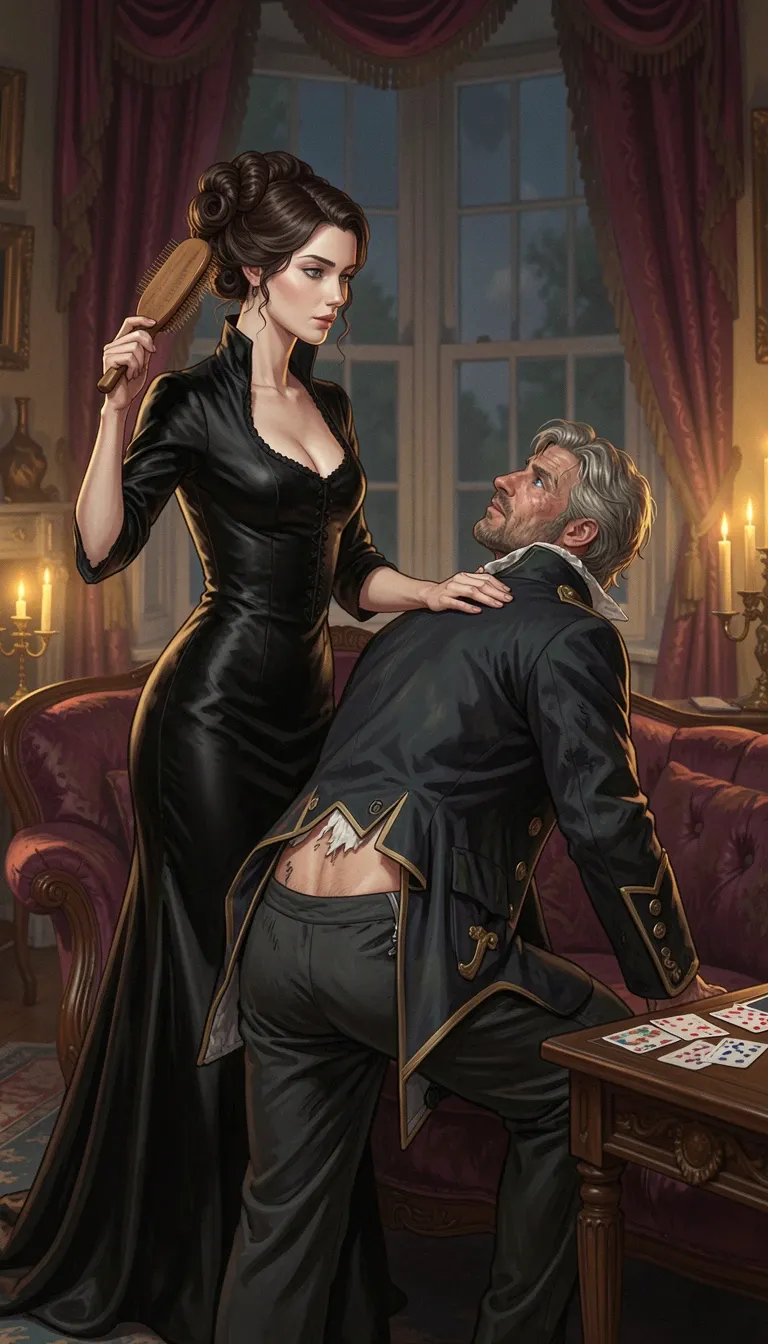
The hairbrush lay face-up on the dressing table, silver-backed, the bristles combed clean of the morning's dust. Henrietta had set it there before she lit the candles, and now she sat before it in her wrapper, her hair down her back in a dark rope, and watched the fire make its slow work of the coals. Thirty-four years old, a widow of seven, and she had not spent an evening in this room with a man since her husband's coffin went into the ground at St. Swithin's.
She heard him on the stairs. The boards of Ashcombe House were old and honest and told her everything — his boot on the third step, the pause at the landing where the window looked out over the roofs, the last flight taken slower than the first. Then his knock, two knuckles, the way a man knocked who had already been told to come in and was giving her the courtesy of pretending otherwise.
"Enter."
Edmund Rowe filled the doorway. He had come in his shore coat and plain breeches, no uniform, no epaulettes — a man who had left the Navy in his dress and was not yet certain what to wear instead. Thirty-seven years old, sun-bleached hair combed wet, the weathered face above it carefully still. His dark blue eyes went, as she had known they would, straight to the dressing table. To the brush.
"You've set it out," he said.
"I have. Shut the door."
He shut it. The latch clicked and the room got smaller by half. Henrietta rose and crossed to him, and she did not stop at a decent distance; she stopped close enough to smell the soap on his jaw and the salt that never quite left a sailor's skin, and she put her hand flat on his chest and felt his heart going under her palm like a caught bird.
"Your ship," she said. "When?"
"Thursday's tide. I must be in Bristol by Wednesday night." He swallowed. "The Perseverance. She's had her refit and she'll not wait on a captain who dawdles in Bath."
"No. She won't." Henrietta let her hand stay where it was. "So tonight is an accounting. You owe me a hundred strokes of that brush, Captain, and I mean to have them before you go. After that we shall discuss what you owe me besides."
"A hundred." He said it without flinching, which she noted. "You'll want the word."
"I'll want the word." She stepped back and looked up at him, and her grey eyes did not soften. "Say it."
"Anchor."
"Again. And mean it."
"Anchor." His voice was low and gravelly and steady. "If it grows past what I can bear, I say anchor, and you stop. No argument, no shame in it."
"And I say it also," Henrietta said. "If I judge you have taken enough, I will say it, and you will not argue with me either. That is the whole of the bargain. Both of us may call it. Neither of us may grudge it."
"Agreed."
She turned away and went to the chair she had set out — a plain mahogany chair with a low back and a seat worn smooth — and she sat, and arranged her wrapper over her knees, and held out her hand. "Your breeches. Folded. Over the chair-back, not dropped on my floor."
He did it. Unbuttoned, stepped out, folded them with a sailor's neatness and hung them over the chair-back, and stood before her in his shirt and stockings with his cock already half-risen and his face carefully composed, and Henrietta felt the old quiet satisfaction of a woman who has been obeyed exactly.
"Over my lap," she said. "You know how."
He came down across her knees, and she took a moment to arrange him — his chest on the cushion, his hands braced on the floor, his backside lifted and bare and already showing the pale ghost of the morning's paddle-work across the fullness of it. She laid her palm flat between his shoulder blades, felt him breathe, felt the breath go out of him and not come back in a hurry.
"A hundred," she said. "I shall count them aloud. You will not count. You will not speak unless it is the word. Do you understand?"
"Yes, my lady."
The first stroke was light. She brought the flat of the brush down on the meat of his left cheek and it made a sound like a hand clap in a small room, and he twitched, and she said, "One."
The second fell on the right. "Two." The third across both, a shade harder. "Three." By ten his skin was going pink and he had stopped bracing so rigidly and had begun, instead, to breathe in time with the strokes, a low sound in his throat on each one that he was too proud to let out whole. By twenty the pink had gone to a hot even red and the sound was not in his throat any longer but in his chest.
"Twenty-one," she said, and struck, and watched the red bloom under the silver back of the brush. "Twenty-two." The fire had burned down to a low orange and the candle branch on the table guttered and spat. "Twenty-three."
"My lady—"
"That is not the word." The brush came down. "Twenty-four."
He put his forehead down on the cushion and his hands knotted in the stuff of it and he did not speak again. She worked him steadily, no hurry, no cruelty in it either — a woman keeping an honest count, letting the sting build and settle and build again so that he felt every one of them instead of losing them in a blur. His backside was a deep even crimson now, hot to look at, and when she laid her free hand on the small of his back she could feel the heat coming off him like a brick out of a kiln.
"Forty," she said. "Forty-one." The brush cracked down and he jerked and a sound came out of him that was not quite a word. "Forty-two. You are doing well, Captain. Do not mistake me. You are doing very well."
"I—" His voice was wrecked. "I did not think—"
"You did not think it would be a hundred. I know." Stroke. "Fifty. Nor did I, when I first set it out. But a hundred is what you asked for, in your pride, and a hundred is what you shall have, and you will thank me for it after, and mean it." Stroke. "Fifty-one."
The candle guttered and nearly went out and Henrietta did not get up to tend it. She kept the count. Sixty came and went, and seventy, and somewhere past seventy his breathing changed and his hips began to move against her thigh, a small helpless press and release that he could not have stopped if he had tried. She felt the wet heat of his cock against her knee through the silk of her wrapper and did not remark on it.
"Seventy-five," she said. "Seventy-six. You may spend if you must, Captain. It will not shorten the count."
"I don't— I can't—"
"You can. You will not, until I have finished. Seventy-seven."
He groaned into the cushion and held, and she struck him again and again, and the room was nothing but the sound of the brush and the sound he made and the silence after each one, and the fire hissing low, and her own voice keeping the tally like a woman counting coin. Eighty. Eighty-five. Ninety.
"Ninety-one," she said. "Ninety-two." His backside was scarlet and she had begun to strike the tops of his thighs where the skin was tenderest, and he was shaking now, all over, the way a rope shakes when the strain comes on it. "Ninety-three. Ninety-four. You are nearly there, Edmund. Hold."
"Ninety-five," she said. "Ninety-six. Ninety-seven." The brush came down and he sobbed, one short broken sound, and did not say the word. "Ninety-eight. Ninety-nine."
She held the brush up a moment, let him feel the waiting, let the whole room feel it. Then she brought it down across the crimson of him with all the weight of her arm. "One hundred."
He went limp. All of him at once, the way a sail goes slack when the wind dies, and she set the brush down on the floor beside the chair and put both her hands on him and held him there across her knees while he shook. The candle guttered out. The fire was coals. In the dark her palm moved slow and steady down the burning length of his back and he wept against her thigh, quietly, the way a man weeps when he has not done it in years and has forgotten the shape of it.
"There," she said. "There. It is done. You took every one of them, and you did not call the word, and I am proud of you." She let her hand rest at the nape of his neck. "Now. Up. On the bed, on your back. I have a use for that mouth of yours, and then I have a use for the rest of you, and you will not spend until I give you leave. Say it."
"I will not spend until you give me leave." His voice was raw and thick and he was already moving, already turning over, already obedient. He got himself onto the bed and lay back against the pillows, and in the last of the firelight she saw his face — flushed, wet about the eyes, open in a way she had never seen it in the card room or the retiring room or the loose box in the mews.
Henrietta stood, and untied her wrapper, and let it fall. She was thirty-four and had not been naked before a man in seven years. She did not look away from him as she climbed onto the bed and straddled his chest and brought her cunt down over his mouth. "There," she said. "Lick. And mind your tongue — I want the flat of it, not the point."
He licked. She felt the flat warm sweep of it up her whole length and her thighs tightened on his ears and her hand went into his sun-bleached hair and held him where she wanted him. "Again. Slower. There — just there, do not move from there." His tongue found her clit and stayed, and she rode his mouth in a slow rocking that she set. He could not hurry, and the wet sound of it filled the room under her breath and his. "Good. Good. Do not stop."
It came up on her faster than she had expected. Seven years of nothing, and then his mouth, and her hips had gone out of her control and were grinding down on his face. She was gripping the headboard with one hand and his hair with the other and saying his name — Edmund, Edmund. Then she came, clenching, her cunt pulsing against his tongue, and she felt him groan against her with his own need. She did not let him up until the last of it had run through her and her thighs had stopped shaking.
"Enough," she said, and lifted off him, and looked down at his wet shining face. "Now you may have what you have been holding for a hundred strokes." She moved down his body and took his cock in her hand — hard, hot, leaking at the tip. She smeared the wet over the head of it with her thumb and watched his whole body arch. "You will not spend until I say. You will look at me while I ride you."
"My lady—"
"Look at me." She sank down on him. He filled her in one long slow push and her cunt stretched and clenched around him. She heard herself make a sound she had not made in years. "Ah. There. Do not move. Let me have you." She rode him slow at first, her hands braced on his chest, and his hands came up to her hips and she let them stay. Then faster, her thighs working, the slap of her body on his and the wet sound of her cunt taking him, and his face beneath her was all she had wanted it to be — wrecked, adoring, and holding, holding, holding.
"Now," she said. "Spend. Inside me. Now."
He came with a sound that was half her name and half something older, his hips driving up into her, his cock pulsing and spilling inside her. She rode him through it and felt the heat of it flood her and did not stop until he was spent and shaking and his hands had fallen away from her hips.
She stayed where she was a moment, looking down at him. Then she lifted off and lay down beside him in the dark and put her head on his shoulder, and for a while neither of them said anything at all.
"Edmund," she said at last. "The Perseverance sails Thursday."
"It does."
"Then come back from this voyage and marry me." She said it into his shoulder, plainly, the way she said everything that mattered. "The hairbrush included. I have no intention of giving it up, and I have no intention of giving you up either, and I am too old to pretend otherwise."
He was quiet for so long that she thought she had misjudged it. Then his arm came around her and his hand found her hair and he turned his head and kissed her forehead, and his voice, when it came, was as wrecked as it had been at the hundredth stroke.
"Yes," he said. "God help me. Yes."
She had not expected the yes. She had braced for a laugh, or a long silence, or the careful voice of a man explaining why a captain with a ship and a widow with a house could not make a marriage of it. What she got was his hand in her hair and his mouth on her forehead and that ragged God help me, and Henrietta found that her eyes had gone hot and her throat had closed, and she lay still against his shoulder and let the wetness gather at the corner of her eye and did not wipe it away, because the room was dark and he could not see it and she did not have to be the widow with the sharp tongue for one more minute.
"You are crying," he said.
"I am not." Her voice came out steady enough. "I am perspiring. It is a warm night."
His chest moved under her cheek — a laugh, silent. His fingers worked slowly through the rope of her hair, unpicking it where it had come loose, and she felt the pins give way one by one and her hair come down over his arm and her own shoulder. "Aye," he said. "Warm."
She lay there until her breath had evened, and then she pushed herself up on one elbow and looked down at him — really looked, in the last of the firelight, at the wet eyes and the flushed cheeks and the mouth still faintly shining with her. "Do not think," she said, "that this alters the terms. You are still going to sea on Thursday. I am still going to keep the brush on that table, and you are still going to feel it when you sit down to sign your ship's papers."
"I had not supposed otherwise."
"Good." She reached down and closed her hand around his cock, which lay softened and wet against his thigh, and felt it twitch at her touch. "And I am not finished with you tonight. I said I had a use for the rest of you."
"My lady, I—" He caught his breath as her thumb dragged over the head of it, the wet smear of his own seed still on him. "I do not know that I can."
"You can." She bent and put her mouth to the side of his throat, just under the jaw, where the old scar ran, and she did not kiss the scar itself, only the skin beside it. "You are a captain of a king's ship. You have brought her through worse weather than this. Now put your hands on the headboard."
He put them there. She watched the muscles of his back and shoulders take the strain as he reached up and gripped the rail, and the sight of it — his body stretched out beneath her, offered up, his cock already thickening again against his belly — sent a slow heat down through her. She straddled him, her knees on either side of his hips, and did not take him inside her yet. She took him in her hand and stroked him, slow and firm, root to tip, and watched his face.
"Look at me," she said. "You will not close your eyes."
"I am looking."
"You are looking at the ceiling." She tightened her grip and his hips jerked and a sound came out of him that was not a word. "There. Now look at me."
His dark blue eyes came down to hers and stayed, and she held them while she worked him. He was hard again now, hard and hot and leaking, and every stroke of her hand pulled a breath out of him and then another. She could see him fighting to keep his gaze steady and losing the fight by degrees. "That is the mouth I want," she said. "Not the one that gives orders on a quarterdeck. That one. Open."
"Christ, Henrietta—"
"My lady."
"My lady." It came out of him broken. "My lady, please—"
"Please what?"
He could not say it. She watched him try and fail and try again. Then she took pity on him, or perhaps not pity — she took him inside her, one long slow sink down his length, and his hands came off the headboard and knotted in the sheet on either side of him. He made a sound like a man going under water.
"Ah," she said. "There." Her cunt stretched around him, wet and tight and full. She sat still a moment and let him feel the whole of her. "You will keep your hands where they are. You will not touch me unless I tell you. And you will not spend until I say."
"And you?" His voice was thin. "Will you—"
"I intend to." She began to move, a slow roll of her hips, and her own breath caught at how deep it took him. "But not until I have had my money's worth out of you. Do you understand?"
"Yes. My lady. Yes."
She rode him. Slow at first, her hands flat on his chest, feeling his heart go under her palm again like that caught bird, and then harder, her thighs working, the wet slap of her body down on his filling the room. The angle was different this way — he was deep, and every time she came down on him the head of his cock pushed against something that made her see white at the edges. She heard herself begin to make a sound she had not made in seven years and did not stop it. "There," she said. "There. Do not you dare move."
"I am not moving. I am—" His hands were white-knuckled in the sheet. "I am trying—"
"Try harder." She leaned back, changing the angle, and took him deeper, and her own hand came down between them to her clit. She worked it in time with her hips. "You may touch me now. One hand. My breast."
His hand came up and closed over her breast, his callused palm rough on the tender skin, and his thumb found her nipple and dragged across it. She gasped and ground down on him and felt the first flutter deep in her belly. "Again," she said. "Harder." He pinched, and she cried out, and her hips lost their rhythm and went fast and hard and graceless. She was close, she was so close—
"Now," she said. "Now, Edmund. With me. Now."
He came with a shout, his hips driving up off the bed, and the feel of him pulsing inside her — the hot flood of it, the way his cock jerked and spilled — tipped her over. She came with her back arched and her head thrown back and his name on her mouth, her cunt clenching down on him in waves that went on and on until she had nothing left to give and collapsed forward onto his chest.
For a while there was no sound in the room but the two of them breathing.
Then she lifted her head and looked at him, and he looked back, and something passed between them that had no words in it at all.
"Well," she said at last, and her voice was not quite steady. "That is one way to settle a debt."
"It was never about the debt," he said.
She was quiet a moment. "No," she said. "I know."
She got up off him and went to the washstand and poured water into the basin and brought the cloth back to the bed, and she cleaned him herself, which she had not done before and did not know why she did now, and he lay still and let her. Then she pulled the counterpane up over them both and lay down beside him in the dark, and the fire was coals and the candle was out and the house was settling around them the way old houses do.
"You will write to me," she said. "From the ports. Not a captain's report. A letter."
"I will write to you."
"And when you come back—" She stopped, and then went on, because she had never in her life been a woman who left a sentence unfinished. "When you come back, you will come to this house, and you will knock on that door, and you will tell me what you want. Not what you think I wish to hear. What you want. And I will tell you what I want. And we shall see whether they are the same thing."
"They are the same thing," he said.
"You do not know that yet."
"I know it." He turned his head on the pillow and looked at her, and in the dark his eyes were only a shine. "I have known it since the card table. I was too proud to say it and too much of a coward to stay and find out, and I have been running from it ever since, and I am done running. Henrietta." He said her name plainly, no title, no my lady, and it landed in her chest like a stone in still water. "I want you. Not the brush and not the debt and not the game of it, though God knows I want those too. I want to come home to this house. I want to sit at your table and lose to you at cards and go up these stairs with you at the end of the night. I want to be the man who knocks on that door."
She did not answer at once. She lay looking at the dark ceiling, and her hand found his under the counterpane and held it.
"Thursday," she said. "You will sail on Thursday, and I will stand on the quay and watch the Perseverance go out, and I will not wave, because I am not a woman who waves. And then I will come home and I will put that brush back on the dressing table and I will wait."
"And if the voyage is long?"
"Then it is long." She turned her head and looked at him. "I have waited seven years, Captain. I can wait a while longer for something worth having."
He was quiet. Then he lifted her hand and pressed his mouth to the knuckles of it, and held it there a moment, and she let him.
"Sleep," she said. "You will not get much of it on a ship."
He slept. She did not, not for a long while — she lay awake and listened to him breathe and watched the last of the coals go from orange to grey, and thought about the quay on Thursday and the long grey water beyond it and the letter she would read and read again until the paper went soft at the folds. Somewhere in the house a clock struck two, and then three, and the rain came on again, soft against the window, the way it had come on in the afternoon when he first climbed her stairs.
When the grey light came up she got out of bed and went to the dressing table and took the silver-backed brush in her hand and looked at it a moment — the bristles, the silver, the small scratches in the back where it had struck and struck and struck. Then she set it down again, face-up, where it had been, and went to the window and opened the shutter.
The Perseverance was not yet in sight. The river was grey and the roofs were wet and the town was beginning to stir, and Henrietta Ashcombe stood at the window with her hair down her back and her wrapper loose at the throat and watched the road that led to Bristol, and she did not move from it until she heard him wake behind her and say her name.
She turned from the window. He was sitting up in her bed with the counterpane fallen to his waist, his hair flat on one side and standing on the other, and the marks of the night on him — the red print of her hand at his hip where she had gripped him, the faint bruise at his throat where her mouth had been. He looked, she thought, like a man who had been in a fight and won it by losing.
"You are still here," she said.
"You told me to sleep."
"I did not tell you to sleep in my bed until the maids came up." She said it without heat. "There is water in the ewer. The cold water. Wash, and dress, and go down by the garden stair — it lets out onto the mews and the mews onto the lane, and the lane has no one in it at this hour but the milk."
He got out of the bed and went to the ewer. She made herself look away and then did not look away, because she had never been a coward about her own wants. She was not going to begin at four-and-thirty. He poured the water and washed, quick and thorough, the way a man washes on a ship. The marks on his backside had faded to a deep rose in the night, the stripes of the crop gone the colour of old bruises, and when the cold water touched them he drew a sharp breath through his teeth and did not complain.
"Does it pain you?" she asked.
"It will pain me more in the saddle." He reached for his breeches. "I have to ride to Bristol this morning and find my first lieutenant, who will be drunk and will tell me the powder is short and the purser has run off with the slop chest." He buttoned himself and looked at her. "It will be a good day."
She laughed — a short, surprised sound, out of her before she could stop it. "You are a strange man, Captain Rowe."
"I am a man who has been given something," he said. "It puts a different face on powder."
She went to him then, and took his coat from the chair and held it for him, and he put his arms into the sleeves and she came round to the front of him and did up the buttons herself, one by one, from the waist up, and he stood and let her, his eyes on her face the whole while. When she reached the top button she did not do it. She put her palms flat on his chest instead, and felt the heart under her hand, steady now, going at a walking pace.
"Thursday," she said. "What time does the tide serve?"
"Two in the afternoon, if the wind holds. My lady—" He stopped. "Henrietta. I would not have you stand on a cold quay for my sake. It will be wind and gulls and a great deal of shouting, and the ship will not be at her best, and I will be in a bad temper."
"I have seen ships go out before," she said. "I am not a girl who has never seen a ship."
"I know what you are." He said it quietly, and it was not flattery. "That is why I would spare you the cold."
"You will not spare me anything." She drew her hands down his chest and let them fall. "I will be on that quay, and I will not wave, and you will see me from the deck and you will not lift your hat, because a captain does not lift his hat to a woman on a quay in front of his crew, and I will know what it means that you did not."
He looked at her a long moment. Then he bent his head and kissed her, once, on the mouth, plainly, without any of the games in it, and she let him and kissed him back and did not hold him there.
"Go," she said. "The milk will be up the lane in a quarter hour."
He went to the door and put his hand on the latch and stopped. "The letters," he said. "Where do I send them?"
"Ashcombe House. Bath. It will find me." She folded her arms. "And you will not write me a letter that has been read by your first lieutenant and your bosun and the whole gunroom before it comes to me. You will seal it."
"I will seal it." He opened the door. Then he turned back. "My lady — the brush. When I come back."
"When you come back," she said, "you will knock on that door and tell me what you want, and I will tell you what I want, and then — and only then — we will see about the brush." She tilted her head. "Do not look so eager. It will keep."
"It will keep," he agreed, and the corner of his mouth went up, and he was gone down the garden stair, and she heard his boots on the wet stone and then nothing.
She stood a moment in the empty room. The bed was tumbled and still warm on his side. His razor was on the washstand where he had left it, and a button was on the floor by the chair, and the room smelled of him — salt and wool and the faint tar of a ship — over the lavender. She picked up the button and turned it in her fingers and put it in the drawer of the dressing table, and closed the drawer.
Then she rang for the maid and had her bath drawn hot, and washed the night off her, and dressed in her grey morning gown, and went down to the breakfast room and ate a boiled egg and read the Bath paper and found nothing in it worth the reading. At eleven she walked out to the Pump Room and took the waters and heard Mrs. Ellery say that Captain Rowe had been seen at the White Hart at an unseemly hour, and Henrietta said that captains kept unseemly hours, it was the nature of the profession, and turned the conversation to the weather with such finality that no one dared turn it back.
Thursday came grey and blowing. She put on her heaviest cloak and her stoutest boots and drove down to the quay in the chair, and the wind took the hood of the cloak and pulled it back and she let it, and stood at the edge of the stone with her hair coming loose and her hands in her muff and watched the Perseverance work her way out into the channel with her topsails filling and the water breaking white at her bow. The shouting came clear across the water, and the gulls, and somewhere a man was singing.
On the quarterdeck a figure in a dark coat stood at the rail. He did not lift his hat. She did not wave.
The ship went down the river and out toward the grey water beyond, and grew small, and smaller, and was a speck, and was gone. The crowd on the quay began to break up and go about its business. Henrietta Ashcombe stood a while longer, until the wind had got into her bones and the last of the gulls had gone off after the ship, and then she turned and walked back to her chair without looking back at the water.
At home she went up to her bedchamber and took the silver-backed brush from the dressing table and set it face-up in the middle of the table, square with the edge, where she would see it every morning when she rose and every night when she undressed.
Then she sat down at her writing desk and took out a sheet of paper and dipped her pen, and wrote, in her small, sharp hand: Captain Rowe. The brush is on the table. It is waiting, and so am I. Do not write to me of the weather. She sealed it and addressed it to the Perseverance at her next port, and rang for the boy to take it to the post.
And then she sat in the window with her hands in her lap and the grey light coming in, and the house settling around her, and waited — as she had said she would — for something worth having.