
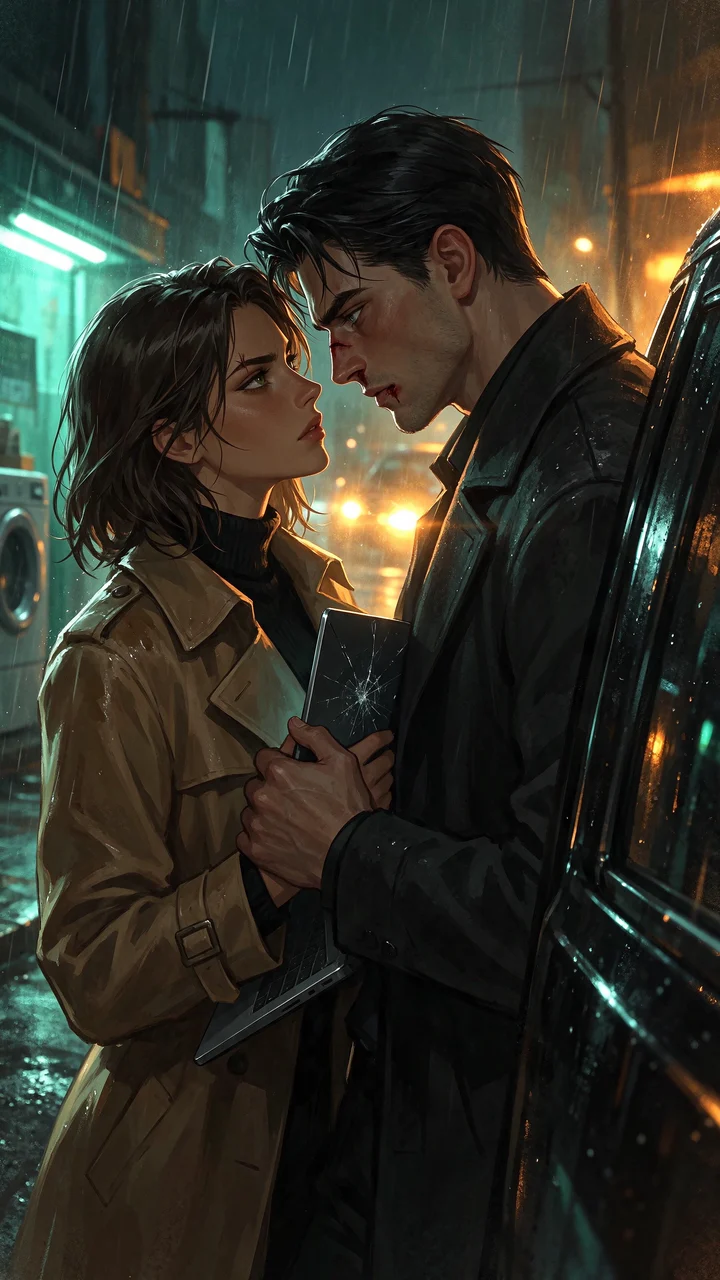
“The door’s not locked.”
Lev said it from across the room without turning around, the way he might have told her where the bathroom was. He was hanging his coat on a hook by the stairs. Beside it, on a second hook, a set of car keys swung from the motion and went still.
Mara stayed just inside the threshold, dripping on the floorboards.
The room was enormous and nearly dark. One lamp burned on a desk at the far end, and its amber light stretched across shapes she took at first for furniture under dust sheets, then understood. Pianos. A dozen at least, uprights and baby grands and one long concert grand in the middle, sleeping under canvas gone grey with age. The air smelled of dust and old lacquer and hammer felt. Overhead a skylight took the full weight of the rain and drummed with it.
“Grey sedan, downstairs, full tank,” he said, nodding at the keys. “Take it. Drive anywhere you like.” He finally looked at her. “You’ll be dead by morning, but you’re free to leave.”
“That’s your sales pitch.”
“That’s the situation. I’m not interested in a hostage.”
“What are you interested in?”
He walked to the kitchen along the side wall, a narrow galley of steel and white tile, and ran the cold tap over a cloth. Under the lamp his face was worse than it had been in the car. The bridge of his nose had swollen thick and sat just slightly wrong. Blood had dried in a seam along his lip.
“You think I sent them,” he said.
“I think your family sends people. I think you’re your family.”
“Fair.” He pressed the cloth to his mouth. “Then ask for proof.”
“I’m asking.”
He took a phone from his trouser pocket, an old one with a cracked corner, not the one he’d used in the car. He set it on the counter, pressed play, and stepped back, as if he did not want to stand too near it.
The voice came out small and tinny into the big room.
“Lev. It’s me, it’s Teo.” A rustle, a car passing somewhere. “I’m sorry to call this number. I know you said only for emergencies. I don’t know if this is one. There’s a car outside my building again. The blue one. It’s probably nothing. You said they wouldn’t look at me if I kept my head down, and I have, Lev, I swear I have.” A small, damp laugh. “My wife says I worry like an old woman. Anyway. The girl, the reporter. She’s good. She’s careful. If something happens, you look after the things I left. You know where. All right. That’s all. Thank you for everything, my friend. Truly.”
The message ended. The rain kept on.
Mara found she had her hand over her mouth.
She knew that voice. The way he said truly, rolling the r. She had sat across from it for five months and never once heard it afraid, because he had never let her.
“The date,” she said, when she could.
Lev turned the phone so she could read it. Tuesday, 9:14 p.m. The night they pulled him out of the water.
“He was mine to protect,” Lev said, perfectly level. “I got him the job keeping the books, years ago. I was the one who told him it was safe to talk to you.” He looked at the cloth in his hand, red now. “So I didn’t come to the laundromat out of kindness, Ms. Vell. I came because I already lost one of you.”
She wanted to throw something again. She wanted to sit down on the floor.
Instead she looked at his face.
“Your nose is broken.”
“I’m aware.”
“It’s crooked. If you leave it, it’ll set crooked.”
“Then it’ll set crooked.”
“You can’t do it yourself, can you.” She was already shrugging out of the soaked trench, slinging it over a chair. “You’d have done it in the car.”
“I tried in the car. You were busy hating me.”
“Sink,” she said. “Now.”
He came. She set her back against the edge of the counter by the sink. “Come down here. I can’t reach you.”
He looked at her for a long moment. Then he leaned down and set his hands on the counter on either side of her hips, steel and tile at her back, his arms bracketing her, his face level with hers. Close enough to see that the grey of his eyes was not one grey but several, and the pulse ticking at the side of his throat above that buttoned collar.
She noticed. She decided not to.
“My brother broke his in fourth grade,” she said. “My father set it at the kitchen table. On three.”
She laid her thumbs along either side of his nose. His skin was hot under the swelling and cold everywhere else from the rain. Her fingertips rested on his cheekbones. He held absolutely still for her, and the stillness was its own kind of attention.
“One,” she said, and pushed.
The cartilage gave with a small grinding click she felt in her own teeth. His hands closed hard on the counter edge. He made no sound, only a short breath through his mouth that she felt against her wrist.
“That wasn’t three,” he said, after a moment.
“Nobody ever waits for three.”
She did not take her hands away at once. She told herself she was checking the alignment. His eyes held hers, very close, and neither of them said anything, and the rain went on drumming overhead.
Then she ducked out from under his arm and ran the tap.
“Ice,” she said, not looking at him. “Freezer.”
“Yes, doctor.”
. . .
They made terms at the kitchen table, under the lamp, with her laptop open between them and his blood still on the lid.
“You get me Gavriil,” she said. “Documents. Names. Dates. Things I can verify twice.”
“You’ll have them. And you publish when I tell you. Not before.”
“That’s prior restraint.”
“That’s staying alive. If it runs early, he burns everything and everyone and flies to Cyprus.”
She hated that he was right. “Fine. My rule. You don’t lie to me. Not once. Not to protect me, not to protect yourself.”
“Same rule.”
“I don’t lie.”
“You told your editor you were fine,” he said. “I heard you.”
She looked at him. He looked back.
“No lies,” she said.
“No lies.”
“And when this is over, I’ll write about you too.”
“I’d expect nothing less.”
“It won’t be kind.”
“It wasn’t kind the first time.” He touched the bridge of his nose, gingerly. “I survived.”
He held out his hand. She took it. His palm was rough along the edge, a deckhand’s hand in a tailor’s cuff, and he did not let go a second sooner than she did.
. . .
He gave her the bed, a narrow iron one behind a folding screen, sheets that smelled of cold and cedar. He took the couch. Neither of them pretended it was a good arrangement.
She lay awake listening to the skylight. She could hear him not sleeping, too. The couch creaked every time he turned over, and he turned over a great deal. Somewhere a piano string sighed in the cold, the way old instruments do when the temperature drops.
Then the rain thinned to a patter, and in the gap it left she heard something else. A single note. Another, soft, muffled.
The clock on her phone said 3:04.
She got up in her sweater and bare feet and went to the edge of the screen.
He was sitting at the concert grand. He had folded the canvas back from the keys and nowhere else, so the instrument stayed shrouded, one bare strip of ivory showing in the lamplight. His sleeves were rolled to the elbow. He was playing with one hand, slowly, something she didn’t know, in a minor key, a phrase that kept climbing toward an ending and turning away before it arrived.
She stayed where she was with her arms wrapped around herself and breathed quietly. She watched the long line of his back. The bruise blooming purple beneath his eyes. The way he stopped, sometimes, with his hand resting on the keys, and then went on.
He played the phrase through again and broke off in the same place.
“Mara,” he said, without turning around.
She went still.
“Teodor kept a storage unit,” Lev said to the piano. “Industrial quarter. He gave me the key and told me never to go there unless he was dead.” His hand came off the keys. “He’s dead. Get your coat.”