
“They used the words walk it back, Mara. In my office. With the door closed.”
Mara kept typing. The cursor ran ahead of her, eating white space, and the dryer behind her thumped a pair of someone’s sneakers around its drum with the regularity of a fist on a door. “Then open the door.”
“Don’t be clever with me at eleven at night.”
“It’s ten fifty-two.” She hit save, hit send, and watched the Harbor Ledger’s filing system think about it. “The follow-up’s in your queue. Shell companies, three of them, all registered to the same dead aunt in Odessa. Kestrov Maritime pays itself to move containers it already owns. It’s clean, Bea. It’s documented.”
“It’s a grenade.”
“So was the first one. You ran that.”
A pause on the line. Mara could see her as clearly as if she were sitting on the folding table between the bleach and the lost-sock bin: reading glasses shoved up into the grey-black of her hair, burgundy cardigan buttoned wrong, the lanyard she never took off even at home, as if she might need to prove who she was to her own kitchen.
“I ran it,” Beatriz said, “and a man is dead.”
The cursor blinked. Mara did not.
“Teodor knew what he was doing.”
“Did he.” Not a question. Beatriz never wasted a question mark on Mara. “Where are you?”
“Somewhere with Wi-Fi.”
“Mara.”
“The laundromat on Pier Road. The one with the broken change machine. I’m fine. Nobody follows a woman into a laundromat at night unless they want to watch her fold.”
“The owners want a retraction by Friday.”
“The owners can retract my—”
The lights went out.
Not flickered. Died. The fluorescent tubes, which had been humming a long flat note into the back of her skull for two hours, stopped mid-hum, and the silence that rushed in was so total she heard the rain properly for the first time, sheeting down the front window in grey ropes. The dryers kept turning in the dark, slower now, heavy loads rolling over and landing. Thud. Thud. Hot lint and bleach and someone’s cheap floral softener.
Her laptop screen was the only light left. It made a small blue room around her hands.
“Mara? You cut out.”
“Power’s gone. Probably the whole block. Bea, I’ll call you—”
The bench shifted.
Someone had sat down beside her. She hadn’t heard the door. She hadn’t heard a step. One moment the bench was hers and the next a weight had settled on its far end, close enough that she smelled wet wool and, under it, cedar and cold air, the scent of a man who had walked here through the weather and not hurried.
She hung up on her editor without looking.
He didn’t speak. A hand came into the blue glow of the screen. Long fingers, a plain steel watch, a black cuff buttoned tight at the wrist. The hand laid a piece of paper on the bench and slid it toward her, and she knew what it was before she looked, because she had chosen it.
Her photograph. Page one, above the fold, cut neatly from the Ledger. Lev Kestrov stepping out of a car outside the family’s shipping office, collar up, face half-turned, caught by a long lens in the second he’d glanced toward it. She’d liked that shot because he looked like he knew. Her caption ran underneath. The youngest Kestrov, whose companies the family uses to clean its money.
She lifted her eyes.
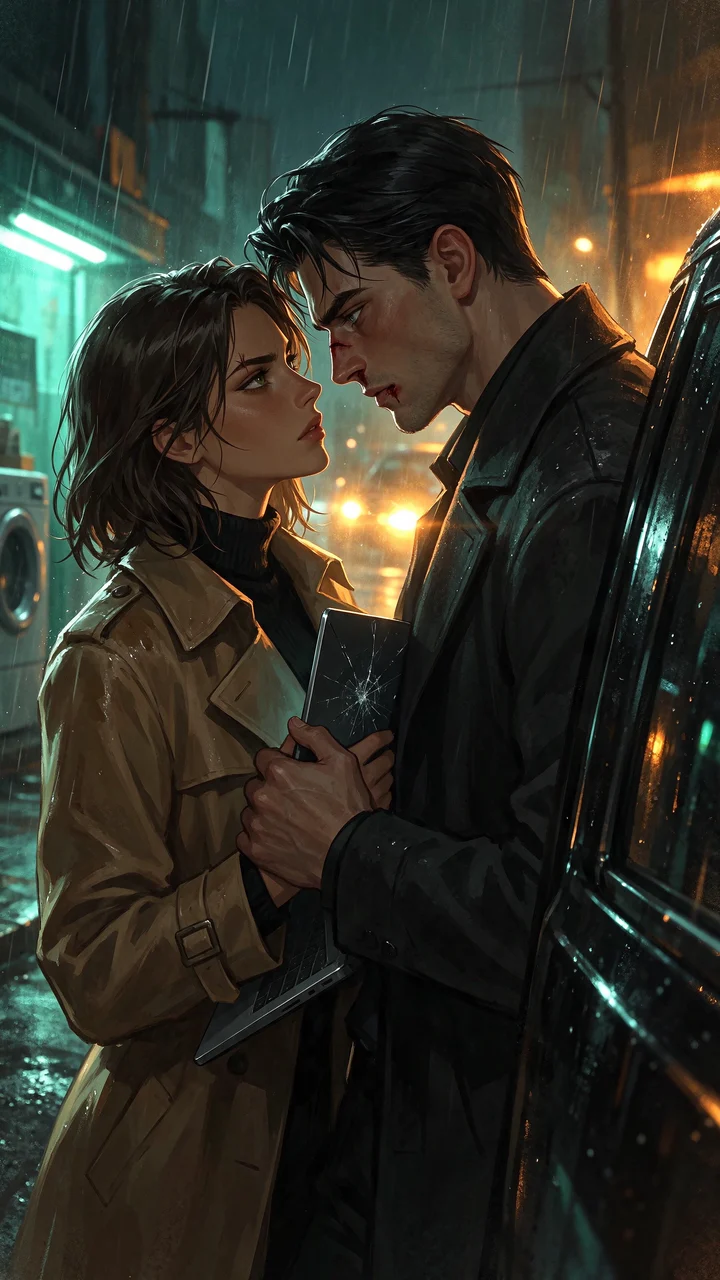
He was wearing the same face. In person it was harder, all cheekbone and shadow, the screen light carving it into planes. Black hair soaked and pushed back off his forehead. Rain dripping from the shoulders of a charcoal overcoat gone almost black with it. Pale grey eyes under heavy brows, watching her with a patience she did not like at all.
“Good likeness,” Lev Kestrov said.
“Get away from me.”
“In a moment.” His voice was low, dry, entirely unhurried. He glanced at the watch. “You have about four minutes, Ms. Vell. Less, if Dock Street is quiet. Two cars are going to stop outside that window, and the men in them have been told to make this look like a robbery. They’re not imaginative. They’ll take the laptop.”
Her heart was going hard and high, up under her collarbone. Her hands stayed flat on the keyboard.
“And you’re here to warn me. Out of kindness.”
“I’m here to take you somewhere else. You’ll come with me, or you’ll stay and be very brave for about four minutes.” He tipped his head toward the back of the laundromat. “I’d decide quickly.”
“You’d love that. Me in your car.”
“I wouldn’t love it.” He leaned back, as though they had all evening. “You’ve been a remarkable inconvenience.”
She shut the laptop, gripped it in both hands, and swung.
It caught him across the middle of the face with a sound she would hear for the rest of the night, a wet crack under the hard edge of aluminum. His head snapped back. The light vanished and the dark came down whole, and for a second there was nothing but the dryers thudding and her own breath sawing in and out and a short, low exhale from him that was almost a laugh.
When her eyes adjusted, he was still sitting there.
Blood ran from his nose over his lip and into the stubble along his jaw. His lower lip had split where the edge caught it. He touched the back of his hand to his face, considered the dark smear on his knuckles in the grey window light, and then looked at her. He did not seem angry. That was the worst part.
“That’s fair,” he said thickly. “Teodor Brandt.”
She went cold from the scalp down.
“You never printed his name,” Lev said. “Bookkeeper. Fifty-eight. Two daughters in Gdańsk. Took his coffee with three sugars because his wife wouldn’t let him at home. They pulled him out of the harbor last Tuesday with his hands tied behind him, and the police called it an accident.” He stood. He was very tall in the dark. “My brother Gavriil gave that order. He gave this one too.”
He buttoned his coat. Then he turned and walked toward the back door, past the folding tables and the dead change machine, and did not look back once.
“You’re lying,” she said to his shoulders.
The back door opened on the roar of rain and closed on it.
Mara sat in the dark with his blood on her laptop. Three minutes, maybe. She thought of three sugars. She had watched Teodor stir them in a café on Viska Street, the spoon going round and round, and he had said, You will make it right, yes? You will make it worth it.
Light swept across the front window.
Headlights, low and white, nosing in close to the curb. A second set behind them. Doors opened. Two men got out and stood in the rain without bothering to hurry, and the taller one shaded his eyes to peer through the glass, and Mara knew him. She knew the scar on his chin and the way he rolled his shoulders. She had photographed him from a parked car for six weeks. His picture sat in a folder labeled MUSCLE, in a drawer, in her own apartment.
She was off the bench before she had decided anything.
Laptop under her arm, bag strap dragging across her chest, she ran for the back through the thudding dark, hit the bar of the door with her hip, and the rain struck her full in the face.
The alley was black and running with water. A car idled at the far end, lights off. He stood beside it, one hand on the open door.
“Kestrov!”
He moved before she reached him. His hand closed around her wrist and pulled, not hard, just certain, and her own momentum did the rest. She hit the side of the car and he was there, and for one second there was no room between them at all. Wet wool against her trench. His chest rising under the palm she’d thrown out to stop herself. Rain running off his jaw onto her collar. His thumb lay over the inside of her wrist, exactly where her pulse was slamming, and she felt him feel it.
He looked down at her. Blood on his mouth. Grey eyes, very steady.
“Four minutes,” he said quietly. “You took three and a half.”
Inside the laundromat, glass broke.
“Get in the car, Mara.”
She got in the car.
. . .
He drove without headlights for the first two blocks, and she sat with the laptop clutched to her chest, dripping onto his leather seats, hating him with a clarity that was almost restful.
“Who ordered it,” she said. “Say it again.”
“Gavriil.”
“Why would you hand me your own brother?”
He turned onto the harbor road and switched the lights on, and in their wash she saw his face: swelling already across the bridge of the nose, blood drying dark at the corner of his mouth.
“Because,” Lev Kestrov said, “I’m going to bury him. And I could use a witness.”