
The key lived in his wallet, behind his driver’s license, wrapped in a folded square of handkerchief.
Mara watched him take it out under the sodium lamp at the gate. He unfolded the cloth one corner at a time. Inside lay a small brass key on a ring with a cardboard tag, and on the tag was a number in blue ballpoint, written by a careful, old-fashioned hand that crossed its sevens.
114.
“You carry it on you,” she said.
“Every day for two years.” He folded the handkerchief back into its square and put it away. “He asked me to.”
“Most men would have put it in a drawer.”
“Most men didn’t owe him.” He keyed the gate code from memory and the barrier groaned up.
“The gate logs codes,” she said.
“I know.”
“So they’ll know we were here.”
“Eventually. Stay close. Don’t talk unless you need to.”
“I always need to.”
“I’ve noticed.”
Inside, the facility was a maze of corrugated steel. Long corridors of roll-up shutters, orange doors gone brown at the seams, each with a padlock and a number stenciled in white. The sodium lights buzzed and flickered, washing everything the color of weak tea. Concrete underfoot, cold through the soles of her boots. The place smelled of rust and of rain leaking in under the roof. Somewhere a loose panel banged in the wind, over and over, and each time it went she felt him track it without turning his head.
She stayed close. His coat brushed her arm at every corner.
114 sat at the end of a dead-end row, under a light that had given up. Lev crouched, worked the padlock, and rolled the shutter up waist-high. It screamed on its runners. They both froze. Nothing but rain on the roof.
They ducked under.
He found a battery lantern on a crate and switched it on, and the unit rose out of the dark: banker’s boxes stacked to the ceiling, a filing cabinet with a dented drawer, a folding chair with a cardigan draped over its back. Brown wool. Leather patches at the elbows.
“He left that in March,” Lev said quietly. “Said he’d come back for it when it got cold. He worked here. Where nobody could watch him.”
The ledgers were in the second box. Cloth-bound, green, a dozen of them, every line filled in that same careful blue hand. She opened one on her knee and turned the pages under the lantern. Columns of figures. Ship names. Dates. In the margins, tiny notes: check w/ L. Not right. Ask again. A doodle of a coffee cup in one corner, steam curling off it, three dots beside it.
Three sugars.
Further on, her own initials. M.V. Stubborn. Trust her.
Her throat closed. She bent her head over the page so he wouldn’t see her face, and kept turning, and the figures swam.
He said nothing. His hand came down once on her shoulder, a weight there and then gone, and he moved off to the filing cabinet and let her have it.
The photographs were in a shoebox under the ledgers. Dozens of cheap lab prints, rubber-banded in bundles. Meetings in parking lots. Men on a dock at night. A ship’s manifest with a coffee ring. Gavriil’s car, she knew the plates, outside a restaurant. She didn’t stop to read them. One copy is no copy, Beatriz always said, so she fanned them on a crate and shot them with her phone, fast, and sent them as she went to the only person she trusted.
“What are you doing?” Lev asked.
“Insurance.”
“We agreed—”
“I agreed not to publish. I didn’t agree to die holding the only proof.” She sent the last batch. “You said no lies. This isn’t one. I’m telling you to your face. She won’t touch it until I say.”
He held her eyes for a long second. Then his head turned sharply toward the corridor.
She heard it too. An engine. Car doors. Footsteps, several sets, the hard ring of good shoes on concrete, coming down the far row.
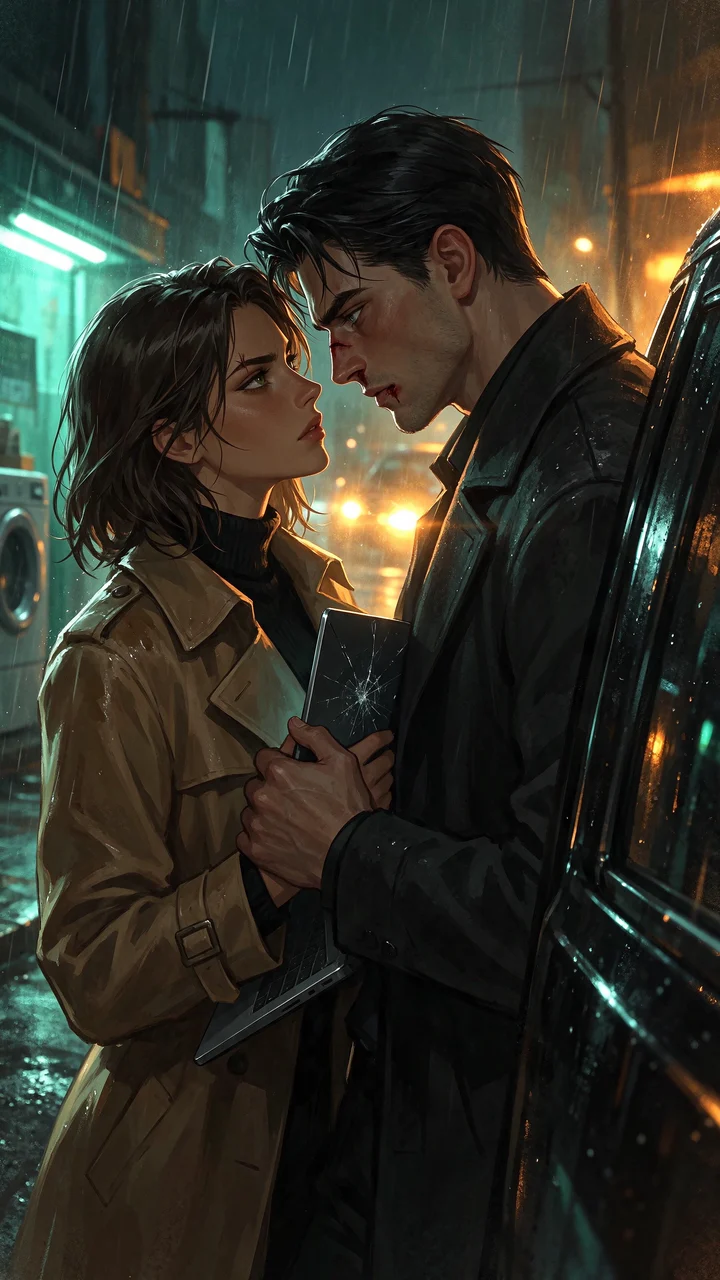
Lev killed the lantern. He caught the bottom of the shutter and drew it down slowly, so slowly the runners only whispered, until the gap was no taller than her hand. Then he took her arm and pulled her back behind the stacked crates into the deepest corner, turning so his back was to the door and hers was to the steel wall, and there was nowhere else for either of them to go.
The steel at her back was so cold it ached through the trench. The front of her was not cold at all.
Through the gap she saw sodium light, and shoes. Polished. Three pairs. Then a fourth, walking more slowly, and a voice, pleasant and unhurried, a man remarking on the weather.
“He was always sentimental, my brother. Find the old man’s door.”
Gavriil.
Her breath caught. Lev’s hand came up and settled along her jaw, his palm warm against her cheek, his thumb resting at the corner of her mouth. Not pressing. Just there. A request. She could have turned her face out of it. She didn’t.
Her hands had gone into his coat. Both fists knotted in the wet wool at his chest, the phone crushed in her right, and she didn’t remember doing it.
A shutter rattled up two doors down. Someone swore. The slow footsteps stopped directly outside, and through the gap she saw the hem of navy trousers, a waistcoat button, a hand hanging loose with a heavy gold signet on the smallest finger. The hand tapped the shutter of 114 twice with the ring. Idly. A knock on a coffin lid.
Lev did not move. She could feel his heart against her knuckles, steady, slower than hers. His mouth was so close that every breath he gave up, she took in. Cedar. Cold. Copper, faintly, from the healing split in his lip. Neither of them closed the distance. Neither of them could afford the sound.
“Padlock’s off this one, sir.”
“Then my brother has been and gone.” Gavriil sounded almost fond. “I don’t crawl about in sheds, Andrei. Burn the row tomorrow, all of it. Lev will hear. That will do more than finding him.”
The ring tapped once more. The shoes walked away. Doors, engines, the long fade of tires on wet asphalt.
Silence. Rain on the roof. Somewhere the loose panel banged again.
Neither of them moved.
His hand was still on her jaw. Her fists were still in his coat. In the dark she could see nothing of him but a faint grey line of light along one cheekbone and the shine of his eyes, very close, lowered to her mouth.
“This changes nothing,” she whispered.
She meant it to come out hard. It didn’t.
His thumb moved, a fraction, along her lower lip.
“You’re lying,” Lev said, low. “We agreed. No lies.”
She could have stepped away. He had left her room to; she could feel it, the way his body held itself just short of hers, waiting for her to choose. She uncurled her left hand from his coat and slid it up flat over his heart, and felt it kick under her palm, finally, as hard as hers.
She leaned in.
Her phone lit up between them.
White light flared across both their faces, sudden and terrible after the dark. It buzzed against his chest, still caught in her right fist. A message from Beatriz.
Zoomed in on #31. Look at the date on the back. Mara. Is this who I think it is?
Below it, the photograph. A dock at night, a car, two men under a lamp. One thick-shouldered in a three-piece suit, a gold ring catching the light. Beside him, taller, collar up, face half-turned toward the lens in a way she would have known anywhere, because she had chosen a photograph exactly like it for page one.
And the back of the print, in blue ballpoint, in that careful hand with crossed sevens: Lev & G. Tuesday.
The night Teodor died.
She looked up from the screen. Lev was looking at it too. In its light his face had gone completely still.
She thought of three sugars. She thought of how carefully he kept a key.
The shutter was down. The dark was all around them. And he was standing between her and the only way out.