

He hadn’t summoned her. He’d simply been there in the library aisle, a broad silhouette against the stained-glass window, holding the very botanical text she needed for Harpy’s assignment. ‘My study has better light,’ Professor Maddox had said, his voice a warm, low rumble that brooked no argument. Now, surrounded by the scent of old paper and his particular, clean-smelling cologne, Clara felt the world transform. This wasn’t chaotic attraction or stormy protection. This was curated attention, and the walls felt like they were gently, inexorably, closing in.
The study was a small, perfect box of warmth. A single lamp cast a honeyed glow over the spines of leather-bound books. Maddox’s desk was clear except for her open text, a pair of reading glasses, and a porcelain cup steaming faintly. He stood by the window, his back to her, watching the fog coil against the glass. “The *Drosera rotundifolia*,” he said without turning. “Sundew. A fascinating specimen. It secretes a sticky mucilage to trap its prey. The struggle only ensnares it further.”
Clara’s fingers tightened around the straps of her book bag. “I just need to copy the diagram.”
“Of course.” He finally turned. His smile was a gentle curve in the lamplight. “But understanding the mechanism is far more valuable than replicating its image. Don’t you think? Come. Sit.”
He pulled out the heavy chair behind his desk for her. It was too large, too plush. She perched on the edge, her body a tight coil. He leaned over her shoulder to point at the illustration, his tweed sleeve brushing her arm. He smelled of starch and that faint, clean cologne. His finger, long and elegant, traced the plant’s delicate tendrils. “Note the glistening droplets. They look like dew. Inviting. Nourishing, even.”
His breath stirred the hair near her temple. Clara’s own breath hitched, trapped in her chest. This was the trap. Not a cage of iron, but one of velvet. Of quiet explanations and paternal guidance. Of being seen, understood, and meticulously folded into a space just for her. The kindness was a weight, pressing down, making her small.
“I can see it from here,” she said, her voice thin.
“Can you?” His tone held no malice, only a soft, profound curiosity. He didn’t move away. “You seem tense, Clara. Is the assignment troubling you? Or is it the atmosphere of our little garden shed?”
Garden shed. The words from Althor’s note flashed in her mind. *The garden shed. Be there after supper.* This wasn’t the place. This was something else. A test she hadn’t known she was taking. Maddox was the curator, Maya had said. He collected distress. And here she was, delivering hers, neatly packaged in a trembling silence.
“I’m fine.” The lie was brittle.
“You’re not.” His hand came to rest on the back of her chair, just beside her shoulder. Not touching her. The heat of him radiated through the wool of her sweater. “There’s no shame in not being fine. This is a difficult place. The fog… it gets into the bones. Makes one crave a hearth.”
His words were a key, turning in the lock of her deepest fear. Craving. Need. Softness. Her father’s voice, slurred and contemptuous, echoed up from the past. *Pathetic. Look at you, sniveling. You’ll always be weak. You’ll always need a man to tell you what to do.* The memory was a slap. A spark to tinder.
Clara shoved back from the desk, the chair legs screeching on the floor. “Stop it.”
Maddox straightened, his expression one of mild, concerned surprise. “Stop what, my dear?”
“This! All of this!” Her voice climbed, sharp and cracking. “The gentle voice. The understanding looks. The fucking… the fucking *sherry* in the bottom drawer! I’m not your dear. I’m not a sweet girl you need to coax into a goddamn spiderweb!”
His eyes softened further, which was infuriating. “Clara, please. You’re upset. Let’s talk about this.”
“No! We’re not talking! Talking is what you do! You talk and you look and you *smell* like a goddamn grandfather and it’s all just… it’s just the price!” She was shaking, tears of pure, hot fury blurring her vision. “Althor’s the same! With his hugs and his quilts and his goddamn notes! You’re all the same! You make us need it so you can control it! So you can control *us*!”
She was shouting now. The words tore out of her, ripped from the old, scarred-over places where her family’s misogyny had festered. Being soft was pathetic. Needing comfort was a flaw. Trusting a man was the first and last mistake. She would not be pathetic. She would not be weak.
The door to the study opened. Professor Althor stood there, his silver-streaked hair haloed by the fluorescent light of the hallway, his rumpled tweed jacket familiar. For a disorienting second, in her tear-blurred panic, he was Maddox. The same solid build, the same air of quiet, male concern. The confusion fueled her rage.
“What’s all this noise?” Althor asked, his voice that low, soothing murmur. He stepped inside, closing the door. “Clara? Whatever is the matter?”
“Get out!” she screamed at him, whirling. “Just get the hell out! I don’t want your help! I don’t want *any* of you!”
Althor exchanged a glance with Maddox, a look of profound, shared worry. It was the final straw. That silent communication, that club of concerned fatherhood. They were a unit. She was the problem to be managed.
“You see?” she sobbed, the anger dissolving into a torrent of helpless grief. “You’re all in it together! You and him and Althor! You’re just… you’re just nicer prisons!”
She couldn’t breathe. The walls were truly closing in now, the warm, book-scented air suffocating. She stumbled back, wanting to hit something, to break the perfect, gentle order of this room. Her fist connected with a shelf, sending a tremor through the books. The pain in her knuckles was clean, sharp, real.
“Clara.” It was Althor who moved first. He didn’t grab her. He simply stepped into her space, his hands open at his sides. “You’re hurting yourself.”
“Don’t touch me!” She swung at him, a wild, open-handed slap that caught him on the shoulder. He didn’t flinch. He absorbed the blow, his body solid and unmoving. She hit him again. And again. Fists pounding against the rough wool of his jacket, against the solid wall of his chest. “I hate you! I hate all of you! Stop being so fucking *nice*!”
Her blows were weak, childish. Sobs wracked her, stealing her strength. Althor didn’t restrain her. He didn’t catch her wrists. He just stood there, letting her pummel him, his warm brown eyes holding nothing but a deep, unbearable sadness. When her arms grew too heavy, she collapsed forward, her forehead thudding against his chest.
Then his arms came around her. Gently. Slowly. One hand cradled the back of her head, his fingers threading into her messy chestnut hair. The other pressed firmly between her shoulder blades, holding her steady as she shattered. He made a low, shushing sound, a vibration she felt through his ribs. “It’s alright,” he murmured into her hair. His voice was a bedrock. “Let it out. It’s alright. I’ve got you.”
And she cried. Great, heaving sobs that felt like they were turning her inside out. She cried for the mother who chose new husbands over her. She cried for the father who taught her love was contempt. She cried for the terrifying comfort of Althor’s bed and the clinical hunger in Maddox’s gaze. She cried because she was so, so tired of being strong.
Althor held her through all of it. He didn’t speak. He just held. His hand moved in slow, steady circles on her back. His chin rested on the top of her head. He was warm and solid and he smelled of old books and bergamot and a simple, human warmth. It wasn’t a seduction. It was a shelter. And that was the most confusing thing of all.
Slowly, the storm passed. Her sobs subsided into shaky, ragged breaths. She was limp against him, utterly spent. The fight was gone, leaving a hollow, aching vulnerability. She was soft. And he was still holding her.
“There now,” he whispered. His hand stilled on her back. “There’s my brave girl.”
The endearment should have felt like a trap. A hook. But in the wreckage of her outburst, it felt like a blanket. A recognition. He had seen her fury, her violence, her ugly, snotty tears, and he had called her brave.
Clara didn’t pull away. She let herself be held, her cheek pressed against the soft tweed of his jacket. Her mind was a numb, quiet blank. The choice yawned before her, vast and terrifying. This felt like happiness. This soft, supported surrender. And it felt like a betrayal of every hard-won lesson that had kept her alive. To be strong was to be miserable, suspicious, and alone. To be soft was to be happy, comforted, and… owned.
Althor finally stirred. He reached into his pocket and pulled out a clean, pressed handkerchief. He didn’t hand it to her. He gently dabbed at her cheeks, wiping away the tears and the salt. His touch was impossibly tender. Paternal. “You’re exhausted,” he said, his voice still that low murmur. “This isn’t the place for you tonight. Professor Maddox, would you be so kind as to fetch Miss Vance a glass of water from the staff lounge?”
Maddox, who had been a silent, observant statue throughout her breakdown, nodded once. “Of course.” He left without another word, the door clicking shut softly behind him.
Alone with Althor, Clara felt the silence swell. He guided her to sit in the plush chair again, then knelt before her, his hands resting on his knees. He was at her eye level. No looming. No pressure. “Clara,” he said, his gaze steady and kind. “I need you to listen to me. Truly listen. You are not pathetic for needing comfort. You are human. What was done to you, what was said to you… it was a lie. A cruel, wicked lie designed to make you easy to control. Real strength isn’t never needing. It’s knowing what you need, and having the courage to accept it when it’s offered freely.”
She stared at him, her eyes wide and raw. His words were a key turning in a different lock. They fit. They made a terrible, beautiful sense. “Nothing is free here,” she whispered, her voice hoarse.
His smile was sad. “Perhaps not. But this moment is. My care for you, right now, asks for nothing in return. Can you let that be enough for tonight?”
The door opened again. Maddox returned with a crystal tumbler of water. He handed it to Finch, who held it to Clara’s lips. “Small sips,” Althor instructed softly.
She drank. The water was cool and clear. It washed the taste of salt from her mouth. Althor took the glass away when she was done, his fingers brushing hers. A simple, fleeting contact.
“Come,” Althor said, rising and offering her his hand. “It’s time you were in your dorm. The fog is particularly thick tonight.”
She looked at his hand. Broad, palm up, waiting. An invitation. To be led. To be taken care of. The hollow ache in her chest yearned for it. The defiant survivor in her screamed in warning.
Clara Vance took his hand.
The fog outside was a living thing. It swallowed the path, the distant lampposts, the world. Clara’s hand was small and cold in Althor’s. He didn’t clasp it tightly, just held it with a steady, guiding pressure as they stepped from the stone portico onto the gravel walk. The air was a cold, wet kiss. Tiny beads of dew settled on the wool of his jacket, on the black strands of his hair. They landed on Clara’s cheeks like frozen tears.
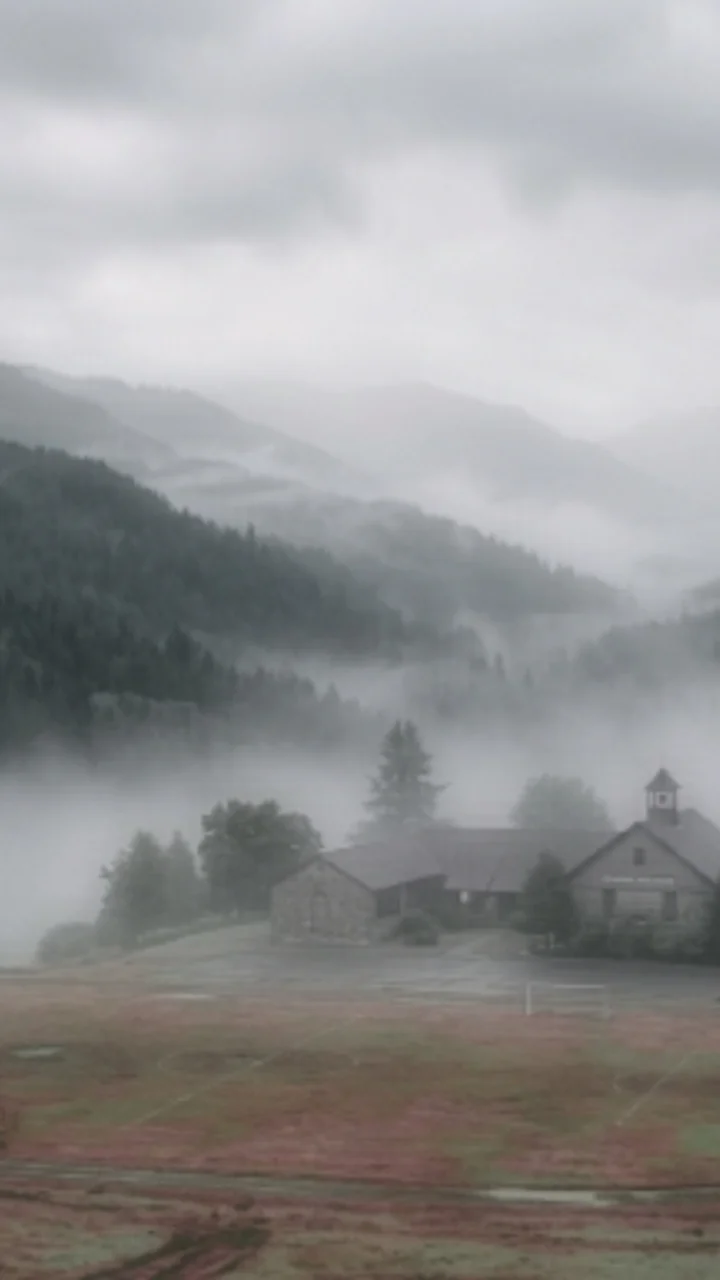
She looked away from the school. The grounds fell away into a vast, open field that blurred into a dark line of forestry, which then climbed into the vague, humped shapes of mountains. Everything was layered in deep, saturated greens and grays, smothered under a thick, ghostly blanket of white. The mist moved, slow and serpentine, across the distant tree line. It felt less like a place and more like a painting of a place. A beautiful, desolate, and utterly distant reality.
Althor walked beside her, his gaze fixed ahead on the path only he could see in the murk. He was quiet. Not the heavy, waiting quiet of the study, but a casual, companionable silence. As if escorting weeping girls through haunted landscapes was a Tuesday evening errand.
“Rasles,” she said. Her voice was scraped raw, barely a whisper. It was the first time she’d used his given name.
He didn’t look at her. “Yes, Clara?”
“Where are we?”
“The east walk. The dorms are just ahead.”
“No.” She stopped walking, forcing him to stop with her. She stared out into the consuming whiteness. “I mean… where is this? On a map. What’s outside that?” She pointed a trembling finger toward the impossible mountains.
Althor followed her gaze. He was silent for a long moment, the fog coiling around his legs. “Forest. Then more forest. Then a road that eventually meets a motorway. About sixty miles to the nearest town of any note.”
“It doesn’t feel real.”
“The fog plays tricks on the mind. Makes distances meaningless.” He gave her hand a gentle, tugging squeeze. “Come along. You’ll catch a chill.”
She let him pull her forward, but her head stayed turned, her eyes drinking in the void. The aesthetic perfection of it—the melancholic beauty of the mist-shrouded pines, the somber palette—felt like another layer of the trap. Even the prison was picturesque.
They walked. The only sounds were the crunch of gravel under their feet and the distant, mournful sigh of wind in high branches. The damp seeped through her sweater, a cold that reached her bones. Her mind, numb from the storm of tears, began to prick back to life. The hollow ache was still there, but around its edges, a fresh, sharp suspicion crystallized.
He had called her brave. He had held her while she fell apart. He had wiped her face. He had spoken truths that resonated in the wounded parts of her soul. And now he was walking her to her dorm in the fog, a perfect gentleman. The script of a rescuer. The performance of a good man.
Her fingers twitched in his. The warmth of his hand was no longer a comfort. It was a data point. A very convincing data point.
“You’re very quiet,” Althor murmured, his voice blending with the mist.
“You’re not,” she said.
“Pardon?”
“You’re not asking me anything. You’re not… probing. You usually probe. Finch probes. Maddox… observes.”
“You’ve had enough of being looked at for one night, I should think,” he said. A simple, startlingly perceptive statement. It felt like genuine care. It felt like expert strategy.
The path curved, and the dark bulk of the girls’ dormitory emerged from the fog, its gabled windows glowing with a soft, yellow light that did nothing to dispel the gloom. It looked like a lantern sunk in a swamp.
Althor stopped at the bottom of the wide stone steps. He finally turned to face her, releasing her hand. The sudden absence of his touch left her skin feeling colder. He stood a respectful distance, his hands slipping into the pockets of his trousers. His expression was gentle, but there was a watchfulness in his warm brown eyes. A teacher ensuring a task was complete.
“You should go straight to your room,” he said. “Get some rest. The world will make more sense in the morning.”
Clara didn’t move. She looked from him to the dorm door, then back into the swallowing fog. The choice wasn’t between strength and softness anymore. It was between two different kinds of captivity. The harsh, visible lock of the female teachers, or the gentle, invisible latch of the men. Both led to the same room.
“Why did you really come to Maddox’s study tonight?” she asked. Her voice was flat. “You heard the noise. But you came in. You closed the door. You didn’t fetch Harpy. You didn’t call for Croft. You contained it.”
Althor’s smile was faint, tired. “Would you have preferred I summoned Miss Harpy?”
“That’s not an answer.”
“It is, Clara. Just not the one you’re hunting for. I contained it because the alternative would have been worse for you. That is the truth.” He took a half-step closer. The fog swirled between them. “Not everything is a transaction. Not every kindness is a ledger entry.”
“But some are.”
“Some are,” he agreed softly. “But you are seventeen years old and you have just torn your heart out on my colleague’s floor. For tonight, can the math wait?”
He was doing it again. Disarming her with reason, with a compassion that felt unassailable. It stoked a low, smoldering anger in her gut. Not the explosive fury from before, but something colder. More durable.
“You smell like the fog,” she said abruptly.
He blinked, thrown. “I… suppose I do.”
“No. You smell like bergamot and books. But you’re standing in the fog. You’re part of it. You’re not a sanctuary from it, Rasles. You’re the reason we don’t mind being lost in it.”
His face changed. The gentle mask didn’t slip, exactly. It deepened. The sadness in his eyes became profound, a well she couldn’t see the bottom of. It was the most genuine thing she’d seen from him all night. “Oh, my dear girl,” he breathed, the endearment a sigh of real pain. “What a terrible weight to carry. To see the world so clearly.”
A shiver that had nothing to do with the cold racked her body. His pity was worse than his manipulation. It felt true. And if it was true, then his care was real. And if his care was real, then the system was even more monstrous than she’d imagined.
“I don’t want to see clearly,” she whispered, the confession ripped from her. “I want to be stupid and happy. I want to believe you.”
“I know.”
“Don’t!” she snapped, the anger flaring. “Don’t just ‘I know’ me! Fight me! Tell me I’m wrong! Be a man! Be angry! Be something real!”
He didn’t rise to it. He just watched her, that unbearable understanding in his gaze. “Would that help? If I shouted? If I grabbed you and shook you? If I was the monster you sometimes need me to be, so the world would make simple, brutal sense again?” He shook his head slowly. “I won’t give you that, Clara. I will not be the villain that makes your pain feel righteous. That would be the cruelest transaction of all.”
Clara felt the fight drain out of her, leaving a terrifying emptiness. He had won. Not by overpowering her, but by refusing to fight. By being the unbreakable, kind wall against which all her defiance spent itself. She was alone. Profoundly, utterly alone with a man who claimed to care, and the sheer, isolating horror of that realization was worse than any threat.
A tear, hot and solitary, escaped and traced a path through the dew on her cheek. She didn’t sob. She just stood there, letting it fall.
Althor saw it. His hand came out of his pocket. He didn’t reach for her face. He simply extended his hand, palm up, toward her once more. An invitation. A bridge over the unspeakable void between them.
Her eyes dropped to his open palm. The lines there. The warmth she knew it held. The safety that was also a sentence.
Clara Vance, who carried knives and read the truth in the silence between words, who was strong enough to be miserable forever, took a step backward. Up onto the first stone step. Away from his hand.
“Goodnight, Professor Althor,” she said, her voice clear and final in the muffled air.
She saw it then. The crack. Not in her, but in him. A flicker in those warm brown eyes. Something that looked like loss. Like genuine, paternal disappointment. It was there and gone, replaced by a respectful, solemn nod.
“Goodnight, Clara,” he said. “Sleep well.”
She turned and climbed the steps without looking back. She pushed through the heavy oak door into the bright, sterile fluorescence of the dorm foyer. The door thudded shut behind her, sealing out the fog and the man standing in it.
She didn’t go to her room. She leaned against the closed door, her ear pressed to the cold wood, listening. For footsteps walking away. For a sigh. For any sound at all.
There was only the deep, echoing silence of the fog. And the terrible, hollow victory of having chosen her own prison, all by herself.
Clara pushed away from the door with a sudden, sharp resolve. The hollow victory curdled in her stomach, a sour aftertaste. She would not stand here listening for him. She turned her back on the oak and the fog beyond it and walked down the fluorescent-lit hallway toward her room, her footsteps the only sound in the vast, sleeping dorm. The emptiness was a physical presence, a cold draft that followed her.
Her door clicked shut behind her, a softer, flimsier sound than the oak. She didn’t turn on the main light. The glow from the hallway seeped under the door, painting a sickly yellow rectangle on the floorboards. She slid down the wood until she was sitting, her back against the door, and hugged her knees to her chest. The position was fetal, protective. The fluorescent bleed from the hall was unforgiving, etching every detail of her sparse room in sterile monochrome: the neatly made bed, the empty desk, the window a square of absolute black.
Lost. Empty. But peaceful. The thought surfaced like a bubble in a still pond. She was away from them. From Althor’s devastating understanding, from Maddox’s curated attention, from the suffocating fog of their collective concern. Here, in this blank cell, there was no performance required. No ledger of kindness. No terrifying, gentle hands. She was alone. The aloneness was vast, an Arctic tundra inside her ribcage, but it was hers. She had chosen it.
And yet, the emptiness ached. It was a clean ache, a surgical removal. The warmth they offered—the phantom feeling of Althor’s hand, the scent of Finch’s sherry, the solidity of Maddox’s silence—had become a phantom limb. She felt the absence of it more keenly than she had ever felt its presence. She rested her forehead on her knees. What now? The question was a quiet echo in the hollow space. Rebel against what? The system had just proven it could absorb her rebellion, metabolize her rage, and offer her a cup of tea afterward. What did strength even look like here?
A soft scrape at the door made her freeze. Not a knock. The sound of something being slid across the floorboards from the other side. Her breath hitched. She waited, muscles coiled, for footsteps to recede. None came. Only the deep, listening silence of the dorm at midnight.
Slowly, she uncurled and turned, pressing her eye to the narrow crack between the door and the frame. On the floor of the hallway, just outside her room, lay a small, rectangular parcel wrapped in plain brown paper and tied with a simple string. No note. No identifying mark. It hadn’t been there when she walked in.
Her mind raced. A trap? A test from Harpy? A peace offering from Althor that she would have to reject? The compulsion to leave it, to prove her defiance, was strong. But stronger was the need to know. Cautiously, she opened the door just wide enough to snatch the parcel inside, then shut it again, locking it this time.
She carried it to the strip of light under the door and knelt. The paper was dry, not damp from the fog. It crackled as she untied the string. Inside was a book. Not a textbook. A slender, cloth-bound volume of poetry. Emily Dickinson. It was old, the spine softly creased, the pages gilt-edged and faintly fragrant with the smell of pressed flowers. A single, dried sprig of lavender marked a page.
Clara opened to it. The poem was short. The lines were underlined in faint, precise pencil.
*“The Soul selects her own Society —
Then — shuts the Door —
To her divine Majority —
Present no more —”*
Her throat tightened. This was not Althor’s style. Too oblique, too austere. This was not Maddox’s either; it lacked clinical purpose. Finch. Professor Finch, with his rumpled tweed and his bottom-drawer sherry. The quiet one. The one who offered blankets and hot tea and asked nothing in return except your presence in his warm, book-lined study. A society of one.
It was the most insidious gift yet. It saw her. It honored her retreat. It dignified her isolation by calling it a sovereign choice. It didn’t ask her to come back. It simply said, *I see you there. And I approve.* The kindness was a mirror, reflecting her own defiance back at her as wisdom. It made her solitude feel less like exile and more like nobility. The walls of her room, which had felt like a protective shell moments ago, now felt like the boundaries of a cell she had proudly locked herself inside.
A hot tear splashed onto the open page, blurring the pencil underline. She slammed the book shut. The sound was too loud in the quiet room. She couldn’t stay here. The four walls were beginning to whisper. She shoved the book under her pillow, a guilty secret, and got to her feet. She needed air that wasn’t filtered through central heating. She needed to see the sky, even if it was just the starless, fog-choked vault of Winter’s Gentle Keep.
She slipped out of her room and moved silently down the back staircase, the one used for laundry, that led to a side courtyard. The cold hit her like a slap as she pushed the heavy metal door open. It was bracing, cleansing. The fog was thinner here, a milky veil over a cloistered garden of dead rose bushes and stone benches. The world was reduced to shades of gray and the smell of frozen earth.
She walked to the center of the courtyard, her arms wrapped around herself, and tilted her head back. The mist moved in slow, ghostly currents above her. For a few minutes, there was only the cold, and the silence, and the faint, rhythmic sound of her own breathing. The peace returned, fragile and thin.
“You’ll catch your death, my dear.”
The voice, a low murmur from the shadows near the archway, didn’t startle her. It was as if she had been waiting for it. She lowered her gaze. Professor Finch stood there, a darker shape in the gloom. He wasn’t wearing a coat, just his tweed jacket over his shirt. He held a steaming ceramic mug in one hand.
“I’m already dead,” Clara said, her voice flat in the damp air. “This is just the afterlife.”
Finch made a soft, tutting sound. He walked toward her, not with purpose, but with a gentle amble. He stopped a few feet away, respecting the boundary. “A rather bleak assessment for one so full of fire.” He extended the mug. “Chamomile. With a drop of honey. It will soothe your nerves.”
She looked at the mug, then at his face. The silver in his hair caught what little light there was. His expression was one of pure, uncomplicated concern. No disappointment like Althor’s. No analytical curiosity like Maddox’s. Just a simple, paternal worry about a girl in the cold. The ordinariness of it was devastating.
“Why?” she asked, not taking the mug.
“Why the tea?”
“Why anything. The book. This. Why are you out here?”
He smiled, a small, sad curve of his lips. “I often take a late walk. The quiet helps me think. As for the rest… I saw a wounded bird retreat to its nest. It is a natural impulse to leave a few seeds nearby.” He took a slow sip from the mug himself, then offered it again. “It’s just tea, Clara. Not a contract.”
Her hands were freezing. The promise of warmth was a physical pull. She thought of the poem under her pillow, the society of one. She reached out and took the mug. The heat seared her palms, glorious and painful. She brought it to her face, the steam carrying the floral scent of chamomile and the faint, sweet promise of honey. It smelled like childhood. Like safety that hadn’t yet been weaponized.
She took a small sip. The warmth spread through her chest, a liquid comfort. She couldn’t suppress a small, shuddering sigh.
Finch watched her, his hands now tucked into his jacket pockets. “Better?”
It was. That was the terrible thing. She nodded, unable to lie.
“Good.” He looked up at the fog. “It will be a thick one tonight. A blanket. The world will feel very small and very quiet by morning.” His gaze returned to her. “Sometimes, small and quiet is what we need to heal.”
“I don’t want to heal here,” she whispered, the steam from the mug warming her face. “Healing here means accepting the sickness.”
“Does it?” he asked, his head tilting. “Or does it simply mean gathering the strength to understand the sickness? You cannot fight a fog, Clara. You can only learn to see within it.”
He was doing it again. Reframing. Making captivity sound like clarity. Making surrender sound like strategy. The tea was a truth serum, loosening the cold knot of her defiance. She took another sip, her eyes on him over the rim of the mug. He was just a man. A kind, tired, silver-haired man standing in a cold garden. Where was the sinister rot? It wasn’t in his eyes. It was in the perfect, unassailable goodness of him. It was in the way he made her feel ungrateful for suspecting him.
“Professor Althor was disappointed in me,” she said, the words coming out unbidden.
Finch’s expression softened further. “Rasles carries a heavy burden. He wants so desperately to fix what is broken. Sometimes, he mistakes a scar for a wound. Your strength frightens him, because it is something he cannot mend.” He took a step closer. The space between them shrank. She could smell the old books on him, the bergamot. “I am not disappointed, Clara. I am… admiring.”
His hand came up. Slowly, giving her every chance to pull away. He didn’t reach for her face. He gently adjusted a stray lock of her chestnut hair that the fog had dampened, tucking it behind her ear. His fingertips brushed the shell of her ear. The touch was fleeting, paternal, impossibly soft. A bolt of pure, undiluted sensation shot through her—not fear, not anger, but a shocking, visceral longing for that softness to continue. To be cared for. To be *admired*.
She froze, the mug locked in her hands. Her heart hammered against her ribs.
Finch’s hand fell back to his side. His smile was tender. “There. Now you look less like a storm cloud.” He nodded at the mug. “Finish that. Go inside. Dream of something beautiful. The world will keep until tomorrow.”
He turned and walked back toward the archway, his figure dissolving into the mist without a backward glance. He left her standing alone in the courtyard, holding the warmth he had given her.
Clara stood there long after he was gone, until the tea went lukewarm in her hands. The fog thickened, a gentle, smothering embrace. She thought of the poem, of selecting her own society. She had selected no one. And yet, they kept offering. The door was shut, but they were sliding gifts underneath it.
Finally, she turned and walked back to the metal door. The courtyard was empty. The world was small and quiet, just as he’d promised. She stepped inside, leaving the fog to swirl in the empty garden where a kind man had given her tea and a touch that felt like a blessing and a brand, all at once.