
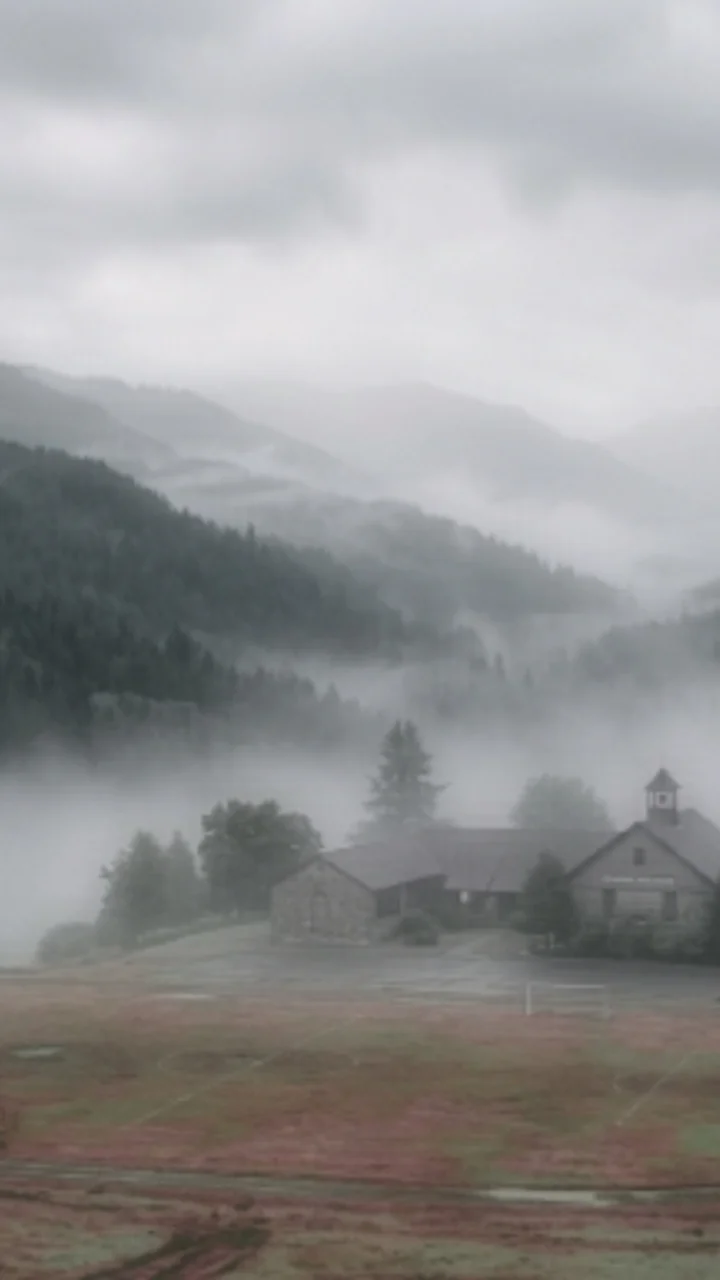
The staff wing hallway was a tunnel of yellowed fluorescence and muffled silence. Clara’s footsteps on the worn runner were swallowed by the thick quiet, the air smelling of old wood polish and the faint, sweet starch of laundered linen. She moved through the dimness like a swimmer through murky water, her body still humming with the contradictory warmth of Finch’s tea and the cold dread of his touch. She needed a true north. She needed the solid, conflicted anchor of Althor’s presence, the one man whose guilt felt like a promise of something real beneath the performance.
A figure stood at the far end of the corridor, backlit by the sconce outside Althor’s door. The shape was unmistakable: the broad shoulders, the patient stillness, the tilt of the head that suggested listening. Relief, warm and desperate, flooded her chest. “Professor Althor?” Her voice was a frayed thread in the quiet.
The figure turned. The light from the sconce carved the planes of Professor Maddox’s face—the same strong jaw, the same paternal concern etched into his features. His smile was a perfect replica of warmth. “Clara, my dear. Are you quite alright?” His voice was a deep, resonant cello of care, so like Althor’s it made her bones ache.
But his eyes held the difference. Where Althor’s gaze would have been shadowed with a complicated guilt, Maddox’s held a quiet, gleaming victory. It was a subtle thing, a spark of recognition in the pale blue, a slight crinkle at the corner that wasn’t kindness—it was amusement. He had been waiting. He had known she would come looking, and he had known she would mistake the silhouette. The world didn’t tilt; it solidified into something colder. The sanctuary of the staff wing evaporated, leaving only a hunting ground lined with linen and old wood.
“I… I thought you were someone else,” Clara said, her voice small. She took a step back, her heel catching on the runner.
“Did you?” Maddox asked, his tone gently teasing. He took a step forward, not encroaching, but closing the distance she had created. His hands were clasped before him, a picture of benign patience. “We must look quite alike to you in this poor light. A pair of weary old watchmen.” He chuckled, a soft, rumbling sound. “What did you need from Professor Althor? Perhaps I can be of assistance.”
The offer was draped in velvet concern, but it felt like a trapdoor opening beneath her. To confess she needed comfort, needed an anchor—it would be handing him a tool. “It’s nothing,” she said, forcing her chin up. “A question about the reading. It can wait.”
“Are you certain?” Maddox’s head tilted, his eyes scanning her face with clinical tenderness. “You look pale, Clara. The fever hasn’t fully left you, I think. The courtyard air is damp. It’s no place for recovery.” His words mirrored Finch’s, Althor’s, the entire chorus of paternal worry, but the melody was off. Beneath the harmony ran a bass note of possession. *I see your weakness. I note your distress.*
“I’m fine,” she insisted, the words brittle. “Thank you, Professor.”
“Of course.” He didn’t move to let her pass. He simply stood, blocking the way to Althor’s door, his presence a warm, immovable object. “You know where my study is, Clara. My door is always open. For any… questions.” He emphasized the last word, letting it hang in the stale air between them. Then, with a final, appraising look that felt like being inventoried, he gave a slow nod and turned, walking away down the shadowed hall without another word.
Clara stood frozen, the afterimage of his knowing smile burned into her vision. The haze she felt wasn’t from fever anymore. It was a fog of indistinguishable faces, of mirrored concern, of warmth that could be a shelter or a cage depending on which identical man offered it. She turned and walked away, her steps quicker now, fleeing the fluorescent tunnel for the marginally safer gloom of the main corridors.
She found Maya in their dorm room, sitting on the edge of her perfectly made bed, methodically polishing a single, already-shiny shoe. The rhythmic swipe of the cloth was the only sound. Maya didn’t look up as Clara entered and closed the door, leaning back against it as if barricading herself.
“You saw one of them,” Maya stated, her voice flat. She examined the shoe’s toe.
“Maddox. In the staff wing. I thought he was Althor.” Clara’s own voice sounded distant to her ears.
Maya’s hands stilled for a moment, then resumed their polishing. “And the world got a little smaller.”
“It’s like they’re all the same man,” Clara whispered, sliding down the door to sit on the thin carpet. She pulled her knees to her chest. “They use the same words. The same tone. They offer the same damn tea. How are you supposed to know which warmth is real?”
“You’re not.” Maya set the shoe down with precise finality. “That’s the point, Clara. The realness isn’t the feature. The consistency is. It doesn’t matter if it’s Althor’s guilt or Finch’s poetry or Maddox’s… curation. The effect is the same. You get lonely, you get scared, you get cold. And there’s a warm, deep voice asking you how you feel. The source is interchangeable.”
Clara rested her forehead on her knees. The cute clips in her hair felt silly now, childish ornaments in a game that was no game at all. “I yelled at Althor today. I hit him.”
“And he held you while you cried,” Maya finished, not a question. She finally looked at Clara, her dark eyes weary. “And then you hated yourself for liking it. And then you went looking for him again.”
The accuracy was a slap. Clara didn’t deny it. “What do you do, Maya? How do you not… want it?”
A faint, bitter smile touched Maya’s lips. “I want it every day. I just don’t trust it. There’s a difference. I let Finch check my homework. I let Maddox ask about my sleep. I perform the grateful student. It keeps the harsher eyes off me. But I never drink the tea. I never follow them into rooms. And I never, ever mistake one for the other.” She tapped her temple. “You keep a ledger. Althor: holds you when you cry, leaves you notes, smells like guilt. Maddox: collects distress, smiles with his eyes closed, smells like formaldehyde and peppermints. Finch: trades poems for vulnerability, touches your hair. They are not the same. The trap is letting them feel the same.”
There was a soft knock at the door. Both girls froze. It wasn’t the authoritative rap of a female teacher; it was tentative, student-like.
Maya nodded to Clara, who slowly got to her feet and opened the door a crack.
A girl stood there, a first-year by the look of her too-neat uniform. She had wide, frightened eyes and mousy brown hair pulled into a tight braid. “I’m Moira?” she said, as if unsure. “From the hallway? Professor Finch said… he said you were kind. He said if I was feeling lost, I might find you two.”
Clara and Maya exchanged a look. A referral. Finch was sending them his wounded birds, expanding his ecosystem of care. Clara opened the door wider. “Come in.”
Moira shuffled in, clutching a leather-bound journal to her chest. She perched on the edge of Clara’s unmade bed, looking between them with a desperate hope. “I just… the fog. It’s so constant. And my dorm head is Miss Harpy. She took my letters from home. Said they were a distraction.” A tear traced a clean path down her cheek. “Professor Finch gave me a butterscotch. He said it would help.”
Of course he did. Clara felt a surge of nausea that had nothing to do with fever. She saw herself in Moira’s wide eyes, the raw, uncomplicated need for a gentle word.
Maya’s voice was softer than Clara had ever heard it. “The butterscotch is a down payment, Moira. He’ll ask you what’s wrong. He’ll listen. He’ll seem like the only person in this whole frozen place who sees you.”
Moira nodded eagerly. “Yes! He already does.”
“And then,” Maya continued, her words dropping like stones, “you’ll owe him. Not with money. With pieces of yourself. Every worry you share, every tear he dries, it goes into his ledger. And one day, when you’re so tangled up in his kindness you can’t breathe without it, he’ll ask for something back. Or someone else will. And you’ll give it, because what else do you have?”
Moira’s hopeful expression shattered into confusion and fear. “But… he’s nice. He’s the only one who’s nice.”
“I know,” Clara said, her voice thick. She sat beside Moira, not touching her. “That’s exactly why it works.”
The three of them sat in the dim room, the fog pressing against the window like a silent watcher. Clara looked from Maya’s resigned clarity to Moira’s crumbling innocence, and felt the haze inside her crystallize into a cold, hard clarity. The warmth was a system. The fatherly care was the bait. And they were all, every one of them, swimming in the same poisoned water, mistaking the same hooks for lifelines.
Clara stood. The movement felt heavy, final. She looked at Moira’s tear-streaked face, then at Maya’s resigned, knowing eyes. “You should stay with her,” Clara said, her voice low. “You’re better at this. I can’t even…” She trailed off, gesturing vaguely at herself, at the lingering disorientation from the hallway, from the courtyard, from the sheer weight of indistinguishable paternal concern. “I have a headache.” It wasn’t a lie. A dull, persistent throb had settled behind her eyes, a physical echo of the cognitive haze.
Maya gave a single, slow nod. She understood the unspoken part: *I am a liability right now.* “Go,” she said softly. “Breathe different air.”
Clara didn’t go to her dorm. The thought of the small, fog-pressed room made her skin feel tight. She walked, her soft-soled shoes silent on the stone floors, through the sleeping heart of Winter’s Gentle Keep. The grand staircase was a cavern of shadows, the portraits of severe founders watching her descent with painted indifference. She pushed through a heavy oak door into the academic wing.
The corridor here was a tunnel of blue dark, the tall windows lining one side offering a view to the outside world. It was 5 AM. A deep, saturated indigo hung over the grounds, bruised at the horizon with the faintest suggestion of gray light. It was raining—a steady, whispering drizzle that blurred the world into a watercolor of grays and greens. The smell of wet soil and decaying leaves seeped through the old window frames, cold and clean and achingly familiar. She loved this smell. It was the only thing here that felt honest.
She stopped at a familiar door: PHYSICS. Professor Althor’s classroom. She tried the handle. It was unlocked. The classrooms always were; the school’s trust was a weapon, an assumption you had nowhere better to be.
She slipped inside and closed the door behind her, the click echoing in the vast silence. The room was a cathedral to empty order. Rows of wooden desks faced the large slate chalkboard, which was still covered in yesterday’s equations. The air was cool, smelling of chalk dust, old paper, and the faint, clean scent of the rain outside. The only light was the gloomy predawn glow filtering through the bank of windows, painting everything in shades of charcoal and ash.
Clara moved to her usual seat, third row from the front, beside the window. She ran her fingers over the carved initials in the desktop, not her own. She sat. For a long moment, she just stared at the board. The formulas were a ghostly white scrawl in the dim light. *Resistance (R). Current (I). Voltage (V). V = IR.* The relationship between force, flow, and opposition. The law governing every circuit. Her eyes traced the symbols for static charge, for flowing electricity. A circuit needed a complete path. A break, and the flow stopped. The light went out.
Her head throbbed in time with her heartbeat. The headache was a tight band around her temples, pressing inward. She let out a slow breath, the sound loud in the quiet. She folded her arms on the cool desktop and lowered her head, resting her forehead on her sleeves. The rough wool of her blazer was scratchy against her skin. She closed her eyes, but the equations remained, burned on the backs of her eyelids. *Resistance. Flow. Opposition.*
The rain whispered secrets against the glass. The world outside was a study in monochrome motion, the distant pine trees just darker smudges in the fog. Here, in the empty room, the performance stopped. There was no one to be strong for, no one to suspect, no kind face to misinterpret. There was only the ache in her head and the cold, clean truth of the rain. She felt a single, hot tear seep from beneath her closed eyelid, soaking into the wool. It was not a sob, just a slow leak of exhaustion. She didn’t wipe it away.
She didn’t hear the door open. The first she knew was the subtle shift in the air, a displacement of the room’s silent equilibrium, followed by the soft, definitive click of the latch engaging. Her head snapped up.
Professor Althor stood just inside the doorway, a dark silhouette against the darker hall. He held a steaming ceramic mug in one hand. He wasn’t dressed for the day; he wore a simple, thick-knit charcoal sweater and dark trousers, his hair slightly damp, as if from a shower. He looked at her, his expression unreadable in the low light. There was no surprise in his posture. It was the stillness of a man who had found exactly what he was looking for.
“I saw the light from the hall,” he said, his voice a low rumble that fit perfectly in the rainy morning quiet. He didn’t move closer. “The reflection on the floorboards. It’s usually dark in here at this hour.”
Clara straightened up, swiftly wiping her cheek with the back of her hand. Her heart was a trapped bird against her ribs. “I couldn’t sleep.”
“Neither could I.” He finally walked in, his steps quiet on the wooden floor. He didn’t approach her desk. Instead, he went to his own, at the front of the room, and set the mug down. He leaned back against the desk’s edge, facing her. The steam from the cup curled upward, a fragile white thread in the blue dark. “Headache?”
She nodded, wary. “How did you know?”
“You’re squinting. And you’re here.” He gestured vaguely at the room. “It’s where I come when mine is bad. The quiet. The order of it.” He studied her for a moment. “You met Moira.”
It wasn’t a question. Clara felt a chill that had nothing to do with the room’s temperature. “Finch sent her to us.”
“I know.” Althor’s jaw tightened, a faint ripple in the shadows of his face. “He told me. He thought he was being… helpful. Building a support system among the students.” He said the last words with a faint, bitter edge. “He doesn’t always see the weight of the gifts he gives.”
“It’s not a gift,” Clara said, her voice harder than she intended. “It’s a transaction. Maya explained it. The butterscotch is the down payment.”
Althor was silent for a long moment, looking out at the rain-streaked window. “Maya Chen is a very perceptive young woman. And she is not wrong.” The admission hung in the air, stark and undeniable. He looked back at her. “Is that what you think this is? A transaction?”
“What else would it be?” The words burst out of her, fueled by the headache, by the lingering shame of mistaking Maddox for him, by the terrifying clarity in the dorm room. “You give comfort. You listen. You hold girls when they cry. And what do you get?”
He didn’t flinch. “What do you think I get, Clara?”
“I don’t know!” She stood up, the desk legs scraping harshly against the floor. The sound was violent in the quiet. “That’s the worst part. I don’t know if it’s guilt, or some… some need to feel like a savior, or something worse. All I know is it works. It works on Moira, it works on me. We’re so cold and so lonely that we’ll take warmth from anyone, even if we know it’s going to burn us later. And you all just stand there, handing out matches.”
Althor pushed off from the desk. He didn’t advance, but his presence seemed to fill the space between them. “You think I don’t know that?” His voice was low, intense. “You think I don’t lie awake knowing that every kindness I offer in this place is filtered through a system that turns it into a weapon? That my hand on a shoulder can be a comfort one moment and a claim the next, depending on who’s watching?” He ran a hand through his damp hair. “You asked what I get. Most nights, I get a stomach ache. I get the memory of a girl flinching because my voice is too much like another man’s. I get to play the gentle father in a production where the finale is always the same.”
Clara stared at him, her breath coming fast. The raw frustration in his tone was new. It wasn’t the polished guilt, the performative anguish. This was quieter, more exhausted. More real. “Then why do you do it?”
“Because the alternative is leaving you to the Harpies and the Crofts,” he said simply. “Because if I resign, they replace me with another Finch, or another Maddox, and there is no one left in the staff room arguing for restraint, for boundaries, for *seeing you as children* instead of…” He stopped, cutting himself off.
“Instead of what?” Clara whispered.
He didn’t answer. He looked at the chalkboard, at his own handwriting. “You study the laws of electricity. You know a circuit must be complete to flow. This place… it’s a broken circuit. The women provide the negative charge—the cold, the lack, the discipline. The men are positioned as the positive terminal—the warmth, the solution, the comfort. The students complete the circuit. Your need is the current. Your loneliness is the energy that makes the whole damn thing light up.” He finally looked back at her, his eyes dark pools in the dim light. “I can’t break the circuit, Clara. But I can try to be a resistor. I can try to slow the current down. Make it less… damaging.”
The metaphor was so apt it stole her breath. It was the cold, systemic understanding she’d reached in the dorm, but articulated with the precision of his subject. He saw the machine, too. He was trapped inside its wiring. The realization was more disorienting than any fog.
He walked over to the window beside her desk, looking out at the weeping sky. “You came here because you had a headache. Because you needed a place that felt neutral. That felt like *yours*.” He glanced at her. “This is your seat, isn’t it?”
She nodded, unable to speak.
“I know,” he said softly. “I’ve always known.” He turned fully toward her now, his large frame blocking the gray light. “Let me try to be a resistor. Just for a moment.” He raised his hands, slowly, palms open, showing he held nothing. “Your head is paining you. May I?”
Every warning screamed in her mind. *Maya’s ledger. Althor: holds you when you cry. The trap is letting them feel the same.* But he was asking. And the pain was a sharp, bright knot behind her eyes. And he had just called the school’s care a weapon, had called himself a component in a broken machine. The contradiction was the crack in his armor.
She gave the smallest, barely perceptible nod.
He stepped closer. He didn’t touch her head, not at first. His hands came to rest lightly, warm and solid, on her shoulders. His thumbs pressed gently into the tense muscles at the base of her neck. A jolt went through her—not fear, but a shocking, immediate relief. The touch was firm, specific, clinical almost. It was the opposite of Maddox’s possessive appraisal or Finch’s poetic caress. This was mechanics. Physics.
“Breathe out,” he murmured.
She did, a shuddering exhale she didn’t know she was holding. His fingers began to move, finding the tight cords along her shoulders, kneading with a steady, practiced pressure. It hurt, a good hurt, the hurt of something locked up beginning to loosen. He worked in silence, his focus absolute. The only sounds were the rain, their breathing, and the soft, almost inaudible rustle of his sweater sleeves.
His hands moved up, his fingers sliding into her hair, his thumbs finding the precise points at her temples. The pressure was exquisite, a direct counterpoint to the throbbing ache. A small, helpless sound escaped her lips—a sigh of pure, uncomplicated surrender. She felt her eyelids flutter closed. The world narrowed to the heat of his hands, the scent of clean wool and plain soap on his skin, the dissolving pain.
“You carry it all here,” he said quietly, his voice a vibration she felt through his fingertips. “The suspicion. The fear. The want. It knots the muscles. Steals the sleep.” His thumbs made slow, circular motions. “You cannot be on guard every second, Clara. The circuit will overload. You must find the breaks. The quiet places. Even if they’re only five minutes long, in an empty classroom, in the rain.”
His words washed over her, seeping in along with the relief. This didn’t feel like a transaction. It felt like a secret. A stolen moment outside the machine. Her body, traitorously, melted into his touch. The last of her resistance bled away, leaving her boneless and pliant under his hands. She was leaning into him, her forehead almost touching the soft wool of his sweater. She was warm. She was safe.
And that was the most dangerous feeling of all.
His hands stilled. They didn’t leave her skin, but the kneading pressure ceased. They simply rested there, cradling her head, his thumbs now motionless on her temples. His breathing had changed. It was deeper, slower. She could feel the solid wall of his chest, so close to her own. The moment stretched, thin and taut. The quiet was no longer neutral; it was charged, waiting.
Clara opened her eyes. She was looking at the weave of his sweater, inches from her face. She slowly tilted her head back to look up at him.
He was looking down at her, his face shadowed. But his eyes were clear. They held no gleaming victory, no poetic melancholy. They held a profound, weary conflict. And something else, something hotter and more immediate. His gaze dropped to her lips, just for a fraction of a second, before snapping back to her eyes. A flush of heat that had nothing to do with headache relief spread through her, pooling low in her stomach. Her breath caught.
His hands tightened, almost imperceptibly, in her hair. Not a pull. A possession. The resistor was failing. The current was finding a path.
Outside, the rain fell harder, sheeting down the window, blurring the world into nothing.
The tinny, distorted chime of the school’s intercom sliced through the charged silence between them. A click, then Headmistress Croft’s voice, flat and efficient, echoed from the speaker in the ceiling corner. “Due to inclement weather, all morning classes are postponed until further notice. Students are to remain in their designated common areas. Staff, please report any flooding in the lower corridors.” Another click. The silence that followed was thicker, more intimate, as if the announcement had sealed them in.
Clara let out a long, slow sigh, her gaze drifting to the window where the rain painted the world in weeping streaks of gray and dark blue. The fog beyond the glass was a solid wall, swallowing the courtyard, the trees, the distant gates. It felt less like weather and more like a state of being. The tension in her shoulders, so recently kneaded into submission, threatened to coil again. But instead, she did something she didn’t plan. She leaned forward, letting her forehead rest fully against the soft, damp wool of Althor’s sweater. It was a nestling motion, almost cuddly. She gave a small, wordless shake of her head, a plea for the massage to continue.
Althor went very still. Then, a low, warm chuckle vibrated through his chest and into her skin. It wasn’t the careful, measured sound she was used to. It was breathy, surprised, a genuine release of air. “Demanding,” he murmured, but his hands obeyed, his fingers sliding back into her hair, his thumbs resuming their slow, perfect circles at her temples. The pressure was divine.
“The rain cancelled everything else. So. We have a tutorial.”Clara felt her body soften further, accepting the premise like a blanket.
He shifted, just slightly, turning them both so he could look past her at the chalkboard. His hands remained cradling her head, one thumb still stroking her temple. “We were discussing the flow of electricity. The completed circuit.” He nodded toward his own handwriting from the previous day. “But there’s a related concept. Resistance.”
He began to talk. Not in the performative, gentle-father tone, but in his real teacher’s voice—engaged, slightly pedantic, lit with a genuine passion for the subject. He explained Ohm’s Law. He described how resistance isn’t an obstacle to be eliminated, but a necessary property that controls the flow, protects the components, turns raw power into useful work. He used the metaphor of a river and a dam. He pointed to the diagrams with his free hand, his other arm a steady bracket around her shoulders, his fingers absently stroking the hair at her nape.
Clara listened, her headache a distant memory. She watched the rain blur the world outside and felt the solid warmth of him at her back, the rhythmic motion of his hand. This was the trap, she knew. This exact feeling. The suspension of fear. The wholesale buy-in to a moment of uncomplicated, paternal warmth. But knowing it was a trap didn’t stop her from wanting to live inside it. For just this hour. As he talked about joules and coulombs, she felt lighter than she had in weeks.
Althor was not pretending he was being genuine he was being real with his heart. He didn’t plan any trap he just wanned to be thr physics teacher he always wanned to be that's all there was. And he felt lighter when he did. Clara broke out of her sadness as well she was just as normal and happy she was smiling and genuinely chuckling at his teaching. Lighter. Softer. Simpler.
Althor seemed lighter, too. The grim set of his jaw had relaxed. The weary conflict in his eyes had banked, replaced by the clean focus of instruction. He was in his element. This was the man he might have been, in a different building, under a different sky. When she asked a halting question about parallel circuits, his face lit with a teacher’s pleasure. “Exactly,” he said, and he reached for a fresh piece of chalk, his movement finally forcing him to break contact with her.
The cold air rushed in where his warmth had been. Clara wrapped her arms around herself, watching him. He drew swiftly, confidently, the chalk squeaking in the quiet room. The lines were clean, the symbols precise. He explained how current chooses the path of least resistance, but how every path, no matter how easy, still has a cost. His voice was calm, steady, a harbor in the storm of fog and rain. He was just a teacher. She was just a student. The fiction was so potent it felt truer than the truth.
He finished the diagram and turned back to her, dusting chalk from his fingers. A soft, almost shy smile touched his lips. “Any of that make sense, or have I put you to sleep?
Clara’s laugh was a bright, clear sound that seemed to startle the rain-streaked windows. It was genuine, unburdened, the kind of laugh she hadn’t heard from herself since before the gates of Winter’s Gentle Keep closed behind her. “No, you didn’t put me to sleep,” she said, wiping a stray tear of mirth from the corner of her eye. “But I think you lost me at ‘potential difference.’ It sounds like a philosophy problem.”
Althor’s smile widened, softening the lines of fatigue around his eyes. He leaned back against the edge of his desk, crossing his arms. The pose was loose, unguarded. “It is, in a way. Everything is potential until it finds a path. Then it becomes current. Action.” He nodded toward her. “You’re full of it. Potential.”
The comment hung in the air, warm and uncomplicated. Clara hugged her knees to her chest, resting her chin on them. The hard plastic of the chair was uncomfortable, but she didn’t want to move and break the spell. For these suspended minutes, the fog outside was just weather. The dim classroom was just a room. He was just a teacher, a good one, who cared about his subject. She was just a student who finally understood a difficult concept. The simplicity was a narcotic.
“What’s the path, then?” she asked, her voice quieter. “For all that… potential.”
He considered her, his head tilted. The fluorescent light buzzed overhead, a faint, persistent note beneath the drum of rain. “That’s the only real question, isn’t it? The school… it’s designed to be the path of least resistance. It’s easier to be comforted than to be alone. It’s easier to be guided than to be lost. The current flows where it’s easiest.” He pushed off the desk and walked to the window, looking out at the obliterating gray. “My job—the job I wanted—was to be a different kind of path. One with higher resistance. One that made you stronger for traveling it, not just… comfortable.”
Clara watched his broad back, the slump of his shoulders. The confession felt like a gift, a heavy one. “Is that what this is?” she gestured vaguely between them, at the chalk dust and the shared quiet. “Higher resistance?”
He didn’t turn. “I don’t know what this is,” he said, his voice barely above a murmur. “It feels like a short circuit. A direct connection that bypasses all the safeguards.”
The air in the room changed. The warmth took on a charge. Clara’s skin prickled. She uncurled from her chair, her socks silent on the linoleum as she walked to stand beside him at the window. She didn’t look at him. She looked at their faint, ghostly reflections superimposed over the fog. They stood close enough that the heat from his arm radiated against her shoulder.
“Safeguards are for machines,” she said softly.
“We are machines, Clara. Flesh and blood and wiring. Just… exceptionally complicated ones.” He finally turned his head to look down at her. His expression was open, raw with a conflict that had nothing to do with deception. It was the conflict of a man who knew the rules of his own prison. “The safeguards are there for a reason.”
“To keep the current controlled.”
“Yes.”
“What happens if it isn’t?”
His gaze was a physical weight. It traveled over her face, from her eyes, still slightly puffy from earlier tears, to her lips, still curved from her recent smile. “It burns things out,” he said, his voice low and rough. “It destroys the components.”
The distance between them was less than a breath. Clara could see the individual flecks of gray in his brown eyes.. She could smell the chalk on his hands, the clean, plain soap. Her heart was a frantic, living thing against her ribs. Every warning, every lesson from Maya, every chilling encounter with Maddox—they were still there, a chorus in the back of her mind. But they were distant, muffled by the rain and the profound, disarming honesty in his face. This was not a performance. This was a man standing at the edge of a cliff he’d sworn never to approach.
She saw the moment he decided to step back. A subtle tightening around his eyes, a slow, deliberate inhalation as he broke their gaze to look back out the window. The loss of his attention felt like a sudden chill. He cleared his throat, the sound awkward in the thick quiet. “You should go. Before the common areas get too crowded. Before… someone comes looking.”
The dismissal was gentle, but it was a dismissal. The tutorial was over. The circuit was broken. Clara felt the return of the real world like a pressure change in her ears. The fog outside was no longer just weather; it was the Keep, waiting. She nodded, a sharp, jerky motion. “Right.”
She turned and walked back to her chair, sliding her feet into her loafers. The simple act felt absurdly difficult. Her body, so recently pliant and warm under his hands, now felt clumsy and cold. She gathered her blazer, not looking at him. “Thank you. For the lesson.”
“Clara.” His voice stopped her at the door. She glanced back. He hadn’t moved from the window. His profile was etched against the gray light, a study in quiet regret. “The path of least resistance… it’s still a path. It still leads somewhere. Be careful which one you choose.”