
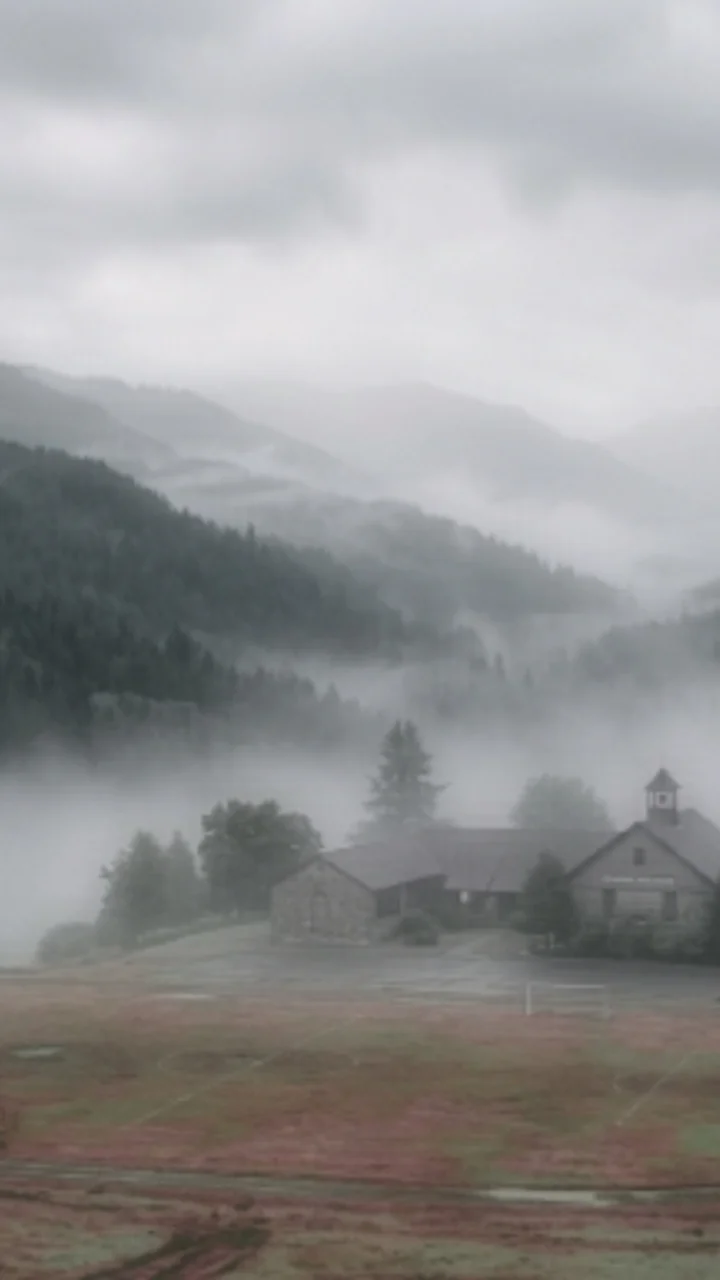
The room smelled of him. Not just the pine soap from the basin, or the cold stone of the walls. Him. Butterscotch, yes, the ghost of the candy on her tongue. And wood—not the damp rot of the forest outside, but something dry and warm, like a study with a fire. Cedar, maybe. Did he smoke? She couldn’t place it. She breathed in, and the scent filled her lungs, intimate and suffocating. His skin had looked like warm milk tea in the candlelight last night. Beautiful. The thought made her stomach twist. There was no sunlight here to give anything that warmth. Only fog, mist, rain, and the endless fluorescent hum of hallways.
The floorboards were icy under her bare feet. Her socks were gone. Taken off, with care, while she drifted in that fever haze. She couldn’t remember which hands had done it. Four sets of them, hovering, adjusting the quilt, smoothing her hair. Four men wanting to serve her. “Serve” her? She sighed, the sound loud in the silent room. She hated Wilson. She was neutral about Finch—a wary, watchful neutral. But Althor? They had lore now, a tangled history of almost-kisses and protective lies and hands that both wounded and soothed. And Maddox. Evil, warm, spoiled milk. His thumb at her lips, the syrup, his quiet, pleased eyes. The deception was insane. It was perfect. She made a scrunched face at herself in the dim air.
She stood, the wool blanket falling away. Her uniform was rumpled, her white blouse untucked. She felt hollowed out, light-headed from the fever’s departure. She needed to move. She walked to the wardrobe, an old oak thing that stood sentinel in the corner. Opening it felt like a violation. The intimate smell of him grew stronger—wool, that cedar note, a faint trace of chalk. His clothes hung neatly: dark sweaters, pressed trousers, a single, good winter coat. Her heart hammered against her ribs. What was she looking for? Proof? A secret? She just needed to do something, to touch the reality of this place he lived in.
She rustled through the garments on the hanger. Her fingers brushed the sleeve of a black sweater. It was soft, worn thin at the elbow. And there, on a small hook inside the door, she saw them. Her socks. Small, white, student-issue ankle socks. They were folded neatly, laid side-by-side with a pair of his. His were black, thick, woolen. The two pairs looked domestic together. Planned. A message. Her breath caught. What an intimate thing it is, isn’t it? To have your professor fold your socks and place them beside his own. The care of it was a cage. She snatched her socks back, the cotton cold in her fist.
She didn’t know what to do. How to get out of this room, this wing, this feeling. She pulled the socks on, the simple act feeling like a reclaiming. She smoothed her skirt, finger-combed her messy chestnut waves. No clips today. She felt stripped. She went to the door, pressed her ear against the cold wood. Silence in the corridor. She turned the handle. It gave without a sound. He hadn’t locked her in.
She slipped out. The male staff wing was a tunnel of warm, yellow light from sconces, a stark contrast to the blue-white fluorescence of the student halls. It felt like a different organ of the school, a secret heart. Wilson’s door was next to Althor’s, shut tight. Such an annoying place. She looked to the right. Another door, identical. Who’s room was it? Maddox? Finch? She didn’t know. She stared at the grain of the wood. Oddly, she wished it was Maddox’s. The thought came unbidden, a dark little curl in her mind. She didn’t know why she wished that. The memory of his touch wasn’t pleasant. It was clinical. Possessive. But it had been a choice, a direct line of attention. Althor’s kindness was a maze. Maddox’s was a straight road to a known destination. In that moment, the straight road felt simpler.
She turned and walked quickly down the corridor, her socked feet silent on the runner. The journey to the main hall felt endless. She passed no one. The school was in a class period, the silence a living thing. She pushed through the heavy door into the main corridor, and the world shifted back to cold fluorescence and the smell of damp wool and floor polish. She blinked, disoriented. What time was it?
The cafeteria was empty, long tables bare, chairs tucked in. The high windows showed a solid wall of gray fog. It could have been morning, or afternoon, or some timeless hour in between. The only sound was the distant clatter of pans from the kitchen. She stood in the doorway, unmoored.
“You look like a ghost.”
Clara started. Maya sat at their usual table in the far corner, a single textbook open before her, a cup of steamless tea at her elbow. She hadn’t been there a second ago. Or Clara hadn’t seen her.
“Feel like one,” Clara said, her voice raspy from disuse and sickness. She walked over, her legs weak. She slid into the chair opposite Maya.
Maya’s dark eyes took her in: the rumpled uniform, the bare legs, the absence of her usual clips, the hollows under her eyes. “Croft was looking for you. First period. Harpy made a note.”
“Let her.” Clara rested her forehead in her hands. The pine-and-butterscotch scent seemed trapped in her hair. “I was in the medical wing. Then I wasn’t.”
“I heard.” Maya’s voice was flat. She closed her textbook. “Chen heard from Briggs who heard from Moira who was crying in the west hall bathroom. The story is you collapsed in front of Harpy. That the professors carried you away. That you spent the night in the male wing.” She paused. “Again.”
“It’s not a story. It’s what happened.” Clara lifted her head. “They were all there, Maya. Finch, Wilson, Althor. Maddox.”
At the last name, Maya’s expression didn’t change, but her fingers tightened minutely around her teacup. “Maddox.”
“He gave me medicine. While I was half-asleep. It was…” Clara searched for the word. “Efficient.”
“They’re always efficient.” Maya pushed the cup toward Clara. “Drink. It’s cold, but it’s something.”
Clara took the cup. The tea was bitter, over-steeped. It washed the phantom sweetness of butterscotch from her mouth. “Althor says protecting me makes me a target. To them. The other teachers.”
“He’s not wrong. It’s the economy of this place. Attention is currency. His attention on you is a withdrawal from someone else’s account. They’ll want a deposit.” Maya leaned forward, her voice dropping. “What did they do, Clara? When you were in there?”
“Nothing. And everything.” Clara set the cup down. “They took my temperature. Gave me syrup. Took off my shoes. My socks. Folded my socks, Maya. They put me to bed and… watched. It was like being a doll in a display case. Their concern was so thick I could taste it.”
“And Althor?”
Clara met her gaze. “He held my hand. He told them to back off. He wiped Maddox’s syrup from my mouth. He played the protector. Perfectly.”
“But you wanted him to.” It wasn’t an accusation. It was a statement of weather.
Clara’s throat closed. She looked at the fog outside, the endless, featureless gray. “Yes. And that’s the worst part. My body… it doesn’t care about the trap. It just knows the cold, and he’s warm. My brain screams, and my skin just… leans.”
Maya was silent for a long moment. “You know what they call Maddox, among the seniors who’ve been here longest?”
Clara shook her head.
“The Curator. He doesn’t collect art. He collects distress. The more refined, the better. A panic attack in the library? He’ll be there with a glass of water and a question about your home life. A failed exam? He has the perfect, quiet study carrel reserved. He fixes things. He smooths them over. And he remembers every detail he smooths.”
“Why are you telling me this?”
“Because you said his name differently. And you wished his door was the one next to Althor’s just now.”
Clara froze. “How did you—”
“I didn’t. But I know the look. The calculation. Althor is a storm front—you never know if it’s rain or lightning. Maddox is a locked room. You know exactly what’s inside: order. After chaos, order can feel like a gift.” Maya’s eyes were old. “It’s still a locked room.”
Clara wrapped her arms around herself. The cafeteria felt vast and freezing. “I don’t know what to do.”
“You get through the day. You go to your classes. You let Croft see you’re properly chastened. You accept Finch’s concerned smile in History. You avoid Wilson’s hallway. You take the note Althor undoubtedly left you and you follow its instructions, because the performance is the only thing keeping you safe from the women while you figure out the men.”
“And what are you doing?” Clara asked, a sudden spike of frustration cutting through her fatigue.
Maya smiled, a thin, brittle thing. “I’m waiting. And watching. And making sure when one of us falls into the locked room, the other one still has the key.”
The kitchen door swung open with a bang. Miss Harpy stood there, her pinched face scanning the empty cafeteria until it landed on them. Her eyes, like chips of flint, fixed on Clara. “Vance. You are absent from Botany. Explain yourself.”
Clara stood, her body moving on autopilot. The performance. She let her shoulders slump slightly, kept her eyes downcast. “I was ill, Miss Harpy. In the medical wing. I came straight here to find something to eat.”
Harpy strode over, her shoes clicking like teeth on the linoleum. She stopped too close. Her gaze was a physical inspection, scanning Clara’s dishevelment, her bare legs, the vulnerability. Clara felt the woman’s satisfaction like a cold draft. This was the narrative Croft wanted: the struggling girl, worn down by the school’s rigors.
“The medical wing is not a holiday resort. Your constitution is weak. It invites… attention.” Harpy’s voice dropped on the last word, laced with a venomous implication. “See that you are in my classroom in five minutes. We are dissecting lilies. Try not to faint on the specimen.”
She turned and marched away. Clara released a breath she didn’t know she was holding.
Maya stood, gathering her book. “Five minutes. Better run.”
“Maya.” Clara reached out, caught her wrist. “The note from Althor. It said… ‘The garden shed. The loose stone. After dark.’”
Maya’s composure cracked for a single, fleeting second. Fear, raw and deep, flashed in her eyes. Then it was gone, sealed away. “Don’t go.”
“I have to.”
“You don’t.” Maya pulled her wrist free. “That’s not an instruction, Clara. It’s a lure. The garden shed is where Finch takes the gardening club. The loose stone is where seniors whisper they’ve left things for him. Notes. Trinkets. It’s a honey pot.”
Clara’s heart thudded against her ribs. “Then why would Althor send me there?”
“To see if you’ll go.” Maya shouldered her bag. Her face was a mask of resigned defeat. “To see how hungry you are. The warm hand, the soft word, the secret meeting in the dark… it’s the same test. They all write it. You just have to decide if you’re going to pass.” She walked away, her footsteps echoing in the empty hall, leaving Clara alone with the fog and the crushing weight of the choice, already made, burning like a fever in her veins.