
“You keep asking questions,” Brynn said, “and not drinking.”
“I’m the host.” Soren passed her the bottle anyway. Green glass, no label, stoppered with a whittled plug. What was inside tasted of resin and frost and burned all the way down. “Hosts pace themselves.”
“Hosts don’t usually keep their guests.”
“You’re very attached to that word.”
“Which one?”
“Keep.” He took the bottle back. “Hattie makes this. She says it keeps the wolf out of your blood.”
“Does it?”
“No.” He drank. “But it makes you mind less.”
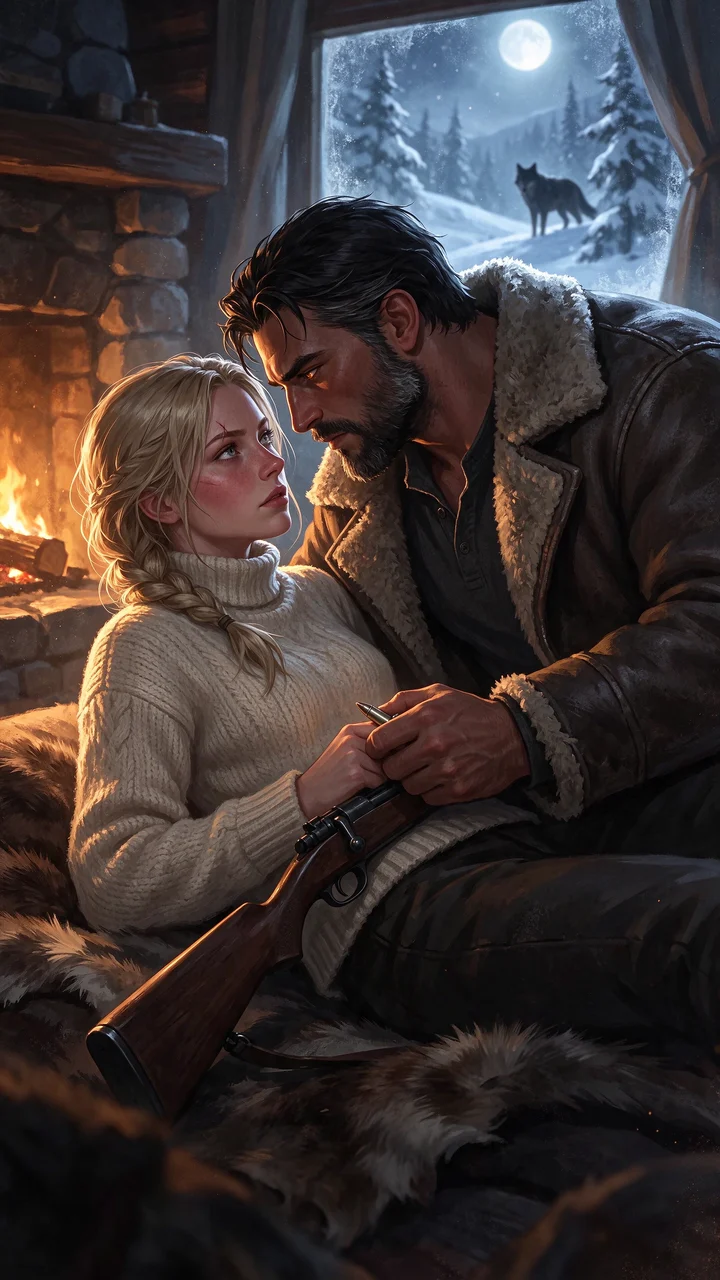
The second storm had come over the saddle at noon on the sixth day, and by dark it had buried the cabin to the eaves. The windows were solid white. Snow had found every gap in the shutters and laid fine lines of powder across the sill. They’d let the fire sink to spare the woodpile, and now it was a bed of red embers ticking in the grate. The only warm place left in the world was the hearthrug, and they were both on it.
She sat with her back against the cot frame and her splint stretched toward the coals. He sat beside her with one knee drawn up, near enough that his shoulder warmed her left side through the wool.
She held out her hand for the bottle. “Ask, then.”
“Why you.”
“Why me what?”
“Abel Strand has forty hunters on his books. Some have been doing this since before you were born. He sent you. Alone. Up my pass in December.” He turned his head. “Why did you say yes?”
She could have lied. She’d lied to better men. But the liquor was warm in her, the dark was close, and he had held her hands as if they were worth saving.
“My father came up here,” she said. “Twenty years ago. Tom Mathers. He cast his own rounds, he was good, and he came up after the Harrow alpha and never came down.” She drank. “I was seven. They never found him. Every year since, Abel says next year, Brynn. Next year you’ll be ready. This year he finally said it.”
“So you came to finish it.”
“I came to finish it.”
“What was he like?”
Nobody had asked her that in twenty years. “He hummed,” she said, slowly. “When he poured silver. Out in the shed, at night, with the lamp turned down. Always the same three songs, and he never knew the words to any of them.”
Soren was quiet a long time.
“And when it’s finished?”
“I get a seat at the table.”
“A chair.”
“It’s not a chair.” She heard her voice go hard. “It’s walking into that room and having them see me. Not his kid who didn’t come home.”
He said nothing to that. Instead he reached up, unfastened the top button of his henley, then the second, and drew the collar aside.
The scar ran along his collarbone, three inches long, puckered and pale against his olive skin, the edges ruined in the way only silver ruined them. She’d seen burns like it on dead wolves. She had never seen one healed.
“Twenty years,” he said. “It still aches when the weather turns.”
She didn’t decide to touch it. Her hand was simply there, two fingertips resting on the raised ridge, and then tracing it, slowly, from the hollow of his throat out toward his shoulder. His skin was very warm. The scar was cooler. Under her fingers he went utterly still, the stillness of a big animal choosing not to move, and his breathing changed, and she knew he’d heard hers change too.
He caught her wrist.
Not hard. Not to stop her. His fingers closed around it and simply held, his thumb settled on the inside, over the pulse that was giving her away. She could have pulled free. They both knew it.
She didn’t.
The embers ticked. The wind flung itself at the shutters and fell back. She leaned in, or he did, or the floor tilted the way it had that first night, and then his face was near enough that she could pick out each silver hair in his beard, taste pine on his breath, count his lashes if she’d wanted to count anything at all. His forehead almost touched hers. They were breathing the same breath. Her lips parted, and what remained between her mouth and his was nothing, a hair, the width of a decision.
He stopped.
She felt him do it. Felt the leash pull taut.
“No,” he said, very low, so close to the corner of her mouth that she felt the word land. “Not like this.”
“Like what?” It came out ragged.
“With your leg broken and my wolves at the door and a bullet between us you haven’t fired yet.” His thumb moved once across her pulse. “I won’t take anything you might want to shoot me for later, Brynn. If you want it, you’ll come and get it. When you’re sure.”
He let go of her wrist.
The cold came back into the space where he’d been. She sat with her hand still lifted and her heart going as if she’d run the ridge, and she hated him, and she wanted, with a clarity that scared her worse than the eyes in the trees, to close those last few inches herself.
Before she could, he reached into his shirt pocket. “Hold out your hand.”
“Why?”
“Humour me.”
She held it out. He laid something in her palm, small and cold and heavy for its size, and folded her fingers over it with his own.
“Three days early,” he said. “I promised you one. I never said when.”
She opened her hand.
A single silver round lay across her palm, tarnished nearly black at the shoulder, the tip dull and scored. Old. Older than anything from the guild forge. She tilted it toward the embers to see the base of the casing, and the red light caught the engraving there, worn shallow but still clear.
A hawthorn sprig. Two letters beneath it. T.M.
She knew that mark. She’d grown up with it. It was stamped into the leather of the bandolier across her chest, cut into the lid of the cartridge box under her bed in Kettering, burned into the bench in a shed where a man had sat at night with the lamp turned low, humming three songs he never knew the words to.
Her hand began to shake.
“Where,” she said. “Where did you get this?”
Soren buttoned his collar over the scar, one button and then the other, and only then looked at her. The embers turned his eyes molten.
“Your father fired that at me twenty years ago,” he said. “I’ve been waiting to see if his daughter has better aim.”