
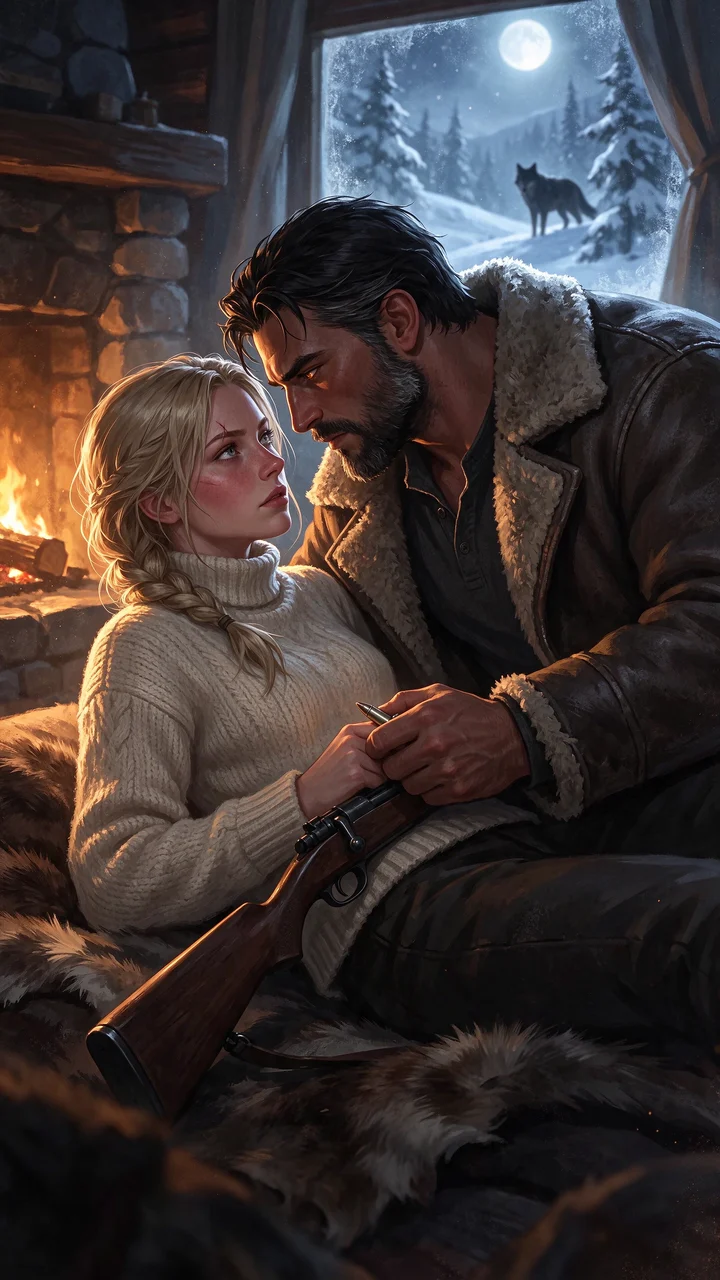
“If it were up to me,” Hattie Moss said, “you’d still be in the ravine.”
She said it to Brynn’s leg, not to Brynn, her cold fingers working along the splint lashings, her parka hood shoved back and snow melting in the black stubble of her hair. She had come through the door an hour after dawn on the second day as if the drift had blown her in, stamped twice, and gone straight to the cot without asking.
“Noted,” Brynn said.
“I want it more than noted.” Hattie yanked a strip tight. Brynn didn’t flinch, which was a small victory and cost her a great deal. “I want it remembered. I set this. I can unset it.”
“Hattie.” Soren, from the hearth, feeding split pine to the fire.
“I’m being a healer.” Hattie sat back on her heels, hazel eyes narrowed. “Bone’s knitting. Fast, for a human. Faster than it ought to.” A glance over her shoulder. “You give her anything?”
“Broth.”
“Mm.” She stood, tall and rangy under the low beams, and buckled her satchel. At the door she lowered her voice, though not by much. Brynn suspected she meant to be overheard. “Lantern’s got men at the foot of the pass. Three, maybe four. When it clears they won’t sit and wonder where their girl went.”
“I know.”
“Do you.” It wasn’t a question. She gave Brynn one last look, the look a woman gives a trap somebody else has set in her kitchen. “Don’t make me bury you for her, Soren.”
Then she was gone into the white, the door swung shut on its leather hinges, and he didn’t bar it behind her. He hadn’t barred it once.
. . .
On the third day, at dusk, Brynn tried it.
She had spent two days watching him. He split wood at noon. He went out before dark and was gone an hour, sometimes two. He drank his coffee black, stood when he was thinking, and read, of all things, with a pencil tucked behind one ear. She knew the creak of the third floorboard and the exact weight of the door.
She did not know what she’d do once she was through it. That part she left to her body.
He went out at four. She counted three hundred, sat up, and shouldered the door open. The cold hit her full in the face. The light had gone the blue of skimmed milk, and the clearing was a bowl of untouched snow ringed by pines bowed nearly double under their load.
She went on her knees and one foot, dragging the splint, the knife between her teeth for the first ten yards and then in her fist. Twenty yards. Thirty. The cold found her wrists, the gap at her collar, the bare skin at the nape of her neck. Her breath smoked. Overhead the pines groaned, wood settling under weight.
At fifty yards she saw the first pair of eyes.
Green-gold, low between two trunks. A second pair to the left. A third, higher, on a rock she’d taken for a stump. She turned her head slowly and they were behind her too, between her and the gold seam of light around the cabin door. Nine. Ten. They didn’t growl. They didn’t need to. They stood in the falling snow and watched her with the bottomless interest of animals that knew how this ended.
Brynn got her good knee under her and raised the knife.
“Come on, then,” she said, and her voice didn’t shake, and she’d be proud of that for the rest of her life.
The snow behind her shifted.
He came out of the dark between the pines without a sound, and the others went still. He was enormous. She had seen wolves all her life, had skinned them on her father’s bench, and this was not that. Black from nose to tail, the ruff at his throat frosted silver, the long muzzle as fine as a hound’s, his heavy winter coat rimed white along the spine. He walked between her and the pack, stopped, and turned his head toward the nearest of them.
That was all. He looked.
The eyes went out one by one, lamps going dark in a house at bedtime. The trees were empty.
Then he turned those same amber eyes on her. Of course she knew them.
She didn’t lower the knife. He didn’t seem to expect her to. He came around to her left side, the splinted side, and stood there, close enough that his heat reached her through the snow, close enough that her fingers would have sunk into that ruff if she’d moved them three inches. She didn’t. He waited.
So she crawled back. Fifty yards, knife in her fist, knees gone numb, and he walked beside her every inch of it, matching her pace, his great feet soundless in the drifts, his breath clouding at her shoulder.
She hauled herself through the door and onto the cot on her elbows, shaking so hard her teeth knocked. When she looked back, the clearing was empty.
Ten minutes later the door opened and Soren came in wrapped to the chin in a grey wool blanket, his hair wet, snow melting in his beard.
He said nothing about it.
He knelt by the cot. “Your splint’s turned.”
“I’m aware.”
“May I.”
It wasn’t quite a question, and it wasn’t quite not one. She gave him a short nod. He unknotted the frozen wool and eased the birch back into line, his palm flat and warm against the back of her calf to hold it steady. She gripped the edge of the cot. She didn’t look away. If he was going to put his hands on her, she would watch him do it.
He worked slowly. His thumb found the knot of muscle above her ankle that had seized in the cold and pressed, once, until it let go, and a sound came out of her she would have cut from the record if she could. He didn’t look up. His jaw moved, very slightly.
“Hands,” he said, when the splint was bound.
“They’re fine.”
“They’re white.” He took them anyway, both of them, between his own, and chafed them. His palms were rough as split bark and hot as hearthstones. Feeling came back in needles. Then it came back as something else: the slow thud of his pulse at the heel of his hand, his thumbs dragging across her knuckles, the smell of snow and smoke and wet wool and him.
She took her hands back. She did it first, and fast, and was furious that she’d had to.
He let her go without a word and went to the fire.
. . .
The wind rose after dark and worried at the shutters.
“Why haven’t you killed me?”
He was a shape against the coals, the blanket traded for the henley again, forearms on his knees. He didn’t turn.
“You’ve had three days,” she said. “You had me in the ravine. You had me out there tonight. Your wolves wanted me. I saw it.”
“They did.”
“So why?”
The fire ticked. Somewhere in the pines a branch let go of its snow with a long, soft sigh.
“I’m curious,” he said.
“About what?”
He turned his head, and the coals found his eyes and lit them.
“Which of them you’ll turn out to be.”
“Which of who?”
He looked back at the fire and didn’t answer, and she lay awake a long time with the question in her mouth and her hands still warm.