
"The printer's a Heidelberg," Emma said. "Five-color, older than both of us, and it lives in a basement in Bermondsey. If we miss the ten o'clock slot, the next one is Thursday, and Thursday is the day the crates arrive from Rotterdam, so Thursday is dead."
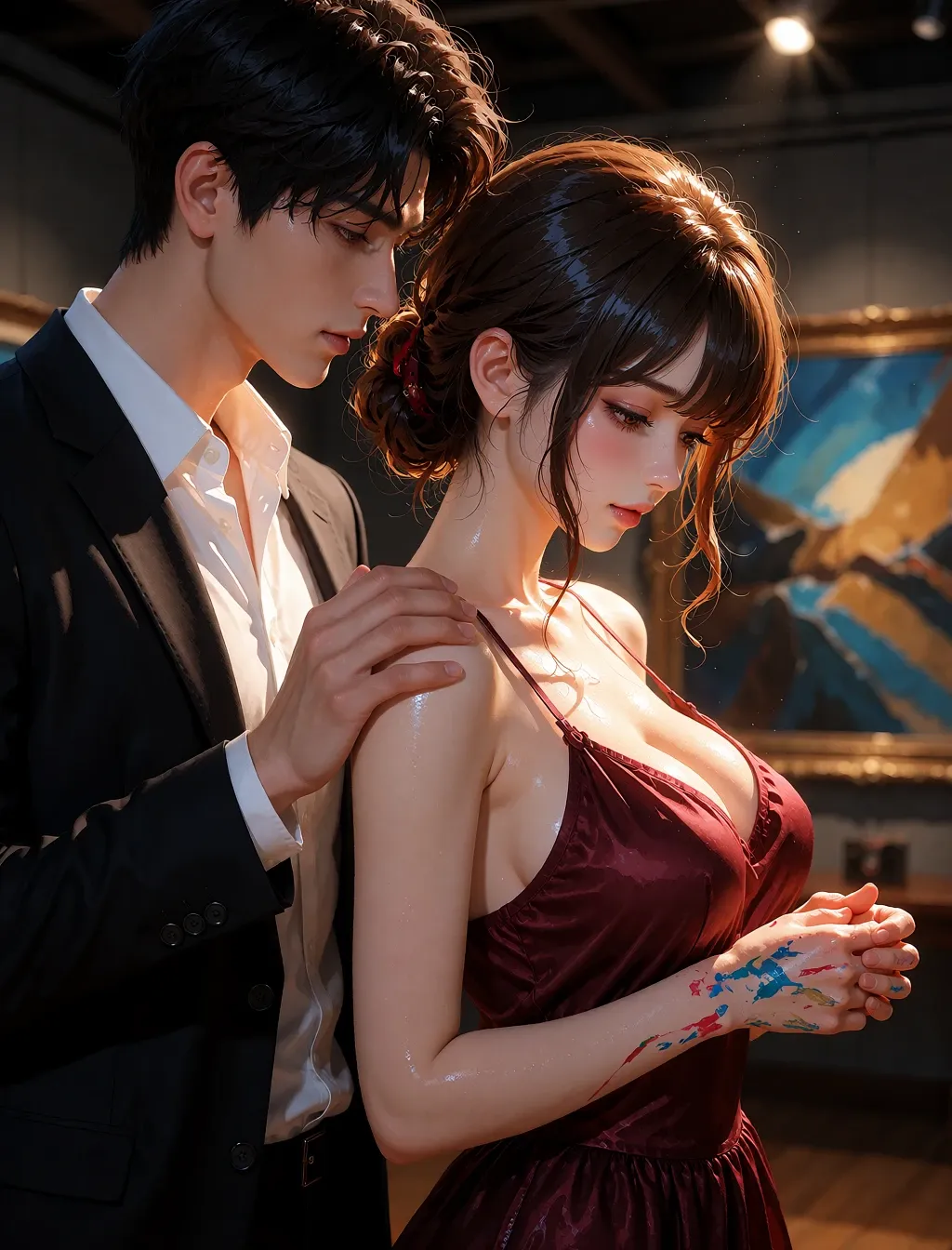
Julian had not moved. His forearms rested on the oak, the wet cuffs of his shirt dark and flat against the wood, and the lamplight made a small gold ring on the table between them where the water had run off him.
"How many colors in the anchor piece?" he asked.
"Four. But the red needs a pass of its own or the whole thing goes the color of liver." She caught herself. "It's a technical term."
"I know what liver looks like."
Emma pulled her chair in. The scrape of it was loud in the empty building. "So it's a five-color run for a four-color painting, because the artist painted like he was trying to get the red to stand up off the canvas, and it does, it does stand up, you can feel the ridge of it under your thumb. If we print it flat he'll know in a second and he'll be right to know."
Julian turned his head slightly, listening the way he'd promised—like a man who worked for her—and she found she did not like it as much as she'd expected. It left her nothing to push against.
"Go on," he said.
She went on. She talked about stock weight and the way the catalogue's matte cover would drink the ink and come out looking like newsprint if they weren't careful, and about the woman who ran the basement, Greta, who had a bad hip and a perfect eye and would not be rushed, and about the fact that the artist—his name was Colm, he was twenty-three, he had hands like a bricklayer—had asked to be there for the run, had asked in a voice that made it clear he'd never been asked to be anywhere for anything.
"So he comes to Bermondsey at ten in the morning," Julian said.
"He comes at nine. He'll want to touch the paper first."
"Then he comes at nine." Julian sat back. The chair creaked under him and he let it. "And you'll be there at eight."
Emma looked at him. "I'll be there at seven. I want to see Greta set the plates before anyone's hands are in the room."
Something moved at the corner of his mouth—not a smile, the place a smile would have been—and it was gone before she could decide what to do with it. "Seven," he said. "I'll have a car at your flat at half six."
"I didn't tell you where I live."
"No," he said. "You didn't."
The radiator knocked in the corner of the office, that ancient complaint the building made every time the heat came up, and Emma heard it now the way she hadn't heard anything all night—the way you hear a clock only when you're waiting for something. She stood up. Her knees were not entirely reliable and she made them reliable.
"Then I'll need to go home," she said. "I'm not sitting in Bermondsey at seven in the skirt I've been in since yesterday."
"No," Julian said. "You're not."
He stood too, and the two of them were on their feet on opposite sides of the oak with the lamp between them, and the rain had thinned to a fine hiss against the windows, and Emma understood that the office had become very small. She had spent the whole night in this room and it had never once been small until this moment, until both of them were standing in it.
"About the sentence," she said.
"I told you. Not tonight."
"It's not tonight anymore." She nodded at the window, at the gray coming up behind the rain. "It's nearly morning. You said you'd finish it, you didn't say when, and I've been—" She stopped, and she reached for the ring on her finger, turned it once, and set it straight again. "I've been sitting across from a man in a wet shirt for an hour and being very professional, and I'd like to know what I'm being professional about."
Julian came around the table. He did not hurry. He stopped close enough that she could smell the rain in the wool of his coat where it hung on the chair, close enough that she could see the place on his jaw he'd missed with the razor, and he looked down at her with his hands loose at his sides as though he had all the time in the world and knew exactly what it was worth.
"I don't mix business with—" he said, and stopped.
"With," Emma said. Her voice came out lower than she meant.
"With anything that can be taken from me." He said it plainly, without weight, the way a man reads out a figure. "My father gave me this place to run because he thought it would teach me something. It taught me that everything in it can be taken from me. A painting, a contract, a curator who's better than the last three." His eyes did not leave hers. "I don't mix business with anything I'd miss."
Emma stood very still. The radiator knocked again and she did not hear it.
"That's not an answer," she said. "That's a—" she searched for the word and found the wrong one and used it anyway "—a disclaimer."
"It's the sentence," he said. "You wanted it finished. It's finished."
"It's not the same sentence." She heard her own voice climb and she brought it back down, curator's voice, measured, the one she used on donors. "You wrote 'I don't mix business with' and left it open, and now you've closed it with something that means you don't want to lose me and something that means you'd rather lose me first. That's two sentences, Julian. Pick one."
For a moment he only looked at her—and there it was, the crack, the thing she'd been waiting all night to see: his jaw worked once, and his eyes went somewhere else entirely, somewhere she couldn't follow, and then came back and were his again, and she knew she had found the place in him that no one was supposed to find.
"I don't know which one," he said. "That's the honest answer and you won't like it."
"I don't like the dishonest one either."
"No," he said. "You wouldn't."
He reached out and took her hand—not the way he had taken her in the layout room, not the way he had taken her in the parking lot, but simply, his fingers finding hers and closing, and his thumb resting on the ring on her finger, turning it once, the way she did herself. He had noticed. He had been noticing, all this time, the thing she did with her hands when she was thinking too much, and he had learned it and now he used it, and the smallness of the gesture undid her more than anything he'd done with his mouth all night.
"Seven o'clock," he said. "Half six, the car. Don't wear anything you'd mind getting ink on."
"Everything I own has ink on it."
"Then wear whatever you like." He let go of her hand. He picked up his coat from the chair and shrugged into it, and it was still damp and he did not seem to care, and he turned up his collar against the morning the way men did in films and never in life. "I'll walk you to your car."
"You'll get wet."
"I'm already wet."
They went down through the dark gallery together, past the walls she'd measured and the plinths she'd placed, and their footsteps made two sounds in the empty rooms and then one where they fell into step, and Emma thought about the fact that she had come into this building a week ago as a woman with a contract and a layout tube, and she was leaving it at dawn as something she did not yet have a word for.
At the door he held it and she went out under his arm into the wet gray morning, and her car sat alone in the lot with its little interior light still burning, exactly as she'd left it, exactly as he'd known it would be.
Julian stopped on the step. "You left it on," he said. "Again."
"I know," Emma said, and she walked to the car and got in and did not turn it off.
The door shut and the interior light stayed on, and through the windscreen she watched him not move. He stood on the wet step with his collar up and his hands in his pockets, and the rain had thinned to almost nothing, a gray damp in the air that wasn't falling so much as hanging, and he was waiting for her to drive away. She turned the key. The engine caught. She did not put it in gear.
Instead she leaned over and pushed the passenger door open.
It swung wide into the wet and he looked at it, and then at her, and the distance across the lot was maybe thirty feet and she could see him decide. He came down off the step. His shoes made no sound on the wet tarmac and his coat swung and he reached the car and bent to the open door and did not get in.
"You're not driving me home," he said.
"No." Emma put both hands on the wheel, at ten and two, the way she'd been taught by a man who'd shouted. "I'm giving you a lift to the end of the road so you can get a cab in the dry, and then I'm going home and washing my hair, and I'll see you at half six." She looked up at him. "Get in, Julian. You're dripping on my paintwork."
He got in. The car was small and he was not, and his shoulder came up against the door and his knee against the gearstick housing, and the smell of him—rain and wool and the ghost of whatever he'd worn under the shirt—filled the whole cabin and displaced the smell of her own stale night. He pulled the door shut. The interior light went out. The two of them sat in the dark of it with the engine running and the wipers going and neither of them said anything at all.
"Rothschild Street," he said, when she pulled out of the lot. "There's a rank by the church."
She drove. Bermondsey at dawn was a different country from Bermondsey at midnight—men in high-vis unloading crates outside a bakery, a woman hosing down the pavement in front of a nail bar, a bus going past with three people on it and all three of them asleep. The wipers dragged and squeaked. Julian sat with his hands on his thighs and looked out at it as though he'd never seen the street in daylight, and maybe he hadn't, she thought; maybe he only ever came out at night, like something that would crack if the sun got at it.
"The thing you said," she said, at the lights. "About everything being taken from you."
"I said a lot of things."
"You said it like a man reading a figure off a page. That's what I keep coming back to." She watched the light. "You didn't say it like it hurt. You said it like it was arithmetic."
He was quiet for long enough that the light changed twice. "It was arithmetic for a while," he said. "Then it stopped being."
"When?"
"I'll tell you at seven," he said. "Or I won't." And he turned his head and looked at her then, properly, and there was nothing smooth left in his face at all—he looked like a man who had been up all night and knew it and had stopped caring who saw. "You should know I'm not good at this. Whatever this is. I'm good at the other thing. The room, the contract, the red pen. I'm very good at the red pen."
"I noticed."
"This—" he gestured, a small frustrated movement of one hand between the two of them in the cramped dark "—I don't have a method for. So if I do it wrong, tell me. Don't be professional about it. Tell me."
Emma pulled up at the rank. There was one cab there, its light on, the driver reading a paper. She put the car in neutral and did not pull the handbrake and did not look at him, and she was aware of her own hands on the wheel and the ring on her finger and the fact that her heart was going like she'd run up stairs.
"You do it wrong," she said, "and I'll tell you. But you should know that I don't fold either. You tested that and you found out. So don't—" she turned to him then, and the words were there and she used them "—don't decide what I can take before you've asked me. That's the thing. That's the only thing."
Julian looked at her for a moment. Then he reached over and put his hand on the back of her neck, and it was warm and it was certain and it was not the hand of a man who was good at the red pen; it was the hand of a man who had heard her. He kissed her. It was not the parking-lot kiss, not the layout-room kiss; it was slow and it tasted of the rain on his face and it lasted long enough that the cab driver put his paper down and looked, and Emma did not care, did not care at all, and when he pulled back her hand came up and caught his wrist and held it there a second longer than the kiss had needed.
"Half six," he said. His voice was not quite level.
"Half six."
He got out. He bent to the open door and looked in at her, and the gray morning was behind him and the cab was waiting and he said, "Put your light on when you get home. So I know you got there." And then he shut the door and walked to the cab and did not look back, and she watched him fold himself into the back of it and the cab pull away, and she sat at the rank with the engine running and realized she had not told him her address and had not asked how he knew it and had not, in the end, cared.
She drove home through streets that were filling up with people and light. Her flat was a top floor in a terrace off the Old Kent Road, and she parked badly and did not fix it, and she went up the stairs with her hand on the rail and her skirt still holding the crease of the night and her whole body humming like a struck thing. In the hall she stopped and took out her phone and texted him one word—home—and then, because she could not help it, she went to the window and looked down at the street and turned the light on and stood there a moment in the yellow of it, letting him know.
Then she drew the curtain and went into the bathroom and ran the water until it steamed and got out of the skirt and stood in the steam and looked at herself in the mirror. There was ink on her forearm. There was ink she did not remember getting, a small blue smudge at the base of her thumb, and she looked at it and thought of what he'd said—don't wear anything you'd mind getting ink on—and she laughed, once, out loud, in the empty flat, at the sheer nerve of him.
She was in the water when her phone went. She got out dripping and wrapped a towel round herself and read it with her hair dripping onto the screen.
Greta sets the plates at seven. I've seen her do it. She does the red first, which means the red will be dry before Colm touches the paper, and he'll want to touch it wet. Tell her to run the red last or he'll ruin it with his hands and then we'll all have to be very calm about it.
Emma stood in the steam with the towel slipping and read it twice. He had not been listening like a man who worked for her. He had been listening like a man who was going to be in that basement at seven and had already thought it through to the red.
She typed back: You've been in a print room before.
The reply came fast, the way his replies did when he was not being careful. My grandfather had a shop in Walthamstow. Newsprint and parish newsletters. I did the ink when I was a boy and I was bad at it and he made me do it again.
Emma read that one three times. She sat down on the edge of the bath with the towel round her and the water going cold and the flat going light, and she thought about the man in the suit with the red pen and the boy in the shop with the ink on his hands, and she thought that she had spent a week deciding what Julian Vance was, and that she had been wrong, and that being wrong about him was going to be the best thing that had happened to her in a long while.
She got up and dried her hair and put on the oldest jeans she owned and a shirt with a split seam at the cuff and no thought at all for what he'd think of it, because he'd told her to wear what she liked and she'd decided to believe him. Then she sat on the floor with her back against the bed and her wet hair on her collar and laid out the catalogue proofs across the boards and worked until the light came up properly, and somewhere in the middle of it she found she was smiling at nothing, and she let herself.
At six the buzzer went. She looked at the clock and then at the door and then at the proofs scattered round her knees, and she got up and went down the stairs with her wet hair and her old jeans and the ink still on her thumb, and she opened the door on the gray street.
Julian was standing on the pavement beside a black car with the engine running, and he had shaved, and his jaw was clean, and he was holding two paper cups of coffee and looking at her front door as though it were a painting he was deciding whether to buy.
"You're early," she said.
"I know," he said, and held out a cup.
She took it. The cup was hot enough to sting and she wrapped both hands around it anyway, and for a moment they stood on the step with the gray light coming up over the rooftops and the car idling at the kerb like a held breath, and neither of them said anything that mattered.
"You shaved," she said.
"I had a razor in the car." He looked at her old jeans, the split seam at the cuff, the wet hair she hadn't bothered to fix. Whatever he thought of it he kept behind his teeth. "You didn't sleep."
"I worked."
"On what?"
"The catalogue. The cover stock's wrong." She drank. The coffee was better than it had any right to be at six in the morning on a South London street, and she had a bad feeling about where it had come from. "Where did you get this?"
"The bakery on the corner opens at five. The man in there doesn't like me."
"Why doesn't he like you?"
"I bought his building." Julian drank from his own cup, unhurried, and his eyes went past her to the window above her door. "Your light was on at half four. I could see it from the rank."
Emma turned and looked up at her own window, at the yellow of it behind the curtain, and something in her chest did a small stupid thing that she had no intention of examining at this hour.
"Come up," she said. "You're not standing on my doorstep drinking coffee like a bailiff. Come up for ten minutes and then we'll go."
He looked at her. "You're inviting me in."
"I'm inviting you up. There's a difference and you know it, and if you make it weird I'll take the coffee back."
He didn't make it weird. He went round to the driver's window and said something to the man in the car and the black car pulled away down the street and was gone, and then he followed her up the stairs with his hand on the rail and his clean jaw and his coat still carrying last night's rain in the shoulder of it. On the landing she got the door open with her hip because her hands were full, and he came in after her and stopped just inside the door and looked.
She had not tidied. She had not thought to tidy. The proofs were still fanned across the floorboards in their careful rows, weighted at the corners with whatever had been to hand—a mug, a shoe, the jar of brushes she kept on the sill even though she hadn't painted in two years. There was a stack of frames against the wall. There was a shirt over the back of a chair. The flat was one room and a kitchenette and a bathroom, and the morning light came in flat and honest and showed all of it, and Emma stood in the middle of her own mess holding a paper cup and felt, for the first time in a week, the specific fear of being seen.
Julian walked to the proofs. He crouched—not easily, his knees were not a young man's knees, and she noticed that, the small human cost of him getting down there—and he looked at the fanned pages without touching them, his forearms on his thighs, and she watched the back of his neck while he read.
"This one," he said.
"Which?"
He pointed. The plate of the anchor piece, printed small, the red of it dulled down to something the size of a postcard.
"It's wrong at that size," he said. "The whole thing's about the red standing up off the canvas and at this size it's a picture of a red thing. It's not the same object."
Emma set her cup down on the sill. "Yes," she said. "That's exactly what's wrong with it. I've been up since four trying to find the words for that and you've had it in nine seconds."
"I've been looking at it for a week."
"That's not—" She stopped. She came and crouched down across from him, the proofs between them, her wet hair falling forward, and she pushed it back with the heel of her hand. "The catalogue can't do what the canvas does. The catalogue's a book. People will see the red at the size of their hand and think it's a nice painting of a red thing, and then they'll walk into the gallery and be hit by the real one, and the book was never going to be the painting. The book's the argument. It's the thing that makes them come."
"Then stop trying to reproduce it." Julian straightened a corner of the proof with one finger, aligning it to the floorboard, and she saw the boy in the print shop in the gesture, the ink on his hands and the old man making him do it again. "Print the red wrong on purpose. Print it flat. Let the book be the book and the painting be the painting, and put a line in the front that says so."
Emma sat back on her heels.
"That's a good idea," she said.
"I know."
"No, I mean it's a—" She laughed, and it came out surprised. "It's a genuinely good idea and I hate it, because it means the catalogue's honest about being a catalogue, and I've spent three weeks pretending it was going to be the exhibition." She looked at the proof. She could see it now, the whole shape of it, the flat red and the note in the front matter in her own measured sentences, and it would work, it would actually work. "Who are you, Julian? Because the man with the red pen wouldn't have said that."
He stood up. His knee cracked and he didn't acknowledge it. "The man with the red pen is very tired," he said. "The man with the red pen has been up all night trying to work out how to say something to a woman who doesn't fold, and he's not good at it, and he's had a bad idea."
Emma got up too. "What idea?"
"The idea that I should—" He put his cup down on the windowsill beside hers, deliberately, and turned back to her. "I've been running this place for four years. I know every corner of it. I know which plinths wobble and which lights hum and which donor wants his name on a wall and which one wants his name off it. I know it the way I know my own hands." He said it flatly, an inventory. "And I don't know a single thing about what makes a painting worth showing. Not one. I can tell you what it costs. I can't tell you what it's for."
"That's not—"
"You can." He said it without flattery, the way he read out a figure. "You've been in that building a week and you've told me more about what those paintings are for than anyone who's worked there in four years. You don't fold. You fight for a canvas like it's a person." His jaw worked once. "So I'm asking. Not telling. Asking."
Emma stood very still. The radiator in her flat was not knocking and the street was filling up outside and a door banged somewhere below, and she heard all of it the way she'd heard the clock in the office, the way you hear things when you're waiting.
"Ask me, then," she said.
"Teach me." His eyes did not move from hers. "The exhibition. Not the money and not the walls and not the donors—the other thing. The thing you do that I can't. Show me what I'm looking at and why it matters and I'll do the rest, I'll do the part I'm good at, and you'll never once have to be professional about it with me again."
Emma reached for her ring. She turned it once and set it straight.
"You understand what you're asking," she said. "You're asking me to teach you my whole job. The thing I'd be paid for. The thing I've got and you haven't."
"Yes."
"And what do I get?"
Julian looked at her for a moment. Then he reached into his coat and brought out a folded paper—creased, damp at one corner—and held it out to her.
She unfolded it. It was a page from a legal pad, in his hand, and it was the exhibition schedule, every date and every deadline and every deposit, laid out in a neat grid with times in the margin and names against them and a column at the right for what he'd call the risk. It was the most thorough piece of work she'd seen since she walked into that building. It was, she realized, the whole thing already planned—planned before she'd ever explained a word of it to him.
"I did it in the car," he said. "While you were working. Before I knew about the red."
"This is—" She turned the page. "This is three months of work."
"It's arithmetic. It's the part I'm good at." He watched her read it, and his voice went quieter. "You get a man who does the arithmetic. You get the basement at seven and the car at half six and the man who buys the building the bakery's in so the bakery stays open. You get someone who won't take the painting from you." He paused. "You get the red pen. But only ever on my own paper."
Emma read the schedule twice. The dates were right. The deposits were right. He had put Greta's name against the plate-setting and Colm's against the paper-touching and her own against everything else, and in the risk column, against the anchor piece, he had written one word in his neat hand: Emma.
She looked up.
"That's not a risk," she said. "That's a—"
"It's the whole risk," he said. "It's the only one on the page. Everything else I can buy my way out of." He said it without self-pity, the way he said everything, and that was somehow worse. "You told me not to decide what you can take before I've asked you. So I'm asking. I'm asking you to take it. All of it. The catalogue, the run, the walls, the whole exhibition. And me, in the part of it I'm good at, doing what you tell me."
Emma set the page down on the windowsill beside the two paper cups. The morning light was coming in properly now, and the street was loud with bins and vans, and her flat smelled of cold coffee and the ghost of last night, and she stood in the middle of it with her wet hair and her old jeans and the ink still on her thumb and looked at the man who had bought a bakery to keep it open and had written her name in the risk column like it was the only honest word on the page.
"There's a condition," she said.
"Name it."
"You don't get to be good at the red pen at me." She held his eyes. "You test me again and I'll pass again and then I'll walk, and you'll have a schedule with a hole in it where the only person who knows what the paintings are for used to be. That's the thing you don't get to take back. That's the only thing."
Julian nodded slowly. "And if I do it wrong?"
"Then I'll tell you," she said. "The way I told you last night. Not professional. Just true."
He reached out and took her hand—not the way he'd taken her in the layout room, not the way he'd taken her in the parking lot, but the way he'd taken it in the office, simply, his fingers finding hers, and his thumb found the ring and turned it once. "Then we have an agreement," he said. "Curator."
Emma looked down at their hands. His thumb was still on the ring and his cuffs were still damp and somewhere below a van was reversing with a beeping that went on too long. She thought about the sentence—I don't mix business with anything I'd miss—and about the man who had said it like arithmetic and then written her name in the risk column, and she thought that he had not answered it at all, not really, and that she was going to have to be the one to say the rest of it out loud.
"Julian," she said.
"Mm."
"You said you don't mix business with anything you'd miss." She lifted her eyes to his. "So which one am I? Because I'm in the schedule. My name's on the page. And you're standing in my flat at six in the morning with a razor you keep in your car, and I don't think that's business."
He was quiet. His thumb stopped on the ring.
"You're both," he said. "That's the problem. You've been both since the day you walked in and told me the red was a technical term."
"That's not a problem," Emma said. "That's a decision. You just have to make it."
The car came back for them at twenty past six. They went down the stairs together with the schedule folded in her pocket and the proofs left where they lay on the floorboards, and the street was full of light now and the bakery was open and the man in it did not like Julian, and Julian bought two more coffees anyway and left the man a note that Emma did not read.
In the back of the black car he sat with the schedule open on his knee and read it aloud to her while she corrected him—the stock weight, the ink, the order of the plates, the red last—and the car carried them south through streets she'd never driven in daylight, and her voice was steady and his was steady and between them the page was filling up with the thing they were going to make.
"Greta first," she said, as the car turned into a yard of low brick buildings with a chimney going up out of the middle of them. "Greta first, and you let me do the talking."
Julian folded the schedule and put it in his inside pocket and got out and held the door. "I'm the man who works for you," he said. "Remember?"
Emma got out into the cold and the smell of ink and oil and wet brick, and the basement door stood open at the bottom of a ramp with a yellow light coming up out of it, and somewhere down there a machine was already running.
The yard was a bowl of wet brick with the sky sitting low over it, and the machine noise came up the ramp in a steady grind — a big old offset press turning over slow, the way a thing turns when it has been turning since before either of them was born. Emma stood in it a moment, cold working through the soles of her boots, and then she turned around.
Julian was still at the car, one hand on the door he'd held for her, and he was looking down the ramp with his jaw set in the particular way that meant he was about to walk into a room and start giving orders.
"Julian."
He looked up.
She put both palms flat on his chest and shoved.
He went back — two steps, three, because she had put her shoulder into it and because he had not been expecting a single pound of it — and his back met the brick beside the basement door with a flat sound and a puff of dust out of the mortar, and his hands came up automatically to catch her elbows, and she was already there, already closing the last of the space, and she kissed him.
Not the way he'd kissed her at the rank. Not slow. This was a week of held breath coming out of her at once and she did not bother to make it pretty. Her mouth opened over his and her hands went into his coat, both of them, flat against his chest through the shirt, and she could feel his heart going under her palm like something knocking to be let out. His back hit the wall again when she pressed in — she hadn't pushed him, she'd just leaned, and he'd given, and that was the thing that lit her up from the sternum down. He gave.
His hands found her waist and pulled her in against him and she felt it — the hard line of him through his trousers, against her hip, against the inside of her thigh — and she made a sound into his mouth that she would think about later and be embarrassed by and not regret at all.
"You said the man with the red pen," she said, against his jaw, her breath wrecked. "I've been thinking about the man with the red pen all night."
"Emma—"
"You said don't be professional." She got a hand up and got it into his hair, which was still damp at the back, and she pulled his head down and kissed the corner of his mouth, the place where the clean shave met the edge of his jaw. "So I'm not being professional. I've been sitting on my hands since the parking lot and I'm done sitting on them."
He laughed — it came out of him low and surprised and entirely unlike anything the man in the suit had ever produced — and then he stopped laughing because she had got her mouth back on his and her hips were working a slow circle against his, and his hands slid down her back and gripped her through the old jeans and hauled her up onto her toes.
The brick was cold at her shoulder where he turned her into it, and the car was still ticking somewhere behind them, and the machine down the ramp ground on. She got her fingers under his coat and then under his jacket and then under the shirt itself, and his skin was warm and there was the ridge of a scar under her thumb that she did not know about and did not ask about, and he made a sound when she found it — a short, involuntary thing — and his teeth came down on her lower lip, not hard, a question.
She answered it. She got her leg up around the back of his and pulled him in until the whole length of him was against her and she could feel exactly what she was doing to him, and she was wet already, had been wet since the rank, since before the rank if she was honest, and the seam of her jeans was doing something to her that she had not asked it to do.
"Julian." She said it into the skin under his ear. "How long has it been."
"Since what."
"Since you let yourself—" she pressed the flat of her hand against his chest and pushed him back against the brick again, just to feel him go "—have something."
He looked at her. Up close, in the gray yard light, there was rain still in his lashes and his mouth was red from hers and he looked like a man who had been asked a question he had a prepared answer for and had lost it.
"A while," he said.
"Then don't be good at it." She got her hands on his jaw and held his face where she wanted it. "You said you're bad at this. Be bad at it. Be bad at it with me."
He kissed her then like a man who had been given permission and did not entirely know what to do with it — clumsy at first, too much teeth, and then finding it, and then finding it too well, and one of his hands came up and got a fistful of her wet hair and turned her head where he wanted it and his mouth went down her throat and she heard herself say oh in a voice she did not recognize.
Somewhere above them a door opened and a man said something to someone about a delivery, and Emma did not care, and Julian's mouth was on the tendon of her neck. She had one hand flat on the brick beside his head and the other down between them, working at his belt, and her fingers were not steady. He noticed.
"Your hands are shaking," he said, against her throat.
"I know." She got the buckle. "Don't stop."
He didn't stop. He got his thigh between hers and pressed up and she ground down on it with a small broken noise and her forehead came down on his shoulder and she thought, very clearly, in the middle of all of it: I am in a wet brick yard in Bermondsey at seven in the morning with my hand down the trousers of the man who crossed out my anchor piece, and I have never in my life been so glad of a red pen.
His fingers found the button of her jeans.
"Emma," he said. Just her name. A check.
"Yes." She lifted her head and looked at him. Her hair was everywhere and her mouth was swollen and she knew exactly what she looked like and she did not care. "Yes. God, yes, don't ask me again."
He got the button and the zip and his hand went in flat and warm against her and she stopped breathing entirely. His fingers found her through the cotton and she heard the sound she made and it was not a small sound, and his other arm came around her back and held her up because her knees had gone unreliable in a way she was not going to be able to explain to Greta.
"You're soaked," he said. The flatness was gone out of his voice. It had gone low and rough and there was something in it that was not arithmetic at all.
"I've been soaked since the parking lot," Emma said, and then his fingers moved and she stopped talking.
He was not gentle and she did not want gentle. He worked her through the cotton in a slow steady rhythm that was nothing like the way he'd done it in the car and everything like the way he read a contract — patient, thorough, watching her face the whole time for the place she couldn't hide — and she got her hands into his coat and held on and let him watch. Let him see her mouth come open. Let him hear the pitch change when he found the right angle and stayed on it.
"There," she said. "Don't you dare move."
"I wasn't going to." He said it against her temple, quiet, and his breath was not steady either, and she realized he was shaking too, just slightly, in the arm that held her up, and something in her chest turned over at that — at the fact that the man who did arithmetic for a living had gone to pieces in a brick yard over her.
She came with her forehead against his collarbone and her fist in the wool of his coat and her boot heel skidding on the wet concrete, and she bit down on his shoulder through the coat to keep it quiet, and it did not keep it quiet, and the machine down the ramp ground on and on and drowned most of it.
Then the machine stopped.
The silence came down on the yard like a dropped plate — sudden, total, the air ringing with the absence of it — and Emma lifted her head and Julian's hand came out of her jeans and they stood there against the brick with their breath going loud in the quiet, both of them wrecked, both of them caught.
Neither of them moved. Julian's hand was still half-raised between them, fingers wet, and he looked at it — at the shine on his own skin in the gray light — and something crossed his face that Emma had no name for. Not shame. Something quieter than shame and harder to look at.
She got her jeans buttoned. Her fingers were still not right. It took her two tries.
"Julian."
"Give me a minute." His voice came out scraped. He turned his head aside and put the back of his wrist against the brick and breathed, and she watched his shoulders come down out of their lock, one degree at a time, the way a man comes down off something.
The yard had gone strange without the press. She could hear everything now — a gull somewhere over the river, the tick of the car cooling, water going down a drain with a sound like someone swallowing. And under the basement door, a voice. Greta's, low and flat, saying something to someone that ended in a laugh.
"She'll be setting the plates," Emma said. "It's seven."
Julian straightened off the wall. He got a handkerchief out of his coat — actual cloth, actual monogram, the man was a museum piece — and held it out to her without a word, and she took it, and it was warm from his pocket, and she cleaned her hands with it while he looked at the sky and did not look at her, and the whole thing was so absurdly formal that she nearly laughed.
He put himself back together the way she imagined he did everything: fast, exact, no wasted motion. Coat straight. Cuff righted. The wet shirt collar turned down. When he was done he looked like the man from the layout room again, and she hated it a little, and she understood it.
"You'll want to be in the basement before Greta runs the first plate," he said.
"I know what I'll want."
He looked at her then. Properly. The gray light was on the side of his face and there was a mark on his jaw she hadn't put there — a shaving nick, old, scabbed — and his eyes had gone careful in a way she was beginning to recognize as the opposite of cold.
"Emma," he said. "What just happened—"
"Happened." She folded the handkerchief into a square and put it in her back pocket, which was not where handkerchiefs went, and she did not care. "You can have this back when I've decided what it's worth."
Something moved at the corner of his mouth. It did not become a smile. It got close enough that she felt it in her own face.
"The step," she said.
"What?"
"The step." She nodded past him, at the low stone stoop that ran under the basement door, wet and dark and wide enough for two. "Sit on it. I'm not finished with you and I'm not doing it standing up against a wall like a woman who's had a hard week."
"You have had a hard week."
"Sit."
He sat. It took him a moment to do it, and she watched him decide to — watched the calculation go across him and lose — and then he lowered himself onto the wet stone with his forearms on his knees and looked up at her, and there was rain on the step and rain on his shoulders and he was the owner's son, the man who crossed out anchor pieces, sitting on a basement stoop at seven in the morning waiting to be told what came next.
Emma stood over him a moment and let herself look. The suit was ruined. There was dust from the mortar on the shoulder of his coat where she'd shoved him into the brick, and his hair had dried wrong, and his tie was gone — she had a vague memory of her own hand and did not examine it — and his collar was open at the throat, and under it the ridge of the scar she'd found was a pale line disappearing into his shirt.
She put her knee on the step beside his hip and her hand flat on his chest and pushed him back against the door frame, and he let her, and she kissed him.
This one was slow. She had not known she had slow in her. Her mouth came down on his and stayed, and his hands came up to her hips and stayed there, and the kiss went on long enough that she forgot to be in a hurry, forgot the plate at seven, forgot the man upstairs who had said something about a delivery. His lower lip was split a little from her teeth earlier and she found it with her tongue and he made a sound low in his chest that she felt in her own ribs.
When she pulled back his eyes were closed.
"Look at me," she said.
He did. Up close, the careful was gone out of them entirely.
"That's the one," she said. "That's the one I wanted."
He got a hand up and pushed her hair back off her face, tucking it behind her ear with a gentleness that did not match anything about him, and his thumb stayed at her temple, and he looked at her like a man reading a page he was not sure he was allowed to keep.
"Emma," he said. "I don't—"
The basement door opened.
Greta stood in it with a rag in her hand and the light behind her, and she looked at the two of them — Emma with her knee on the step and her hair everywhere and her hand still on Julian Vance's chest — and her face did not change at all.
"Plates are set," she said. "Red's going on in ten minutes whether there's a curator in the room or not."
Then she went back inside and pulled the door to, and the yard was quiet again except for the gull and the drain.
Emma looked down at Julian. Julian looked up at her. Neither of them said anything for a moment, and then his mouth went crooked at one corner and she felt the laugh coming up out of her before she could stop it, and she put her forehead down on his shoulder, and his hand came up and settled flat between her shoulder blades.
"Ten minutes," she said, into the wool.
"Ten minutes."
She got up off the step. Her knees had opinions about it. She put her hand out and he took it and she pulled — he did most of the work himself, but she pulled — and he came up off the stoop and stood there in front of her, and for a moment they were just two people in a wet yard with a ruined suit between them.
"You're a mess," she said.
"So are you."
"Yes." She turned for the door. "Come and watch the red go on."