
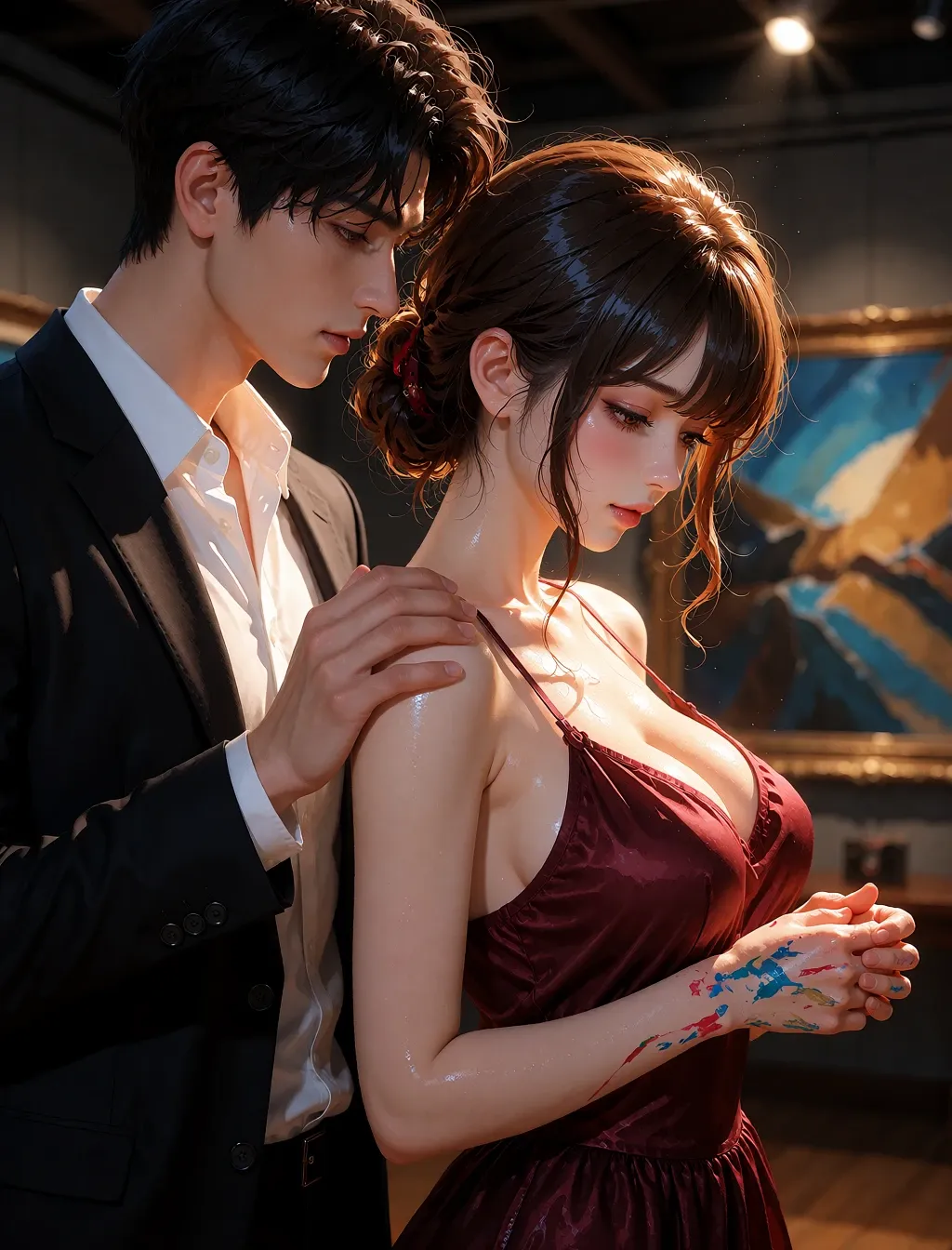
The note was still warm. Not from the letterhead, not from anything the paper had done on its own—from her palm, the heat of her own hand pressed against it so long the fibers had gone soft at the crease. Emma stood at the edge of the oak table in the empty office and read it again. Keep the circle. Four words. The same red pen he'd used to cross out her anchor piece, the same red pen she'd taken from his fingers and used to circle the line back to life.
The gallery had gone quiet the way galleries do—not silent, but emptied of intent. Somewhere down the corridor the climate system hummed its low, patient note, keeping the air at sixty-eight degrees for paintings that didn't care. The track lights over the main hall had clicked off on their timer an hour ago. What was left was the desk lamp she'd switched on, throwing a yellow puddle across the table, and the dusk coming blue through the tall office windows.
She should go. Her bag was by the door, keys in the side pocket, the layout tube propped against the chair leg where she'd set it down to read the note the first time. She had a car in the lot and a bed in her apartment and a printer coming at ten in the morning. She should go.
She set the note down on the table instead. Smoothed it flat with two fingers. The letterhead's embossed seal caught the lamplight and threw a tiny shadow of itself across the words.
That was when she saw the pen.
It lay where he'd left it—no, not where he'd left it. She'd watched him cap it. She remembered the click of it, the way he'd set it down beside the layout with that deliberate, unhurried economy he did everything with. But the cap was off now, resting a few inches away like a thing set down in a hurry, and the pen itself had rolled a quarter turn toward the window, its nib pointing at the glass. She hadn't touched it. The cleaner hadn't come through—the wastebaskets were still full. It had simply rolled, the way round things do on a surface that isn't quite level, and the small wrongness of it made her throat tight.
She picked it up.
It was heavier than it looked. Black lacquer, a thin gold band at the join, the kind of pen a man bought once and kept for a decade. The nib was fine and slightly splayed at the tip from too much pressure—he wrote hard, then. Pressed the paper like he was carving the words into it. She turned it over between her fingers, and there, on the barrel, a crescent of red ink where his thumb had rested. She rubbed at it with her own thumb. It didn't come off. It had been there long enough to have stained.
The smell reached her then—not from the pen, but from the air itself, from the wool of his coat that had hung on the back of the chair for the better part of an hour. Rain-damp wool and something underneath it, cedar or sandalwood or simply him. It was fading. By morning it would be gone. She stood very still and let it fade a little more, and told herself she was only breathing.
"You're being ridiculous," she said, out loud, to the empty office. Her voice came back off the far wall thinner than she'd meant it.
She set the pen down. Not where it had been—she set it parallel to the layout tube, squared to the table's edge, the way she squared everything when her hands needed a job. Then she reached for the tube to put it away properly, and her knuckles knocked against something underneath.
A second sheet of letterhead. Folded once, tucked beneath the tube like a receipt someone meant to throw away and didn't.
Her hand stopped. The tube was cool and solid against her palm, and beneath it the corner of the paper showed white and crisp, and she stood there for a full three seconds deciding whether to be the kind of person who looked. Then she lifted the tube and picked up the sheet and unfolded it.
One line. His hand—she knew it now, the hard downward strokes, the way he didn't lift the pen between letters, the slight backward lean of his capitals. The same hand that had crossed out her piece. The same hand that had written Keep the circle.
It read: I don't mix business with—
And stopped. No period, no dash, no trailing scribble where he'd thought better of it. The line simply ended, the last stroke of the d in with hanging there with nowhere to go, and below it the rest of the page was blank.
Emma read it twice. The first time fast, the way you read a headline. The second time slowly, the way you read something that's been left for you to find—the way you read a signature to see if it's real.
He'd written it here. In this office, at this table, with this pen. Sometime in the hour they'd spent in it, or before, or after—she couldn't know. He'd started a sentence and stopped it and folded the page once and slid it under her layout tube, and then he'd written a different note and left it out in the open where she was meant to see it. Two notes. One for her to find. One for her to find.
"What are you doing," she said, to the paper, to the room, to the man who wasn't in it. Not a question. The kind of thing you say when your chest has gone tight and your hands need to do something and there's nothing in reach but words.
She looked at the cut-off line again. I don't mix business with— Business with what? With pleasure? With people like her? With women who came apart on his fingers over a layout and then had the nerve to circle his line in red and hand him back his pen? He'd said it earlier—she remembered it now, the way he'd stopped mid-sentence and looked at her and not finished, and she'd let it go because her heart was still hammering and her legs weren't entirely reliable. He'd said it and stopped and she hadn't asked. And now here it was again, the same unfinished sentence, written down and hidden and left for her to find like a splinter in a drawer.
She folded it. Carefully, along his crease, so the fold lay true. Then she laid it on top of the first note, the two of them squared together on the oak, and she pressed them flat with the flat of her hand, and she stood there looking down at the two pages as if the arrangement of them might tell her something the words hadn't.
It didn't. They lay side by side, one generous and one withheld, and neither of them explained the man who'd written them.
The office had gone darker while she wasn't looking. The blue at the windows had deepened to a bruised violet, and the desk lamp's puddle had grown to fill the whole room, so that the corners were shadow and the table was the only lit thing in the world. She could see her own reflection faintly in the glass now, a woman with a loose bun and a smudge of something on her jaw, standing over a table with two pieces of paper on it, and she did not entirely recognize her.
She was still standing there when the phone rang.
It was the desk phone—not her mobile, which was in her bag by the door, but the heavy black handset on the corner of the table, the one with the coiled cord and the little red light that meant a line was live. It had rung maybe three times before she registered it. Nobody called the gallery office at this hour. The cleaner didn't call. The donors didn't call. The gallery was closed, the lights were off, and the phone was ringing into the empty room, and Emma stood with her hand still flat on the two notes and did not move.
Fourth ring. Fifth.
She lifted the receiver. "Holloway." Her voice came out steadier than she had any right to.
A pause on the line—not the dead air of a bad connection, but a person, breathing, deciding something. She could hear the shape of the silence. She knew the shape of it.
"You're still there," Julian said.
Not a question. He said it the way he said everything—as if the answer had already been decided and he was only confirming the paperwork. But there was something underneath it, a thread pulled tight, and she caught herself listening for it the way she'd listened for the coat-smell in the air.
"I'm still here," she said.
"The lights were off in the main hall. I thought you'd gone." Another pause, shorter. "I saw the office lamp from the street."
She looked at the windows, at the violet dusk beyond them, and for a moment she imagined him down there on the wet pavement, phone to his ear, looking up at this one yellow square of light in the dark building. The image did something to her that she didn't have a name for and didn't want one.
"I was just leaving," she said. She didn't move, though. Her hand was still on the two notes, and the receiver was warm against her ear, and the cord stretched taut across the table and down to the floor and out of sight, and she was not leaving.
"No, you weren't."
She should have been angry at that. She was, a little—the small clean anger of being seen too clearly by someone who hadn't earned it. But it sat in her chest alongside the other thing, the tight warm thing, and the two of them didn't cancel out. They never did, with him.
"What do you want, Julian?"
The line hummed. Somewhere behind him a car went past, tires on wet asphalt, the sound of a city at dusk. He was outside, then. Standing in the rain. Looking up at her window.
"I want to know what you found," he said.
Emma's eyes dropped to the table. Two notes, squared, her hand flat on top of them. The pen beside them, capped now—she'd capped it without thinking. And the layout tube, and the empty chair where his coat had hung, and the whole room holding its breath around her.
"You left me a note," she said carefully. "I read it."
"That's not what I asked."
She was quiet. The receiver grew warm in her hand. She could hear him waiting on the other end—not impatient, not filling the silence the way a nervous man would. Waiting the way a man waits who knows the answer is coming and has decided to let it.
"I found the other one," she said. "The one you hid."
A pause. Longer this time. She heard him exhale—slow, controlled, the sound of a man setting something down.
"Yes," he said. "I thought you might."
"You stopped mid-sentence." She looked at the folded page under her hand. "You wrote I don't mix business with and then you stopped. You didn't finish it."
"No."
"Why?"
The silence on the line stretched, and in it she heard the city and the rain and her own heart, and she kept her hand flat on the two notes as if they might otherwise blow away.
"Because I didn't know how it ended," he said.
It was the truest thing he'd said to her all day. She could hear that it cost him something to say it—the way his voice had gone a shade lower, the way he'd stopped after the word ended and not filled the space. Julian Vance, who crossed out other people's work with a red pen and told them everything was a test, didn't know how his own sentence ended.
Emma looked down at the two notes, the generous one and the withheld one, and she thought of the crescent of red ink on the pen barrel, and the coat-smell fading in the air, and the yellow light throwing her own reflection back at her from the dark window.
"And now?" she said. "Do you know now?"
The line hummed. Outside, the rain came harder against the glass, and she imagined him standing under it, phone to his ear, looking up at the one lit window in the dark building—waiting, the way he waited, for her to say the thing he hadn't.
"You're still there," he said again. Not a question this time either. But his voice had gone strange on it—softer, almost careful, the way you speak to something you're afraid of startling.
Emma's hand tightened on the receiver. On the table, under her other hand, the notes lay squared and flat and waiting. The lamp threw her shadow long across the oak, and the rain came down, and somewhere in the empty gallery the climate system hummed its patient note, keeping the air at sixty-eight degrees for paintings that didn't care, and she opened her mouth to answer him.
"I found the note," she said. "I found both of them."
The words came out flat and ordinary, the way the truest things always did—no tremor, no drama, just a woman standing in a pool of lamplight with her hand on two pieces of paper. On the other end of the line, the city noise had gone thin. She could hear him not breathing, which was a different silence than the one before.
"The one in the open, and the one under my tube," she said. "The one you didn't finish."
"Emma—"
"I'm not finished." She hadn't planned to say that. It arrived on its own, and once it was out she found she didn't want it back. "You asked me if I was still here. I'm still here. I've been standing in this office for an hour with your coat-smell in the air and your pen in my hand, and I'm still here, Julian, and I don't entirely know what I'm doing."
The line held. Rain ticked against the glass in a slow irregular rhythm, and she could hear his breathing again, careful, measured—a man walking across ice.
"But I'm not leaving," she said. "That's the part I do know."
The silence went on so long she looked at the receiver to see if the line had died. It hadn't. The little red light still burned.
"Say something," she said.
When his voice came back it had lost its edge. All of it—the dry control, the paperwork tone, the man who confirmed things he'd already decided. What was left underneath was younger than she'd have guessed, and rougher, like a door opening onto a room nobody had aired out.
"Then I'm coming up," he said.
The line clicked. Dead air, then the dial tone, thin and insectile, and Emma stood holding the receiver away from her ear as if it had said something rude.
She set it down in its cradle. Her hand had left a damp print on the black plastic. She looked at that print for a moment, then at the two notes under her other palm, then at the window—violet gone to near-black now, the rain streaking the glass so the streetlights below smeared into long wavering lines of gold. Somewhere down there was a wet pavement where a man had been standing with a phone to his ear. Not standing anymore.
The office was very quiet. She could hear the climate system again, and under it, faintly, the sound of the building itself—the tick of the radiators, the settling of old timber, a pipe somewhere knocking twice and going still. She pulled her hand off the notes and found she'd left a crease in the top page where her fingers had pressed. She smoothed it flat. Then she smoothed it again, which did nothing, and she made herself stop.
Her hair. She put a hand up to it and found what she'd expected: the bun half-collapsed, curls sprung loose at her temples, one long strand stuck to the damp of her neck. She pulled the pins out, one, two, three, and the whole thing came down around her shoulders. She gathered it up again and twisted it and pinned it back, and her fingers were not steady, and a curl escaped immediately and hung against her cheek, and she left it there.
She looked down at herself. The blouse she'd worn that morning—was it only that morning?—was creased across the front from the table edge, and there was a smudge of something on the cuff, graphite or ink, and her skirt had a fold pressed into it that wouldn't come out without an iron. She wet her thumb and rubbed at the smudge. It only greyed.
Footsteps.
Not in the corridor yet—outside, on the paving, quick and sure and not trying to be quiet, the sound of a man crossing wet stone at a pace that wasn't quite running. Then the heavy clunk of the street door, and the footsteps changed register, went hollow and echoing, and she heard them come into the lobby and stop.
A pause. Long enough that she pictured him there in the dark, water running off him, looking up the length of the corridor at the one lit doorway at the far end.
Then the corridor. The footsteps came on, unhurried now, deliberate, and the sound of them was worse than the running had been—each one a decision, laid down and left behind. The corridor's parquet carried sound strangely; she'd noticed it before, the way a visitor's steps announced themselves a full ten seconds before they arrived. She counted them. She didn't mean to. Eight, nine, ten.
The steps stopped outside the door.
Emma's hand found the edge of the table. The oak was cool and solid under her fingers, and she stood with her back straight and her chin level and her heart going like a bird in a box, and she did not look away from the doorway.
The key went into the lock. It turned—one heavy click, then the softer sound of the bolt sliding back—and the door swung inward, and Julian Vance stood in the frame.
Rain in his hair. It had darkened it nearly black at the temples and flattened the front of it down over his brow, and there were beads of it caught in his lashes, and one running down the side of his jaw that he didn't wipe away. His coat was soaked through at the shoulders, the wool gone dark and heavy, and his tie was loose, pulled down an inch, the top button of his collar undone. She had never seen his collar undone. It did something to the whole architecture of him—took a man built entirely of right angles and put a single human flaw into the design.
He didn't come in. He stood on the threshold with his hand still on the door and looked at her—at her hair coming down, at her creased blouse, at her hand on the table beside the two squared notes—and his face did something she couldn't follow, some quick rearrangement behind the eyes, like a man recalculating a sum he'd thought he had.
"You're wet," Emma said.
"It's raining."
"I noticed." She nodded at the coat. "You'll ruin that."
"It's a coat." He came in then, one step, and the door swung shut behind him on its slow hinge and closed with a soft, complete sound. The room got smaller. "It's had worse."
He stopped at the far side of the table—the side she'd stood on that afternoon, the side where he'd crossed out her anchor piece with his red pen and then watched her circle it back to life. The lamp stood between them, and the two notes lay in its light, and he looked down at them and then at her and said nothing at all.
"You came up," she said.
"You told me to say something."
"I told you to say something. I didn't tell you to—" She gestured at him, at the rain, at the whole dripping fact of him standing in her office. "That's not saying something. That's an entrance."
The corner of his mouth moved. Not a smile—something held back at the last moment, a door not quite opened. "You want the sentence finished," he said. "I heard that much."
"I want to know what you meant."
He put his hand on the back of the chair—his chair, the one his coat had hung on—and didn't sit. Water was pooling slowly on the parquet under him, a small dark ring spreading from the hem of his coat, and she watched it spread and thought, absurdly, that the cleaner would have something to say about it in the morning.
"I meant what it says," he said. "I don't mix business with—" He stopped. Deliberately this time, she could see it, the way he set his jaw and let the sentence die in his mouth the way it had died on the page.
"With what, Julian?"
"With this." He lifted his hand from the chair and let it fall. "With standing in a wet coat in a dark building at nine at night because a woman left her light on. With a note I wrote and hid and then couldn't stop thinking about. With you, standing there with your hair down, looking at me like I'm a problem you're going to solve."
The rain filled the space after it. Emma's fingers had gone white on the table edge and she made them let go.
"That's not the end of the sentence either," she said.
"No."
"You've still not finished it."
"No," he said again, and this time something in his voice had gone raw at the seam—the place where the control was thinnest. "Because I don't know how it finishes, Emma. I've known how every sentence in my life finishes. I've known since I was twenty years old what the gallery is and what I am to it and what I'm not allowed to be. And then you walked in with your paint-stained fingers and your red circle and your—" He stopped himself. His hand had come up, and he looked at it as if it had betrayed him, and put it back down at his side. "You're the first thing in five years I haven't been able to finish."
Emma came around the table.
She didn't decide to. Her feet made the decision, three steps on the cool parquet, and then she was standing in front of him with the lamp throwing both their shadows up the wall behind, and she could smell the rain on him now, cold and clean, and under it the cedar and sandalwood, stronger than it had been in the coat, because the coat had only carried it and the man was making it.
"I'm not a problem to solve," she said, and her voice had gone quiet with the closeness. "And I'm not a sentence for you to finish. I'm a woman who's going to be here at ten in the morning when the printer comes, and I'm going to be here every morning after that until this exhibition opens, and if you want to stand in the rain and look up at my window, you can—but you don't get to write half a sentence and hide it under my tube and call that honesty."
He looked down at her. There was rain still on his face, and the lamplight caught it, and his eyes had gone very dark and very still, and she could see him deciding something—see the whole machinery of him working, weighing, calculating, and then the moment it stopped.
"All right," he said.
"All right what?"
"All right, I'll finish it." His hand came up and found her jaw—cold fingers, wet from the rain, and she flinched at the cold and then didn't, and his thumb rested in the soft place under her ear where her pulse was going. "But not tonight. Tonight I'm going to stand here and dry off and look at you, and you're going to tell me about the printer, and the anchor piece, and whatever it is you've been doing to that layout for three weeks, and I'm going to listen like a man who works for you."
"You don't work for me."
"No," he said. "I don't. That's the problem, and I'm not finishing that sentence either. Not tonight."
His thumb moved once along her jaw and then his hand dropped, and he stepped back and shrugged out of the wet coat and hung it—carefully, of course, precisely, the way he did everything—over the back of the chair. Underneath, his shirt was damp at the shoulders and clung to him, and there was a crease across his chest from the seatbelt of whatever car he'd driven here, and Emma stood with her arms at her sides and her hair coming down and did not know what to do with her hands.
He pulled the chair out and turned it and sat down in it—his chair, at the head of the table, the lamp beside him—and looked up at her.
"Ten o'clock," he said. "Tell me about the printer."
Emma sat down across from him. The notes lay between them on the oak, squared and flat and still in the lamplight, and she reached out and drew them toward her and folded them and put them in the pocket of her skirt, and then she looked up at the man sitting in the wet shirt with rain in his hair, and she began, in her measured curator's voice, to tell him about the printer.
Outside, the rain kept on. The little red light on the desk phone went out.