
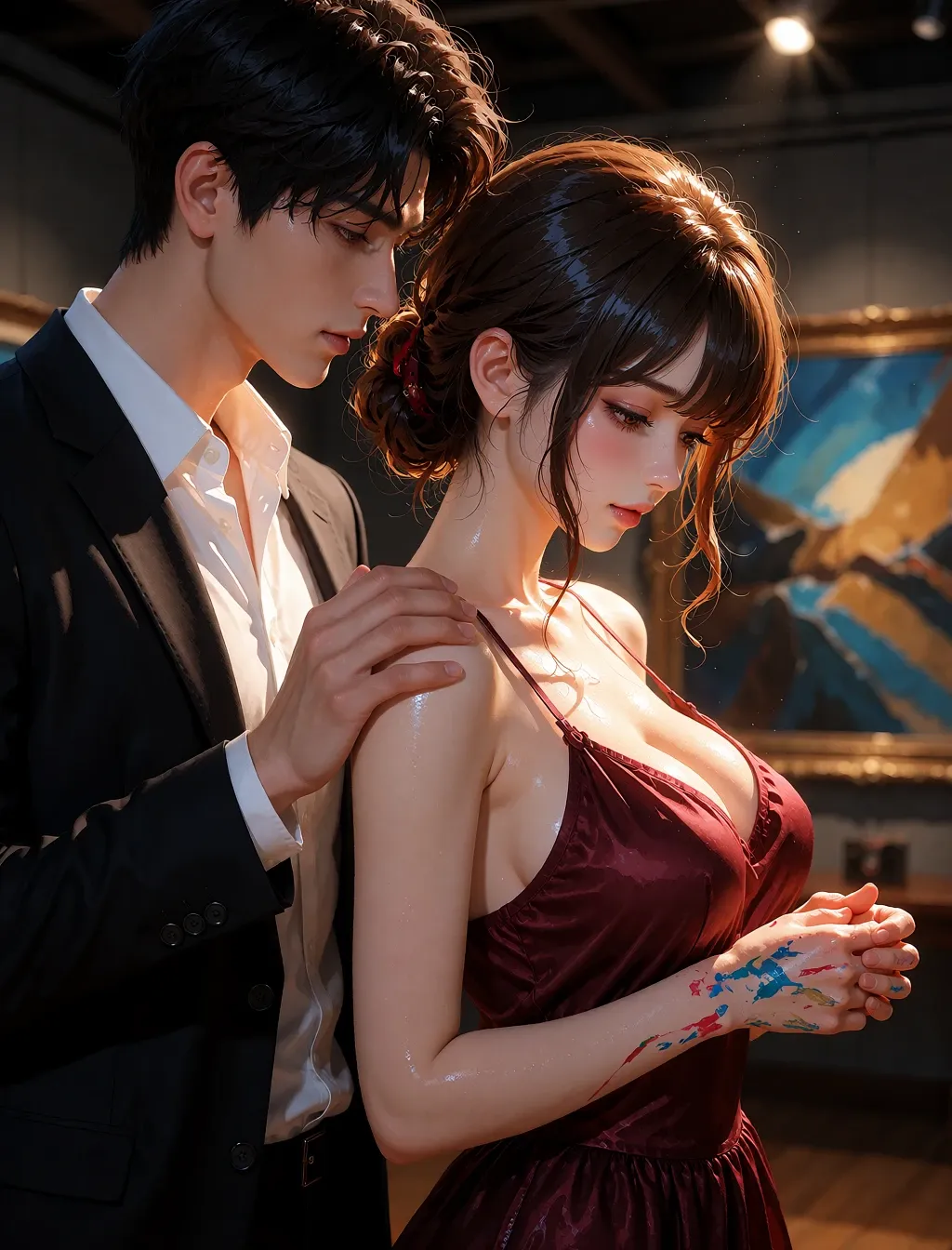
Emma pinned the last corner of the layout and stepped back, letting her hands fall to the cool surface of the oak table. The anniversary exhibition spread before her like a promise she'd made to herself weeks ago—every piece placed with a curator's patience, every sightline calculated to make a donor pause mid-step, reach for their checkbook, and feel something they hadn't felt in years. The late afternoon light slanted through the blinds, striping the paper with gold.
She reached up to tuck a curl behind her ear. It slipped free immediately, as it always did. She'd stopped fighting it hours ago.
The door opened without a knock.
She didn't turn around. She knew the footsteps—the deliberate click of leather on hardwood, the unhurried pace of a man who'd never once been late to anything in his life and expected the world to accommodate him accordingly.
"You're still here."
"I'm finishing." She kept her voice even, professional. "The layout needs to be finalized before the printer runs tomorrow morning."
"I'm aware."
He crossed the room with the quiet confidence of someone who owned every square inch of it—which he did, technically, or at least his father did, and everyone in the building knew the distinction was merely a matter of time. She heard the soft rustle of his suit as he stopped beside her, close enough that she could smell cedar and something sharper, like the air before a storm.
She turned.
Julian Vance. The owner's son. Tailored charcoal suit, silver tie, dark hair swept back from a face that belonged on the cover of a financial magazine she'd never pick up. He looked at her the way he looked at everything—like he was calculating its value and finding it slightly short of the asking price.
"I reviewed your proposal," he said.
"And?"
He didn't answer. Instead, he leaned over the table, bracing one hand on the polished oak, and picked up the red pen that had been lying beside the printer. She watched his fingers close around it—long, precise, the nails immaculate. The kind of hands that had never held a paintbrush, never known what it felt like to scrape dried pigment from under their nails for three days after a commission.
"This piece," he said, and drew a decisive line through the center of her layout. The red ink cut through the photograph she'd spent three weeks negotiating for, bisecting it with brutal efficiency. "Too bold for our donors."
The scratch of the pen against paper was loud in the quiet room.
Emma stared at the red line. Her central piece. The anchor of the entire show—a massive, visceral canvas by a young artist from the East End who painted like she was running out of time, all raw color and unapologetic fury. It was the piece that had made Emma believe in this exhibition in the first place.
"That piece," she said carefully, "is the reason the show will sell out. It's the conversation piece. The one people will argue about over cocktails and come back to see twice."
"It's the one that will make our older donors clutch their pearls." He straightened, and his gaze dropped to her hands where they rested on the table—to the paint-stained knuckles she'd scrubbed raw this morning without quite managing to erase. "We're not courting controversy, Ms. Holloway. We're courting checks."
"The two aren't mutually exclusive."
"In my experience, they usually are." He set the pen down with a click that felt deliberate. Final. "Your instincts are good. I'll give you that. But good isn't enough for this gallery's anniversary. We need safe."
"Safe is boring."
"Safe pays the bills."
She bit her lower lip, a habit she'd never managed to break, and forced herself to look at him instead of the ruined layout. His eyes were pale gray, almost silver in the fading light, and they held hers with an ease that suggested he'd won this argument before it started.
"The board approved my vision," she said. "Your father approved it personally."
"My father approves whatever I tell him to approve." He tilted his head, studying her the way she'd studied the layout—assessing, cataloging, finding the weak point. "You're new here, Ms. Holloway. You don't know our donors the way I do. You don't know what they'll tolerate."
"I know what they'll remember." She stepped closer to the table, her palms flat on the oak. "In twenty years, no one will remember the safe show. They'll remember the one that made them feel something."
"And if that something is offense?"
"Then at least they felt it."
Something flickered in his eyes. Not quite respect—she wasn't sure he was capable of that—but something adjacent to it. Recognition, maybe. The acknowledgment of a worthy opponent.
He looked at her for a long moment, and she refused to look away first. The climate control hummed its low, steady note. The lemon polish scent had faded to something fainter, overlaid by his cologne and the sharp, electric tension that seemed to gather in the space between them.
"You're stubborn," he said.
"I'm right."
"Those aren't mutually exclusive." He almost smiled. Almost. "But they're not the same thing either."
He turned and walked toward the door, and she let out a breath she hadn't realized she'd been holding. Her fingers found her grandmother's silver ring, twisting it around her knuckle—a nervous habit she'd never managed to break, no matter how many gallery openings she'd survived.
His hand closed on the door frame. He paused.
The silence stretched, one heartbeat, two. The door stood half-open, the hallway beyond it dim and empty. She watched the line of his shoulders, the way his suit jacket pulled across his back, and felt something tighten in her chest that had nothing to do with the exhibition.
"Stay," he said, without turning around. "We're not done."
The door clicked shut.
The sound was soft, almost gentle, but it landed in the quiet room like a verdict. She was alone with him now—alone with the red line through her work and the weight of his words hanging in the air between them.
She turned back to the table, to the ruined layout, and reached for the corner of the photograph he'd crossed out. Her fingers brushed the paper, tracing the line of red ink, and she felt the heat of frustration rise in her cheeks. She'd spent three weeks on that piece. Three weeks of phone calls, negotiations, convincing an artist who didn't trust galleries to trust her. And he'd killed it with a single stroke of a pen he hadn't even had to sharpen.
She heard his footsteps behind her. Closer. Closer still.
"You're angry," he said.
"I'm professional."
"You're angry." His voice was closer now, low and certain. "Your shoulders are tight. Your hand is on your ring. You're biting your lip."
She released her lip, straightened her shoulders, and turned to face him. He was closer than she'd expected—close enough that she had to tilt her head up to meet his eyes. The silver in them had darkened, gone the color of storm clouds, and she saw something there that made her breath catch in her throat.
"What do you want, Mr. Vance?"
"Julian." He stepped closer. "And I want to show you something."
"I've seen enough of your red pen for one day."
"This isn't about the pen." He reached for her wrist, his fingers circling it with a gentleness that surprised her. His thumb pressed against the inside of her wrist, finding her pulse, and she felt it jump under his touch. "You're right about the piece. You know it. I know it."
"Then why—"
"Because I needed to see what you'd do." His grip tightened, just slightly. "When someone challenged you. When they crossed out your work and told you it wasn't good enough. I needed to see if you'd fold."
"I didn't fold."
"No." He pulled her closer, and she went, her feet moving without her permission. "You didn't."
His free hand came up to her face, his thumb brushing the corner of her mouth, and she felt the heat of his touch like a brand. Her breath came short. Her heart hammered against her ribs, and she hated how much she wanted this, hated how her body leaned into him before her mind had even decided.
"You're going to fight me on this," he said. "Every step of the way. You're going to argue, and push, and refuse to back down."
"Yes."
"Good." His hand slid from her face to the nape of her neck, fingers threading through the curls that had escaped her bun. "I was hoping you would."
He turned her, quick and sure, and she gasped as her hips met the edge of the oak table. The wood pressed against her thighs through the thin fabric of her skirt, cool and unyielding, and his body came up behind her, a wall of heat and tailored wool. His hands found her hips, gripping them, and she felt the evidence of his interest pressing against her through his trousers.
"Julian—"
"Shh." His mouth found her neck, lips brushing the sensitive skin just below her ear. "You talk too much."
His teeth grazed her skin, and she shuddered, her hands gripping the edge of the table. The layout crinkled under her palms—her beautiful, ruined layout, with its red line and its careful sightlines—and she couldn't bring herself to care.
His hand slid down her side, over the curve of her hip, and under the hem of her skirt. She felt his fingers brush the inside of her thigh, slow and deliberate, and her breath caught in her throat.
"Is this what you wanted?" he murmured against her ear. "When you looked at me across the table. When you argued with me about your precious art." His fingers traced higher, found the damp fabric of her underwear, and she heard him exhale. "When you thought about what it would be like to have me this close."
She couldn't answer. His fingers pressed against her through the silk, finding her wet, finding her swollen, and she bit her lip to keep from making a sound.
"That's what I thought." His voice was dark, satisfied. "You've been thinking about this since the day you walked in. Since the first time you saw me."
"You're—" Her voice broke as his fingers circled her clit through the fabric. "You're insufferable."
"And you're wet." He pressed harder, and she gasped. "Soaked." His fingers hooked the edge of her underwear, pulling the fabric aside. "Tell me I'm wrong."
She couldn't. His fingers found her bare, found her slick and hot and aching. She couldn't breathe, couldn't think, couldn't do anything but grip the table and try not to fall apart.
"That's what I thought," he said again, and slid one finger inside her.
She cried out, a sharp, bitten-off sound, and he shushed her with his mouth on her ear while his finger curled, searching, finding the spot that made her see stars. He pressed against it, steady and relentless. She felt herself clench around him, desperate and wanton.
"You're so tight," he murmured. "So hot." He added a second finger, stretching her, and she moaned, her head falling back against his shoulder. "I've been thinking about this. About you. About the way you'd feel around my fingers."
"Julian." His name came out broken, a plea she hadn't meant to make.
"Not yet." His thumb found her clit, circling it in a rhythm that matched his fingers, and she felt the pressure building, coiling low in her belly. "Not until I'm ready."
"I can't—"
"You can." His teeth grazed her earlobe. "You will."
His fingers moved inside her, faster, deeper, and she felt herself climbing, climbing, the edge of something vast and inevitable rushing toward her. His other hand came up to her throat, not squeezing, just resting there, a reminder of who was in control, and she felt the heat of his palm against her racing pulse.
"Look at you," he breathed. "Falling apart on my fingers. On my table." He pressed deeper, and she sobbed. "Tell me you want it."
"I want—"
"Tell me."
"I want it." Her voice was raw, unrecognizable. "Please."
"Please what?"
"Please let me come."
"That's it." His fingers drove into her, relentless, and his thumb circled her clit with brutal precision. "That's my good girl."
She shattered.
It took her like a wave, crashing over her without warning, and she cried out his name as her body clenched around his fingers, pulsing, trembling, falling apart in his hands. He held her through it, his mouth on her ear, whispering words she couldn't quite hear through the roaring in her head, and she felt the pleasure go on and on until she was limp against the table, gasping, shaking.
He pulled his fingers out slowly, and she felt the loss like a physical ache. She heard him bring his hand to his mouth, heard the soft sound of him tasting her, and a fresh wave of heat flooded through her.
"Delicious," he said softly.
She turned, her legs shaky, and met his eyes. They were dark now, almost black, and there was something in them she couldn't read—something hungry, and something else, something that looked almost like wonder.
He reached out and tucked a curl behind her ear. The gesture was gentle, almost tender, and it undid her more than his fingers had.
"We're not done," he said. "Not by a long shot."
He stepped back, straightening his suit, and she watched him cross to the door with the same unhurried confidence he'd entered with. He paused at the threshold, his hand on the frame, and looked back at her.
The layout lay spread across the table, the red line still cutting through her central piece. Her underwear was ruined. Her legs were still trembling.
"Fix the layout," he said. "Keep the piece."
He was gone before she could answer.
The door clicked shut behind him, and she was alone with the hum of the climate control, the scent of lemon polish, and the echo of his words hanging in the air like a promise she didn't know how to keep.
Her fingers found her grandmother's ring, twisting it around her knuckle, and she stared at the red line on her layout—at the piece he'd told her to keep, the piece he'd crossed out and then given back.
She didn't know what game he was playing.
She only knew she was already in it, up to her neck, and she had no idea how to get out.
The pen was still there. He'd left it lying across the corner of the layout like a signature he hadn't bothered to finish, and she stood over it for a long moment with her ruined underwear sticking to her thighs and her heart still not quite back to its regular rhythm.
Her hands were shaking. She noticed it distantly, the way you notice weather.
She picked up the pen.
It was heavier than it looked—a good pen, balanced, the sort of object that had been chosen by someone who understood that the weight of a thing communicated something to the hand holding it. The cap came off with a soft pop. The nib was fine and dark with ink, and it had been the instrument of a small murder, and now it was hers.
She looked down at the layout. At the red line bisecting her anchor piece, the photograph of the canvas she'd fought three weeks for. The line was confident. Arrogant. It went through the center of the image the way a scalpel goes through skin, without hesitation and without apology.
She set the nib down just outside the line, at the top edge of the photograph, and drew.
Not a line. A circle. Slow, deliberate, the red ink following the curve of her wrist as she brought it around the whole of the piece—around the canvas, around the slash he'd cut through it, enclosing both in a single unbroken loop. Her hand steadied as she worked. By the time she closed the circle she wasn't shaking at all.
She capped the pen and set it down. The click of it against the oak was small and neat and final.
Then she turned around.
He was still in the doorway. She hadn't heard him come back—hadn't heard the door open at all—but there he was, one shoulder against the frame, jacket undone now, tie loosened a fraction at the collar, watching her with an expression she couldn't parse. He'd been standing there long enough to see the whole of it. Long enough to see her hands steady.
She raised one brow.
"Well?" she said.
The silence held for a moment, and then his mouth did something she hadn't seen it do before. It cracked. The corner of it went up, and then the other, and then a sound came out of him that she would have bet the entire exhibition budget he was incapable of making—a laugh, low and startled and real, the laugh of a man who had been caught off guard and was enjoying it more than he'd expected to.
He stepped back into the room. The door swung shut behind him with a soft click.
"You circled it," he said.
"I did."
"You circled my line."
"I circled the piece." She leaned back against the table, her palms flat on the oak, and found that her legs would hold her after all. "Your line's inside the circle. That's your problem, not mine."
He came toward her slowly, and there was nothing of the earlier prowl in it now—no performance, no calculated advance. He was looking at the layout the way she looked at a canvas she was trying to decide about, his head tilted, his hands loose at his sides.
"It's a good piece," he said.
"I know."
"I knew it when I crossed it out."
She stared at him. "Then why—"
"I told you why." He stopped at the table's edge, across from her, the layout between them. "I needed to see what you'd do."
"And what did I do?"
"You fought." He reached down and turned the layout a quarter turn, so the circle faced him properly, and studied it. "You fought, and you didn't cry, and you didn't call my father, and you didn't fold. And then—" He tapped the circle with one finger, light. "Then you did this. After. When I wasn't in the room to see it."
"You were in the room."
"I was in the doorway." His eyes came up to hers. "There's a difference."
She didn't have an answer for that, so she said nothing, and the quiet stretched out between them with the hum of the climate control underneath it and the last of the daylight going thin and gold through the blinds.
"Most people," he said, "when I cross out their work, they either argue until they run out of breath or they go quiet and do what I say and hate me for it in the car on the way home. You did neither."
"I did both."
"You did both, and then you took my pen." He picked it up—her pen now, she thought, and felt a small absurd flare of possessiveness—and turned it over in his fingers. "Nobody takes my pen."
"It was on my table."
"It was on your table because I put it there." He set it down again, and this time he set it down on her side of the layout, deliberately, like a chess piece moved across the board. "I wanted to see if you'd touch it. If you'd pick it up and do something with it, or if you'd just stand there and stare at what I'd done to your work until I came back."
Emma's jaw tightened. "You were testing me again."
"Everything's a test, Ms. Holloway."
"Emma."
He paused. Something moved behind his eyes—the same flicker she'd seen earlier, the one that wasn't quite respect but lived next door to it—and then he inclined his head, a small, formal gesture that felt absurdly like a concession.
"Emma," he said. He said it slowly, like he was trying the shape of it. "Fine. Emma. Everything's a test. You passed this one."
"I wasn't aware I was taking it."
"That's what makes it a good test." He braced both hands on the table and leaned in, and the distance between them narrowed to the width of the layout. "You want to know what I actually think?"
"I suspect you'll tell me whether I want to know or not."
That got her another almost-laugh—just a breath through the nose, but it was there. "I think," he said, "that you're the best thing that's walked into this gallery in five years, and I think it's going to be a problem for both of us."
She should have said something sharp. She had a dozen sharp things queued up behind her teeth, and none of them came out, because he was looking at her now the way he'd looked at the circle—assessing, yes, but underneath the assessment something quieter and more dangerous, something that had nothing to do with donors or sightlines or the price of a canvas.
"Why a problem?" she said.
"Because I don't mix business with—" He stopped himself. Straightened. His hands came off the table and went to his jacket, and she watched him button it with quick, efficient movements, putting himself back together the way he'd put himself back together in the doorway ten minutes ago. "Because it complicates things. And I don't like complicated."
"You crossed out my work to see if I'd fight you. That's not complicated. That's just rude."
"It's effective."
"It's cruel."
The word landed between them and sat there. She hadn't meant to say it—or rather, she had meant to say something, and that was what had come out, and now it was in the room and she couldn't take it back.
He didn't flinch. But he didn't answer right away either, and the pause was long enough that she heard the building settle somewhere above them, a distant groan of old pipes and older wood.
"Yes," he said at last. "It is. I'm not going to pretend it isn't." He looked at the layout again, at the red line and the red circle, and something in his face shifted—not softening exactly, but opening, the way a door opens onto a room you didn't know was there. "I've been doing this a long time. The gallery, my father's expectations, the donors and their pearls. You learn to move people by finding the thing they're afraid of and pressing on it. It works. It's also, as you say, cruel. I don't usually have anyone in the room who notices."
"I noticed."
"I know." He met her eyes. "That's the problem."
She reached for her ring, twisted it once around her knuckle, and made herself stop. Her hands were steady now. She wanted them to stay that way.
"So what happens now?" she said. "You've decided I'm the best thing in five years and also a problem. Do I get a gold star and a warning label?"
He laughed again—properly this time, a short, surprised burst of it that he didn't bother to smother. "You get the piece," he said. "You get your anchor. You get to run the show the way you want to run it, and I'll keep the donors off your back, and if it goes wrong—" He shrugged, a small movement of one shoulder inside the charcoal wool. "Then it goes wrong, and I'll have been wrong, and I'll say so."
"You'd say so?"
"I said it just now, didn't I? About the piece." He gestured at the layout. "I crossed it out and then I told you to keep it. That's me being wrong in public. Don't expect it to become a habit."
She studied him. The loosened tie, the undone jacket buttoned again, the fine lines at the corners of his eyes that hadn't been there—she was almost sure—an hour ago. He looked tired. He looked, for the first time since she'd met him, like a man rather than a verdict.
"All right," she said.
"All right?"
"All right. I'll keep the piece. I'll run the show. And the next time you decide to test me—" She picked up the pen and held it out to him, nib first, the way you'd hand someone a knife. "Ask first. I'll tell you exactly how I'd fight you. It'll save us both a red line."
He took the pen. His fingers brushed hers—deliberate, she was almost certain, the contact held a half-second longer than it needed to be—and he tucked it into his breast pocket with the same easy precision he did everything.
"I'll consider it," he said.
"You'll do more than consider it."
"Will I?"
"Yes." She straightened away from the table, smoothed her skirt, and felt the damp ruin of her underwear against her thighs and refused, absolutely refused, to let it show on her face. "Because I'm going to be here every day until this exhibition opens, and so are you, and if we spend all of it with you crossing things out and me circling them back, neither of us is going to get any work done. So we can be professional about it. Or we can keep doing—" She gestured vaguely at the table, at the layout, at the whole charged and impossible space between them. "This."
"And which would you prefer?"
The question was quiet. It wasn't a test, or if it was, it was a different kind than the ones he'd been running all afternoon—softer, and more honest, and it caught her somewhere under the ribs.
"I'd prefer," she said, "to know what I'm dealing with."
He nodded slowly, and for a moment she thought he might say something else, something that would have made the room hotter and the air thinner than it already was. But he only reached for the door, and this time when he opened it the hallway light spilled in and made a bright rectangle on the floor between them.
"Tomorrow morning," he said. "Nine o'clock. The printer's coming at ten, and you'll want to be here when they run the proofs."
"I know when the printer's coming. I scheduled it."
"Then you'll be here." He stepped into the doorway and paused, and she saw his gaze go past her, to the table, to the layout with its red line and its red circle. "Emma."
"What?"
"That's a good circle."
The door closed behind him, and this time she listened to his footsteps all the way down the hall—the deliberate click of leather on hardwood, unhurried, unhurried, and then the distant sound of the outer door and the building's quiet coming back to her all at once.
She stood there for a while with her palms on the oak and the layout spread out beneath her hands. Then she reached down and turned it back the right way around, so the circle faced her, so the piece sat inside its loop of red ink like something she'd chosen to keep.
Her ring had come loose on her finger—she twisted it back into place—and outside the window the last of the gold light had gone, and the gallery's parking lot was filling up with the evening, one car at a time.
She picked up her bag and her keys and the layout, rolled carefully and slid into its tube, and she was reaching for the light switch when she noticed it: the red pen, still on the table. He'd taken it out of his pocket when she wasn't looking and set it down in the middle of the oak, and beside it, weighted under one corner, a single sheet of gallery letterhead with three words in his narrow, slanting hand.
Keep the circle.
She folded the note into her palm, where it stayed warm, and turned off the light.
The parking lot lights hummed their low electric note over the asphalt, casting pools of sodium orange that made her car look older than it was. Emma walked with the layout tube tucked under her arm and the note folded against her palm, still warm, still faintly creased where she'd gripped it too hard. Her heels clicked against the pavement, and the sound bounced off the empty cars like she wasn't alone in the dark.
She was almost to her door when she heard it—the click of leather on asphalt, unhurried, coming up behind her. She didn't turn. She knew the pace of those footsteps the way she knew the weight of her own ring on her finger.
"You left your light on," Julian said.
"I turned it off."
"You left it on for a while after you turned it off." He was closer now. She could smell the cedar and the storm-sharp note underneath it, and her body remembered what that scent had done to it an hour ago. "I watched from my office window. You just stood there. Holding something."
She turned. He stood a few feet away, jacket off now, shirtsleeves rolled to his elbows, tie loosened to the second button. The parking lot light caught the pale skin of his forearms, the dark hair at his wrists, and she had the absurd thought that she'd never seen him without the armor of the full suit before. He looked almost human.
"You watched me," she said.
"I was finishing paperwork."
"From your office window. Watching me stand in the dark."
"I was curious." He stepped closer, and the space between them narrowed to the width of her car door. "About what you were holding."
She didn't answer. The note was in her palm, and she could feel it burning there, the three words of his narrow handwriting pressed against her skin like a brand she'd chosen.
"Let me see it."
"No."
"Emma."
The way he said her name—slow, testing the shape of it, like he'd been doing it in his head all evening—made her breath catch. He reached for her hand, and she let him take it, let him turn it over and uncurl her fingers. The note lay there, creased and warm, and he looked at it for a long moment without reading it.
"You kept it," he said.
"You left it for me."
"I left it to see if you would."
She pulled her hand back, folded the note again, and tucked it into her coat pocket. "Everything's a test," she said. "I remember."
"And you keep passing them." His eyes were dark in the sodium light, gone the color of the storm that had been gathering in them all afternoon. "Do you know what happens when you keep passing?"
"What?"
"The tests get harder."
He moved then, and she didn't have time to step back. His body came up against hers, and the car door was cold at her back, the metal pressing through her coat, and his hands found her hips and held her there, pinned between the door and the heat of him.
"Julian—"
"I've been thinking about you all evening." His mouth found her jaw, his lips brushing the skin there, and she felt the words against her pulse. "About the way you looked on that table. The way you said my name when you came." His hand slid up her side, over the curve of her hip. "The way you circled my line instead of folding."
"You said we were done."
"I said we weren't done." His teeth grazed her earlobe, and she shuddered against him. "By a long shot."
His hand found the hem of her skirt, and she felt his fingers brush the bare skin of her thigh, higher, higher, until they found the ruin of her underwear—still damp, still slick from what he'd done to her on the oak table. He made a sound low in his throat, almost a growl, and pressed his palm against her through the silk.
"Still wet," he murmured. "Still thinking about it."
"You're—" Her voice broke as his fingers pressed harder, finding her swollen, finding her aching. "You're impossible."
"And you're soaked." He hooked his fingers under the edge of her underwear and pulled them aside, and the night air hit her bare skin, cool and sharp, and then his fingers were on her, skin to skin. She gasped and gripped his shoulders.
"I've been hard all evening," he said against her mouth. "Thinking about this. About you. About the way you clenched around my fingers and begged me to let you come." His index finger slid through her folds, slow, deliberate, finding her clit and circling it. "Do you know what that did to me?"
"Julian—"
"Do you know what I did in my office after I left you?" His finger pressed against her clit, and she bit her lip to keep from crying out. "I sat at my desk and I thought about the sound you made. That little sob. And I had to adjust myself before I could walk out to the parking lot." He slid one finger inside her, and she moaned, her head falling back against the car door. "I've never had to do that before. Not for anyone."
She couldn't answer. His finger curled inside her, finding the spot he'd found on the table, and she felt herself clench around him, desperate and wanton. His thumb found her clit, circling in that same relentless rhythm, and she felt the pressure building again, faster this time, hotter.
"I want you to come for me again," he said. "Right here. Against this car. With my fingers inside you." He added a second finger, stretching her, and she cried out, a sharp, bitten-off sound that echoed off the empty cars. "I want to feel you come apart for me twice in one night."
"Please—"
"Please what?"
"Please let me."
"Let you what?" His fingers drove deeper, and she sobbed. "Say it."
"Let me come."
"That's it." His mouth found hers, and he kissed her hard, swallowing the sound she made as his fingers worked her, relentless, precise. "That's my good girl."
She shattered against him. It took her like the first time—a wave that crashed over her without warning—and she cried out into his mouth as her body clenched around his fingers, pulsing, trembling, her legs giving out so that she sagged against the car door. He had to hold her up with his body and his hand inside her. He kept working her through it, slower now, gentler, drawing out every last tremor until she was limp against him, gasping, shaking.
He pulled his fingers out slowly, and she felt the loss like a physical ache, a hollow emptiness that made her whimper. He brought his hand up between them, and in the sodium light she saw his fingers glistening, slick with her. Then he brought them to his mouth and tasted her, his eyes never leaving hers.
"Now we're done," he said. "For tonight."
He stepped back, and the cold air rushed in where his body had been, and she felt the absence of him like a wound. He straightened his shirt, buttoned his cuffs with quick, efficient movements, and walked to his car—a dark sedan two spaces over, sleek and expensive and utterly him.
He paused at his door, hand on the handle, and looked back at her. She was still leaning against her car, legs shaking, her underwear ruined beyond repair, her heart hammering against her ribs. The note was still in her pocket, warm against her palm.
"Tomorrow," he said. "Nine o'clock."
"I know when the printer's coming."
"That's not what I meant." He got into his car, and the engine turned over with a low, expensive purr. The headlights swept across her, catching her mid-shiver, and she saw him through the windshield—one hand on the wheel, the other adjusting his tie, his face unreadable in the dark.
The car pulled out of the lot, and she watched the taillights shrink and disappear around the corner, leaving her alone in the sodium orange with the hum of the parking lot lights and the echo of his voice in her ears.
Now we're done. For tonight.
She pushed off from the car, found her legs would hold her, and reached into her pocket. The note was still there, creased and warm, and she unfolded it and looked at it in the light.
Keep the circle.
She folded it again, tucked it back into her pocket, and got into her car. The engine turned over, and she sat there for a moment with her hands on the wheel, looking at the empty space where his car had been.
She had no idea what game he was playing.
She only knew she was still in it. Up to her neck.
And she had stopped wanting to get out.
She sat there for a long time with the engine idling, the heater ticking against the cold of the night. The parking lot had gone quiet around her, the sodium lights humming their low, patient note, and she could still feel him on her skin—the press of his body, the scratch of his jaw against her cheek, the ghost of his fingers inside her, a memory that made her thighs press together under the steering wheel.
She should drive home. She knew she should drive home. There was a stack of catalog proofs on her kitchen counter, a half-eaten container of takeout in her fridge that was probably growing a science experiment, and an early meeting with the printer that she'd need to be sharp for. Instead she sat with her hands on the wheel and watched the empty space where his taillights had been, as if the dark itself might tell her something.
Her phone buzzed in her coat pocket. She pulled it out, expecting a message from her sister or the gallery's night security—but it was an email notification from the gallery server, timestamped two minutes ago. She opened it without thinking, her thumb moving on its own, and found a single line in the same narrow handwriting that had written Keep the circle.
You left your light on.
She looked up. Her car's interior light was still glowing, a soft amber dome that had been spilling her silhouette across the asphalt while she sat there. She'd left it on when she'd gotten in, too busy feeling the ghost of his hands on her to notice. He'd seen it. He was still up there, in his office, watching her sit in the dark like a fool holding his note to her chest.
She should turn it off. She should put the phone down and drive home and pretend the last hour hadn't happened—that she hadn't come apart on his fingers twice, that she hadn't begged him, that she hadn't circled his line in red and kept his note like a schoolgirl with a crush. Instead she typed back, her thumbs clumsy against the glass.
I know.
She hit send before she could stop herself, then sat there, heart hammering, watching the screen for the three dots that never came. The light stayed on. She left it on, and she pulled out of the lot with his words still glowing in her palm, the note folded against her thigh like a promise she hadn't asked for and couldn't put down.
The drive home was short and she didn't remember any of it. She parked in her building's lot, killed the engine, and sat in the dark with her hands on the wheel, the note still in her pocket, the taste of him still on her lips. She had no idea what game he was playing.