
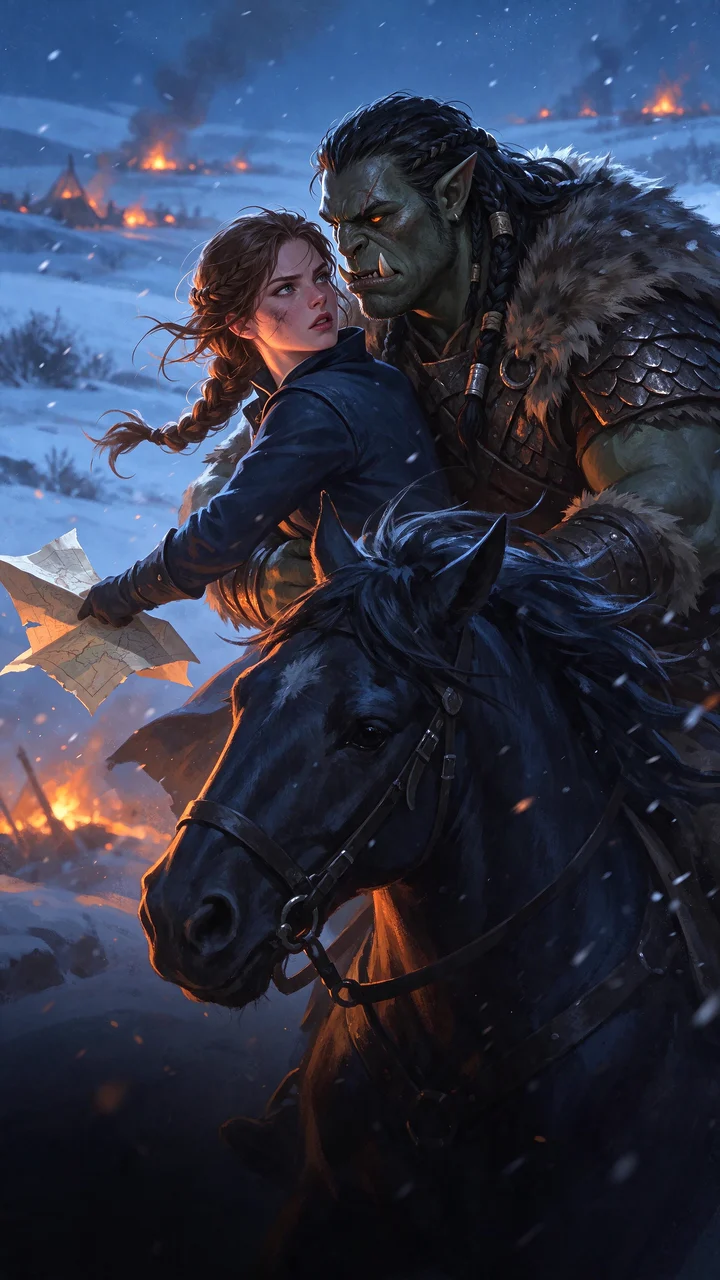
“Down. Now.”
Kharag didn’t wait for her to obey. He swung out of the saddle with her still caught in his arm, and the world was white in every direction. No ridge, no sky, no horde. A moment ago Sefa’s grey cloak had been ten lengths ahead. Now there was nothing but the roar.
“The others—”
“Will do what we do.” He was moving, half dragging her, one fist on the stallion’s bridle. “Or they will not.”
Rock loomed out of the white, black and wind-scooped. He pushed her into a hollow beneath an overhang just deep enough to lie in, then turned the stallion broadside across the mouth and hobbled him there, a wall of horseflesh. The scream of the wind dropped to a howl.
She crouched under the stone and shook. She had stopped feeling her hands an hour ago. She only knew she was shaking because her teeth kept clicking.
He worked fast. A bundle of pine from the saddlebag, flint, a curl of birch bark. One bedroll unstrapped and thrown down. When the flame caught it was small and wavering, no wider than her two hands, and the hollow filled with the smell of pitch and wet fur.
“One bedroll,” she said.
“I packed for me.”
“Of course you did.”
He unclasped the wolf-fur mantle and dropped it over her head. It came to her ankles and weighed as much as a saddle and was still warm from his body. She stopped talking.
“Sit.”
She sat. She tried to unbutton her gloves and couldn’t. Her fingers had gone white and waxen and would not bend.
He crouched in front of her, a mountain folded small, and tugged the gloves off himself. Then he took both her hands between his palms.
It hurt. Blood came back in needles. She hissed and he did not let go. His hands were enormous, rough as saddle leather, hot. He chafed slowly, thumbs moving over her knuckles, over the insides of her wrists where the pulse was coming back.
“Better,” he said. Not a question.
“Yes.”
He didn’t let go. She didn’t pull away. The fire popped and neither of them moved, and the longer neither of them moved, the more it became a thing they were both choosing.
He released her first. He sat back against the rock with his knees drawn up, close enough that the fire warmed them both. There was no other way to sit.
. . .
“Show me,” he said, much later. The wind had settled into a grinding roar. “Your kingdom. You carry it in that case.”
“My case is on the packhorse.” She had given it up at noon only because he’d threatened to cut the strap. “Which is somewhere out there with your horde.”
“Then draw it.”
She looked at him. He looked back, patient as weather.
She pushed back the mantle, reached into the cold ash at the fire’s edge, and drew with one finger. The long throat of the Calder River. The delta and the marsh-towns. The salt flats where the harvest had drowned two years running and then baked to nothing the third.
“Here’s the capital. Here’s where the grain used to come in.” She tapped the empty north. “And here’s you. Somewhere. Nobody’s ever charted it. Every winter caravan we send onto the steppe comes back half dead or doesn’t come back.”
“Because you send them by your roads.”
“We send them by the only roads we have.”
He was quiet. Then he held out his hand, palm up. After a moment she understood and laid hers in it.
With one fingertip he drew a line across her palm, from the heel toward her smallest finger. “The Hunter’s Spear. Seven stars. The point shows north in the dark months.” Another line crossing it, slower. “The Mare. She rises late. When her head clears the horizon, the Varn ice will bear a horde.” A curve near her thumb. “The Lantern. Children learn it first. Follow it and you never die lost.”
His touch was very light. The callus on his finger rasped. She watched the fire, because watching his hand on hers felt too much like being caught.
“You’re giving me your roads,” she said.
“I am telling you stars. Anyone can see stars.”
“Not the way you do.”
He closed her fingers over her palm, gently, folding the map away.
“My clans are hungry too,” he said. “The summer grass burned. We lost a third of the foals. My young ones are tired of hunger, and Yazul tells them hunger ends at the edge of a human sword. Every night more of them sit at his fire.” He looked at the flame. “Your paper is the only thing I have to tell them otherwise.”
“So you need me.”
“I need the paper.”
“The paper doesn’t ride very well on its own.”
That pulled at the corner of his mouth, just slightly, before he caught it.
. . .
She fell asleep sitting up, which annoyed Kharag more than it should have.
He eased her down onto the bedroll and tucked the mantle around her. She murmured something about latitude. There was ink on her cheekbone still, a grey smear she must have carried from Calderine. He did not touch it.
Thirty-eight winters, thirteen of them as warlord of the Tal-Vorun. He knew the weight of every life in the horde to the ounce. He had not meant to learn the weight of hers, and now he had: how she’d leaned back into him by the second afternoon, how she counted his hoofbeats under her breath and thought he couldn’t hear.
He fed the fire a sliver of pine, sat with his back to the wind, and did not sleep.
. . .
Sefa found them at first light, riding out of the thinning snow with frost in her eyebrows and a grin.
“Well,” she said, taking in the one bedroll, the mantle, the warlord sitting a careful arm’s length away. “Cozy.”
“The horde,” Kharag said.
“Mostly together. Two strays, both found. One packhorse with a story.” The grin went away. She looked at Maelis. “You’ll want to see it.”
The horde had sheltered in a dip a mile south. The packhorse stood among the others, unhurt. Maelis’s map case hung from its frame. Someone had opened it with a knife, one long clean stroke, and packed it with snow, and the snow had melted into the leather and frozen again.
She pulled out the charts. They came apart in her hands. Ink bled in blue rivers across the eastern fens, the one he had caught out of the wind. The northern survey was pulp.
Sixty years of Calderine’s work. She knelt in the trampled snow and could not make her hands stop. The treaty, at least, was inside her coat. She had slept on it.
When she looked up, Yazul was watching from across the camp, leaning on his saddle, smiling at her the way a man smiles at weather turning his way.
Kharag saw it too. She knew he did. He said nothing at all.
She waited for him to say something all day. He didn’t.
That night she carried her bedroll to the edge of camp, as she had every night. When she came back from the pits it was gone. She found it laid inside the ring of stones around his own fire, between the flames and the place where he sat.
“I didn’t ask for this,” she said.
“No.” He was drawing a whetstone down his knife and did not look up. “Sleep, Princess. Tomorrow we reach the Varn.”
All around them, the fires went quiet at the name.