
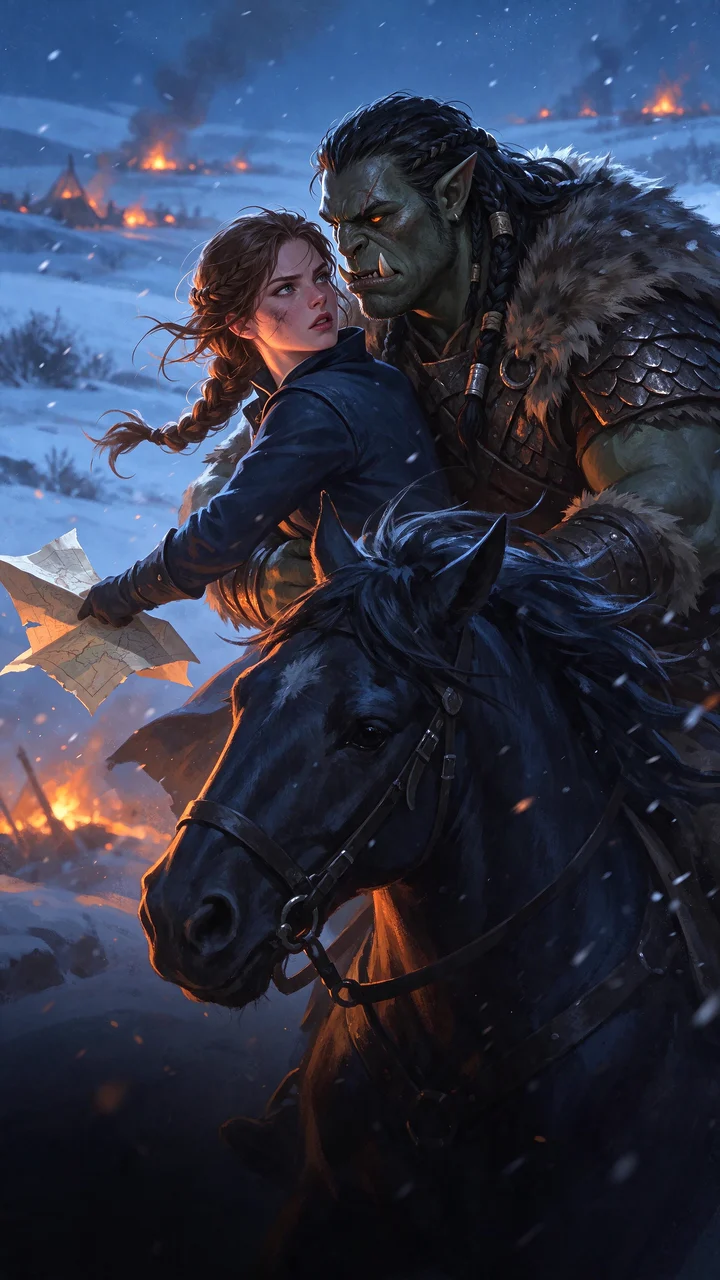
“Your tent is coming down, Highness. You may wish to be out of it.”
Maelis had one boot on and her map case strap in her teeth when the ridgepole went. Hide sagged onto her shoulders, stinking of smoke and old rain, and she shoved her way out through the flap into a camp that was vanishing around her.
The war horns had been bellowing for some minutes. She had assumed they meant attack. They meant leaving. In the blue dark, tents folded inward with a sigh as orcs yanked the stakes. Horses stamped and blew steam, and cookfires were kicked into hissing black. Nobody looked at her. Nobody had been sent.
The voice belonged to a half-orc woman on a dun mare, hood up, silver hair cropped close beneath it. She was chewing a strip of dried meat and watching Maelis with frank interest.
“Nobody told me,” Maelis said around the strap.
“No,” the woman agreed. “Sefa. Chief scout. I’m telling you now, which makes me your favorite person in the horde.” She tipped her chin at the collapsing hides. “Leave the tent. You won’t carry it and nobody else will.”
Maelis spat out the strap and buckled the case across her chest. Inside were eleven charts, a sextant wrapped in wool, three pens, a cake of ink, and a treaty with a royal seal at the bottom and a blank space beside it the size of a large green hand. She had come four hundred miles for that blank space. She was not leaving it in a goat field.
At the edge of camp the riders were already mounted, a long dark line against the paling east, breath smoking. Carts groaned under bundled hide and iron pots. One cart held nothing but goats, packed shoulder to shoulder and bleating their opinion of the morning.
A tall orc sat his horse beside it. Ash-grey skin, a shaved scalp painted with red clan marks, tusks capped in black iron that caught the torchlight when he smiled. He was smiling now. Yazul Bonecutter had smiled at her every day for a week, and every day she had liked it less.
“Envoy.” He swept a hand toward the goats with a courtier’s grace he had certainly stolen from someone. “Your carriage.”
Laughter ran down the line of riders. Not cruel, exactly. Curious. The kind of laughter that waits to see whether a thing will cry.
Maelis looked at the goats. One of them looked back and urinated thoughtfully.
“Generous,” she said. “But I’d hate to crowd your council.”
She walked past him. She did not hurry and she did not look back, though the laughter changed pitch behind her and she felt his pale yellow eyes between her shoulder blades all the way up the line.
Kharag Tal-Vorun sat a black stallion at the head of the horde, and even mounted he made the horses around him look borrowed from children. Wolf fur at his shoulders, iron scale beneath, black braids heavy with carved bone. Hammered silver on his tusks. He was listening to an outrider and did not turn when she stopped at his stirrup.
“Warlord.”
Nothing.
“You struck camp without telling me.”
“I struck camp.” His voice was low and rough, built for wind. “I tell my captains. You are not my captain.”
“I’m the envoy of Calderine.”
“You are a woman standing in front of my horse.”
“Then I’ll be a woman riding it.” She lifted her chin. “Behind you or in front of you, I don’t care which. I won’t sit with the goats, and I won’t be left on the steppe with an unsigned treaty and no horse, which I assume is the general idea.”
That turned his head. Amber eyes, too bright in the grey dawn, and an old pale scar splitting one black brow. He looked at her the way she looked at an unsurveyed coast. Measuring. Deciding what was worth the ink.
“You will slow me.”
“I weigh less than your armor.”
“You talk more than it.”
“Then you’ll have company.”
Somewhere behind her, Sefa laughed out loud.
Kharag leaned down. She thought he meant to say something cutting. Instead one huge gloved arm went around her, and the ground was gone. She was hauled up and set in front of him in a single motion, map case jammed between them, legs scrambling for purchase on the stallion’s broad back. His forearm locked across her waist, solid and warm through the fur.
“Hold the pommel,” he said into her hair. “If you drop one more scroll, I will not stop for it.”
“One more? I haven’t dropped—”
He put his heels to the stallion, and the horde poured after him into the white.
. . .
The snow came sideways by midmorning, fine and dry and stinging. Maelis had ridden all her life, but on roads, on a palace mare with a groom at the bridle. This was different. The stallion did not trot; it devoured. The steppe unrolled grey and endless, and the wind found every seam in her coat.
She learned things fast. That he rode loose in the hips and she would ache everywhere if she fought him, so she stopped fighting him. That his breathing was slow and even against her back. That he smelled of horse and cold iron and something resinous she could not name.
That he did not speak unless he had to, and he never had to.
At noon a gust tore under the flap of her case and ripped a chart free. She saw it go: the eastern fens, two months of work, a pale square tumbling up and away.
She made a sound. She did not know she had.
Kharag’s arm left her waist. He leaned out, impossibly far, the stallion never breaking stride, and his fist closed on the paper in the air. Then it was in her hands again, creased and damp, and his mouth was at her ear, his breath hot through the cold.
“That was the last.”
She held the chart against her chest and did not trust herself to answer. His arm came back around her, a little tighter than before.
. . .
They rode until the light went the color of tin. She kept herself sane by counting: hoofbeats, gusts, the angle of the weak sun when it showed. Northeast, then north, then a long curve she could not account for.
When the horde halted in the lee of a low ridge, she slid down before anyone could help her and nearly went to her knees. Above her, Kharag watched and said nothing.
She spread her charts on her knee in the last light. Calderine’s best surveys of the steppe, bought and copied and corrected over sixty years.
None of them had this ridge. None had the frozen stream they’d crossed at noon, or the standing stone, or the long curve that had kept the wind at their backs all afternoon.
The road he had ridden today did not exist.
She looked up. The first stars were showing, sharp and white, and she remembered him at midday glancing once at a sky that was nothing but cloud to her, then turning the whole horde with a touch of his knee.
Her heart was going hard, and not from cold. Somewhere out here was a way through winter that no grain cart from Calderine had ever found. And it was in his head.
. . .
The fires were small and greedy. His was the largest, which meant she could feel it if she sat close enough to singe her boots. She sat close enough to singe her boots.
Kharag sat across from her, mantle open, cutting strips from a slab of frozen mutton. Yazul’s laughter carried from another fire. Sefa, passing, dropped a skin of something sour into Maelis’s lap and kept walking.
“When do you sign?” Maelis said.
He did not look up. “Not here.”
“Then where?”
“Frost Ford. The clan-moot. Every chief of the steppe, and every one of them with a voice.” Another strip. “I agreed to bring your paper there. I did not agree to sign it.”
“How far?”
“Twenty days.”
Her thighs screamed at the thought. “And if I’m still sitting here at the end of them?”
Then he looked at her. Firelight in the amber, that scarred brow, and something in his face she could not read and did not like how badly she wanted to.
“Then you will have earned the right to ask me.” He held a strip of meat across the fire. “If you survive the march.”
She took it. Their fingers did not quite touch.
“I’ll survive it.”
“Hm.” He went back to his knife. “We ride before light. Sleep close to the fire, Princess.” He let the silence stretch. “Or close to me. The fire is smaller.”