
The text came at four in the afternoon, while Nico was downstairs with Priya and a plow contractor on speakerphone, arguing about salt.
Unknown number. She knew it anyway.
Ledger. His study, second floor, locked. Every page. Before the roads reopen. A.
She read it twice and deleted it, then stood in the middle of his bedroom with the phone warm in her hand, listening to his voice drift up the stairwell. Even, unhurried. The voice of a man who never needed to repeat himself.
That morning he’d left coffee at her elbow, black, no sugar. She had never told him how she took it.
She typed nothing back. Augustin never needed answers; he needed results. He had promised she would never have to switch the wire on. He had never promised anything about this. Forty-eight hours, the city had said. Twenty-two of them were gone.
. . .
The study at the end of the second-floor hall had a brass lock older than she was. She pulled two pins from her hair, bent one into a tension wrench against the doorframe, and knelt on the runner.
Her uncle Teddy had taught her this the summer she turned eleven, on the back door of a bakery in Bridgeport, laughing when she got it under a minute. She had spent seventeen years trying to forget everything the Marsh men had taught her. Her hands remembered anyway. Pressure, patience, listen for the give.
Somewhere below, Priya laughed once, short and dry, and a door closed. The pins set. The cylinder turned. Vivienne slipped inside and eased the door shut behind her.
A green-shaded lamp burned on the desk. Snow glare filled the window, blue and hard. The room smelled of cedar and cold coffee and damp wool; his overcoat lay over a chair, still dark at the shoulders from last night’s sleet.
The ledger was in the second drawer, unlocked, which should have stopped her. Black leather, cracked spine, columns in that same slanted hand. She raised her phone and photographed the first page. Turned it. Photographed the second.
On the third page she slowed. The columns were wrong. The money ran out, not in. Shipments rerouted to warehouses that didn’t exist, Dorne accounts quietly emptied into names she’d never heard on a single wiretap. Six years of dates. Someone was bleeding the Dorne family a little at a time, and doing it in ink.
“Did you mean to ask permission first?”
The voice came from the deep armchair in the unlit corner behind her. Her body went cold, then hot. She didn’t turn. Her thumb stayed on the shutter.
“How long have you been sitting there?”
“Since before your phone buzzed.” Leather creaked as he rose. “Put it on the desk, please.”
She put it on the desk.
“Turn around.”
She turned. Nico stood between her and the door in his shirtsleeves, collar open at the throat, eyes nearly black in the lamplight. He didn’t look angry. That was the worst of it.
“Clause four,” he said. “You have the run of this house. Any room. Any drawer.” He came closer, unhurried. “If you ask me properly.”
“You’d have said no.”
“You don’t know that. You didn’t try.” He stopped an arm’s length away. “So try.”
Her mouth had gone dry. “May I search your study.”
“That’s a statement wearing a question’s clothes. Again.”
“Nico.” She made herself hold his eyes. “May I search your study? Please.”
He didn’t answer. He walked a slow circle around her instead, and she felt him pass behind her, the warmth of him, the clean cedar of his soap, the absolute absence of contact.
“Stand still,” he said quietly. “I’m deciding whether that counted.”
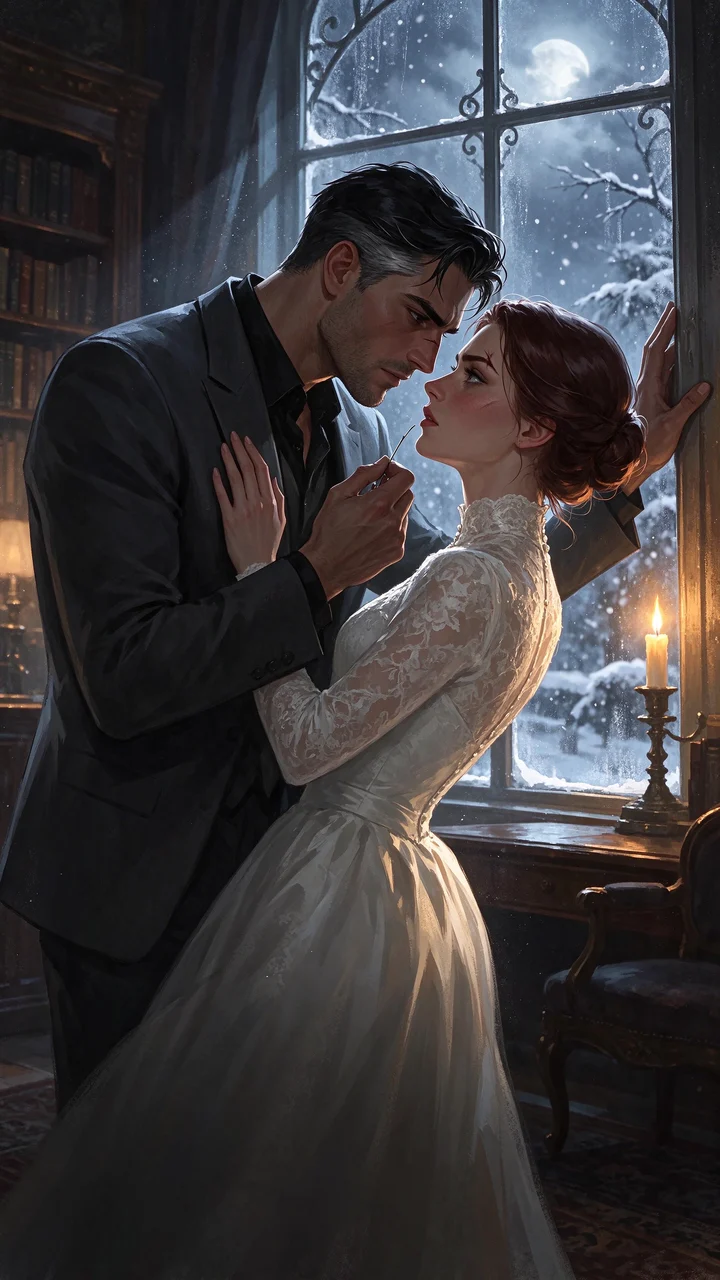
She stood still. Snow hissed against the glass. Her pulse knocked in her throat, her wrists, the backs of her knees, and every second he didn’t touch her felt more deliberate than if he had. The word sat right behind her teeth. Winter. One breath and he would step back and open the door.
She kept it there.
He came around to face her again. “It counted.”
Then he lifted his hand and set two fingers beneath her chin, and tilted her face up to his.
He bent his head. His mouth came close, and closer, until she could feel the warmth of his breath on her lips and the faint rasp of stubble that hadn’t quite touched her skin. A breath away. Less. Her eyes wanted to close. She didn’t let them.
“Do you want this?” he murmured.
Every nerve she had said yes. Her lips parted on it.
“Not yet,” she whispered.
He stepped back at once. Two full paces, his hand gone from her chin, his face calm, as if she had told him the time.
“Then not yet,” he said.
She hadn’t known a refusal could feel so much like being held.
. . .
He moved past her to the desk, opened the ledger to its back cover, and slid a photograph from behind the endpaper. He laid it flat under the green lamp.
A parking structure. Sodium light. A heavyset man in a camel overcoat and rimless glasses, a gold tie bar catching the flash, taking a thick envelope from a hand she had watched hold a cake knife the day before.
Augustin. And Carlo Dorne.
“Date’s on the back,” Nico said. “March. Four years he’s been on my uncle’s payroll.”
“That could be anything,” she heard herself say.
“It could.” He reached into his trouser pocket. “And so could this.”
He held it up between two fingers. Small, black, a curl of surgical tape still clinging to one edge.
Her wire.
“Your hairbrush,” he said gently. “Find a better hiding place. My uncle’s men would have had it by breakfast.”
“You went through my things.”
“I did.”
“There are laws about that.”
“There are laws about wiring a wedding, too.” He turned the transmitter in the lamplight. “You lied to me first. Do you want to know why Augustin put this on you?”
She didn’t. She already knew. She could hear the warm laugh through the phone in the bride’s room. Nobody’s getting through thirty-one buttons tonight. He had said it to comfort her. He had said it so she’d stop checking.
“He never wired you to catch me,” Nico said quietly. “He wired you so my uncle would find it. A prosecutor taped up inside the Dorne house on the first night of the truce.” He set the wire down on the photograph, over Augustin’s face. “Carlo kills you for it. Your father kills Carlo. And your boss stands on the courthouse steps and calls it a tragedy.”
Her hand had found the edge of the desk. She didn’t remember reaching for it.
“And the ledger?” she said.
“Is mine.” He didn’t look away. “Not his. Not my uncle’s.”
The phone between them lit up against the leather blotter.
Well? A.
Nico glanced at it, then back at her. He didn’t reach for it. He waited, the way he had waited with the pen.
“You can send him the pages,” he said. “Or you can tell me the truth.”