
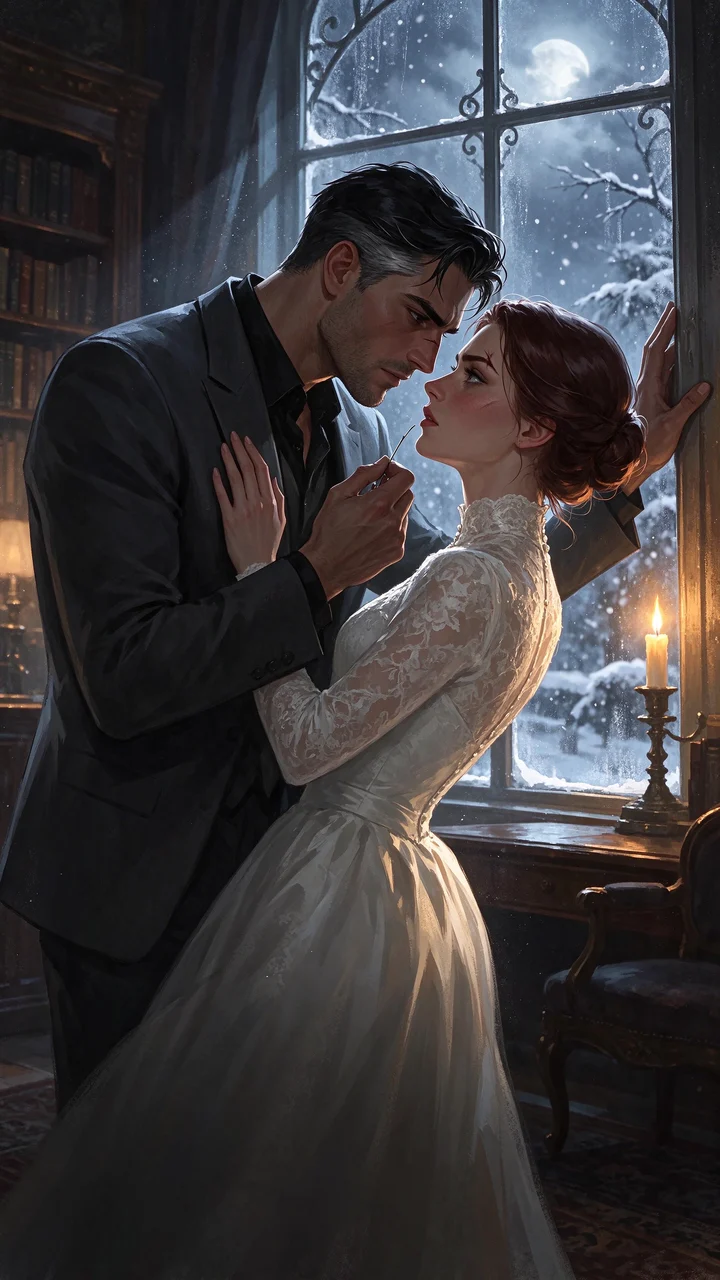
“No,” Vivienne said.
She said it the way she’d said it to defence counsel a hundred times, chin level, voice unhurried, eyes on his. “Nothing to confess.”
Nico held her gaze. He didn’t blink and he didn’t speak, and the silence went on long enough that she heard the candle wicks hiss and her own pulse begin to knock against the lace at her throat. She counted it. Eleven. Twelve.
Then he turned the pen around and laid it in her palm, barrel first, without a word.
She signed. Vivienne Marsh Dorne, the letters sharper than she meant them. He signed beneath her in that slanted hand, capped the pen, and folded the contract into thirds.
“Thank you,” he said.
It was the thank you that cracked her composure, a little. Not suspicion. Courtesy, as though she’d handed him something real.
The door opened without a knock. Priya stood in it with snow melting on her shoulders.
“Lake Shore’s closed. So’s everything west of Clark. City says forty-eight hours, minimum.” She glanced at Vivienne, then back at Nico. “And the guest wing boiler’s gone. Pipes are already ticking. I’ve shut it off before something bursts.”
“The east rooms?”
“Are in the guest wing. It’s thirty-eight degrees up there and falling.” Priya’s mouth did nothing at all. “Your room has the fireplace. That’s the warm room. That’s the only warm room.”
Nico looked at Vivienne. Vivienne looked at the ceiling.
“You’ll take the bed,” he said. “I’ll take the chair.”
“I’m not putting a man out of his own bed on his wedding night.”
“You’re not. I’m choosing the chair.”
“You’ll wreck your back.”
“I’ve slept in worse places than a wingback, Vivienne.”
Priya said, “He has,” in a tone that closed the subject, and left.
“Does she always look at people that way?” Vivienne asked.
“Which way?”
“As if she’s measuring them for a box.”
Nico considered the closed door. “Only the ones she hasn’t decided about.”
“And me?”
“You,” he said, “she’s still measuring.”
. . .
His bedroom was dark panelling and old leather and books stacked two deep on the shelves, the fire banked high, the wind off the frozen lake howling at the windows. One wide bed. One armchair drawn up to the hearth, angled, she noticed, to face the door.
Priya had left a folded stack on the dresser: soft black leggings, thick socks, a grey cashmere sweater far too big to be anyone’s but his.
“Dressing room’s through there,” Nico said, and turned his back before she could ask him to, and stood looking at the fire with his hands in his pockets.
Thirty-one buttons. She undid them alone, by feel, her arms aching by the twentieth. She stepped out of the silk, left it pooled on the dressing-room floor, pulled on the leggings and the sweater, and locked herself into the bathroom.
She turned the tap on full first, so the old pipes would cover whatever sound she made. The tape came off in one long, stinging pull. She bit her lip and kept quiet. The transmitter sat in her palm, warm from her skin, smaller than a book of matches. In the mirror, a neat pink rectangle showed below her collarbone where the sweater’s neck had slipped, the only mark the day had left on her. By morning it would be gone.
Her hairbrush was the old boar-bristle one she’d had since law school, the cushion loose at one edge. She worked a fingernail under it, slid the wire into the hollow, and pressed the cushion down until it held. Then she ran the brush through her hair until the chignon came down and the evidence was just a brush again.
. . .
Nico picked the dress up off the floor because it was silk and someone should.
It weighed nothing. He found the shoulders, shook it out, and began to fasten the buttons from the hem upward, because a dress like that would crease if it hung open, and because his hands wanted something to do while she was behind a locked door with the water running.
At the collar, his thumb caught on the inside of the lace. A fleck of something pale and tacky clung to the lining, no bigger than a grain of rice.
He rolled it between finger and thumb. Surgical adhesive. He knew the smell.
Nico buttoned the last pearl at the throat, very carefully, and hung the dress on the back of the door.
. . .
When she came out the gown was waiting by the door, hung straight, the high collar standing up the way it had in the chapel. Every button was fastened. All thirty-one.
“You didn’t have to do that,” she said.
“It’s a good dress.” He didn’t turn from the fire. “It shouldn’t lie on a floor.”
Something about the buttons made her want to check them. She didn’t.
“Come here a moment,” he said. “Before you sleep.”
She came. He stood by the tall carved post at the foot of the bed, firelight on one side of his face, the crooked line of his nose throwing a small shadow.
“Practise your word with me.”
“Now?”
“A word you’ve never said out loud is a word you won’t trust when you need it.” He held out one hand, palm up. “May I take your wrist?”
She should have laughed. She put her wrist in his hand.
He drew it up slowly and set it against the bedpost. The wood was carved with leaves worn smooth by a century of hands, cool against her knuckles. This close she could smell chapel candle smoke still caught in his shirt. His fingers closed. Not tight. A circle she could have slipped without effort, and they both knew it, and she stayed.
“Say it,” he said quietly.
His thumb rested on the inside of her wrist, exactly over the pulse. He’d feel it racing. He’d feel everything.
“Vivienne. Say it.”
She didn’t. The fire popped. Wind threw snow against the glass, and he waited, and the waiting was worse than any pressure he could have used, because there was none. Nothing held her there but her own refusal.
“You’re allowed,” he said.
“I know.”
“Then why won’t you?”
Because, she thought, it’s the first time in nine years anyone has held on to me, and I’m not ready for it to stop.
“Let go, Nico,” she said.
He let go at once. His hand fell to his side, and there was no disappointment in his face, only a kind of attention, as though she’d shown him something.
“That works too,” he said. “Asking always works. The word’s for when asking won’t come.”
. . .
He blew out the last candle. The fire sank to a red pulse in the grate. She lay in his bed in his sweater and stared at the shadowed ceiling and listened to the leather creak as he settled into the chair.
“Vivienne.”
“Mm.”
“You haven’t asked what I want out of this.”
“Your uncle’s peace. Your family’s territory. My father’s warehouses.”
“No.” A long pause, the wind filling it. “I want the truth. When I ask you for it. That’s all.”
“And if I lie to you?” It was out before she could stop it.
“Then I’ll know something about you I didn’t know before.” The chair creaked once. “Goodnight, Vivienne.”
After that he said nothing. His breathing slowed, deep and even, and she lay on her side with her hand curled under her cheek and listened to it for an hour, two, the words climbing her throat and stopping there. I’m wired. I’m Augustin’s. I’m lying to you in your own bed.
She hated how badly she wanted to say them.
. . .
She woke to grey light and the same white roar at the windows. The fire had been rebuilt. A cup of coffee steamed on the nightstand at her elbow.
Nico was in the armchair, jacket off, sleeves rolled to the forearm, wide awake.
He was watching her.
“Morning,” he said. “Roads are still closed.”
“How long have you been awake?”
“Long enough.” He lifted his own cup. “You talk in your sleep.”
Her blood went still. “What did I say?”
He drank, unhurried, and set the cup on its saucer without a sound.
“Nothing,” he said, “that I’ll hold against you yet.”