
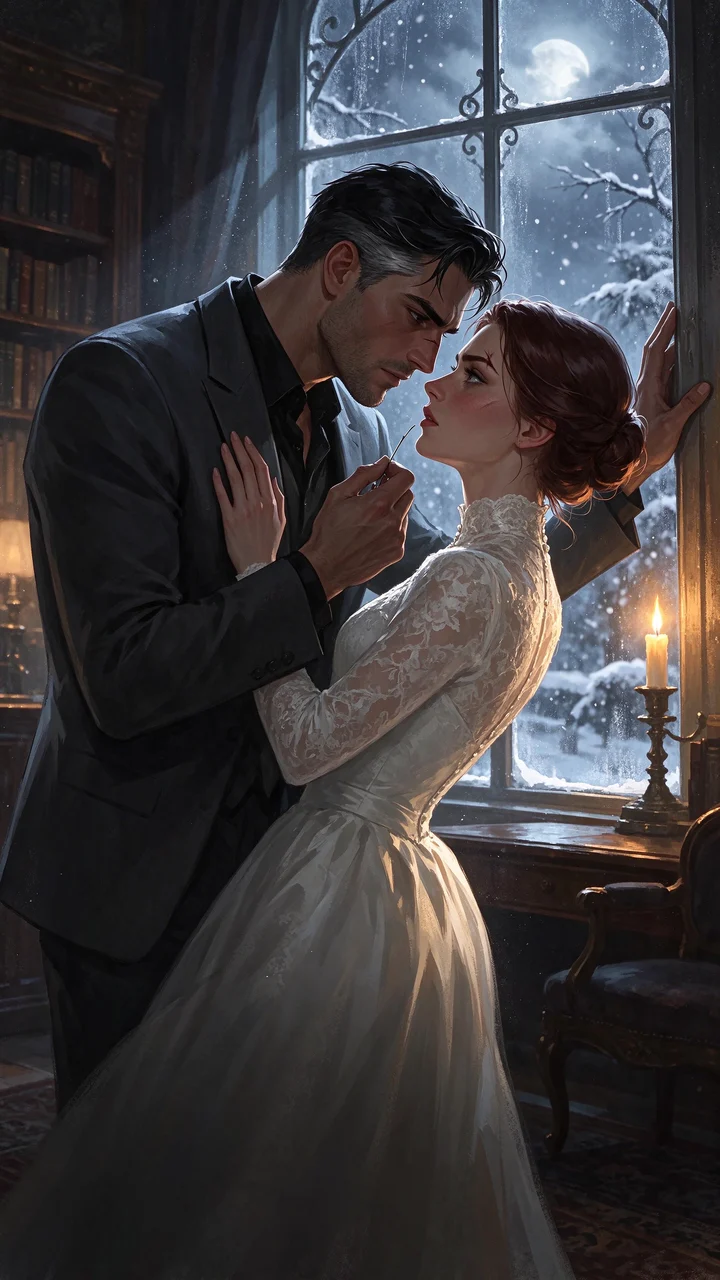
“Lower,” Augustin said. “Below the collarbone. Lace catches on edges.”
Vivienne had the surgical tape between her teeth. She tore a strip, laid it over the transmitter and ran her thumbnail along both seams until the thing was nothing but a coin of hardness against her breastbone. Her phone lay face-up on the vanity, speaker on, volume at two. Through the door, the organist was warming up on something Lutheran and joyless.
“It’s off,” Augustin said. “It stays off. You hear me, Viv? You will never have to switch it on.”
“Then why am I wearing it?”
“Because I’m an old man and I like to sleep.” That warm, rumbling laugh, the one that made juries feel tucked in. “Your mother tells me there are thirty-one buttons on that dress. Nobody’s getting through thirty-one buttons tonight.”
“My mother hasn’t spoken to me in nine years.”
“She spoke to me.” He let that sit. “Do up your collar. Smile when you see him. Remember whose side you’re on.”
She did up the collar. Pearl by pearl, the ivory lace closed over the tape, over her throat, up to the hinge of her jaw. In the mirror a woman with storm-grey eyes and a severe auburn chignon looked back at her, one strand already loose at the temple. Vivienne left it. Perfect was suspicious. Perfect was what a woman wore when she had something to hide.
“Viv?”
“I heard you, Augustin.”
“After tonight, you’ll have the case of your career.”
“After tonight,” she said, “I’ll have a husband,” and ended the call before he could laugh again.
. . .
The Marsh side of the chapel kept their coats on. So did the Dornes. Two hundred people sat in the candle smoke and the cold-stone smell of lilies with their right hands near their lapels, and Vivienne walked between them on her father’s arm, counting exits the way other brides counted bridesmaids.
Nico Dorne wasn’t watching her. He was watching the room.
She had seen him in surveillance photos: grainy, long-lensed, always half-turned away. The photos had missed the size of him, the stillness. Charcoal three-piece, black shirt buttoned to the throat, no tie. Black hair pushed back and silvering at one temple. A nose that had been broken once and set by someone in a hurry. Her father handed her over without a word, the way you’d pass a bag at a checkpoint, and only then did Nico look at her.
His eyes were dark enough to swallow the candles. He took her in, unhurried, the way she read a witness list, and something in his face settled, as if a question had been answered. She didn’t like not knowing which question.
The priest began. Vivienne fixed her gaze on the stained-glass Saint Michael above the altar and listened to snow ticking against his wings.
“Your collar’s turned,” Nico said, very low.
“It isn’t.”
“Hold still.”
He lifted one hand and straightened the lace with the back of a single knuckle, a slow drag along the edge at her throat. Then his fingertips drifted lower, following the line of the buttons, and stopped.
A breath above the tape. One heartbeat, perfectly still.
Then they moved on, and he smoothed the last fold flat, and lowered his hand. “There.”
“Thank you,” Vivienne said, in her courtroom voice.
“You’re welcome,” said Nico Dorne, in his.
When the priest asked, she said I do clearly enough for the back pews. The ring he slid onto her finger was old gold, heavy as a key.
. . .
The parish hall heating had died sometime during the vows. Guests ate wedding cake in their overcoats, their breath fogging over the champagne, and nobody danced.
Vivienne stood beside the three-tiered cake and watched her father and Carlo Dorne close in on it from opposite sides, two old bulls in cashmere.
“Cut it thin, Carlo,” said Desmond Marsh. “Your people choke on big pieces.”
“Funny.” Carlo Dorne picked up the silver cake knife and turned it in the light. “Your brother choked on less.”
The nearest table went quiet. Then the next. Somewhere behind Vivienne a chair scraped, and she heard the particular rustle of a man opening his jacket.
“You want to say that again,” her father said, “in front of my daughter?”
“Your daughter’s a Dorne now, Desmond. I’ll say what I want in front of her.”
Nico came through the crowd without hurrying. He set two fingers on the flat of the cake knife and pressed it gently down onto the tablecloth, and both men looked at him, and he looked at neither of them.
“Not at my wedding,” he said.
Four soft words. Her father’s jaw worked and nothing came out. Carlo released the knife. The man behind her closed his jacket. Within a minute someone’s aunt was laughing too loudly at the far end of the room and the string quartet had remembered it was being paid.
Nico cut a slice of cake, put it on a plate, and handed it to Vivienne.
“I’m not hungry.”
“Your hand’s shaking.”
It wasn’t. She looked. It was, very slightly.
“Eat something,” he said. “It’s going to be a long night.”
. . .
The blizzard had swallowed Lincoln Park by the time they reached the car. Snow came sideways through the headlights in thick, tumbling sheets, and the wipers laboured against it with a sound that reminded her of someone clearing their throat before bad news.
The woman driving had braids gathered high on her head and a thin earpiece cord curling into the collar of her black blazer. Every few blocks her dark eyes found Vivienne in the rearview mirror and rested there, unhurried, the way you’d watch a dog you hadn’t met.
“Priya,” Nico said, by way of introduction.
“Mrs. Dorne,” said Priya, and the mirror held Vivienne a moment longer.
“Marsh,” Vivienne said. “Professionally.”
“Professionally,” Priya agreed, and looked back at the road.
Nico had shrugged his dark wool overcoat off his shoulders and laid it across Vivienne’s lap without asking. It smelled of cedar and snow. She did not give it back.
“Let me tell you how this works,” he said. “You’ll have your own rooms. Separate rooms, separate lives. Your office, your hours, your friends, whoever they are. I won’t ask.”
“Generous.”
“Practical. In return, my name sits between you and anyone who’d like to use you to hurt your father, or me. That’s protection. It’s yours.” He turned his steel watch a quarter-inch on his wrist. “On my terms.”
“And what are your terms?”
“You’ll read them tonight.”
“I’m a lawyer, Nico. I don’t read contracts in the dark at the end of a fourteen-hour day.”
“Then I’ll read them to you,” he said, and Priya’s eyes came back to the mirror and stayed.
. . .
The storm had taken the power somewhere along the lakefront. His study was lit by candles in heavy brass holders, and the flames leaned every time the wind hit the windows.
The contract was handwritten. Cream paper, black ink, a slanted, deliberate hand. He laid it on the desk between them and uncapped a fountain pen and did not offer it to her yet.
“Clauses one through six are logistics. Money, residence, public appearances. You’ll find them dull.” He turned the page. “Seven is the important one.”
He read it aloud.
“One word from you, and everything stops. Whatever I’m saying, whatever I’m doing, whoever’s in the room. No questions. No penalty.” He looked up. “You choose the word.”
She hadn’t expected that. She’d expected rules for her, not for him.
“Anything?”
“Something you won’t say by accident. Something you’ll remember with your heart going.”
Snow scraped the glass. The candle nearest her guttered and steadied.
“Winter,” she said.
He wrote it into the blank space in his own hand, slowly, and blotted it. “Winter.”
Then he read Clause 8.
“You never lie to me.”
He didn’t turn the page. He let the words sit on the paper between them while the candles leaned and the wind worked at the windows, and Vivienne felt the tape under her collar as clearly as if he’d laid his hand there again.
“Vivienne,” he said, very gently. He held out the pen. “Is there anything you’d like to confess before you sign?”