
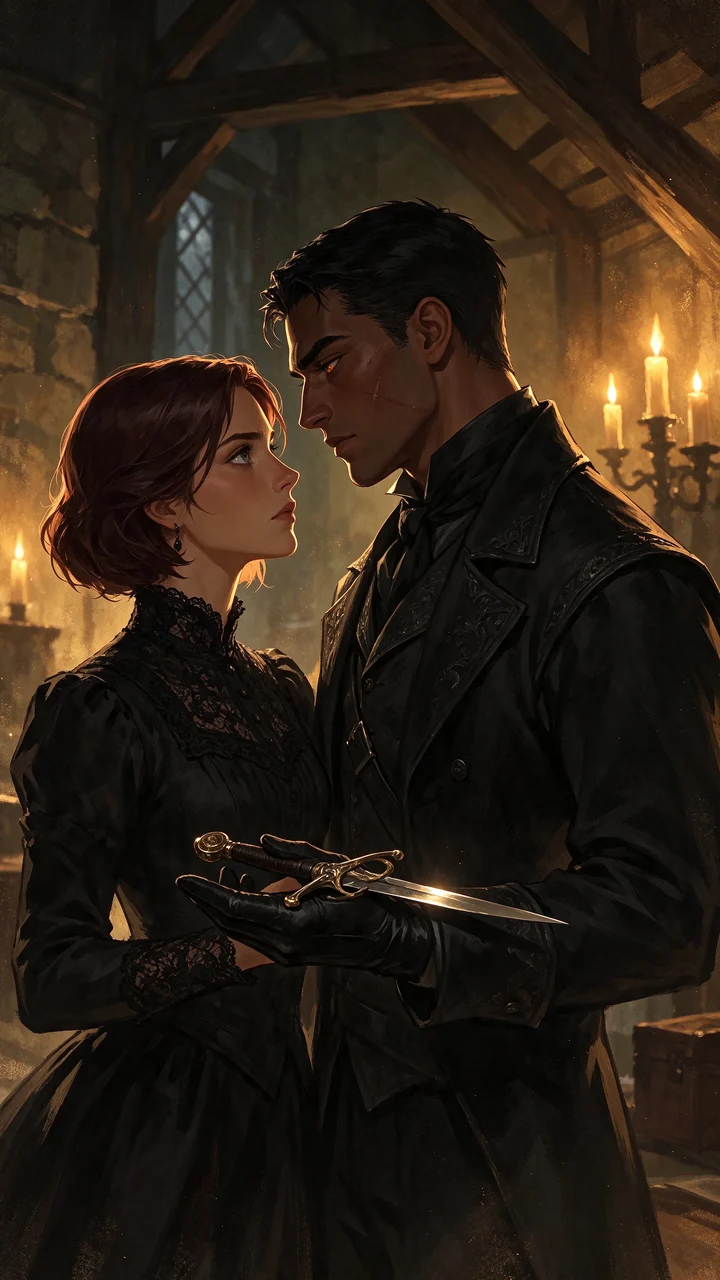
“That’s the third bell,” Sorrel said. “They’ll turn onto Lantern Row on the fourth.”
Behind her, Bettany Quill set down a pot of beeswax hard enough to rattle the lid. “You counted the route.”
“I planned the route.”
The attic window was a single pane of bubbled glass set low under the eaves, and every toll from the cathedral of Saint Vey made it shiver in its lead. Sorrel knelt before it on a folded horse blanket with her palms flat on the sill. Rain ticked across the slates over her head. The air tasted of candle smoke and cold iron, and of the cedar chest where Bettany kept the things she would not explain.
Fourth bell. The procession turned the corner.
Six black horses came first, plumed in crow feathers that the rain had already ruined. Then the household guard in mourning sashes, then the clergy, then the coffin on its gun carriage, draped in the violet and silver of Velmarch. Her colours. Her lilies, heaped and drowning.
“How heavy is it?” Sorrel asked.
“Heavy enough.” Bettany came to stand behind her, smelling of turpentine. “Wax and sandbags and your old riding boots. I gave her your nose. It took four tries.”
“What was wrong with the first three?”
“Too kind.”
Sorrel almost laughed. Below, a woman in a doorway pressed a handkerchief to her mouth. A boy took off his cap and held it to his chest until his father cuffed him to put it back on in the rain. People lined Lantern Row two deep under oilcloth and broken umbrellas, and none of them looked up at the slanted window of a tallow-chandler’s attic, where the woman they were burying watched them weep.
She catalogued them anyway. The weepers. The ones who studied their boots. The tailor across the way who had hung his black bunting a full day before the official announcement.
“You’re memorising faces,” Bettany said.
“I’m memorising debts.”
The door at the foot of the attic stairs opened and shut. Boots on the treads, unhurried, each step placed where the wood would not complain. Sorrel did not turn. She had learned in four days that Silas Callow could make himself silent whenever he wished, and that he chose to be heard when he came near her. She had not yet decided what that meant.
He ducked under the beam at the top of the stairs. Water ran from the brim of his hat and from the shoulders of his charcoal greatcoat and pooled on the boards around his boots. He took off his gloves finger by finger and laid them on the cedar chest.
“Well?” Sorrel said.
“Hallowmere wept at the graveside.” His voice was low and level, with a dryness in it she was starting to listen for. “Real tears. I was impressed. Then he dried them, lifted the chain of office off the archbishop’s cushion, and put it round his own neck.”
“Before the earth was on the lid.”
“Before the first spadeful. He’s named himself Regent of Velmarch until a lawful heir is confirmed.” Silas shook the rain from his hat. “He said it with great sorrow.”
Bettany swore, short and filthy. Sorrel only watched the coffin dwindle down the Row, swaying on its wheels.
“He always did love a ceremony,” she said.
“He’ll love the next one more. Coronations are better catered.”
She turned at last. He stood in the grey light with rain on his cheekbones, the pale scar along his jaw shining where the wet had found it. Amber eyes. A patient face. Four nights ago, the last thing she had seen in the dark of her own bedchamber had been those eyes above a knife.
. . .
She had woken because the room smelled wrong. Oiled leather. Rain.
The steel was cold and very still against her throat, resting along the line of her pulse without breaking skin. A man knelt over her on the coverlet. He had not covered her mouth. She would understand later that this was a courtesy.
“Who paid you?” she asked.
“A man in a mask. Gold up front.” A pause. “You’re calm.”
“I’ve been waiting for you for a month. I just didn’t know your face.” She swallowed, and felt the edge register it. “How much?”
“Three hundred crowns.”
“I’ll give you nine hundred to work for me instead.”
He did not move the knife. “To do what?”
“To kill me. Publicly. Convincingly. Then to hide me while I learn who toasted the news.” She held his gaze in the dark. “The gold is in the second drawer of that desk. Take it either way. If you walk out of that window tonight and keep walking, it’s yours. I won’t send anyone after you.”
“Why would you do that?”
“Because I want a man who chose to be here. I’ve had enough of the other kind.”
The knife stayed where it was for a long time. Then it lifted, and he sat back on his heels at the edge of her bed and said, “Nine hundred is a lot for a dead woman.”
“I’m not dead yet, sir.”
He had stayed.
. . .
“You’ve brought me something,” Sorrel said now.
“I have.” Silas drew from his waistcoat a length of black silk ribbon, narrow and glossy, the kind milliners sold by the yard for mourning bands. He laid it on the little deal table beside the candle, where it curled on itself into a dark question mark. “The invitation to the Regent’s masquerade came to the guild this morning. Two nights from now. Every paid blade in the city is expected to attend and be grateful.”
“And I’m to go.”
“You’re to go as mine. Men in my trade bring trophies to these things. A girl from a debt house. A rival’s sister. Something to show.” His mouth tightened. “Nobody looks twice at a man’s property. They look at the man. You’ll wear this at the wrist so the room knows what you are.”
Bettany made a noise in her throat. “I’ll be downstairs,” she said, “pretending I heard none of that,” and the stairs creaked under her all the way down.
Sorrel crossed to the table and drew the ribbon through her fingers. It was cool, heavier than it looked, the silk tightly woven.
“In public,” she said, “you lead. You speak for me. You put your hand where they expect it and you don’t flinch when they stare.”
“Agreed.”
“In private, you obey.”
He went very still, the way he had gone still above her with the knife. Different, though. She could see the difference in his hands.
“Define obey,” he said.
“You do what I ask. You tell me the truth when I ask for it. You don’t touch me unless I say so.” She wound the ribbon once around two fingers. “And either of us can end anything, at any moment, with one word. No questions after. No sulking.”
“What’s the word?”
She glanced at the window, at the sodden street with its oil-lamps left dark for mourning. “Lantern.”
“Lantern,” he repeated, testing the weight of it. “Either of us.”
“Either of us. I mean it, Silas. You can walk away from this the way you could have walked away from my bed.”
“I know.” He looked at her for a long moment. “That’s why I’m still here.”
Something low in her stomach drew tight at that, and she did not like it, and she did not look away. She let the ribbon slide off her fingers onto the table.
Outside, the bells began the long, slow tolling that meant the coffin had reached the cathedral door. Silas took one step toward her and stopped at the edge of the candlelight, leaving her the distance to refuse him. Then, without hurry, he sank to one knee on the bare boards. The wet hem of his greatcoat spread around him. He rested a forearm across his thigh and lifted his face to her.
It should have been a small thing. Courtiers had knelt to her since she was twelve, whole halls of bent necks, and she had never once felt it in her body. She felt this. In the backs of her knees. In her throat. In her fingers, which still remembered the silk.
“Majesty,” he said quietly. “What do you want of me?”
She opened her mouth and found she had no answer ready. She, who always had one.
He waited. The rain ticked on the slates. The bell rang again, fainter, and then the last note shivered through the glass and thinned and was gone, and in the silence after it he was still on his knee, watching her, perfectly patient, as though he would wait there all night.