
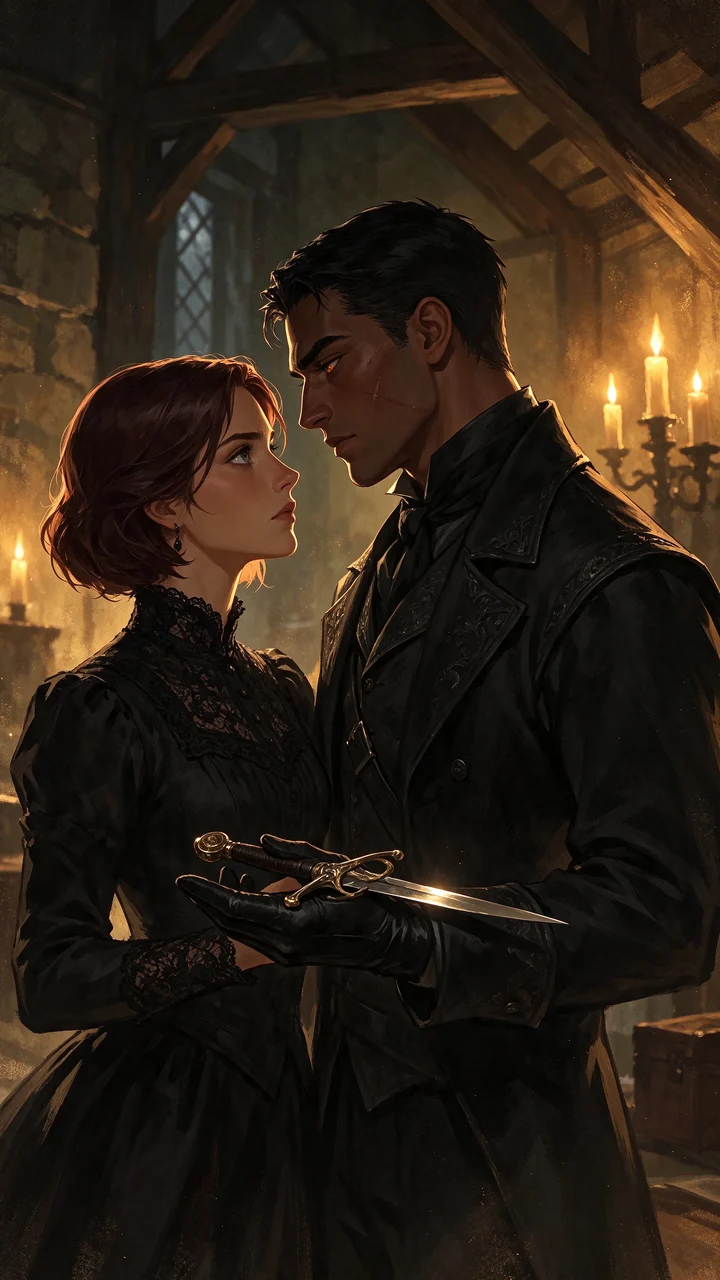
Silas held the candle where Bettany pointed and tried, as a matter of professional discipline, to look only at the hem.
“Higher,” Bettany said around a mouthful of pins. “I can’t see the stitch.”
He raised it. Firelight already did most of the work in the study, gilding the spines of his ledgers and the racked blades along the far wall, but Bettany trusted fire about as much as she trusted the city watch. The room was close and warm and smelled of sealing wax, of the open bottle of Corvane red on his desk, of his greatcoat steaming dry on its hook.
Sorrel stood on the footstool by the hearth with her arms held a little away from her sides, the way a woman stands who has been fitted for gowns since before she could read. The dress was ink-dark velvet, nearly black until the fire found the blue in it, cut close through the bodice with a high beaded collar and sleeves to the wrist. Bettany had stolen the pattern from a duchess’s dressmaker and improved it out of spite.
“Turn,” Bettany said.
Sorrel turned. Her cropped hair brushed her jaw. A drop of wax rolled down the candle and over Silas’s knuckle, and he did not move his hand.
“Mask,” Bettany said, and held it up.
Raven feathers, layered and lacquered to a shine, with a short hooked beak of black horn over the bridge of the nose. Sorrel tied it on herself. When she lifted her face, nothing was left of the queen on the coins but the stubborn mouth and those grey eyes, colder now, framed in black.
“Well?” she said to him.
“You’ll do,” Silas said.
“High praise.”
“I’m a reserved man.”
She stepped down, gathered her skirts in one hand and went up to change, and he listened to every tread until her door closed.
Bettany took the pins out of her mouth one at a time and stuck them in the cushion at her wrist. “Si.”
“Don’t.”
“You’ve got wax all over your hand.”
He looked down. So he had. He set the candle on the mantel and peeled the cooling wax from his skin.
“I’ve known you eleven years,” Bettany said. “I’ve watched you look at men you were paid to kill, and at a woman you were half in love with, and at that Ostrevan sabre you couldn’t afford. I’ve never seen you look at anything the way you just looked at her.”
“And how was that?”
“Like a man already lost.” She pulled off her spectacles and rubbed them on her apron, which only moved the ink around. “She buried herself to catch them. Think what else she’d put in the ground to win.”
“She gave me the door, Bet. The first night. Gold in my hand and the window open.”
“I know. That’s what worries me.” She settled the spectacles back on her nose. “Nobody offers a man the door unless she’s very sure he won’t take it.”
. . .
Sorrel came down in a plain wool dress with the raven mask dangling from her fingers and found him alone, standing at the hearth with his back to the fire.
“Bettany’s gone to bed,” he said.
“Bettany’s listening at the top of the kitchen stairs.”
“Probably.” He didn’t sound troubled. “Where do you want to start?”
“With your hands.” She set the mask on his desk among the ledgers. “You’ll be watched by men who have owned people. If you hold me the way you held that candle, they’ll know inside a minute.”
“How did I hold the candle?”
“As though it might complain.”
A corner of his mouth moved. She liked that more than she should have.
“Come here,” she said, and he came, and stopped an arm’s length away. “You’ll walk me in with your hand at my back. Not the middle. Lower. Where it says you’ve a right to it.”
“May I?”
“You can’t ask me that at the palace.”
“We’re not at the palace.” He waited. “May I?”
“Yes.”
His gloves were off. His palm settled at the small of her back, warm through the wool, and stayed there, light, with the restraint of a man holding something he’d been told was his and didn’t believe it. She felt each finger separately.
“Too careful,” she said.
“I don’t know how else to be with you.”
“Then learn. Spread your hand. Hold me as if I’m yours.”
His fingers spread. The heat of them went straight up her back, and she kept her voice level by force. “Better. When you speak to me, don’t look at me. Look at whoever you’re talking to. I’m furniture.”
“You’re not furniture.”
“In there I am. Say, ‘Stand here.’”
“Stand here,” he said, and it came out low and certain and nothing like furniture, and she had to look at the fire.
“Again. Without the apology in it.”
“There was no apology in it.”
“There was a little.”
“Stand here,” Silas said, and this time there wasn’t, and the room grew very warm.
She stepped away first. He let his hand fall at once, which was its own kind of answer.
“Now tell me what you were saving until Bettany left,” she said.
He took a twist of oilcloth from the desk drawer and opened it. Inside lay a broken disc of red sealing wax the size of a thumbnail. Half an impression: a heron’s head and curved neck, a crown above it, the edge of a ring of lettering.
Sorrel knew it before she touched it. She had sat across a council table from that heron for six years.
“Hallowmere’s signet.”
“Pressed into the seal on my commission. The go-between broke it in front of me to prove whose it was. He kept the other half.” Silas tilted the oilcloth to the light. “He wore a mask, but he limped on the left and smelled of quince. I followed him home.”
Quince. Sorrel had been nine, abed with spotted fever, and a councillor with a bad knee had brought her a jar of quince preserves and read to her until her mother sent him away.
“Osric Dunmore,” she said.
“Osric Dunmore.”
She closed her hand around the half-seal and let its broken edge bite her palm. Silas didn’t say he was sorry. She was grateful.
“He’ll be there,” she said. “He never misses a party.”
“Then we’ll find him.” Silas glanced at the ribbon, coiled on the desk where he had carried it down from the attic. “We should practise that too.”
She held out her left wrist. Her hand was steady. She made sure of it.
“Ask,” she said.
He picked up the ribbon, came to her, and sank to one knee so that his face was below hers. “May I?”
“You may.”
He drew the silk around her wrist. Once. Twice. His thumb lay over the inside of her wrist where the pulse beat, and he must have felt it quicken, because something moved in his face, though he never looked down at his hands. He watched her the whole time. He tied the knot slowly, tested it with one finger slipped beneath, and left that fingertip against her skin a fraction longer than he needed to.
Her breath caught. He heard it. She saw him hear it.
“Too tight?”
“No.”
He let go. He stayed on his knee.
She could have told him to rise. That was the next line, the sensible one. Instead she heard her own voice say, “Stay there.”
His chin lifted. “For how long?”
“Until I say otherwise.”
It had nothing to do with Dunmore or the regent or the throne. She knew it as she said it. So did he.
“Yes, Majesty,” Silas said.
She picked up the raven mask, walked out of the study and climbed the stairs without looking back, and she did not release him.
Her room lay directly above. She lay on the coverlet in her wool dress with the ribbon still knotted at her wrist and stared at the cracked plaster, and listened. The house ticked and settled. Rain came and went in the gutters. Below her, through one floor and one closed door, there was no sound at all. No chair scraping. No tread on the stair.
He had the word. He could say it to the empty room, get up, finish the Corvane red and go to bed. She lay with her thumb on the knot and waited to hear him do it.
The hall clock struck one. Then two.
Somewhere past three she understood that she was listening as hard as a sentry on a wall, and that downstairs in the dark, on his knee on the hearthrug, Silas Callow was listening just as hard for her.