
The leash tightened. Leather creaked through Kofi's fist as he took up the slack an inch at a time, and Willow felt the pull at her collar before she understood it, felt it lift her chin, felt the padlock swing cold against her throat. Her knees had gone numb on the rug. She came up off them anyway, heels finding the floor, thighs trembling with the effort of a rise that had nothing to push against, no hands to steady her — wrists still cuffed behind her back, the steel a small hard pressure at the base of her spine.
"Up," Kofi said. Not loud. He didn't need to be.
She stood. The wig had slipped a little in the signing, and a strand of platinum hung across her cheek, and she could not lift a hand to move it. She could feel the latex where it sealed against her ribs, warm now, sweat gathered in the small of her back under the bodysuit, and the six-inch boots made her taller than she had ever been in her life and no steadier at all.
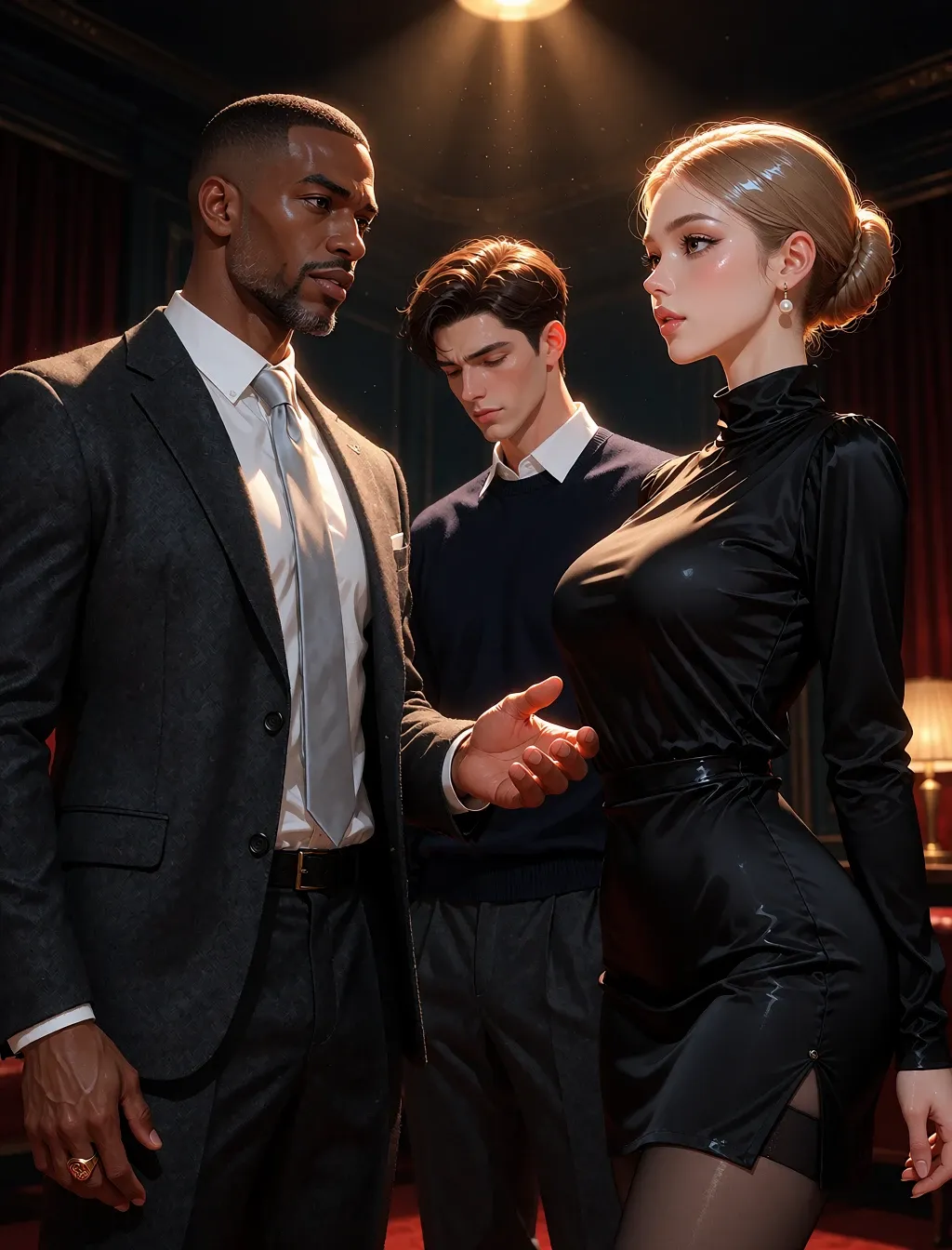
Kofi rose from the desk. He was bigger standing than sitting, the charcoal suit pulling across his shoulders, and the lamplight found the gray in his beard and the gold on his pinky. He wrapped the leash once more around his fist — one turn, two — until there was no slack at all between his hand and her collar, and then he began to walk.
Not toward her. Around her.
His shoes made a slow, deliberate sound on the boards. Willow fixed her eyes on the mahogany desk and the stack of squared papers and the pen laid beside them, and she listened to him move behind her, and every part of her that could not see him began to invent him — the breadth of him, the nearness, the heat of him at her back — and she was ashamed of how much she wanted him to look, and how much she feared it.
"The wig," Kofi said, from behind her left shoulder. "Platinum. Not cheap." A pause. "Your wife has taste. I'll say that for her."
"Yes," Willow said. It came out smaller than she meant. "She — she chose it. Sir."
The word sir had come out of her without being sent for, and she felt her face heat under the paint, and she was glad he was behind her and could not see it. The shoes stopped. She heard him breathe, unhurried, the way he did everything.
"The bodysuit," he said. "Latex. Black. You've worn it an hour and it's already learned your shape." His voice moved as he moved, a slow arc from her shoulder toward her waist. "It shows everything, doesn't it. Every place you've got soft. Every place you've got scared."
"Yes, sir."
"The boots." He had come round to her other side now, and she caught the edge of him in the lamplight, the charcoal, the gold, and then he was past. "Six inches. You're standing like a colt. Legs shaking. And you'll wear them anyway, because I'll tell you to, and because some part of you likes what they do to you."
Her throat worked. She said nothing, because there was nothing true to say that did not give her away.
Kofi completed the circle and stopped in front of her, and he was close now, close enough that she had to lift her chin to keep her eyes on his face, close enough to smell him — leather and clean sweat and something under it, cedar, or the ghost of a cigar. His brown eyes went over her slowly, from the platinum hair down the painted face to the collar with its small brass lock and the latex that clung to her breasts and her belly and the steel cage beneath it, and the whole length of her legs to the boots. He did not hurry. He looked the way a man looks at a thing he has paid for and means to keep.
"Turn," he said.
She turned. Awkward, in the boots, her cuffed arms making a clumsy half-step of it, and she felt his hand find the small of her back — not to steady her, she understood, but to guide her, the way you guide something that belongs to you — and then he was behind her again, and his broad hand came to rest on the curve of her hip.
The heat of his palm went through the latex like it wasn't there. She felt every finger of it, the spread of it, the weight. Her breath caught somewhere in her chest and did not come back out the way it went in.
"There's a mirror on that wall," Kofi said, close to her ear, and his voice in her ear was worse than his hand on her hip, was a thing that went down her spine and settled low. "I want you to see what I bought."
He turned her toward it. His hand on her hip, his other hand taking up the leash again, and the two of them moved together across the boards until the mirror had them both.
Willow looked.
The glass was tall and plain, and the lamplight was low and gold, and in it stood a woman she did not know. Platinum hair falling to her bare shoulders. Paint on her face — the dark around the eyes, the red on the mouth — and the black latex sealing her from throat to thigh, and the collar, and the steel glint of the cage where it showed through the shine of the suit, and the boots. Six inches of heel, and the legs above them long and pale, and the whole of her held in the frame of Kofi Amari's broad hand on her hip.
She had spent two years looking at a photograph of herself in a shoebox, a woman she had made in secret with a wig and a lipstick and a camera on a timer. She had never once seen this. She had never once been seen seeing it.
"There," Kofi said. "Look at her."
Willow's eyes went to the mouth first, because the mouth was easiest. Then the eyes. Then — she could not help it — the eyes went down, to the cage, to the small steel fact of it, and her thighs pressed together without asking her.
"You're looking at the cage," Kofi observed. "Good. That's honest. Most of them pretend not to." His thumb moved once, slow, along the crest of her hip. "You'll learn to be honest with me about everything, Willow. It's the only way this goes easy for you. And I don't mind telling you — easy is not the same as soft. I've no intention of being soft."
"No, sir," she said, and heard the breath in her own voice.
He let go of her hip. She felt the absence of his hand the way you feel a door open onto cold. And then he stepped back, and she watched him in the mirror as he came around in front of her, and he reached out and took her chin between his thumb and forefinger and lifted it, and turned her painted face this way and that, studying it.
"Your wife gave me a file," he said. "Did she tell you that?"
"She said — she said she knew. About me. About all of it." Willow's eyes slid off his face and he brought them back with the smallest pressure of his thumb, and she said, quieter, "She said there was a folder. Photographs. Men."
"Photographs. Men. Router logs." Kofi said the last two words with mild relish, as though they were a dessert. "Two hundred and eleven photographs, Willow. Forty-one men. Two years. She is a very thorough woman, your wife. I'd have hired her, in another life." He let her chin go. "But the file is only what she could see from the outside. What I want to know is what's on the inside."
He walked to the desk and set the coiled leash down on the mahogany, and then he turned and looked at her standing in the lamplight in her boots and her latex, and he said, "Your file mentions something else. Something you did to yourself, in the dark, with headphones on. Files of your own. Do you know what I mean?"
Willow's heart went hard and fast against the inside of her ribs. "Yes, sir."
"Say it."
"Hypnosis," she whispered. "I — I listened to them at night. When she was asleep. The files taught me — they taught me a garden. A quiet place. Where I don't have to think." She swallowed. "And — words. There were words that — that take me there."
Kofi nodded slowly, as though she had confirmed a thing he already knew, and he came back across the rug toward her, and he said, "Show me."
She looked at him. The lamplight, the mahogany, the mirror at her back. "Which word, sir?"
"The first one. The small one." He stopped in front of her, close, and his voice dropped to something soft and level and inevitable. "Pretty."
The word went through her like a hand through still water. She felt it in her knees first, a softening, and then in her shoulders, which dropped, and then in her mouth, which parted, and her eyes — her eyes went far away and gentle and she watched them go in the mirror and could not call them back. The garden opened. The lamplight was warm and the room was quiet and there was nothing in the world to decide.
"Oh," Kofi said, softly. "There it is."
He circled her once more, slowly, and she stood in the garden and let him, her chin tipped, her eyes distant, the leash trailing from her collar to his hand. She heard his shoes. She felt the air move where he passed. She did not think about any of it, and it was the most restful she had felt in years.
"Look at your shoulders," Kofi said, from somewhere behind her. "Look at your hands." She looked. Her shoulders were soft and low and her hands, cuffed behind her, had gone loose and open. "You do this to yourself for a word. A single word, said in a room, by a man who owns you." His voice was almost tender. "That's not a game you play, Willow. That's a door in you that swings both ways. And I'm the one standing in it now."
She wanted to answer and found that the garden had taken her voice, or most of it, and what was left was a small sound in her throat that was not a word at all.
Kofi came round to face her again and looked into her far-away eyes and smiled, and it was the kind of smile that made you feel both welcome and watched, and he said, "Good. Now come back to me." He waited. He did not say another word. He simply waited, patient as the night, until her eyes found his face again and the room came back around her — the lamplight, the mahogany, the leather smell, the bass of the club through the floor — and her knees nearly went out from under her.
"There she is," Kofi said.
The room stayed where it was. The lamp did not move. And Willow stood in the middle of it with her knees locked and her mouth dry and the sound of her own blood loud in her ears, coming back to herself the way you come back from a warm bath into cold air, one inch of skin at a time.
"That was the small one," Kofi said. He had not stepped away. He stood close enough that she could see the weave of the charcoal wool at his shoulder, the single gray thread, the way the lamplight sat flat on the gold of his ring. "There are others. Your files were thorough, and your wife's file was thorough about your files. You wrote down what they did to you, in a notebook, in a drawer. The words you liked best." His head tilted, unhurried. "You want to tell me one, or shall I tell you?"
Her throat worked. "You — you know them. Sir."
"I know them." He said it plainly, no relish now, which was somehow worse. "I know what a man writes down at two in the morning with the door locked. I've been in this trade a long time, Willow. I've met your kind before. And I've never yet met one who told me the truth about the words without being made to." His hand came up and he laid two fingers against the hollow of her throat, just above the collar, where her pulse was going. "So I'll take it as a courtesy that you didn't waste my night."
"I wouldn't," she said, and the words came out cracked. "I wouldn't waste it. I — I've wasted so much already."
He looked at her a moment. Something in his face moved and settled, and it was not softness, but it was not the buyer's calculation either — it was a man adjusting his estimate of a thing he had bought. Then he took his fingers away and stepped back and said, "Kneel. Not the garden. Just your knees. I want to see you do it on purpose."
She went down. It was not graceful — the boots made it a strange, tipping descent, and with her wrists cuffed behind her she had to find her balance in her thighs and her gut, and she did it badly and caught herself and did it again, and got her knees onto the rug. The latex pulled tight across the fronts of her thighs. The rug was rough under the shine of it. She lifted her chin because she had learned that he liked the chin, and she put her eyes on the middle button of his jacket and kept them there.
"Better," Kofi said. "You kneel like a woman who means it now. The first time tonight you knelt like a woman hoping to be told she was doing it right." He walked a slow half-circle to the desk and picked something up — she heard the small click of it, metal on wood — and came back, and she saw what it was and her stomach dropped. A short length of black leather, doubled, with a steel ring at the fold. A strap. "Your wife left this in the file too. Along with a note. Do you want to know what the note said?"
"Yes, sir."
"It said: he will tell you he doesn't want it. He is lying. He has wanted it since he was nineteen and too frightened to say so." He turned the strap over in his fingers, once, and the leather made a soft sound. "So I'm going to ask you a question, and I want the answer your wife would give me, not the answer your shame would give me. Do you understand the difference?"
"Yes, sir." Her voice had gone thin. "The shame answer is no."
"And the truth answer?"
She looked at the strap and then, because she had promised herself she would be honest in this room if it killed her, she looked up at his face. "Yes. Sir. I want it."
He did not smile. He nodded once, slow, as though a ledger line had been ruled and totaled, and he said, "Good girl. That's the first honest thing you've said all night that cost you something." He set the strap down on the desk behind him, out of her sight, and she heard it land and felt her whole body lean toward the sound. "Not tonight. Tonight I'm only looking. But you'll feel that I looked, tomorrow, when you're sore in places you didn't know you had."
He came back around in front of her and crouched, and the crouch brought his face down to hers, and she saw him close — the lines at the corners of his eyes, the gray in the beard, the patience. "Now," he said. "Second word. This one's not small. This one's a door with a lock on it, and I want to see if I can turn the key. Do you trust me to bring you back?"
She thought about the garden, and the quiet, and the way he had waited at the edge of it with his hand out and not one word of hurry. "Yes," she said. "Sir."
"Then listen." He said the word low and level and close, and it was a word she had written in a notebook at two in the morning with the door locked, and it went through her like the first one had but deeper, and the garden did not just open — it took her down, the way a tide takes a swimmer who has stopped swimming, and she felt her shoulders go and her chin drop and her eyes lose their focus and the whole warm quiet close over her head. She heard, from very far away, her own breath go slow and even. She felt the rug under her knees and the steel at her wrists and none of it mattered, and the lamplight was gold and the room was soft and she was, she understood dimly, exactly where she had always been trying to get to with a pair of headphones and a locked door and the volume turned down low.
"There," Kofi said, from somewhere above her, and his voice was the only thing in the garden that had edges. "Look at you. You went down like a stone in water. And you came up when I called you, and you'll come up when I call you again, because that's the whole of it, Willow — not the word. The man who says it. Any fool with a file could say the word. I'm the one you'll answer to." She felt his hand settle on the crown of her head, heavy, warm, and stay there, and she knelt in the gold quiet and let him hold her down into it, and somewhere in her chest a thing that had been clenched for nineteen years let go all at once.
The hand on her head lifted. She felt its leaving the way a bather feels the cold when the sun goes behind a cloud, and she made a small sound she had not given permission to.
"Stay," Kofi said. "I'm not finished with you."
She heard him move away — the boards, the leather of his shoes, the small drag of a drawer. The garden held. She knelt inside it with her chin down and her eyes unfocused on the rug's dark red, and the club's bass came up through the floor into her knees, slow as a pulse, and she thought nothing at all, and it was like floating on her back in water deep enough that the bottom had stopped being a thing she needed to know about.
Then his voice came back, and it was not the voice from before.
"There's a thing about your files I didn't tell you yet," he said. He was behind her, but not close; the voice had the flatness of a man speaking to a room. "The words aren't the same. You wrote them in a notebook as if they were all one kind of thing. They're not. The first one's a key — it opens a door and you walk through it and you can walk back. The second one's different. The second one's a hand on the back of your neck."
Somewhere far off, at the edge of the gold, a part of her understood that this was information she should hold on to. The rest of her let it go past like a leaf on a current.
"And the third one," Kofi said, and now his shoes came back toward her, unhurried, "the third one I'm not going to say tonight. Not because you couldn't take it. Because I don't hand a man the whole of a thing on the first night. You'll get it when I want you to have it, and not a minute before, and you'll spend a while wondering when that'll be. That wondering is part of the price." He stopped. She saw the toes of his shoes at the edge of her downcast vision, black, polished, a thin line of lamplight along each. "Look up."
She lifted her face. It came slowly, as if the garden had put weight in her skull, and when her eyes found his he was crouched again, forearms on his knees, and he was looking at her with the flat patience of a man reading a gauge.
"Now," he said. "This word is not pretty. It doesn't make you soft. It makes you certain. That's the difference, and you're going to feel it, and when you do, I want you to notice that you're still kneeling, and still breathing, and still mine, and that nothing bad has happened to you. You understand me?"
"Yes," she said. Her voice came out of the garden slow and far. "Sir."
"Say it back to me. What did I say the difference was?"
She reached for it. It was like reaching for a coin at the bottom of a clear pool — visible, and further away than it looked. "Pretty makes me soft," she said. "This one makes me — certain. And I'm to notice I'm still kneeling."
"Still mine," he corrected, gently.
"Still mine." The words felt strange in her mouth, a coat cut for a bigger man, and she wore them anyway.
Kofi's eyes creased at the corners. "Good. Close your eyes. Not because I told you to be shy of me. Because I want you to hear it without anything else getting in."
She closed them. The dark behind her lids was warm and reddish at the edges where the lamp pressed through, and she could hear the club now, really hear it, the low end of something with a slow beat, and a glass being set down somewhere below, and her own breathing, and the small tick of the lamp's heat.
He said the word.
It was two syllables. It was not loud. It landed in her the way a key lands in a lock that has been waiting for it — not a click but a whole turning, a mechanism she had not known was loaded. Her spine straightened as if a wire had been drawn up through it from the base to the crown. Her chin came up of its own accord. Her eyes opened without her deciding to open them, and the room came in sharp and close and entirely clear — the mahogany, the green shade of the lamp, the mirror with the woman in it, the gray in Kofi's beard, the single thread of lint on the charcoal wool at his shoulder. The garden was gone. There was no garden. There was only this room and this man and the fact of her knees on the rug, and she was not soft and she was not floating and she was not afraid.
She was sure. Of everything. Of the floor under her. Of the steel at her wrists. Of what she was for.
"Oh," she said. It came out low and steady, a stranger's voice, a voice with a floor to it.
"Yes," Kofi said. "There it is." He had not moved. He watched her the way a man watches a fire he has just lit and means to keep fed. "Tell me what you feel. Not what you think I want. What's in you."
She looked at him and the words came without any hunting at all, which was the strangest part. "I feel like — like a door that's been standing open my whole life and someone finally came and shut it." Her hands, cuffed behind her, had closed into fists and she felt the nails in her palms and did not unmake them. "I feel like I could stand up and walk out of this room and not be able to, and it wouldn't be the cuffs. It'd be that I don't want to. I know exactly what I want, sir, and it's to be right here, doing whatever it is you say, and I have never in my life known a thing that clearly."
Kofi was quiet a moment. Then he said, "You hear the difference in your own voice?"
"Yes, sir."
"That's not the word doing that. The word's a lever. You're the weight behind it." He stood, and the standing brought him tall over her, and he set his hand on her head again — not heavy this time, a flat warm weight, a hand on a hound's skull. "Which means the next time you're alone in a room and you're frightened of something, you'll know the lever's in there and you can pull it yourself. That's not a thing I give you. That's a thing you already had and were too ashamed to reach for." He took his hand away. "Now — I'm going to say it a second time, and this time I want you to do something with it. Not kneel there being sure. I want you to say the thing you've never said out loud. The true thing. The one you'd have died before you said to her."
Her mouth had gone dry. "And the word will—"
"The word will hold the door shut while you say it. That's what it's for. Certainty isn't comfort, Willow. Certainty is standing in the cold and not flinching." He crouched once more, and his face was level with hers, and he said, soft and unhurried, "Ready?"
"Yes, sir."
He said it again.
The wire came up through her a second time and this time it did not just straighten her — it steadied her, set her like a mast in a stepped socket, and she felt her breath go deep and even and her eyes hold his without a tremble. The words were there. They had been there for years, folded small, at the bottom of a drawer.
"I never wanted to be him," she said. "Warren. The — the man in the suit with the good teeth and the right laugh and the hand he puts out for other men to shake. I built him. I built him like a — like a shed over a hole, so nobody would look down the hole. Every morning I put him on. Every night I took him off and I was so tired, sir, I was so tired, and I thought — I thought if I ever said it out loud, even once, to anyone, that the shed would come down and there'd be nothing under it but the hole." Her voice did not crack. It was the sure voice, the floored voice, and it went on. "And now the shed's down. She took it down. She took everything and she sold it and she left, and I'm kneeling on a rug in a stranger's office in a wig and a cage, and I am more — I am more here than I have ever been in my life. Sir. That's the true thing. That's all of it."
Kofi did not move for a moment. The lamp ticked. Down in the club the bass turned over into a new bar.
"Warren built the shed," he said at last, slowly, tasting it. "But Warren's the one who dug the hole in the first place. Don't you go giving him all the blame and none of the credit. A man doesn't dig a hole that deep unless something in him wants the dark to be his." He rose. "You've said it. It's said. It stays said — I'll not have you take it back tomorrow and pretend you were addled by a word. You weren't addled. You were honest, and honesty's the one thing in this house that doesn't come off with the paint."
He walked to the desk and picked up the coiled leash, and she watched him do it with the sure eyes and felt the whole length of the night ahead of her like a road she could see all the way down. He came back and clipped the leash to her collar — she heard the small snap of it — and gathered the slack into his fist.
"Up," he said. "On your feet. Slowly, and don't you dare look graceful about it. I want to see you work for it."
She worked for it. The boots made her tip and she caught herself with a hard flex of her thighs and a grunt she did not bother to swallow, and she got upright and stood with her weight even and her chin up and her eyes on him, and the latex had gone slick with sweat at the small of her back and she did not care, and the cage was a small cold certainty against her and she did not care about that either.
"Better than the first time," Kofi said. "You stand like a woman who knows what she's standing in." He turned toward the door, and the leash drew out straight between them, and he stopped with his hand on the knob and looked back over his shoulder at her. "One thing before we go down. The word I said — you'll not say it to yourself. Not in your head, not in the dark, not to make a bad hour easier. You come to me for it. That's the rule, and it's the only rule tonight that'll cost you if you break it. Do you understand?"
"Yes, sir. I come to you."
"Good girl." He opened the door, and the club's sound came up the stairwell at them, all bass and glass and the far-off rise of a woman's laugh, and he stepped out onto the landing and drew the leash taut. "Now. There's a room downstairs with a mirror in it and a good many people in it who've paid to look at what I keep. You'll go down those stairs on those heels without falling, and you'll go in with your chin where it is now, and you'll let them look. And when you feel that certainty start to thin — because it will, it always does, the first time — you'll find my hand on the leash and you'll remember whose it is." He started down. "Come on, then. Let's show them what a door looks like when it's shut."