
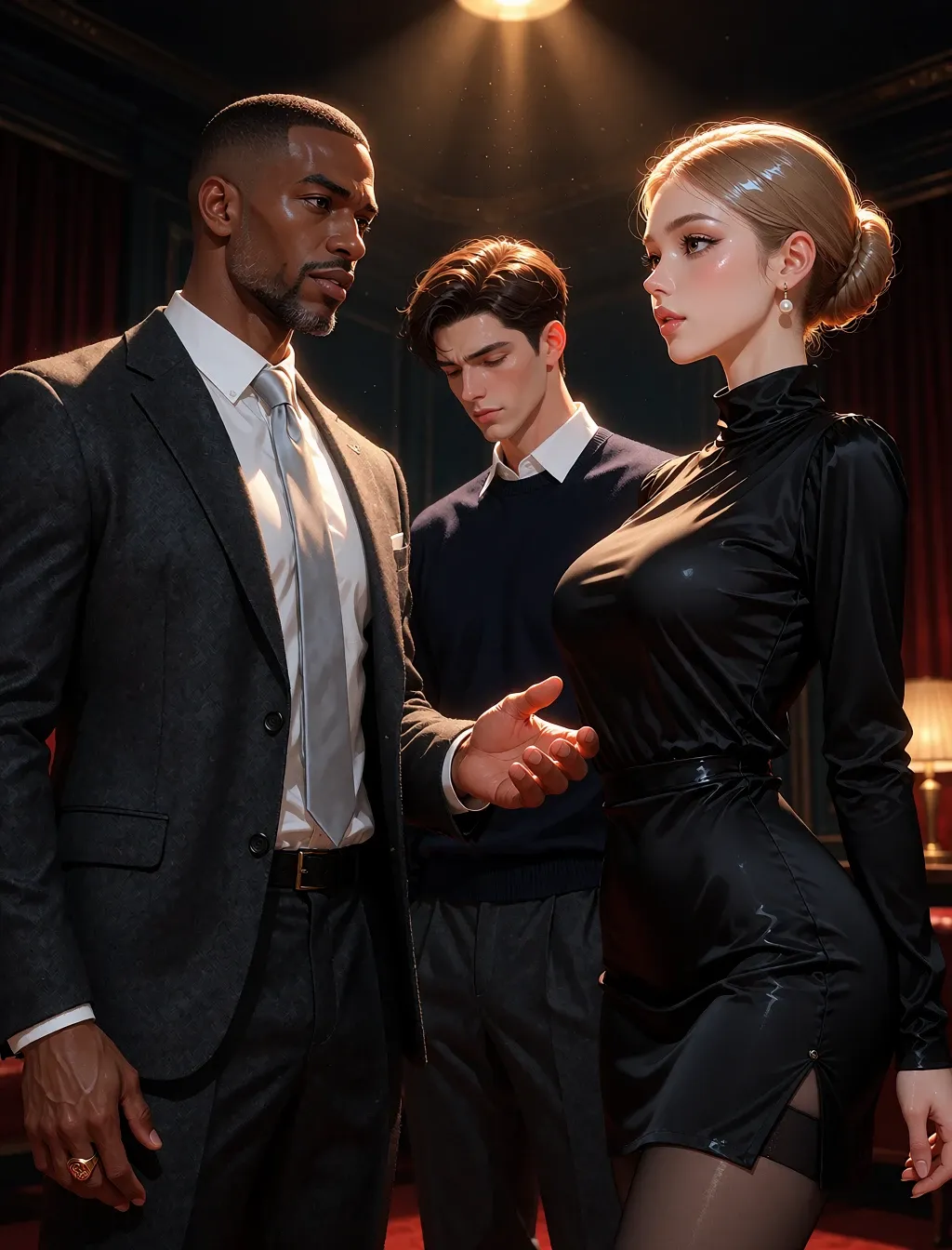
The leash went taut before Willow understood he was meant to move. It cut up under his jaw, dragged his chin off the black marble, and he got one hand down — no, both were cuffed behind him, so he got nothing — and rose the way a puppet rises, knees first, then hips, then the wobble that nearly took him sideways into Lydia's chair leg. Six inches of heel under him. The floor of Club Noir was polished to a mirror and it did not forgive.
Lydia did not look back. She walked, and the leash paid out and snapped tight again, and Willow followed because following was the only thing left in the world that made sense. The music was a fist in his chest. Somewhere to his left a woman laughed — a real laugh, wet and delighted — and he felt it land on the back of his neck like spit.
"Keep up," Lydia said, and her voice was not unkind. That was the worst of it. It was the voice she used for waiters who were doing well.
The black curtain was heavier than it looked. Lydia swept it aside with her free hand and it fell behind him like a wall falling, and the music went from a fist to a hand over a mouth, muffled, far. The corridor beyond smelled of cold stone and old cigarette smoke and something sweet — lily, maybe, or the ghost of a hundred perfumes soaked into the plaster.
The staircase was narrow. Wooden treads, worn concave in the middle by a century of feet. Willow got his shoulder against the wall and his palm flat on the plaster and climbed, and the steel cap at his groin bit with every step, a cold ring that reminded him — politely, then less politely — that he was not going to be allowed to forget it. The bodysuit had ridden up. The latex squeaked against the inside of his thighs. He could hear himself breathing and he hated the sound of it, thin and high and quick, the breathing of a small animal in a sack.
Halfway up, the leash jerked. He had slowed without meaning to. Lydia stood two treads above him, looking down, and the light from the corridor below caught the pearl at her ear and nothing else.
"You're climbing like a woman in a much older body," she said. "Straighten. Shoulders back. You are being taken to meet the man who owns you. Do it properly."
"Yes," Willow said. His voice came out wrong — breathy, the whisper he only ever used in the dark of a closet with a wig on his head and the door locked. "Yes, Mrs. Bakker."
Something crossed her face. It was gone before he could name it, and he was glad, because naming it would have meant knowing what it was, and he did not want to know. She turned and climbed, and he straightened his shoulders and climbed after her, and the heels clicked and clicked and clicked on the wood like a clock counting down.
The door at the top was already open. Warm light spilled down the last three steps. Lydia stepped through and the leash drew him after her into a room that was nothing like the club below — no black, no mirror, no music. A desk of dark wood, enormous, scarred at the corners. A lamp with a green glass shade. Shelves, books, a brass thing that might have been a ship's instrument. A window with the curtain drawn, and through it the orange smear of Amsterdam streetlight.
Kofi Amari sat behind the desk. He had not risen. He sat with his chair pushed back a hand's width, one elbow on the armrest, and one broad hand laid flat on a single sheet of paper, holding it down against a draught. His charcoal suit jacket hung on the back of the door. He wore the waistcoat and the shirt with the sleeves rolled to the elbow, and the gold signet ring on his pinky caught the lamp and threw a small coin of light onto the paper.
"Mrs. Bakker," he said. The voice was low and it came from somewhere under the room, a cellar voice. "You found the stairs. Most people don't, first time."
"I don't rely on finding things by accident," Lydia said. She crossed the room and stood at the near edge of the desk, and the leash trailed from her fist across the rug. "You have the terms."
"I have the terms." Kofi's eyes came off Lydia and found Willow, and Willow felt it the way you feel a hand on your back in a crowd. "And I have the girl. Come here. Down."
Two fingers. A downward flick, unhurried, the way a man might brush ash from a sleeve. The rug was thick under Willow's heels — a worn Persian thing, red gone brown at the edges — and his knees came down on it with a soft thud that he felt all the way up his spine. The bodysuit stretched. The steel cap settled. He put his chin down and looked at the desk leg and the coin of lamplight on the paper and waited.
"Good," Kofi said. "You kneel well. That's not nothing — you'd be surprised how many come in here and fight the floor." He lifted his hand off the paper and the sheet lifted slightly at one corner and settled. "You've read this, Mrs. Bakker."
"I wrote it," Lydia said. "Most of it. You added the parts about the second year."
"I did." Kofi picked up the paper. It was one sheet, front and back, close-typed, and he held it at the distance a man holds a menu in a restaurant with bad light. "Then I will read it aloud. Not for you. For the girl." His eyes came down to Willow. "Because she should hear what she is agreeing to, in her own ears, before she signs. That's how it's done in this house. Nobody signs in the dark."
Willow's mouth was dry. He could feel his pulse in his throat and in his caged cock and nowhere else in his body, as if the rest of him had gone quiet to listen.
"Look at me," Kofi said. "Not at the desk. At me."
Willow lifted his chin. Kofi's face was broad and calm and the gray beard was trimmed so close it lay on his jaw like a shadow, and his eyes did not blink while they held Willow's, and Willow felt the garden come up behind his eyes like water rising in a well — that quiet place, that green place where there was nothing to decide — and he pushed it back down. He wanted to hear this. He did not know why, but he wanted to hear every word of it with his own ears.
"First clause," Kofi said. He read the way he spoke, slow, tasting it. "Hours of display. The girl will be displayed in the public rooms of the house no fewer than four nights each week, from the hour of ten until closing, or until such time as the owner sees fit to send her down. On those nights she will be dressed, leashed, and shown. She will be put where the members can see her and reach her. She will not speak unless spoken to. She will not sit in a chair while a member stands. She will not cover herself when she is looked at."
He let the sheet settle flat on the desk again. The paper made a dry sound on the wood and the room went silent around it, and Willow heard his own breath go out of him in a long, shaking thing that he could not take back.
Four nights. He turned it over. He had done his own version of this for two years — the closet, the wig, the locked door, the mirror in the bathroom angled so he could see himself whole, and the terrible small thrill of it, and the way he had to take it all off again before Lydia came home. Four nights a week with a room full of people looking at him and no door to lock. His cock pushed against the steel cap and got nowhere, and the nowhere was its own bright point of pain, and he made a sound low in his throat before he could stop it.
"Something to say, girl?" Kofi asked. He had not raised his voice. He did not need to.
Willow's tongue was thick. "No," he said. Then, because the leash was still in Lydia's fist and the paper was still on the desk and he understood, suddenly and completely, that he was going to sign it, he added, "I — no, sir. I'm listening."
Lydia had not moved. She stood with the leash wrapped twice around her knuckles and her chin lifted, and she was watching Kofi read the way a woman watches a jeweler set a stone. That was the thing Willow could not stop noticing. She was not watching him. She had already seen everything there was to see of him. She was watching the work being done.
"You'll want to hear the rest before you say sir so sweetly," Kofi said, and there was something in his voice that was almost warm. Almost kind. He turned the sheet over in his big hands. "The rest of it isn't hours and dresses. The rest of it is training."
Willow waited. The lamp hummed. Somewhere below, muffled through the floor, the bass of the club went on and on like a heart that did not care who it was beating for.
"Second clause," Kofi said, and drew breath.
"Training," Kofi read, "will consist of daily instruction in the disciplines of the house. The girl will learn to walk, to kneel, to present, to serve at table, and to hold a pose without flinching for the length of an hour. She will be taught the care of her own body — the smoothness of it, the scent of it, the keeping of it open and ready at all times. She will be taught to take a cock in her mouth without gagging and a cock in her cunt without complaint, and to thank the man who gives her either."
The words went through Willow the way cold water goes through a shirt — everywhere at once, and then the slow cling of it against the skin. Thank the man. He heard the phrase and something under his ribs turned over and lay still. His jaw had gone tight without his telling it to. He made himself unclench it, tooth by tooth, and the small effort of that felt like the largest thing he had done all night.
Kofi did not look up from the sheet. His thumb moved along the margin as he read, slow, as though he were keeping a place in a hymn. "Instruction will be given by the owner or by such members as the owner appoints. The girl will not refuse instruction. The girl will not negotiate instruction. If the girl is instructed to open, she opens. If she is instructed to wait, she waits, and she waits with her eyes up."
Willow's knees had begun to ache against the rug — a dull, spread ache, the pile pressing a pattern into his skin that he would find later, in the dark, with his fingers. He shifted his weight a half-inch and the latex made its small wet complaint, and he stopped, because stopping was easier than explaining.
"Third clause," Kofi said, and turned the page back over, and his voice changed. It had been reading-voice, flat and careful. Now it went lower, and rounder, and it slowed down the way a man slows when he comes to the part of the story he has been waiting to tell. "The men. The girl will be made available to the members of the house, and to such guests as the owner admits, on the nights she is shown. She will be used. She will be used in the ways they choose and for as long as they choose, and she will be left where they leave her until she is fetched. She will not be asked whether she wants it. She will not be asked whether she is ready. She will be asked nothing at all, and she will answer with her mouth full if she answers."
There it was. Willow's breath came out through his nose in two short pulls and would not go back in. He had known — he had known since the foyer, since the black marble, since the moment the leash first cut under his jaw — but knowing a thing in the body and hearing it read aloud in a warm room by a calm man are not the same knowing. The one is weather. The other is a door with your name on it. His caged cock had gone from pushing to pulsing, a thick beat against the steel that had nowhere to spend itself, and the pain of it was clean and bright and he did not want it to stop.
Lydia's knuckles had gone white around the leash. Willow saw it from the corner of his eye — the wrapped leather, the pale bone of her hand — and then her fingers loosened, one by one, deliberately, the way she did everything. She had not looked at him once since the reading began. She was watching the paper, and her mouth was a flat line, and the pearl at her ear caught the lamp and let it go.
"The women," Kofi went on, and the register changed again, cooler now, almost dry, "will watch. They will not be required to touch. They will be seated, and they will be served, and they will be shown the girl at their leisure, and they will say what they think of her while she kneels and hears it. The girl will not reply. The girl will not defend herself. If a woman wishes the girl's mouth, the girl's mouth is hers. If a woman wishes only to look, the girl will be looked at until the woman is done looking."
Willow's eyes had gone hot and he blinked hard against it, and the room swam back into shape — the green lamp, the scarred desk, the coin of light on the paper, the broad calm face above it. He was aware, suddenly and with a shame that had no bottom, that he was kneeling on a rug in a stranger's office in six inches of heel with his cock locked in steel and his mouth wet, and that some part of him — some low, quiet, closet-shaped part — had been waiting his whole life to be told exactly this, in exactly this voice, by exactly this kind of man.
"Fourth clause," Kofi said, and let the sheet settle flat on the desk. The paper made its dry sound on the wood, and the room went silent around it — the lamp humming, the bass below going on and on, Willow's own breath the loudest thing in the world — and Kofi laid his broad hand flat on the page again and drew breath for the next.
"The fourth clause," Kofi said, "is the money." He did not read it off the page. He turned the sheet face down and squared it with the edge of the desk, and the gesture had the finality of a man laying down a card he had been holding all night. "One million euros. Payable to Mrs. Bakker, in full, on the signing of this contract. Not on the passing of the first year. Not in instalments. On the ink."
Willow's chin came up off his chest before he knew it had been down. One million. He did the arithmetic the way he did everything — fast, in the back of his head, a banker's reflex that had outlived the man — and the number sat there in the lamplight and refused to be a number. It was the flat in the Jordaan and the two cars and the accounts he had never once let Lydia see. It was, he understood with a slow cold turn of his stomach, roughly everything he was worth, converted into a single transaction, and Lydia had named the price herself.
"You've valued me," he said. His voice had gone strange. Not the breathy closet-whisper now — something flatter, and it surprised him. "Like a house."
"Like a house," Kofi agreed, unbothered. "You'd rather I'd said a price that flattered you? Two million and a lie about your eyes?" He leaned back in the chair and it took his weight with a creak. "The figure's not a compliment, girl. It's a fence. It says to every man who reads it: this one cost something, she's not a stray, and if you break her there'll be a bill." His finger tapped the desk once. "You'll find the house treats its property better than it treats its guests. That's the whole of what money is for, in a place like this."
Lydia had not sat. She stood with the leash still wrapped around her knuckles and her weight on one hip, and she was looking at Kofi with her head tipped a degree to the side, the way she looked at a wine list she had already decided on. "The transfer clears before I leave the building," she said. "I'm not signing a note."
"You'll see the confirmation on the screen before your pen's dry." Kofi's hand went to a drawer and came back with a small black terminal, and he set it on the desk between them, and its little green light came up and made a second coin of colour in the room. "I don't do business with people I have to chase. It's bad for the nerves."
Willow's knees had gone from aching to something past aching, a bright numbness spreading up under the caps of them, and he shifted his weight and the steel bit and he stopped shifting. The rug had a pattern of small hunting birds worked into the border, faded to the colour of weak tea, and he found himself counting them. Eleven. Twelve. Thirteen, and then Kofi's voice came again and he lost the count and did not try to find it.
"Fifth clause," Kofi said. "And this is the one I'd have you hear twice, so listen with both ears." He did not lift the paper. He folded his hands on the desk and looked down at Willow across them, and the grey beard and the shaved scalp and the lamp made him look, for a moment, like something carved and patient in a church. "Permanent. Not a year with an option to renew. Not a trial. The contract has no end date because there is no end to it. What you are at the bottom of this page, you are at the top of every page after it. There's no clause that gives you back." He let that sit. "Say it back to me."
The room had gone very quiet. The bass below was still going, but it had thinned to a vibration in the floor rather than a sound, and Willow could hear the terminal's little green light — no, that was absurd, you cannot hear a light — he could hear the lamp, then, the low electric hum of it, and under that his own heart going like a fist on a door.
"There's no clause that gives me back," he said.
"Good girl." Kofi said it the way he said everything, without hurry, and it went through Willow like a hand through water. "Sixth. Power of attorney. Irrevocable." He lifted the sheet at last and read from it, and his voice went flat and careful again, the reading-voice. "The girl grants the owner full and irrevocable power of attorney over her mind and her body, her name, her papers, her accounts, and her dealings, to act in her stead in all things and without her further consent, from the hour of signing and for the whole of her natural life. No instrument executed by the girl hereafter shall revoke it. No court shall be asked to unwind it, and if one is asked, the asking is a breach and the breach is the owner's to punish."
Willow's mouth had gone dry again. "My mind," he said. Not a question. He was not sure what he was asking.
"Your mind," Kofi said, and set the sheet down, and looked at him. "You've been in that head of yours alone for a long time, girl, and it's brought you here in a leash and a cage. I'd say the head's had its turn at the wheel. It's mine now. I'll steer it." A pause, and the gold ring turned a quarter on his pinky. "You'll find it a rest. Most do."
And there it was — the garden, coming up green and quiet behind Willow's eyes, and this time he did not push it down. He let it come. It was cool there and there was nothing to decide and nobody to be, and he knelt in it for the length of three breaths and came back up out of it to the sound of Lydia's voice, and the coming back felt like being woken for school.
"The divorce clause," she said. "Read it."
"The divorce clause." Kofi turned the sheet over one last time. "The owner undertakes to see the marriage of the girl and Mrs. Bakker dissolved before the girl enters service, the papers to be lodged by the owner's own solicitor, quietly, no hearing, no cause recited. The girl shall not contest. The girl shall not be present. The girl shall have no further congress with Mrs. Bakker, by letter, by wire, or in person, from the hour of signing, and shall hold her name no more." He looked up. "That's the whole of it. You'll be divorced by Tuesday and you won't be told the hour."
Willow looked at Lydia. He looked at her properly for the first time since the reading began, and she was standing in the lamplight with her chignon still perfect and her pearls still in her ears and her dark eyes fixed on a point somewhere past his left shoulder, and he understood that she was not going to look at him again. Not once. Not in this room. Not ever.
The strange thing — the thing he would turn over later, in the dark, in whatever dark the house gave him — was that it did not hurt the way he had braced for. It was more like the ache in his knees. Present. Bright. Something to be got through, and then got used to, and then forgotten in the getting used to. He had spent three years married to a woman who was watching him the way a jeweller watches a stone, and now the stone was set and she was done with it and she had put down her loupe.
"I'll sign," he said.
Kofi did not smile. He opened a drawer and brought out a pen — a heavy black thing, not a cheap one — and laid it across the page, and the pen rolled a half-turn on the paper and stopped. Then he drew a second sheet from a folder at his elbow, and a third, and laid them out in a fan, and each of them had the close-typed lines and the blank at the bottom and the little printed line beneath it that said, in letters too small to read from where Willow knelt, something he assumed was the date.
"Mrs. Bakker first," Kofi said. "She's the seller. It's her hand opens the door."
Lydia came to the desk. She did not hurry and she did not hesitate, and the leash paid out behind her and drew Willow forward on his knees a half-step before it went slack again. She took up the pen and she bent over the page, and the lamplight came down the slope of her back and caught the silk of the black dress at the shoulder blade, and she wrote her name in a hand Willow had seen on a thousand cheques and birthday cards and the deed to the flat — Lydia Chen-Bakker, the loops of it unhurried, the pen pressing a groove into the paper — and then she wrote it again on the second sheet, and again on the third, and set the pen down with a small clean click.
Kofi turned the terminal toward her. The green light blinked, and the screen filled with a line of figures, and Lydia looked at it for the space of a held breath and then reached into her dress and drew out a slim phone and did something with her thumb.
"It's cleared," she said.
"It's cleared." Kofi turned the terminal back and looked at it himself, and something in his broad face eased, the way a man's face eases when a long job is done and done right. "Then the girl signs, and we're shut of the paperwork."
He pushed the pen across the desk toward Willow, and it stopped at the near edge, and the leash was still in Lydia's fist and Willow's hands were still cuffed behind him, and he knelt there with the pen a foot from his face and understood, with a small hot flush that went all the way to the roots of the platinum wig, that he was going to have to be helped.
"Mrs. Bakker," Kofi said, without looking up. "If you'd do the honours. It's your hand that opens the door, but it's hers that has to hold the pen."
Lydia turned. She turned, and she came to him, and she crouched down in front of him — the black dress pooling at her knees, the pearls swinging forward off her collarbone — and for one moment she was close enough that he could smell her, the lily and the cold clean edge of her perfume, and she was looking at him at last, and her dark eyes were dry and steady and gave him nothing at all.
"Your right hand's no good cuffed," she said. "Give me your left."
He turned his shoulder and brought his left hand round as far as the cuffs would let him, and she took it in both of hers and turned it palm-up and laid the pen across his fingers and closed them around it with her own thumb pressing his thumb down onto the barrel. Her hands were cool. Her nails were short and neat and she had not once, in three years, let him hold her hand this way — both of hers around one of his, deliberate, working — and the intimacy of it, here, at the bottom of a contract, made his throat close.
She guided his hand to the page. The paper was smooth and slightly warm from the lamp, and the blank at the bottom waited, and she pressed his knuckles flat and moved his wrist in the first stroke of the W.
"There," she said, soft, into the side of his wig, and it was the voice she used for a job well done, and it was the last thing she would ever say to him. "All the way through. Don't lift till the end."
He wrote his name. She moved his hand and he let her move it, and the pen went W-a-r-r-e-n and then, after a small hesitation she did not correct, he added Bakker, and the last stroke of the r came off the paper and the nib left a tiny dot of ink where it lifted, and Lydia let go of his hand and stood up and stepped back, and the leash trailed from her fist and lay slack on the rug between them.
Kofi took the sheet and blotted it and held it up to the lamp, and the wet ink shone, and he nodded once, slowly, like a man hearing a good report. "Warren Bakker," he read. "Signed and sealed." He laid it with the others and squared the stack and put the pen back in the drawer and closed it. "And that's the last of that name in this house. From this hour you're Willow, and Willow's all you'll answer to."
He looked at Lydia. She had already turned away. She was crossing the rug toward the door, and her heels made their small precise sound on the boards, and the leash — she had dropped it. It lay coiled on the rug where she had let it go, the end of it a few inches from Willow's knee, and she did not look back at it, and she did not look back at him, and she put her hand on the door and opened it and the warm corridor light came in and took her shape out of the room.
The door closed behind her. The latch went home with a click that was very small and very final, and the room was the lamp and the desk and the rug and the bass below and Kofi Amari, who had picked up the leash and was winding it, unhurried, around his own broad hand.
"Well, Willow," he said, and his voice was almost kind. "Kneel up. Let's have a look at what I've bought."