
The snow came up the pass before the men did, a white hissing curtain that swallowed the road twenty paces out, so that Tetsuo Mikami, forty-three years old, a brewer of Fushimi with twenty years of steam in his lungs, heard them before he saw them — voices, four of them, loose and laughing the way men laugh when they have decided a thing is already theirs.
He had been lashing the tarp over the last barrel, his fingers stiff in the cold, the cart's wheels sunk a hand's width into the new snow. Behind him the gate stood open, its ironwork furred white, and beyond it Kasumi's guardhouse sat with one lamp burning in its window. He had not gone in. She had told him to wait, and he had waited, and now he heard the voices and understood, with a brewer's flat certainty, what was coming up the road.
"Ho! Ho, there, old father!" The first shape resolved out of the snowfall — a lean man with a pry-bar over one shoulder, a rag wrapped around his face against the cold. Two more behind him, and a fourth, a broad fellow with a sword worn badly, all of them dusted white, all of them grinning at the cart. "That's a fine load of barrels. That's a toll-worthy load. What's a Fushimi man doing on the Kurotsuge in this weather?"
Tetsuo straightened from the tarp and put himself between the men and the cart without thinking about it, the way he would step between a vat and a spilled flame. "These barrels are spoken for," he said. His voice came out polite. Twenty years of bowing to customers had made a habit of his throat, and the habit held even now. "I'll ask you to go back down. The road's bad and getting worse."
The lean one laughed, and the laugh went around the four of them, easy as a hand of cards. "Spoken for. Hear that. Spoken for by who — the snow?" He came on, the pry-bar swinging loose in his grip. "Step aside, old father. We'll leave you the cart. We're only after the drink."
*Move,* said the part of him that had crossed the pass once before and remembered what lived at the top of it. *Move and let her have them.* But his hand had already gone flat to the nearest barrel, as though the cart needed holding to the ground, and his feet had already set themselves in the snow, and he did not move.
"I'd not do that," Tetsuo said, and heard, distantly, that his own voice had stopped being polite. "There's a toll at this gate. You'll not want to meet the one who keeps it."
The broad one with the bad sword had come round the side of the cart by then, meaning to get at the barrels from behind, and he was the first to see the guardhouse door swing open. His face changed. The sword came halfway out of its sheath and stopped there, and his mouth worked, and no sound came out of it at all.
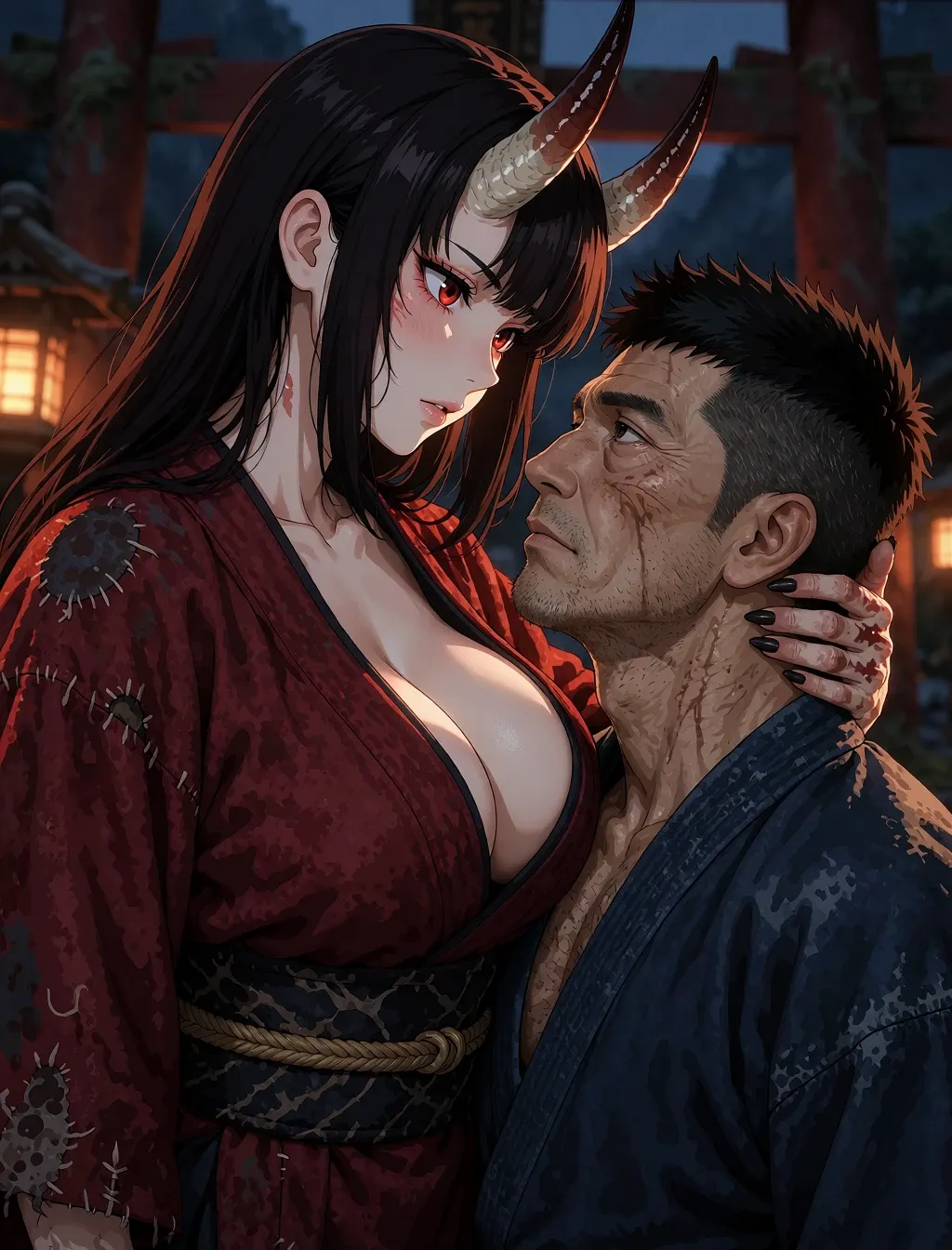
Kasumi of the Thorn Gate stepped out into the snowfall, seven feet of her, her crimson kimono dark with weather, her ivory horns catching the lamplight behind her. Her skin was the color of embers, and where the snow touched her bare forearms and the great slope of her shoulders it melted and ran and steamed, so that she came up the road wearing her own weather, a red woman in a white world, and the kanabo she carried in one blacksmith's hand dragged its iron studs through the snow beside her, leaving a furrow like a plow's.
She was not hurrying. That was the thing Tetsuo would remember after — that she came up the road at the pace of a woman going to look at a thing she had already decided about.
"Brewer," she said, and her voice came low and easy through the falling snow. "You are standing in front of my toll."
"Kasumi-sama," he said. "These men—"
"I heard them." Her obsidian eyes went from the lean man to the broad one to the two behind, unhurried, taking each of them in like a woman counting coins. "Four. In winter. On my pass." She stopped ten paces off, and planted the kanabo in the snow beside the gate post with a sound like a door closing in a mountain. "You have come a long way to steal from a gate, little men. Turn around and go down, and I will forget your faces."
The lean one had gone very still, but he was the sort who could not leave a thing alone. "One woman," he said, to the others, to himself. "One woman and an old brewer. There's four of us." He lifted the pry-bar. "Get the barrels."
What happened next took no longer than a breath. The lean man took one step, and Kasumi's hand closed on the kanabo's shaft, and the great iron club came up out of the snow and around in a single flat arc that began at her hip and ended somewhere past the lean man's shoulder. The crack of it was not a sound so much as a pressure in the ears. Snow went up off the road in a white wall. The lean man left his feet, went sideways into the drift at the roadside, and lay there with his pry-bar still in his hand and his eyes open and no breath in him.
The sudden quiet after was enormous. The snow went on falling through it, patient as ever.
Kasumi set the kanabo's head back down in the snow and leaned on it, and looked at the three who were left, and laughed. It was a laugh that shook the gate's ironwork, that came up out of her chest and rolled down the pass and came back off the mountain, and there was nothing cruel in it and nothing kind either — it was the laugh of a woman four hundred years old who had not been surprised in a very long time and had enjoyed being surprised.
"One woman," she said, wiping her eye with the back of her wrist. "He said one woman." She looked at the broad one. "Well, little man? You have a sword. It is a poor sword and you wear it like a man wearing another man's coat, but you have it. Will you use it, or will you go down the pass and tell the others what keeps this gate?"
The broad one's sword went back into its sheath so fast it clicked. He was already backing, hauling the lean man up out of the drift by his collar, and the two behind him had turned and were going down the road at a shambling run, and in a moment there was only the sound of them going down it — boots and cursing and one man's voice rising high and cracking — and then the snow took even that, and the pass was quiet again but for the wind and the creak of the barrels as the cold bit into them.
Tetsuo's hands were shaking. He looked down at them, both of them, the broad flat brewer's hands that had rolled a thousand casks and never once in twenty years been asked to hold a cart against four men with blades, and one of them was still flat on the nearest barrel, and he could not for the life of him make it let go.
"Brewer." Kasumi had come round the cart. She stood over him, and the snow melted on her arms and ran down them in little rivers, and her red skin steamed where it touched the cold air, and she was still smiling, and her teeth were very white. "You stood in front of them."
"It's my cart," he said. His voice came out cracked. "It's my barrels."
"It is my toll," she said. "And you stood in front of it anyway. With your polite voice in your mouth and your knees knocking, you stood in front of my toll." She reached out and put one huge hand flat on his chest, and he felt the heat of her through the indigo cotton, felt it like a brazier's warmth, and she pushed him back a step, gently, the way a person pushes a door that is already open. "Stop being polite."
"What?"
"You said *these barrels are spoken for.* You said *I'll ask you to go back down.*" Her hand did not leave his chest. Her thumb moved, once, across the cloth over his heart. "You are at the top of a mountain, in a storm, at a gate that eats men, and you were polite to the men who came to rob you. I have kept this gate four hundred years and I have never once been polite to a robber. Stop being polite, Tetsuo-dono. It does not become you."
*She is laughing at me,* he thought. *No. She is not.* And something in his chest turned over, some old thing he had kept folded away behind the bowing and the measuring and the careful words, and he found he did not want to fold it away again.
"I've been polite forty-three years," he said. "It's how a man sells sake."
"Then sell me something else." She took her hand off his chest and turned, and walked to the gate post, and put her back against it — the great iron-banded post at the gate's hinge, black with age, furred white with snow — and folded her arms, and looked at him down the length of her. "You owe me a third toll, brewer. I have been thinking what it should be." Her smile had gone somewhere else; her face was still now, considering. "Come here and take what you want of me. Not what I name. What *you* want. And do not ask my leave first. I am tired of being asked my leave."
The snow fell between them. Tetsuo stood by his cart with his heart going like a smith's hammer, and looked at her — at the width of her shoulders against the post, at the red of her skin steaming in the lamplight, at the horns curving up from her temples with the snow gathering on them, at the long fall of her black hair and the patched crimson kimono with its sash still knotted from the night before.
*She wants me to stop bowing,* he thought. *She wants the man under the bowing.* And he found that he had wanted, for longer than he would have said, to be that man in front of her — not the brewer with his careful voice, but the man who had said yes at this gate and meant it.
He crossed the snow to her. He did not ask. He put his hands on her hips — his broad flat hands on the crimson cloth, on the great solid warmth of her — and pushed her back against the post. She let him, and her breath went out of her in a low sound, and her arms came loose from their fold. He reached the knot of her sash and pulled it, and the kimono fell open down the front of her, and there was her body in the lamplight, red and hot and vast, the muscle of her belly and the heavy slope of her breasts, and the snow melted where it struck her and ran down her skin in shining lines.
"There," she said, and her voice was rough now, and she was looking at him with her obsidian eyes gone wide. "There he is."
He got his own clothes open with hands that were still shaking. She watched him do it, and when his cock came free into the cold air she reached down and took it in her great warm hand and held it. He made a sound he had not meant to make. "You are hard as a barrel stave, brewer," she said. "Was it the fight, or is it me?"
"It's you," he said. "It's been you since the first night."
She turned, then, and put both hands flat on the gate post, and bent forward, and the crimson kimono slid off her shoulders and down her back and hung at her hips, and the long pale scar down the outside of her left thigh caught the lamplight, and below it, between her thighs, the red of her, wet and open to the cold air and steaming like the rest of her. "Then take it," she said, over her shoulder. "As hard as you can. Do not be gentle with me, Tetsuo-dono. I am not a customer."
He put one hand on her hip and guided himself to her. She was wet and hot and slick. He pushed into her all the way in one long stroke. She grunted and her hands clenched on the post and her back arched, and the heat of her came up around him like stepping into a bath. "Gods," he said, and it came out of him ragged. "Kasumi-sama—"
"Harder," she said. "I said as hard as you can."
So he did. He got both hands on her hips and drove into her, and the gate post took the weight of them and did not move, and the snow came down on his shoulders and her back and melted there, and the wet sound of it was loud in the quiet of the pass. She was making a low sound in her chest with each thrust, a sound like a bell struck soft, and her cunt was tight and hot and gripping him. He looked down and saw himself sliding into her, saw the shine of her on his cock each time he pulled back, and it was the best thing he had ever seen, better than a vat coming right, better than the first taste of a new pressing.
"That's it," she said, and her voice was going to pieces. "That's it, brewer, that's— harder, *harder*—"
He gave her harder. The cart creaked behind them and the wind took the sound away. He was not a polite man now and had stopped being one somewhere back down the road. He drove into her with twenty years of rolling casks behind it. She put her forehead against the post and laughed, a broken laugh, and said, "Four hundred years. Four hundred years and no one— *there.* There. Do that again."
He did it again. He did it until his thighs burned and his breath came in white tearing gasps and the sweat stood on his back under his clothes and froze there. And then she straightened, sudden and strong, and turned in his arms and took him by the shoulders and *lifted* — lifted him off his feet the way she lifted a sake cask, and set him down on his back in the deep snow at the foot of the post, and the cold of it went through his clothes and shocked the breath out of him.
"My turn," she said, and straddled him, and the great red warmth of her came down over him like a brazier turned over. She took his cock in her hand and guided it to her and sank down on it in one slow movement. He felt himself go into her to the root, felt her close around him, and she put her hands flat on his chest and rode him.
She rode him slow at first, and the snow fell on her shoulders and steamed and ran, and she watched his face while she did it, her obsidian eyes gone soft and strange. "You said yes," she said, and it was the quiet voice from the first night, the voice that had put something away. "You stood in front of my toll and you said yes to me. Do you know what that is worth, at a gate like this?"
"Tell me," he said, and got his hands up onto her thighs, onto the great warm muscle of them, and her scar under his palm.
"Everything," she said. "It is worth everything, and I will not tell you again." And then she rode him hard, and there was no more talking in her, only the sound she made low in her throat and the slap of her thighs on his and the creak of the post and the hiss of the snow, and Tetsuo got his hands on her hips and pulled her down onto him and thrust up into her to meet her. She cried out and her back arched and her hair came loose and swung. He felt her cunt clench hard around him, once, twice, gripping and releasing and gripping again. She threw her head back and the sound she made rolled down the pass and came back off the mountain.
"Tetsuo," she said, and it was the first time she had said his name without the honor to it, and it went through him like a shock. "Tetsuo— *now*—"
He came with her. It came up out of him from somewhere below his belt and he drove up into her and emptied himself into her. She ground down on him and held him there, and her cunt worked around him, pulling at him. He felt it go on and on, and he said her name, said *Kasumi-sama,*. She bent down over him and put her forehead against his and breathed with him while it passed.
The snow went on falling. The gate post stood. Somewhere down the pass a man's voice was still cursing, very faint, going away.
She lifted herself off him at last, and the cold air came where her heat had been. She sat back in the snow beside him with her kimono open and her hair in her face and her red skin steaming. She looked down at him lying in the drift with his clothes half off and his cock still wet and softening against his belly. She laughed — not the gate-shaking laugh, but a small one, tired and warm.
"There," she said. "Now you have stopped being polite."
Tetsuo lay in the snow and looked up at her, at the horns and the black hair and the red shoulders with the snow melting on them, and found that he was grinning, which he had not done in some while, and that his hands had stopped shaking.
"Kasumi-sama," he said. "The third toll."
"Paid," she said. "In full." And she reached down and put her hand flat on his chest over his heart, the way she had the first night, and left it there, and did not take it away. "In the morning the storm breaks. The gate opens. You will take your cart down the far side and sell your barrels in the low country, and you will not come back this way." She said it looking at her own hand on his chest, not at his face. "That is what the gate does with a man who says yes. It lets him go."
The wind stirred the snow between them. Tetsuo lay still under her hand and said nothing, and the silence went on a beat too long, and Kasumi's fingers curled, very slightly, against his chest.
"Brewer," she said, and her voice had gone strange and careful. "You are not getting up."