
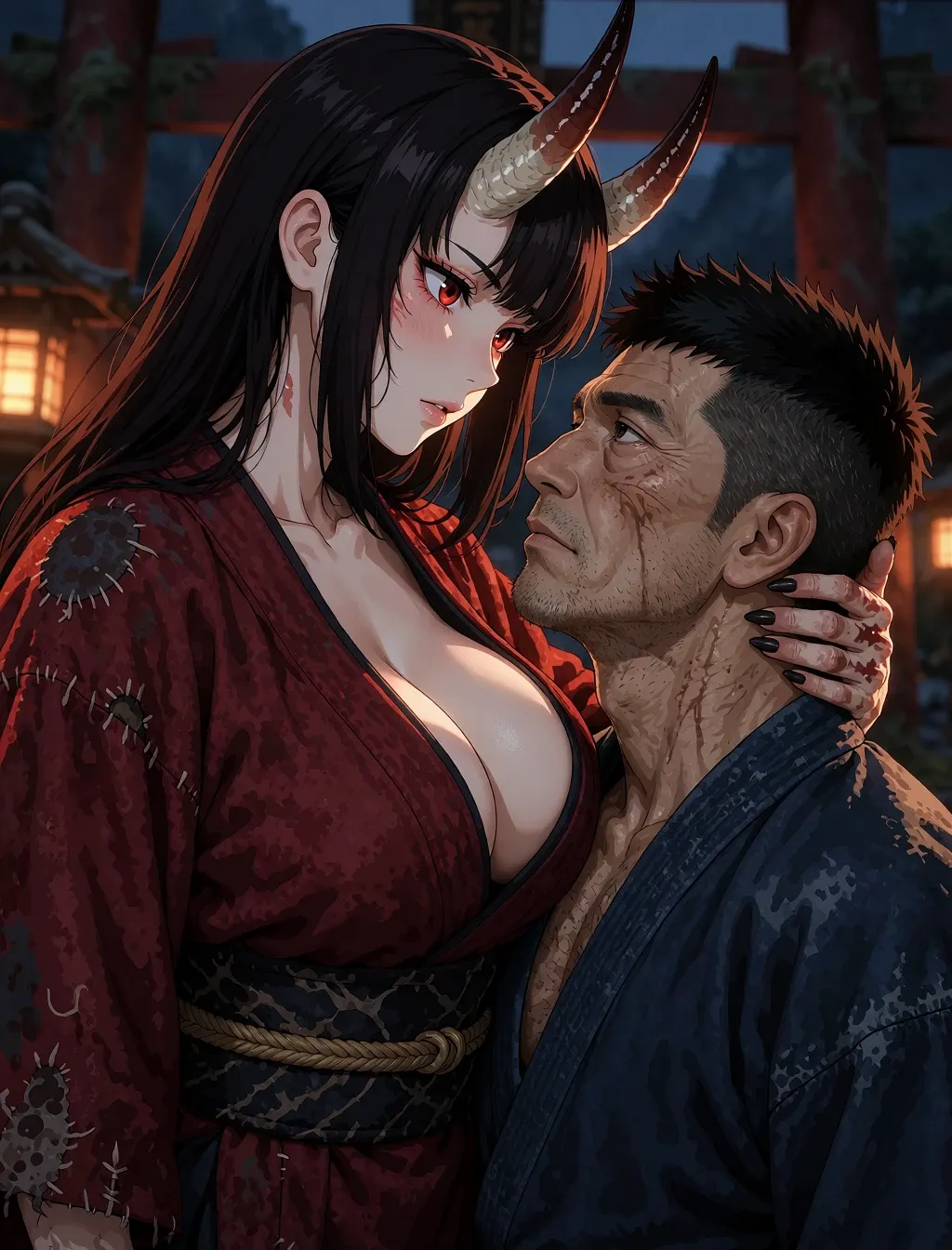
The wind found the shoji again and rattled it in its grooves, and Kasumi rose to her feet with a grunt that a mountain might make shifting in its sleep. Seven feet of her, red as banked coals, the crimson kimono hanging open at the shoulder where it had come loose in the dark. She crossed the room without a lantern and did not need one — her horns caught the hearthlight and threw it back, two curved blades of pale fire moving through the black.
Tetsuo lay where she had left him on the heavy table, naked, his skin gone cold on the side away from the fire and hot on the side toward it. Forty-three years old, a brewer's belly and a brewer's shoulders, and every muscle in his legs still humming from the long climb and the longer hour since. He watched her go and did not move to cover himself. She has seen all of it. She has had all of it. What would I be hiding?
She pulled the shoji tight and set the bar, and the wind went from a roar to a complaint, and the room got smaller and warmer for it. Then she turned and looked at him, and her obsidian eyes went down his body and back up, unhurried, the way a man looks at a good barrel before he buys it.
"You are cold," she said.
"A little."
"Then come down from there. The table is for paying tolls. The hearth is for men who have paid them."
He got down. His knees were not entirely his own, and he put a hand on the table's edge to steady himself, and she saw it and did not laugh, which was somehow worse than if she had. He gathered his indigo work clothes from the floor and she made a small sound of disgust.
"Not those. They are wet through with snow." She went to the lacquered chest against the far wall and lifted the lid, and drew out a length of quilted cloth the color of old straw, and tossed it at him. It unfolded in the air and he caught it against his chest. "A man's robe. From before your grandfather's grandfather. It will be short on you."
It was short on him. It came to his knees, and the sleeves swallowed his hands, and it smelled of cedar and something older, and when he sat down on the mat by the hearth with it wrapped around him he felt less like a man who had been ridden half to death and more like a man who had been given something.
Kasumi lowered herself down across from him, folding her legs beneath her with a care that made the floorboards creak, and set the last barrel between them — his barrel, the Fushimi pressing, tilted on its side now with the bung drawn and a clay cup beneath it. The sake came out in a thin, patient line. She filled the cup, and then a second, and pushed one across the mat to him with one finger.
"The last of it," she said. "I have drunk worse. I have drunk much worse. Sixty years since I had anything I would call good, and I have been at this gate a great deal longer than sixty years."
"What was the last good one?"
She considered the cup. "A brewer from Nada. He came up in the summer, which is a fool's season to cross, and he had a barrel of something that tasted like a river in flood. He would not sell it to me. He gave it to me, and asked for nothing, and I let him through and he wept at the far gate." She drank. "I remember his face better than his name."
"That's how it goes," Tetsuo said. "The good ones don't haggle. They just pour."
"And you?" Her eyes came up. "You haggled."
"I offered a toll. That's not haggling."
"You offered one barrel," she said. "And I took the cart. And you did not once say it was unfair."
He turned his cup slowly between his fingers. The clay was warm where the sake had been. "It was fair," he said. "The gate's the gate. You didn't make the mountain. You've just been standing on it longer than anyone else could."
She was quiet for a while. The fire leaned and the wind leaned with it and somewhere above them the snow shifted on the roof with a sound like a long breath let out.
"Four hundred years," she said at last, "and the men who come up that road are all the same shape in the end. They curse the gate. They curse the mountain. They try to cheat the toll and then they try to cheat me, and I break their shoulders and send them back down the way they came, and the ones who don't come back down I bury in the snow where the road bends." She drank off her cup. "You did not curse. You did not cheat. You said yes, and then you paid, and now you sit at my hearth in a robe four hundred years old and you tell me the gate is fair."
"It is fair."
"Yes," she said. "I know. That is what I am saying."
The fire popped. He refilled her cup from the barrel, which was nearly done, and she watched him do it, and there was something in her stillness he had not seen before — not the gatekeeper's stillness, the patience of a thing that does not need to move. This was a different patience. A thing waiting to see what would happen next.
"Brewer," she said. "How long has it been since you were last touched?"
He thought about lying. The sake made it easy to lie. "Long enough," he said. "My wife's been dead eight years. Since then it's been the vats and the cart and the road."
"And tonight."
"Tonight was the first time in eight years I have been touched by anything that wasn't a barrel or a horse."
She set her cup down. The clay clicked on the floor and she left her hand there, palm flat, and the firelight ran up the ridges of her knuckles. "Then you are due more than one night," she said, "and I am not done with you, and the storm is not done either. So I will ask you a question, and you will answer it plainly, and I will not be angry whatever you say."
"Ask."
She rose. Not the slow rising of a woman leaving a room — a single movement, effortless, seven feet of her unfolding from the mat like a tree righting itself after a wind. She went to the chest again and this time she knelt before it and lifted out something wrapped in a strip of faded silk, and brought it back to the fire and laid it on the tatami between them.
The silk fell open.
It was a shaft of carved oak, worn smooth and dark as old iron where hands had held it, and at its base a flared guard of the same wood cut with a pattern of thorns. It was not a thing made in any workshop he knew. The carving was older than the chest, older than the gatehouse, and the wood had the deep grain of something that had been oiled and handled and used for a very long time.
"My clan's," she said. "From before the gate. Before the road. When my kind kept the old rites and a woman of the mountain took a man and made him hers in the manner of her house." Her finger traced the carved thorns, once. "The rites are gone. The clan is gone. The wood is not."
Tetsuo looked at it. It was a serious piece of oak. It was a serious piece of oak and it was lying on the mat between them and the oni woman was watching him with her blacksmith's hands at rest on her knees.
She is asking. She is actually asking. Four hundred years and she is sitting there with her hands on her knees waiting to see whether a brewer from Fushimi has the spine to say yes twice in one night.
"You said a woman of the mountain took a man," he said. "Took him how?"
"Bent him over a barrel," Kasumi said, "and used him as the rites required, and the man did not die of it, and in the morning he was given a cup of the mountain's own water and sent down the road with his life and his story both." Her mouth moved at one corner. "The rites required a great deal of the man. They were not gentle rites."
"And the man was willing?"
"The rites required that too."
He looked at the carved oak and then at her hands and then at her face, and her face gave him nothing, and the fire popped and the shoji rattled and the wind went on howling off the Kurotsuge like it had been paid to.
"Brewer," she said, and her voice had gone low and even and patient as the mountain. "Do you dare?"
He picked up his cup and drank the last of his pressing down to the lees, and set it down empty, and looked her in the eye.
"I've said yes to harder things than a piece of oak," he said. "Where do you want me?"
She did not smile. But something went through her face like weather crossing a ridge, and she rose, and she took him by the shoulder — one hand, the whole of his shoulder, the way a man takes a bucket by the handle — and turned him and set him where she wanted him, which was bent over the barrel at the hearth's edge, the old robe gone from his back, his forearms braced flat on the cool staves and his feet apart on the mat.
"There," she said. "Like that. Do not move unless I tell you."
He heard the silk and then the wood. He heard the small click of her spitting into her palm, and the slick sound of her hand moving on the oak, and then the carved guard pressed cool and blunt against him. He set his jaw and breathed out and did not move.
"Breathe," she said. "It goes easier if you breathe."
He breathed. She pushed. The stretch of it opened him slow and relentless and there was nothing to do but feel every finger's width of it, and she gave him no mercy and no hurry either, one long patient push until the carved thorns were flush against his skin and her hips were warm and heavy behind his thighs.
"There," she said again, and her voice had a rumble in it now, deep down. "Four hundred years of rites and the last man to take them was a brewer who said the gate was fair. Hold the barrel, brewer."
He held the barrel. She drew back and drove in, and the sound it made was wet and solid and his whole body rang with it, and she did it again, and again, and found a rhythm that was slow and deep and absolutely without mercy, and the hearthlight jumped on the staves and the wind shook the shoji and Tetsuo Mikami held on to the barrel of his own best pressing and let the oni woman have him.
"Harder," he said, through his teeth, and she laughed — the shaking laugh, the guardhouse-shaking laugh — and gave it to him harder.
"You asked," she said, driving in. "You asked, brewer. Four hundred years and no one has ever asked."
His cock hung heavy and ignored beneath him. She reached under and took it in her fist, and her fist was too large and too hot and exactly right. She worked it in time with her hips and he heard himself make a sound he had not made in eight years. "There," she said. "Spend for me. The rites are not finished until you spend."
He spent. The whole of him clenched and broke and he came into her fist with a groan that came from somewhere below his ribs. She worked him through it and did not stop driving until the last of it was out of him and his knees were shaking and his forehead was down on the staves.
She drew out of him slow. He felt the oak leave and the cool air come in after it and he stayed where he was, bent over the barrel, breathing like a man who had climbed the pass twice.
"Straighten up," she said.
He straightened. His legs were not entirely his own. She took him by the arm and turned him and looked at her fist, wet with him, and at the floor, and then at the cup she had set down earlier, which had been knocked from its place and lay on its side with a smear of sake dark on the tatami.
"You spilled my cup," she said.
"I—"
"Bend over the barrel."
He bent over the barrel. Her hand came down across his backside and the crack of it filled the guardhouse and the fire jumped and he yelped, actually yelped, forty-three years old and yelping like a boy, and she did it again, and again, each one landing with a flat, ringing, unhurried weight, and on the fourth she stopped and rested her palm where the heat was rising.
"There," she said. "Now the cup is paid for."
She turned him again, and sat down on the mat with her back against the chest and her knees drawn up, and patted her thigh. "Come here. You have paid your toll twice tonight and I have not yet had what I want, and what I want is to watch a brewer ride me while he holds my horns."
He came. His backside stung and his legs were weak and his cock, which had no business being interested in anything, was already half-hard again at the sight of her sitting there with her knees apart and the crimson kimono fallen open and the dark wet between her thighs catching the firelight.
"You are a marvel," she said, watching him look. "Eight years and a night on the mountain and there he is again."
He knelt between her knees and she took him by the hips and guided him in. She was hot and slick and enormous and tight around him. He put his hands on her shoulders and pushed home and she let out a breath that stirred the fire. "Now," she said. "The horns. Hold them."
He took her horns in his two hands. They were warm and smooth and heavier than they looked, and she tipped her head back into his grip and let out a sound that was not a laugh and not a word and came from somewhere very old, and he began to move.
"Harder," she said. "I am not a barrel. I will not break."
He gave it to her harder. She braced her feet on the mat and met him, and the floorboards creaked and the fire leaned and her breasts moved with every thrust and her black hair swung and her hand came up and closed around his wrist where he held her horn, not to stop him, to keep him there. "There," she said. "There. Do not let go."
He did not let go. He felt her go tight around him, felt the long slow build of it in the great body under him. She threw her head back and came with a roar that shook the guardhouse down to its beams, and her cunt clenched on him so hard he saw white. He drove in twice more and spent inside her with her name — her name, not her title — wrung out of him like water from a cloth.
"Kasumi," he said.
The wind eased. The shoji stopped rattling. The fire settled down to its coals and the two of them stayed where they were, him still inside her, her hand still around his wrist on her horn, breathing together in the dark like two animals in a den.
"Brewer," she said at last, and her voice was rough and quiet. "Tetsuo-dono."
He let go of her horns and put his forehead against hers, and she let him, and the coals shifted and threw one last flare of light across the room, across the empty barrel and the spilled cup and the carved oak lying on the mat with its thorns catching the fire.
"In the morning," she said, into his mouth, "I will tell you what the gate does with a man who says yes."