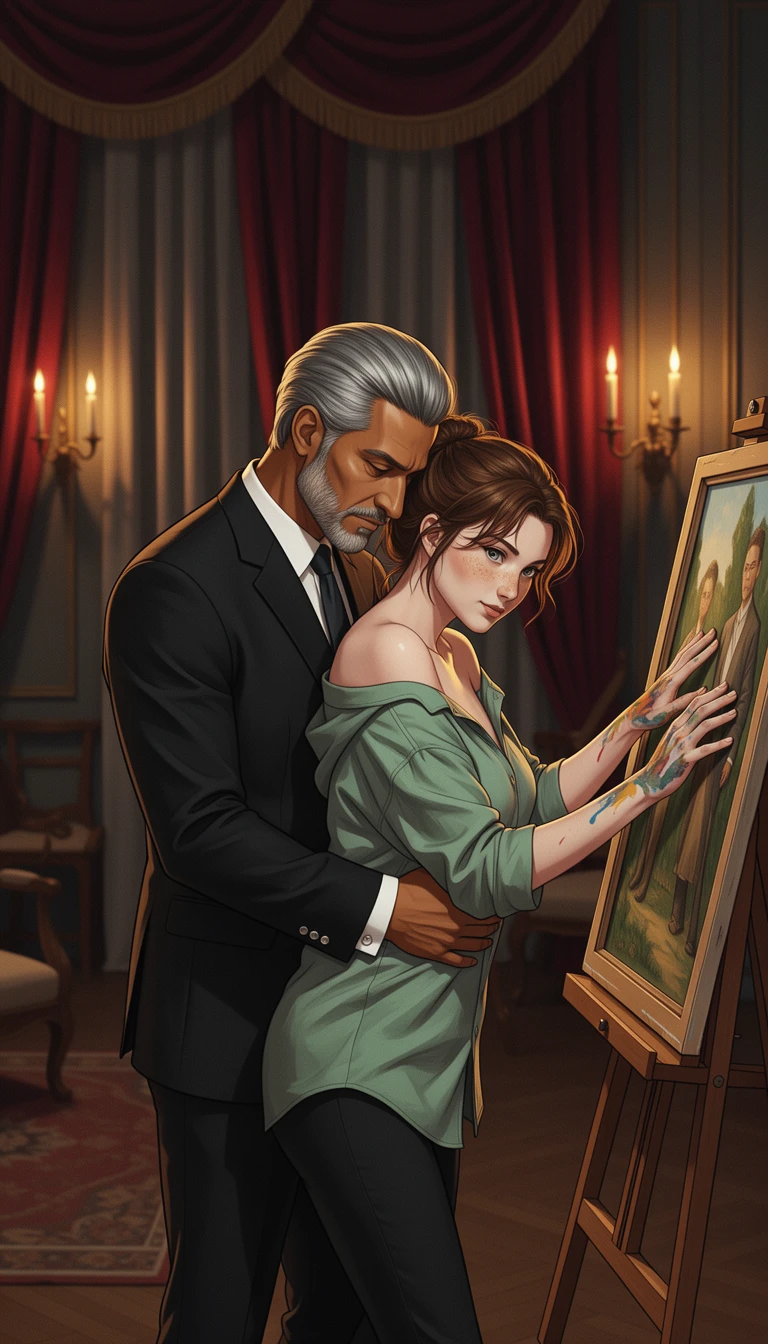
Her palm stayed flat against the canvas edge, the grain pressing into her skin. The warmth was still there—faint, rising through the wood as if it had been waiting for her to notice. She pressed harder, testing, and the ache in her scar pulsed once, sharp and familiar, a needle dragged along a nerve she couldn't name.
The amber light through the studio windows sank lower, bleeding across the concrete floor in long gold sheets. The brass handle of the third door caught a last gleam—patient, unopened. It had been patient as long as she'd stood here. It would be patient after she left.
The silence in the room thickened. No longer waiting. Pressing. The air itself seemed to settle against her skin, dense and watchful, as if the house was drawing a slow breath around her stillness. She could taste it at the back of her throat—turpentine, dust, something older that clung to the walls.
Her thumb moved without permission, tracing the edge of the canvas where his had pressed. The heat there had cooled since she'd found it. Or maybe it was her own hand now, the warmth of her skin against the wood, blurring the boundary between what had been left and what she brought.
She pulled her hand back. Held it above the canvas, palm open, fingers spread. The air between her skin and the wood was cooler. Cleaner. Empty.
The ache in her scar pulsed again—fainter this time, a memory of pressure rather than the pressure itself. Her wrist turned without her deciding it, the pale line exposed to the dying light. She didn't look at it. She never looked at it. But she felt it, the way she felt the heat in the grain, the way she felt the door behind her without turning around.
The brass handle gleamed once more as the sun dropped another degree. Then the gleam was gone, swallowed by shadow, the metal gone dark and heavy.
She let her hand fall.
The silence shifted—settled deeper, the way a held breath releases when the exhale is finally allowed. The house had been waiting for her to decide something. She knew that now. The warmth in the grain, the ache in her scar, the gleam on the handle that held until she saw it—all of it had been waiting.
She did not turn.
The studio settled around her, the shadows climbing the walls, and the third door held its darkness like a promise she hadn't chosen yet.
She turned.
Not a decision. Not a surrender. Her body simply faced the third door the way water finds its level, and there it was—dark wood, brass handle, the faint gleam of old polish catching the last of the dusk. The handle was warmer than the air around it. She saw that now. Or remembered it. Her hand remembered it.
Her feet carried her before she told them to. Three steps. Four. The floorboard that had creaked before was silent this time, as if the house had decided she was allowed. The scar on her wrist pulsed once—not a warning, not a memory. A recognition. The same frequency as the warmth in the grain, the same note held too long.
She stopped in front of the door. Close enough to see the patina on the brass, the way the metal had worn smooth where hands had touched it. Many hands. A lifetime of hands. Her reflection swam in the polished curve—distorted, her face a smudge of shadow and the last light from the window behind her.
Her hand rose. Not fast. Not hesitant. The way a hand moves when it's stopped deciding and started doing. Her fingers found the handle without looking, thumb resting in the groove where it had rested twice before. The metal was cool now. Or maybe her palm was hot. Hard to tell where she ended and it began.
She pressed.
The handle gave a quarter-inch. The latch released with a sound like a held breath letting go. The door shifted inward, a crack of darkness widening between the frame and the wood, and the air that escaped was older, thicker, laced with something that wasn't turpentine or dust. Something that smelled like cedar and stillness and years.
She did not push further. The crack was enough. Her thumb stayed pressed against the brass, holding the latch open, and she stood in the gap between the studio and whatever waited beyond, the darkness a tongue of shadow reaching across her shoes.
Her wrist ached. Not the scar this time—the joint itself, the bones, as if the handle had sent something through her hand that had traveled up her arm and settled in the place where she'd learned to hold herself together. She left her hand where it was. Left the door open by the width of her thumb.
She was not going to step through. Not tonight. But the door was no longer closed, and that fact pressed against her chest like a second heartbeat—faster, sharper, a pulse that didn't belong to her but had found its rhythm inside her ribs.
Her free hand rose before she told it to. Not to the door—to her chest, pressing flat against the linen, fingers spreading over her sternum as if she could hold the second heartbeat in place. It was there. Faster than her own, sharper, a rhythm that hadn't existed an hour ago and now lived under her ribs like something that had been waiting for permission to arrive.
Her thumb found the hollow at the base of her throat. The pulse there was her own—steady, familiar, the one she'd counted through nights she didn't want to remember. But beneath it, pressed against her palm, the other rhythm thrummed through bone and breath. She counted it without meaning to. Faster than sixty. Sharper than calm. A heartbeat that didn't belong to her but had somehow found its way inside her chest and curled there like it planned to stay.
She didn't close the door.
She could have. Her thumb was still on the latch, the mechanism held open by the smallest pressure. One release and the door would swing shut, the darkness sealed again, the house returning to its silence. But her hand stayed where it was, and the door stayed open, and the second heartbeat beat against her palm like a word she hadn't spoken yet.
The air from the crack was cool against her wrist. Not cold—cool, the way air gets in rooms that have been closed too long, where the light hasn't touched the surfaces in years. She could smell cedar now, and something else beneath it. Paper. Old glue. The particular dust of things that have been left alone to settle into their own quiet gravity.
Her scar ached. Not the sharp pulse from before—a deeper throb, bone-deep, as if the handle had sent a message through her hand that was still traveling, still searching for where to land. She pressed her chest harder, feeling both heartbeats now through the heel of her palm. Her own steady. The other insistent. They didn't match. They weren't trying to. They simply existed in the same body, two rhythms that had found each other by accident and didn't know what to do with the discovery.
The last light through the studio windows had faded to a bruised violet, the gold sheets on the concrete gone gray. The room was settling into dusk, shadows pooling in corners, the easel a dark silhouette against the wall. She could feel the house around her—not watching, not waiting. Simply present. As if it had always known this door would open eventually and was patient enough to let her find the moment herself.
Her thumb, still pressed into the groove of the brass handle, began to tremble. Not from fear—from the weight of holding a door open when every instinct she'd built over years told her to let it fall shut. She let it. The latch engaged with a soft, deliberate click, the sound swallowed by the cedar-dark air on the other side, and the crack of darkness sealed itself back into the frame.
She didn't move immediately. Her hand stayed on the handle, no longer pressing, just resting, as if her body needed a moment to catch up to her decision. The ache in her wrist subsided, settling back into the familiar low throb she carried like a second skin. The second heartbeat under her palm slowed, falling into sync with her own steady rhythm now that the choice was made.
Her breath caught in her throat as her fingers spread across her sternum, pressing through the linen of her shirt until she felt bone beneath. The second heartbeat was still there—separate, asynchronous, a wild rhythm that didn't match her own. She'd felt it before, in moments she didn't name. When she'd touched the canvas. When the door had cracked open. When his thumb had pressed into her wrist in the hallway and she'd felt something rise in her chest that wasn't fear.
Her hand pressed harder, as if she could feel through both heartbeats at once. The faster one was warmer. Brighter. A pulse that belonged to the part of her she'd walled off years ago, the part that had learned to want things it couldn't have. She'd thought that part was dead. But it was beating against her palm now, insistent and alive, demanding to be felt.
The scar on her wrist ached in counterpoint—not the sharp pulse of the door handle, but a deeper throb, a memory of the moment the skin had split and sealed shut. She'd made that scar herself. Not to die, not to punish. To feel something real when everything else had gone numb. It had worked. It had kept working, long after the wound healed, a touchstone she could press when the world got too quiet and she needed to know she was still there.
But this—this second heartbeat under her palm—was different. It wasn't pain. It was want. The raw, uninsulated, dangerous kind that had gotten her in trouble before. The kind that made her do things like walk toward closed doors in strange men's houses, like leave her hand on a brass handle until the ache in her wrist matched the ache in her chest, like stand in the dark and let a stranger count her pulse.
Her fingers curled into the fabric of her shirt, clutching. The faster heartbeat stumbled, hesitated, then steadied again under her grip. She felt it like a physical thing—a bird trapped in her ribcage, wings beating against bone, desperate for release. She could smother it. She'd done it before. Press down hard enough, breathe shallow enough, and the bird would stop thrashing. Settle. Go quiet. Become the familiar stillness she'd worn like armor for years.
But her hand wouldn't press harder. It stayed where it was, palm flat, fingers splayed, holding the second heartbeat without trying to quiet it. The linen was warm under her touch. Her own pulse was rising to meet the other one, the two rhythms finding a ragged sync that felt less like harmony than collision—two engines running at different speeds, threatening to shake the chassis apart.
She closed her eyes. The darkness behind her lids was the same as the darkness beyond the third door—thick, waiting, full of things she couldn't see but knew were there. The cedar-and-years smell was in her memory now, clinging to the back of her throat, coating her tongue. She'd tasted that door. She'd felt its latch release under her thumb. She'd held it open long enough to know she could step through whenever she chose.
Her hand dropped from her chest. The absence was immediate—a coolness where the warmth had been, a hollow where the second heartbeat had pressed against her fingers. She felt the bird slow in her chest, its wings folding back, settling into the space between her lungs. Not gone. Submerged. Waiting for the next time she'd let herself feel it.
She reached for the door before she knew she'd decided. Her right hand found the brass handle again—thumb finding the groove by memory, fingers wrapping around the cool metal. She felt the weight of the cracked-open darkness against her palm, the door's inertia pushing back, the whole house holding its breath around her stillness.
She pulled. The latch caught with a sound like a bone settling into joint. The gap of darkness narrowed, the cedar-years smell retreating as the wood met the frame, and the third door was closed again the way it had been before she'd touched it—except it wasn't. The handle was warm where her hand had been. The air had shifted. Something had changed that couldn't be unchanged by closing a door.
Her hand stayed on the handle. She didn't pull away. She just stood there, palm pressed flat against the wood, feeling the grain through her skin the way she'd felt the canvas grain an hour ago—the same warmth, the same recognition, the same ache traveling up her arm and settling in her chest where the second heartbeat had been. The door was closed. But she knew now what was on the other side. Not the Fragonard. Not the painting. The knowledge.
She let her hand fall. Stepped back. One step, then another, her feet finding the creaking floorboard this time—the one that had announced her when she'd arrived. It groaned under her weight, a complaint that felt almost familiar now, almost welcome. The house was still alive around her. Still watching. Still waiting.
She turned. The studio had shifted in the time she'd spent at the door—the shadows had climbed higher, the last gold light had drained from the concrete floor, and the room was now lit only by the amber glow of a single lamp she hadn't noticed earlier. It sat on her worktable, small and brass and warm, casting a circle of light across the tools Vincent had arranged. She hadn't turned it on. She hadn't seen anyone enter to turn it on. But there it was, burning steady, a flame that had been waiting for her to come back from the door.
She didn't question it. She was past questioning now. The lamp was lit. The door was closed. Her chest still held the echo of that second heartbeat, slower now but not gone, a pulse that had found its home between her lungs and was settling in. She crossed to the easel, her bare feet silent on the concrete, and stood where she'd stood before—facing the canvas, her back to the third door, the lamp casting her shadow long and distorted across the far wall.
The canvas was blank. She'd known that. But looking at it now felt different. The emptiness was no longer a surface waiting for paint—it was a mirror, a held stillness, a question that had been asked before she arrived. The grain of the wood where Vincent's thumb had pressed was invisible in the lamplight, the warmth gone, the evidence erased. But she remembered the exact spot. Could have placed her fingertip on it without looking.
She didn't. She picked up a brush instead—not the palette knife she'd held before, but a fine sable, its bristles clean and soft, unused. She turned it between her fingers, feeling the balance, the weight, the way the handle settled against her palm as if it had been shaped for her hand. Vincent had chosen it. She knew that without proof. He'd laid out the tools with the same precision he'd laid out everything else—the lamp, the brushes, the solvent, the quiet permission to use them.
The brush felt foreign. She'd held a thousand brushes, cleaned a thousand bristles, mixed a thousand colors. But this one was new. Unbroken. Unclaimed. She brought it to her face without thinking, the bristles brushing her lower lip—soft, almost impossibly soft, the kind of fine that only came from brushes made by hands that had been making them for generations. She could smell the newness. The animal hair. The faint residue of oils that had been worked into the ferrule.
She set it down. The brush settled into the groove where other brushes had rested before it, a family of tools that had been arranged and rearranged by hands that understood the ritual. Her hands. Vincent's hands. The hands of every restorer who had stood in this room before her, facing a blank canvas or a damaged one, deciding where to start.
The silence in the studio was no longer pressing. It had settled into something companionable, the way a room settles when its inhabitant is finally still enough to hear it breathe. The lamp hummed faintly—a filament singing at the edge of audibility. The window showed nothing but her own reflection now, the night pressed against the glass, the estate folded into darkness.
Her hand lifted from the brush before she had decided to move it. The sable bristles released her fingertips one by one, the handle rolling slightly as her palm left the wood, and for a moment her hand hung in the air—weightless, uncommanded, a bird testing whether it remembered how to fly. Then her fingers found the edge of the table, then the air again, and she was moving toward the window without having chosen the direction.
The concrete was cold under her feet. She hadn't noticed until now—hadn't noticed the floor, the temperature, the way the studio had cooled as the night pressed closer to the glass. The soles of her feet registered each step as a separate fact: cold, colder, the faint grit of dust ground into the surface by years of footsteps she hadn't taken. She reached the window and stopped.
Her reflection looked back at her. Pale. Taller than she felt. The lamp behind her threw her face into shadow, hollowed her cheeks, darkened the hollow at her throat where her pulse beat its steady rhythm. Her hair had escaped its bun entirely, loose strands falling across her jaw, and she looked like someone who had been pulled through a door she hadn't meant to open.
She lifted her hand. The movement was slow, deliberate, as if she were testing whether the glass would accept her touch or reject it. Her fingers spread—thumb first, then the rest, flattening against the cold surface one by one. The shock of it traveled up her arm before she was ready: a sharp, clean cold that seemed to reach through her skin and into the bone beneath. She pressed harder. Her palm flattened. The cold settled into her like a thing that had been waiting for this contact all along.
Her reflection's hand met hers on the other side of the glass. The image was distorted—her fingertips slightly blurred where the pressure changed the plane, her wrist foreshortened, the scar catching the lamplight at an angle that made it look deeper than it was. She stared at that scar through the glass, at the pale line that divided her wrist into before and after. The window was cold enough to ache. She left her palm where it was.
Outside, nothing. The estate had folded into darkness so complete that the glass might as well have been a wall. No lights from the gardens, no distant glow from the gates, no moon—just the black density of country night, the kind that swallowed sound and shape and made the world outside the window feel like a story she'd only heard. Her breath fogged the glass around her hand, a thin ghost of warmth against the cold.
The second heartbeat stirred. She felt it before she heard it—a flutter against her ribs, tentative, as if it had been sleeping and her stillness had woken it. She pressed her palm harder against the glass, the cold deepening into something almost painful, and the heartbeat steadied. Not faster. Not slower. Simply present, a second rhythm living beneath her own, finding its place in the space between her lungs.
Her reflection's eyes were gray in the lamplight. The same gray as the storm clouds she'd been compared to all her life—"Your eyes are like the sky before rain," a boy had once told her, back when she'd let boys close enough to say things like that. She'd laughed then. She didn't laugh now. The eyes in the glass were older, harder, holding secrets the boy had never glimpsed. Holding the memory of a door that had been opened and closed. Holding the weight of a stranger's thumb pressed into her pulse.
Her scar ached against the glass. Not the sharp pulse from before, not the bone-deep throb—a surface cold, the kind that numbs before it hurts, that makes the skin feel like it belongs to someone else. She pressed her wrist flat, the scar aligned with the glass, and watched through the distortion as the pale line disappeared against the dark beyond. Gone. For a moment, gone. She let herself believe it.
Her hand was beginning to go numb. Not unpleasantly—a gradual retreat of sensation, the cold claiming her fingertips one by one, her palm, the heel of her hand, the place where her pulse beat against the glass and fogged the surface with each exhale. She watched her breath come and go, a rhythm that matched nothing, that belonged only to her. The second heartbeat had quieted, or she had stopped being able to feel it through the cold. Either way, the silence in the studio had deepened, and the lamp's hum had become the only sound in the world.