
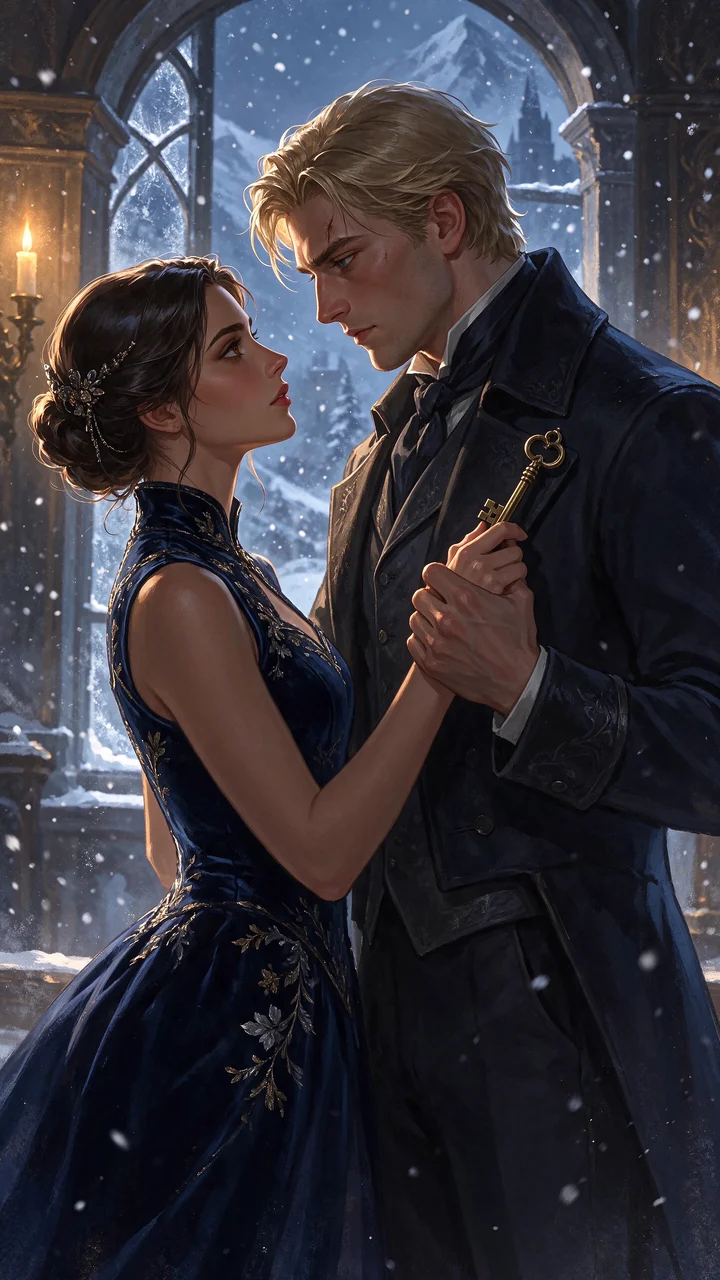
The generator died at nine the next evening with a cough and a long falling whine, and every light in Ilmor went out at once.
Without power the boiler’s pumps stopped. Within an hour the radiators were cooling under Celeste’s palms. Greta took command in the dark as if she’d been waiting all winter for it, a lantern in one hand and her keys swinging at her hip. The sisters and the chef went to the kitchen hearth. Anselm and the two stranded joiners went to the west wing stoves. Blankets came out of cedar chests that had not been opened in a decade.
“And you,” Greta told Teodor, “will take the chaise in the royal suite.”
“The library has a fireplace,” Celeste said.
“The library chimney’s full of jackdaws.” Greta’s smile was perfectly innocent, which was what made it so suspicious. “And it’s the only other fire behind a door that locks. You can lock it from whichever side suits you.”
She left them the lantern.
. . .
Firelight moved over the blue silk and caught the brass fittings on the bed. The storm battered the windows. He sat at one end of the chaise in his shirtsleeves, waistcoat unbuttoned, and she sat cross-legged on the hearthrug in a black sweater with the brass key at her wrist. The room held the only warmth for miles, and it held them both.
“Tell me about her,” Celeste said. “The A.”
He was quiet long enough that she thought he wouldn’t. Then he said, “Annelise. Her father was a saddler in the valley. When she married my father, every pillowcase in this house had his grandmother’s initials on it. She sat up that whole first winter and unpicked them.”
“All of them?”
“Four hundred and twelve. Then she stitched her own.” He almost smiled. “She was a terrible seamstress. My father offered to send them to Vienna. She said if this house was going to hold her, it could learn her name in her own hand.”
Celeste thought of the uneven white thread against her cheek. “And I slept on it.”
“I know.”
“Does it bother you?”
“It did.” He looked into the fire. “Now tell me why thirty days matters so much that you’d crawl through my walls for it.”
She told him. Not the press version. That she was the second daughter of a man who’d wanted a son. That she’d worked the night desk at nineteen and carried bags and bled boilers, because nobody could say she hadn’t. That if Ilmor didn’t open on the first of the month, the board would hand the succession to Edmund Rove, who had never once carried anyone’s bag.
“Rove,” Teodor said. “The man who likes spring.”
“You noticed that.”
“I notice everything in this house.” He said it gently. “Including you.”
The fire cracked. She unclasped the chain from her wrist and held out the brass key, letting it swing between them, catching the light.
“You said I’d have to decide which side of the door I wanted you on,” she said. “So I’m asking. Which side do you want to be on?”
He didn’t reach for it. “It’s always been your choice, Celeste. From the moment you walked in. I only wanted you to know it.”
She closed her hand around the key, fastened the chain again, and didn’t let go of her own wrist.
“This is inside the walls,” she said. “Technically.”
“Technically.” His voice had dropped. “Then I lead.”
“Then lead.”
He slid from the chaise to the rug, slow enough that she could have stopped him with a word, and knelt in front of her. Close, but not touching. The fire was hot on one side of her face. He was warmer.
“May I touch you?”
She nodded.
“Out loud,” he said. “In here, I follow your voice.”
Her throat was tight. “Yes.”
He touched only the chain. One fingertip on the brass key where it lay against the inside of her wrist, the metal warm now from her skin. Then he followed the fine links upward, link by link, until they ended and there was nothing left to follow but her. His fingertip rested on her pulse, which was going far too fast, and he left it there, so that both of them could feel exactly how fast.
“Celeste,” he said. A question.
Her mouth was a breath from his. She could smell woodsmoke on him, and soot not quite scrubbed from his collar, and something green and cold underneath, the mountain itself. His eyes were on hers, waiting, exactly as he had waited in the dark of the passage for every step.
“Yes,” she said.
Behind them, stone ground against stone.
They both turned. Beside the hearth, a panel of blue silk and plaster swung inward on a hinge she had never seen, and light spilled out. Warm light. Lamplight, steady and gold, from a room that should not have had power at all.
Teodor was on his feet before she was. “That’s bricked,” he said, very quietly. “My father bricked it in nineteen ninety. I watched him do it.”
The bricks lay stacked neatly inside, one on another.
Beyond them was a small panelled room with a paraffin lamp burning on a table and a camp bed neatly made. Footprints crossed the dust, fresh, edges still sharp. Small. Narrower than his.
And on the far wall, written over and over in black charcoal, from the skirting to as high as an arm could reach, in a careful, patient hand:
CELESTE. CELESTE. CELESTE.