
By eight the next morning there were rules.
She typed them herself on the porter’s ancient computer and pinned them to the board outside the kitchen, where everyone would pass them on the way to coffee. All master keys to be surrendered to the general manager. East wing doors locked at six. No staff in guest areas without a logged reason. The heritage director to submit a daily schedule.
The keys went into a steel cashbox from the safe. The porter’s set, the chef’s, the sisters’ shared ring. Greta brought hers last, the great iron hoop, and laid it in the box with a clank.
Celeste counted the hooks. “Thirty-one.”
“Thirty-one,” Greta agreed.
“The inventory says thirty-two.”
“Inventories,” Greta said comfortably, “are written by optimists.” She went back to the linen.
At ten, Celeste locked the library to catalogue the books. At twenty past, she turned on the ladder and found Teodor in the leather chair by the window, ankle on knee, reading a first edition in Kesterian.
“How did you get in?”
“I live here.”
“You work here. Different preposition.”
“Same house.” He turned a page. “My schedule’s on your desk. Today I’m correcting your press releases.”
At noon she locked the music room. He was inside it, tuning the piano. At three she locked herself into the small drawing room, deliberately, and sat with her back against the door for an hour to make a point. When she came out, he was waiting in the corridor with two cups of coffee.
“You missed lunch,” he said.
“How did you know where I was?”
“The house told me.” He held out a cup. “Black. No sugar.”
It was how she took it. She hated that he knew. She took it anyway.
. . .
The porter, Anselm, led her down to the cellars at four with a torch, past wine racks stripped by the auction house and a row of copper pans on hooks, to an iron grate set in the floor. Warmth should have risen through it. Cold came up instead.
“Stair’s bricked,” Anselm said. “Since the fire in seventy-four. They service it from the old coal run.”
“And where does the coal run come in?”
He shrugged. “Ask the prince.”
She knelt on the flagstones and aimed the torch down. The boiler squatted below, a black iron beast the size of a carriage. She could see the fuel line where it entered the burner housing. It had not split or perished. It had been cut, cleanly, and the brass valve wheel was gone from its spindle.
In the dust were footprints. They came from a low arch in the far wall and went back into it.
Her phone buzzed against the stone. The satellite link, which worked when it pleased. Edmund Rove filled the screen: silver-shot hair, white collar buttoned to the throat, a fire crackling behind him in his Belgravia study.
“Celeste. I hear you’re snowed in.”
“News travels.”
“Heating trouble?” He smiled. “Thirty days was always ambitious. Nobody on the board would think less of you for moving to spring. The roads open in spring.”
She went very still. “That’s the second time I’ve heard that.”
“It’s the Alps, darling. It’s practically a proverb. We’ll talk Friday.”
The screen went dark. She stayed on her knees on the cold stone, looking at the footprints.
. . .
Teodor found her because he had been looking, which he would not have admitted under oath.
She was kneeling at the grate with dust on the hem of that absurd ivory coat, and she did not get up when he came down the steps. She only looked at him. A great many people had looked at him wanting things. None had ever looked at him the way she did now, as if she were adding him up and the total might be bad.
“Did you do this?” she asked.
He crouched beside her and saw the line, the bare spindle, the prints going in and out of his mother’s coal run. Something old and cold moved through him that had nothing to do with the cellar.
“No.”
“Would you tell me if you had?”
“I’d have done it better.” The prints were small. Narrower than his. “Someone used my passages. I want to know who more than you do.”
“I doubt that.”
“Then let me prove it,” he said. “I’ll take you through.”
. . .
The panel was in the old laundry. The wainscot came away under his palm with a sigh of cold air and a smell of tallow and wet stone.
“One condition,” he said. “Inside, I lead.”
“I own the walls.”
“You own the deeds to them. In there, you follow my voice. There are stairs that end in nothing and a stretch where the floor is a single beam. If I say stop, you stop.”
“And if I say stop?”
He looked at her properly then. “Then we stop. Whatever we’re doing. It goes both ways or it doesn’t go.”
The candle threw his scar into relief. She thought about thirty days, about a cut line, about Edmund’s unmoving smile.
“Fine. Inside, you lead.”
“Say it as if you mean it.”
“Don’t push your luck, Valen.”
The passage breathed. Drafts came at her from openings she couldn’t see, and every breath she took came back off the stone and touched her own face. He went ahead, the candle cupped in his hand, his voice low and even. Step down. Two more. Mind the lintel. She minded the lintel.
Then the walls closed in.
“Chimney breast,” he said. “It juts. Sideways won’t fit you. We go through facing.”
“Facing which way?”
“Each other.”
She stepped in. The stone pressed her shoulder blades and his chest pressed her front, wool against cashmere, and she could feel the buttons of his waistcoat through her sweater, one, two, three. His breath stirred the hair at her temple. Neither of them moved.
A gust came up from below, and the candle guttered and died.
Black. Total and thick. She heard her own pulse and then, closer, his.
“Celeste.” The first time he’d used her name. “Give me your hand.”
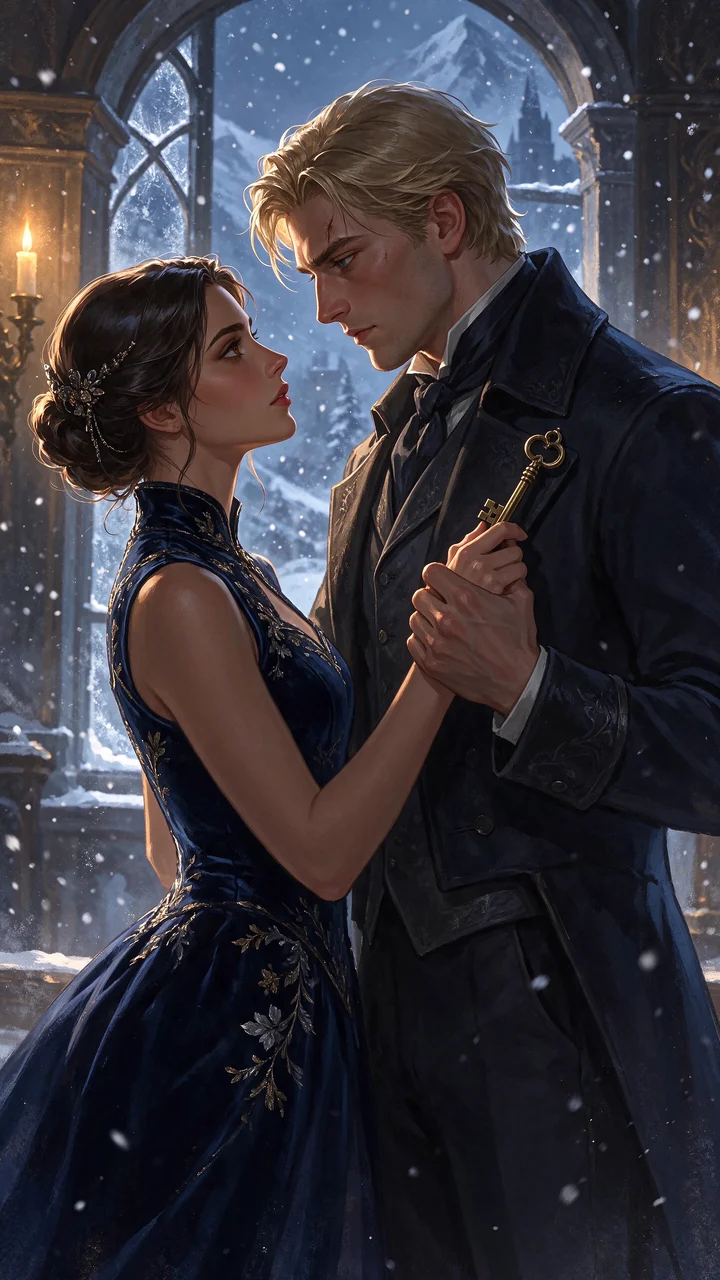
She found his sleeve. His fingers closed around her wrist, loosely, his thumb resting over the brass key on its chain.
“I can’t see you,” she said.
“You don’t need to. I’ll wait. When you’re ready, nod.”
“You can’t see me nod.”
“I’ll feel it.”
She nodded. Her forehead brushed the edge of his collar, the warm skin above it. He drew her one step to the left. Then he stopped and waited, his thumb unmoving on the key, until she nodded again.
Eleven steps. She counted every one, and every one he waited.
. . .
The boiler room was a black cave of iron and coal dust. He relit the candle from a tin of matches on a ledge that had obviously been there for forty years. She held the torch while he fitted a spare valve wheel from his coat pocket, and when he started to bleed the line in the wrong order, she took the spanner out of his hand.
“Zermatt,” she said, when he raised his scarred eyebrow. “I was nineteen and the night engineer had a hangover. Air out first. Then prime.”
He let her. She bled it, he primed it, and together they swung the burner door open and he struck the match. The pilot caught blue, then the main burner roared up gold, and the whole iron beast shuddered and began to tick and sing. Far above them, a radiator knocked.
They were both filthy. There was soot on his cheekbone and, she suspected, a great deal more on her.
“Your arrangement worked,” she said. “I’ll admit that.”
“So did yours.” He wiped his hands on a rag and did not look away from her. “I enjoyed obeying your rules more than I should have.”
“Then here’s another. Outside the walls, I command.”
“And inside?”
She held his gaze. “Inside, you do.”
“Agreed.”
On the way back he stopped so suddenly at a junction that she walked into him. He lowered the candle.
The missing valve wheel lay in the dust. Caught in its brass spokes was a thread of wool. Corvara grey.