
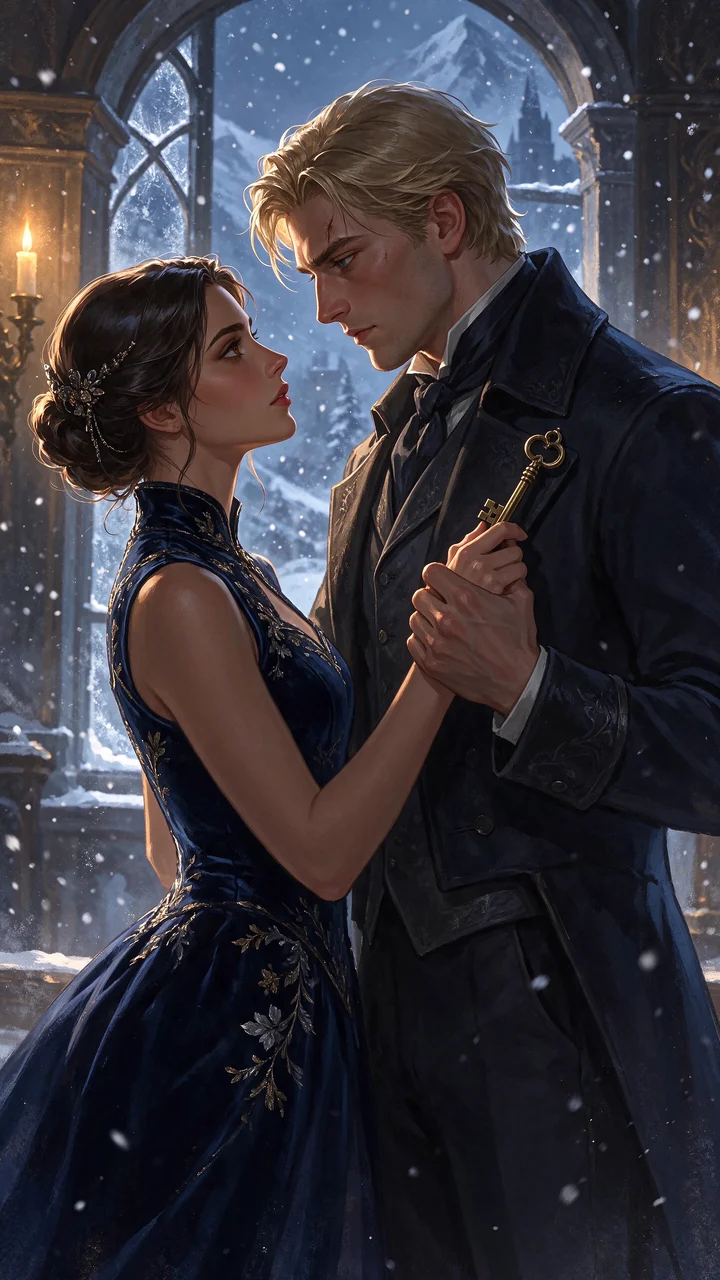
“Tell the board I’m through the gate,” Celeste said, “and tell them the road closed behind me. Not in front.”
The driver took the last switchback in second gear. Chains bit the ice. Below them the valley had already gone, swallowed by a white roar, and above them the Palace of Ilmor rose out of the mountain in pale stone and copper roofs weathered green. Every window was lit, as if the house had been waiting up.
“They’ll want a photograph,” said her assistant in London, thin with distance.
“They’ll get an opening. In thirty days.” She ended the call as the car crunched to a stop beneath the portico. Behind them, a snowplough’s amber lights swung once across the gates and turned back down the mountain. Then came the chain across the road. She heard it through the glass, iron dragged over iron.
Last one up. Of course.
The doors of the great hall stood open. Warmth met her on the threshold, thin and tired, and with it came beeswax and pine smoke and something older underneath, the shut-cupboard breath of rooms nobody had aired since a king lived here. The staff stood in a line across the marble, eleven of them, in Corvara grey that did not quite fit anyone yet.
Celeste unbuttoned her ivory coat and did not take it off. She walked the line.
A pastry chef from Lyon. Two maids, sisters. A night porter with frost still in his moustache. A head housekeeper with a silver braid pinned round her head and an iron key ring at her belt heavy enough to stun a burglar.
“Greta Hollis.” The woman shook Celeste’s hand as if she were weighing it. “Welcome to the house, Miss Corvara.”
“The hotel.”
“Of course.” Greta’s blue eyes did not change at all. “The hotel.”
At the end of the line, a man in a charcoal three-piece suit stood with his hands clasped behind his back, as though he were the one receiving.
She knew the face from the file. The file had not mentioned the height, or the scar that split his left eyebrow, or that he would look at her as if she had come to read the meter.
“Teodor Valen,” he said. “Your heritage director.”
“Mr Valen.”
“Valen is fine. Most people manage it.” His voice was low and unhurried, an accent sanded smooth by English schools. “Welcome to Ilmor.”
He said it differently. Eel-MOHR, the last syllable lifted and held.
“I’ve been saying it wrong,” she said.
“For eight months, in every press release. Ill-more. As in, more ill.” He inclined his head a quarter of an inch. “It’s a small country. We notice.”
“Then you’ll correct the press releases.”
“I’d be delighted to correct anything you like, Miss Corvara.”
Down the line, one of the sisters made a small sound and turned it into a cough.
Celeste held his gaze. Storm grey, she thought, and then refused to think it. “Good. The contract says one year. I’d hate for you to spend it sulking in the stables.”
“I don’t sulk. I wait.”
“For what?”
“Spring.” He let the word sit. “The roads open in spring.”
The lights stuttered. Every chandelier in the hall sank to amber and climbed back, and under the floor something knocked three times, deep in the bones of the house. A long metallic sigh followed. The radiators along the wall ticked once and fell silent.
Greta was already moving. She crossed the hall with her keys swinging and vanished through a baize door. Celeste counted. At forty-one, Greta came back with her cheeks redder than before.
“East wing’s gone cold,” she said. “Pipes, I’d guess. Or the old boiler having opinions.”
“The guest suites?”
“All of them. The west wing runs off its own stoves, and they’ll want a day to draw.” Greta folded her hands. “There’s one set of rooms still warm tonight. Separate flue. Always has been.”
“Which rooms?”
Greta did not look at the prince. That was how Celeste knew.
“The royal suite,” Greta said. “Her Majesty’s rooms.”
The hall went very quiet. Snow hissed against the tall windows.
“Then I’ll take them,” Celeste said. “Unless someone has an objection they’d like to put in writing.”
Teodor reached into his waistcoat. He drew out a brass key on a faded blue ribbon, long in the shank, its bow worked into a crown worn so smooth by thumbs that the points had softened. He held it out on his open palm.
When she reached for it, he bowed.
It was a slow bow. A beautiful one, from the waist, the kind she had only seen in films about doomed empires. It lasted exactly long enough for every person in the hall to understand what it meant. When he straightened he was closer than before, and he pitched his voice for her alone.
“The door locks from both sides,” he said. “So you’ll have to decide which side you want me on.”
The key was warm from his body. She closed her fist around it.
“Outside,” she said. “Goodnight, Mr Valen.”
“Valen,” he corrected gently. “Goodnight.”
. . .
The suite was blue. Blue silk on the walls, faded at the seams to the colour of old ice. Blue velvet on a chaise by the hearth. Blue hangings on a bed so high she needed the little mahogany step to climb into it. A fire had been laid and lit, and someone had turned down the sheets. On the pillow, white thread on white linen, was a monogram: an A and a V twined beneath a small crown, stitched by hand, the stitches very slightly uneven.
Celeste locked the door and tested it twice. She slid the brass key off its ribbon and onto the fine chain at her wrist, where it lay cold against the bone. Then she sat on the edge of the bed in her coat and looked at the monogram for a long time.
His mother had slept here. Perhaps died here. The file said only that the queen was buried under the larches by the chapel, and that this was why the prince had signed.
It was a bed, she told herself. Linen, horsehair, a frame. Corvara owned it. Corvara owned the chaise and the fire irons and the eleven people in grey downstairs and the snow piling on the roof.
She took her hair down, undressed by firelight, and lay beneath his mother’s initials with her eyes open.
The storm went on. The fire settled into embers. Somewhere far below, the dead boiler ticked as it cooled. She thought about the board in its glass room on the Strand. She thought about Edmund Rove’s pleasant voice saying, Thirty days is ambitious, Celeste, and her own voice answering, It’s a hotel, not a coronation. She thought about a bow that had lasted five full seconds, and about a man downstairs who knew precisely whose pillow her cheek was resting on.
At midnight the clock on the mantel struck, small and silver.
When it stopped, she heard the other sound.
Footsteps. Slow and unhurried, the scrape of a leather sole on stone. Not in the corridor; the corridor was carpeted and lay beyond the locked door.
These were to her left. Beside her head.
Inside the wall.
She lay perfectly still. The steps drew level with the bed and paused. She could hear, she was almost certain, someone breathing on the other side of the blue silk, an arm’s length from her ear.
Then a soft knock. Two knuckles, twice. Polite.
And the footsteps moved on.