
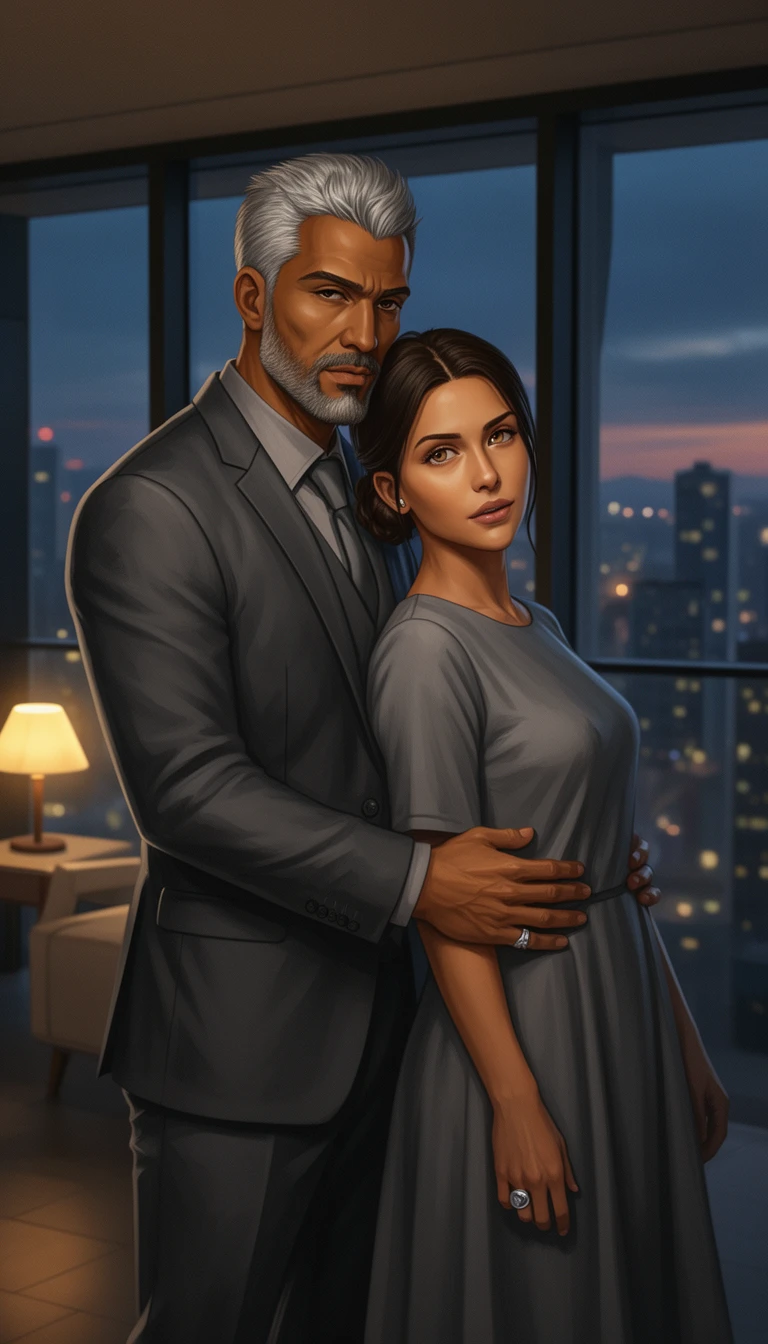
Noah's thumb traces the crease in the photograph once, slow, as if reading the fold lines. He does not look up at her. The foyer holds its breath—the lamp flickers, casting a shifting shadow across the armchair. Iris's hand tightens on the banister, the wood cold and rough under her palm. The question hangs between them, unanswered, and the silence widens like a crack in ice.
The photograph is small in his hands, the edges soft from handling, the crease a pale line now under his thumb. He does not blink. His thumb moves again, following the crease from one side to the other, and she watches the motion as if it holds an answer she cannot read.
Her chest rises. Falls. The air in the foyer is still damp from the rain she carried in, and the wool of her dress clings to her shoulders. She does not shiver. She counts the seconds—one, two, three—and the silence deepens, swallowing the space between them.
The lamp flickers again, and this time the shadow stretches across the armchair, reaching toward the cold hearth. Noah's face is half in shadow, half in gold, and she cannot tell if his eyes are closed or open. His thumb has stopped moving.
Iris shifts her weight on the stair. The wood groans, a low sound that dies in the stillness. Noah's thumb lifts from the photograph, hovers for a breath, then settles at the edge of the image—her brother's shoulder, the one she traced in the firelight upstairs.
He holds it there. Does not press. Does not look up. The photograph rests in his palms like something fragile, something that might tear if he breathes too hard. She remembers folding it, the first crease, the second, the tight square in her pocket. She remembers pressing the crease to dull it, but the line remains.
Her hand on the banister has gone numb. She does not loosen her grip. The cold wood is a fixed point, the only thing in the room that does not hang between them—no history, no question, no answer. Just the grain under her fingers.
Outside, a branch scrapes against the window. Thin, dry. No wind behind it, just the shudder of something settling. The sound passes. The silence returns, thicker now, like water filling a room.
Noah's thumb begins to move again, slower than before, tracing the crease from one end to the other. He still has not looked at her. The question is still in the air, and she can taste it—salt and ash, the shape of words she cannot speak.
The lamp flickers a third time. The shadow on the armchair shivers, stretches, and the room contracts around them. Iris's throat tightens. She opens her mouth, but no sound comes out.
Noah's thumb stops at the edge of the photograph. He holds it there, at the boundary of her brother's shoulder, and the room goes still around them. The lamp steadies. The shadow on the armchair freezes mid-stretch. He does not look up, but his jaw shifts—a muscle working beneath the close-cropped beard, the only crack in his composure.
"You came here with nothing." His voice is low, flat, the words placed with care. "A satchel. A dress soaked through. No coat worth the name." He lifts his thumb from the photograph, sets it at the center of the crease. "You didn't come from a home. You came from somewhere you were already leaving."
Iris does not answer. Her hand on the banister is white at the knuckles, the grain of the wood pressed into her palm like a map she cannot read. The silence stretches, and she feels it in her chest—a pressure building, the shape of words she has not spoken to anyone.
Noah raises his head. His grey eyes find hers, and they are not cold. They are patient. Heavy with something she cannot name, but it is not judgment. It is the weight of a man who has already guessed the answer and is waiting for her to say it herself.
"The question I haven't asked," he says, "is not where they are." He sets the photograph down on the armchair beside him, face-up, her mother and brother staring at the ceiling. "It's how long you've been carrying them alone."
The words land in the hollow of her chest, and she feels them settle—a stone dropped into deep water, sinking past light, past sound, into the dark where nothing moves. Her throat works. She draws breath, and it comes in jagged, like glass in her lungs.
"Three years," she says. The number is small in the foyer, swallowed by the high ceiling and the cold hearth. She says it again, softer, as if testing whether it sounds real. "Three years since my mother. Two since my brother."
Noah does not look away. His hands are still at his sides, the photograph resting where he left it, and he does not reach for her. He does not fill the silence with comfort or questions. He simply stands in it with her, letting the number hang between them, letting it be true.
The lamp flickers once more, and this time it holds steady. The shadow on the armchair settles, still, the photograph lying face-up at its center. Iris's hand loosens on the banister, the blood returning to her fingers in a slow, pins-and-needles crawl. She does not look away from him.
"Is that the truth?" Noah asks. Not a challenge. A door held open.
"Yes." The word comes clean, no hesitation, no catch. She feels lighter for having said it, and heavier at once—the truth now spoken, no longer hers alone to carry.
She holds his gaze. The grey of his eyes is steady, unblinking, and she feels the weight of them like a hand pressed flat against her chest. "What do you see?" she asks. The words come out quiet, not quite a whisper, but they carry in the still air of the foyer. "When you look at me. What do you see?"
Noah does not answer immediately. His jaw shifts, the muscle beneath his beard working once, and his eyes move across her face—not scanning, not reading, but something slower. Something that feels like recognition. The lamp casts a warm glow across his features, and she watches his expression change, a subtle softening at the corners of his mouth.
"Someone who has been surviving for a long time," he says. His voice is low, the words placed with the same care he gives everything. "Someone who learned to fold herself small so she wouldn't take up space. Someone who forgot what it feels like to be seen without having to earn it first."
Her throat tightens. She does not look away. The banister is still cold under her palm, the wood grain pressing into her skin, and she uses the sensation as an anchor, something real to hold against the weight of his words. "And?" she manages. "Is that all?"
Noah's eyes hold hers. He takes a step closer, the sound of his shoes on the marble floor muffled by the stillness, and stops when he is close enough that she can smell him—woodsmoke and wool, something clean beneath, something that makes her breath catch. "No," he says. "That's not all."
He does not reach for her. His hands remain at his sides, the silver signet ring catching the lamplight, and she watches his chest rise and fall with a breath that seems deliberate, measured. "I see someone who walked through my door with nothing but a satchel and the kind of exhaustion that comes from carrying alone. I see someone who handed me the only thing she had left to hold, and let me unfold it."
His voice drops lower, and she has to lean in to catch the words. "I see someone who is still standing, despite every reason she's had to fall."
The air between them thickens. She can feel the warmth of his body now, the proximity a new gravity she has to resist. Her hand on the banister tightens, the wood cold and rough, and she forces herself to breathe. "And what do you do," she says, her voice barely steady, "with what you see?"
Noah's lips part. A pause. Something shifts in his grey eyes—not a crack, but a door held ajar. "I wait," he says. "I wait to see what you do with it now that someone else is watching."
The lamp flickers once, a brief pulse of shadow across his face, and then holds steady. She does not break his gaze. Her chest rises and falls, the truth still sitting between them like a stone in shallow water, visible now but not yet lifted. She holds his eyes, and she does not look away.
Her hand leaves the banister. The motion is slow, deliberate—her fingers uncurling from the wood one by one, the blood rushing back into her palm in a hot prickle of sensation. She does not look away from him as she steps forward, the marble floor cold through the soles of her shoes, and crosses the small distance to the armchair where the photograph lies face-up.
She stops beside it. The paper is pale in the lamplight, her mother and brother frozen in their half-smile, their shared July afternoon. She does not pick it up. She reaches out and touches the photograph's edge—her index finger finding the corner, the place where the paper curls slightly from handling, from folding, from being pressed into the dark of her pocket.
The texture is soft, worn. A seam of warmth still clings to it from where Noah held it, and she spreads her finger flat along the edge, tracing the boundary of the image without crossing into it. Her mother's hand, resting on her brother's shoulder, stops just before her finger. She has not touched their faces in the photograph—not since she folded it the first time, not since she stood in the firelight and pressed the crease to dull it—and she does not touch them now.
Noah has not moved. She can feel him behind her, the weight of his presence a pressure at her back, the faint warmth of his body still close from when he stepped toward her. She does not turn. Her finger rests at the edge of the photograph, the curl of paper against her skin, and she lets the silence hold.
"I haven't touched their faces," she says. Her voice is quiet, the words coming without her willing them, like water finding its own level. "Not since I folded it. I don't know why." She draws her finger back, a slow drag across the paper's edge, and lets her hand drop to her side. "Maybe because touching them would make it real. That they're not coming back."
Behind her, she hears him breathe. A single, measured exhale, not a sigh but a release, and the sound draws something loose in her chest. She turns, finally, and finds him watching her with those grey eyes—steady, patient, the same quiet weight she felt when he asked the question she had not been ready to answer.
"They're not coming back," she says. The words are flat, final, and she feels them land in the space between them like a door closing. "My mother, three years. My brother, two. I was the one who buried them. I was the one who folded their clothes and let the landlord take the rest." She swallows. "And then I walked out, and I kept walking, and I ended up here."
Noah does not speak. He does not offer comfort or platitudes. He simply stands, his hands at his sides, the silver signet ring catching the light, and lets her words exist in the air without trying to soften them. The silence is not empty—it is full of the truth she has just placed between them, and he holds it with her, without flinching.
She looks down at the photograph, still face-up on the armchair, her mother and brother staring at the ceiling. The crease runs through the center of the image, a pale line that splits her mother's chin from her brother's shoulder, and she sees it now as a seam—not a tear, but a fold, something that holds two sides together rather than apart.
"You asked what I see," Noah says. His voice is low, the words chosen with care. "I see someone who loved them enough to carry the weight alone. I see someone who is still here." He pauses. "I see someone I want to stay."
Her throat tightens. She does not look up from the photograph. The paper curls at the edge where her finger touched it, a small wave in the surface, and she presses it flat with her thumb, gentling the curl back into place. The motion is small, almost unconscious, but it steadies her. The paper smooth beneath her hand, the image intact.