Her hand finds the banister, oak smooth and cold under her palm. The stairs descend into shadows broken only by the faint light from the foyer below, where a single lamp burns. She places one foot on the first step, and the wood groans under her weight, the sound too loud in the quiet. She stops, the photograph pressing against her thigh, the crease an invisible fault line she carries down with her.
Below, the lamp casts a small circle of gold across the floor. Beyond it, the dark pools into the corners of the foyer where the front door waits, solid and closed. She can hear nothing from the ground floor—no footsteps, no shifting weight, no breath. Just the silence of a house that has learned to wait.
She takes another step. The wood protests again, lower this time, a long exhale that fades into the dark. Her fingers curl around the banister, knuckles white against the dark grain. The photograph presses against her thigh through the thin fabric of her dress, the folded square a weight she cannot shed.
Halfway down, the staircase turns. The light from the foyer catches her ankles, then her calves, then her hips as she descends. She moves slowly, her hand trailing along the rail, each step measured, deliberate. At the turn, she pauses, her palm flat on the wood, and looks down into the foyer.
A single figure sits in the armchair by the cold hearth, legs crossed, a glass dark with whiskey held loose in his hand. Noah does not look up at her arrival. His eyes are fixed on the dying embers in the grate, the last orange glow painting his jaw in soft light. The silver signet ring catches the lamp glow, glinting once as his fingers shift.
She stands on the landing, caught in the moment between descent and arrival. The last few steps stretch before her like a threshold she has not crossed. The photograph is a hard square against her thigh, the crease a line she has pressed and pressed until the paper has memorized the fold.
Noah still does not look up. He lifts the glass to his lips, takes a slow sip, and lowers it again. The liquid catches the light, amber and still. He is waiting. He has always been waiting, she realizes—not for her to speak, but for her to arrive at the decision she has already made.
She takes the last three steps. Each one sounds in the quiet, the wood singing under her weight. The foyer opens around her, the lamp casting long shadows across the floor. She stops at the foot of the stairs, her hand still on the banister, the photograph burning against her thigh.
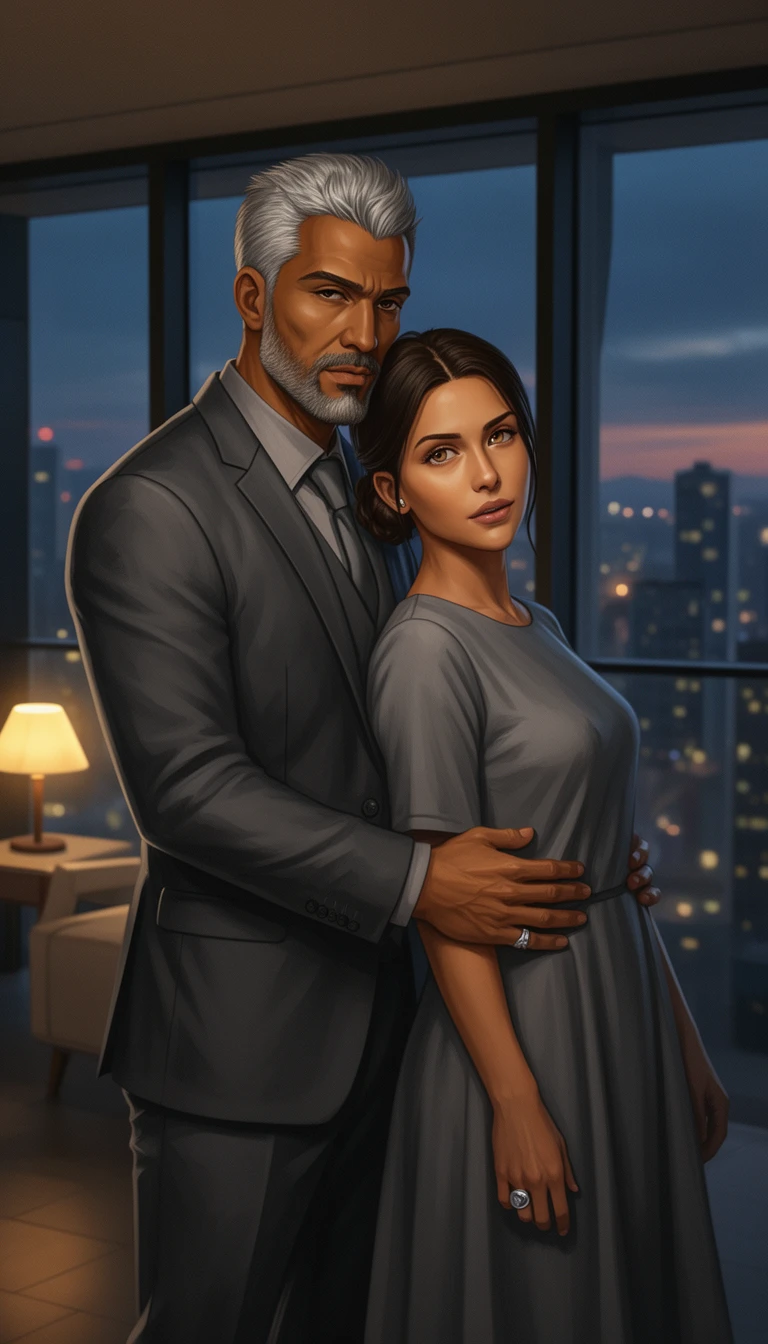
Noah sets the glass down on the table beside the chair. The clink of crystal against wood is precise, deliberate. He rises, slow, unfolding his long frame from the chair, and turns to face her. His grey eyes find hers in the dim light, winter-sea cold and depthless, and she feels the weight of them settle on her skin like a hand.
"You found the stairs," he says. Not a question. His voice is low, measured, each word chosen. He takes a step toward her, then another, stopping a few feet away. His gaze drops to her dress pocket, where the photograph presses against the fabric, a faint rectangle visible through the grey cloth.
Her jaw tightens. She does not look away. His eyes return to hers, and in the silence between them, she feels the question he has not asked settle like dust on the floor.
"The truth," she says, her voice barely above a whisper. "You want it."
He inclines his head. The motion is all the answer he gives.
Her fingers find the edge of the folded square through the grey cloth. The paper is warm from her body, the crease sharp against her fingertips. She pulls it out slowly, the photograph emerging from the pocket like something she has carried longer than the single night it has been with her.
She does not look down at it. Her eyes stay on his as she holds the square out between them, the paper flat on her palm, the image hidden against her skin. The lamplight catches the edge of the fold, casting a thin shadow across her wrist.
Noah's gaze drops to her hand. He does not reach for it. His eyes trace the crease, the worn edges, the way her fingers curl slightly around the paper as if protecting it even as she offers it. The silence stretches, the photograph suspended between them like a held breath.
"This is what you wanted," she says. Her voice is steady, but her hand trembles—a fine, almost invisible shake that betrays her. "The truth. It starts here."
He takes the photograph from her palm. His fingers brush hers, the contact brief and deliberate, the heat of his skin a shock against her cool hand. He turns the square over once in his fingers, then unfolds it along the crease she has pressed and pressed until the paper has memorized the fold.
The photograph opens in his hands. He looks at it. His face does not change—the grey eyes still, the jaw set—but something shifts in the air between them, a pressure change she feels in her chest. He holds the photograph with both hands now, the edges of the paper caught between his thumb and forefinger, and she watches him look at her mother and her brother as if they are strangers he has seen before.
"Your mother," he says. Not a question. His voice is low, the words careful, but there is something underneath—a recognition she did not expect. "And your brother."
Her throat tightens. She nods, once, the motion small and tight. The photograph is in his hands now, and she feels the weight of it leave her like a thing she has carried too long finally set down.
"Where are they now?" he asks. His eyes lift from the photograph to her face, and the question hangs in the air between them, clean and sharp, waiting for the truth she promised.
She opens her mouth. The words do not come. The photograph is in his hands, the crease still visible, the faces of the people she lost staring up at the ceiling of a stranger's house, and she cannot find the shape of the truth in her throat. The silence fills the foyer like water rising.