
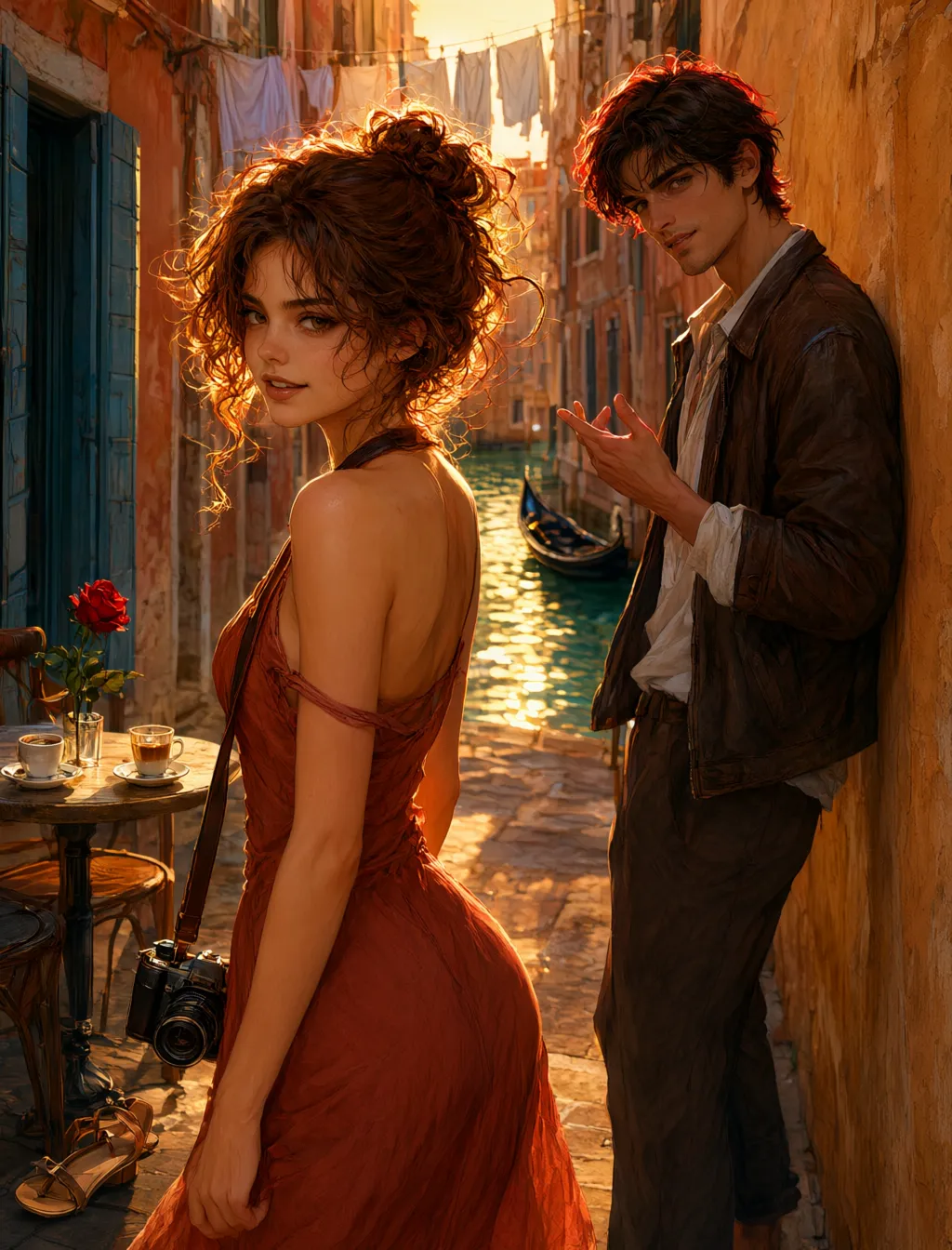
The lecture hall door swung shut behind me, cutting off the murmur of departing students like a blade. The fluorescent lights hummed overhead, that same dull glare on the scuffed linoleum, and I was already three steps into the hallway before I registered the shape against the wall.
Matteo.
Arms crossed. Leather jacket dark against the pale plaster. His gray-green eyes were already on me, unblinking, like he'd been waiting for this exact moment—for me to be the first one out the door.
I stopped short. The strap of my bag cut into my shoulder, and I shifted it, buying myself a second I didn't know what to do with.
"You gave the professor your name," he said. "Now give it to me."
His voice was low, deliberate, carrying over the hum of the fluorescents like it had been tuned to cut through exactly this kind of silence. He pushed off the wall and stepped into my path, close enough that I caught leather and something else—something clean and sharp, like rain on hot stone.
My back hit the plaster before I'd decided to move. The cool of it seeped through my sundress, and I pressed into it like it could hold me up. My heart was slamming against my ribs, and I hated that he could probably see it, the pulse in my throat, the way my fingers had gone tight around my bag strap.
"I don't give my name to strangers who follow me across cities," I said. My voice came out steadier than I felt. "It's a policy."
His mouth curved. Not quite a smile—something sharper, more pleased. "A policy. You have policies for this?"
"I have policies for men who recite my day back to me in bars." I tilted my chin up. "It's a growing category."
He laughed. A short, surprised sound that seemed to escape him against his will, and something in his face shifted—the armor cracking for half a second before it settled back into place. "You're quick," he said. "I remember that about you."
The words landed somewhere in my chest. I remember that about you. Like I was something he'd catalogued, filed away, kept.
"You remember a lot of things about me," I said. "That's the problem."
His eyes held mine, and I watched something move in them—not anger, not mockery. Something hungrier. "You were photographing the canals," he said. "You missed your vaporetto by eleven minutes. You stood at the edge of the water and watched the light hit the buildings like you were memorizing it." He took a half-step closer. "You didn't take a single picture."
The fluorescent light buzzed. Somewhere down the hall, a door opened and closed, but I couldn't look away from him.
"You were watching me," I said. "For how long?"
"Long enough."
"That's not an answer."
"It's the only one you're getting." His gaze dropped to my mouth, then back up, and the air between us went thick. "You gave the professor your name. You stood up in front of the whole seminar and told him you're Amara Chen. So I know it now anyway."
The sound of my name in his mouth did something I wasn't prepared for. He said it like he was testing it, tasting it, deciding whether it fit.
"Amara," he repeated, slower. "It suits you."
"You already knew it," I said. "Before I stood up."
He didn't deny it. He just watched me, and I watched him, and the silence stretched until I could hear my own breathing, too loud in my ears.
"Why?" The word came out before I could stop it. "Why did you follow me here?"
Something flickered across his face—there and gone, too fast to name. "I told you. I've been looking for you."
"That's not why." I shook my head, the curls bouncing against my cheeks. "People don't follow strangers from Venice to Padua because they want to know their names. People do that because—" I stopped, the word catching in my throat.
"Because what?"
"Because they want something." My voice dropped. "What do you want, Matteo?"
His name in my mouth changed something in his face. His jaw tightened, and for a second he looked almost thrown—like he hadn't expected me to say it, hadn't expected it to sound like that.
"I want to know why you didn't take the picture," he said finally.
The answer caught me off guard. I blinked. "What?"
"In Venice. You stood at the edge of the canal with a camera around your neck, and you watched the light hit the water for—I don't know, ten minutes. And you never lifted the camera." He tilted his head. "I've been thinking about that for three days."
I opened my mouth. Closed it. The strap of my camera bag was suddenly heavy against my collarbone, and I was aware of it in a way I hadn't been all day—the weight of it, the promise of it.
"Some things aren't meant to be captured," I said. "Some things you just have to be inside of."
His eyes went dark. "That's the most honest thing you've said to me."
"Don't get used to it."
He smiled again, that sharp, pleased curve, and I felt it in my chest like a match struck. He was too close. The hallway was too narrow. The fluorescent light was too bright, and I could see everything about him—the way his hair fell over his forehead, the faint stubble along his jaw, the way his hands hung at his sides, restless, like he was holding himself back from something.
"The professor asked you about chiaroscuro," he said. "You said light exposes isolation."
I went still.
"You knew I'd answer," I said. "You knew before I stood up."
"I knew you couldn't resist." He stepped closer, and the toe of his boot brushed against the edge of my sandal. "I saw it in Venice. The way you look at things. Like you're trying to understand them from the inside." His voice dropped. "Like you're trying to understand yourself."
My breath caught. The plaster was cool against my back, and his body was close enough that I could feel the heat coming off him, could smell the leather and the rain-smell and something underneath that was just him.
"You don't know me," I said, but my voice came out thin, and we both heard it.
"I know you're afraid of being seen." He said it quietly, without mockery. "I know you've been walking around this city with your camera around your neck, trying to disappear into it. I know you gave the professor your name because you couldn't stand to let his question go unanswered, even though it meant giving yourself away."
I couldn't breathe. The hallway was too small, the air too close, and he was looking at me like he could see through the sundress and the camera strap and the sarcasm, down to something I'd been trying to keep hidden.
"You've been watching me for three days," I managed. "That's not normal."
"I know." He didn't look away. "I don't care."
The words hung between us, heavy and honest, and I didn't know what to do with them. I didn't know what to do with any of this—the way he was looking at me, the way my heart was slamming, the way my hands had gone useless at my sides.
"You should care," I said. "You should care a lot."
"Why?" He took another half-step, and now there was barely a breath of space between us. "So you can pretend you're not curious? So you can pretend you didn't feel it too, in that bar, when I told you I'd been looking for you?"
"I felt alarmed," I said. "I felt like I should call the police."
"And yet you're still here." His voice was soft. "You could have walked out that door. You could have turned around and gone back into the lecture hall. You could have screamed." He tilted his head. "You didn't."
The truth of it sat between us, unacknowledged and undeniable. I was still here. I had stopped walking the second I saw him. I had let him corner me against the wall, had let him step into my space, had let him say my name like he had a right to it.
"I'm trying to figure out if you're dangerous," I said.
"I am." He said it without hesitation. "But not the way you think."
"How, then?"
His hand lifted.
I watched it rise—slow, deliberate, like he was giving me time to stop it. His fingers were long, restless, and they moved toward my face with an intent that made my breath catch in my throat.
I should have moved. I should have ducked away, should have pushed past him, should have done any of the things a sensible person would do when a stranger they barely knew reached for their face in an empty hallway.
I didn't move.
His fingers brushed the stray curl at my cheek, tucking it behind my ear, and the touch was featherlight—barely there—but I felt it everywhere. The pad of his finger grazed my cheekbone, and his eyes followed the movement like he was memorizing the shape of my face.
The curl slipped from his fingers and fell back against my cheek.
He didn't pull his hand away.
"I've been looking for you since Venice," he said, low and deliberate, his thumb hovering at the edge of my jaw. "I'm not letting you walk away again."
The words landed in the space between us, and I felt them in my chest, in my throat, in the way my hands had gone white-knuckled on my bag strap. His hand was still there, still hovering, still a breath away from touching me again, and I couldn't move, couldn't speak, couldn't do anything but stand there with my back against the cool plaster and my heart slamming against my ribs.
His thumb paused mid-air, a hair's breadth from my skin, and I watched his eyes drop to my mouth and back up, slow, like he was memorizing me.
The fluorescent light hummed. The hallway was empty. And Matteo Ricci stood in front of me with his hand still raised, his words still hanging in the air between us, and I had never felt so completely, terrifyingly seen.
My fingers curled into the strap of my bag so hard the leather creaked. The sound was small, almost swallowed by the hum of the fluorescents, but his eyes flicked down to my hands and then back up, and something in his expression shifted—softer, or maybe just more patient.
"You're gripping that like it's going to save you," he said.
"Maybe it is."
"From what?"
I didn't have an answer. Or I did, but it was too close to the surface, too honest, and I wasn't about to hand it to him in a fluorescent-lit hallway with his thumb still hovering a breath from my skin. So I said nothing, and he let the silence sit, and the weight of it pressed against my chest like a second body.
His hand lowered. Not all the way—just enough that his fingers brushed the collar of my sundress, a whisper of contact that made my breath catch. He didn't seem to notice. Or maybe he did. Maybe he noticed everything.
"You're thinking about running," he said. It wasn't a question.
"I'm thinking about a lot of things."
"Name one."
I looked past him, down the hallway to where the stairwell waited, the exit sign glowing green over the door. He followed my gaze and then looked back at me, and I watched him shift his weight—a small, deliberate movement that put his shoulder in the path, blocking the only clear line to the stairs without ever touching me.
"You see that?" I said. "You just did it again."
"Did what?"
"Moved so I couldn't leave."
His mouth curved, that sharp, pleased thing. "You noticed."
"Hard not to notice when someone's herding you."
"I'm not herding you." He said it softly, almost gently. "I'm standing where I want to stand."
The words landed in the space between us, and I felt them settle somewhere I didn't want them to. Somewhere warm. Somewhere that had been cold for a long time and didn't know how to be anything else.
The fluorescent light flickered—once, twice—and steadied. In the silence, I could hear my own heartbeat, could feel it in my throat, in my wrists, in the place where my chest pressed against the strap of my camera bag. He heard it too, maybe. His eyes hadn't left my face.
"You're scared," he said. Not mocking. Just stating it, like a fact he'd already verified.
"I'm cautious," I said. "There's a difference."
"Is there?"
"One of them means I'm paying attention. The other means I'm about to make a bad decision."
He laughed again, that same surprised sound from before, and I felt it in my chest like a hand closing. "You're something else," he said, almost to himself.
"So I've been told."
"By who?"
"Anyone who's ever tried to have a conversation with me." I tilted my chin up. "It's exhausting, apparently. I'm exhausting."
"You're not exhausting." His voice dropped. "You're the most awake person I've met in this city."
The words hit me somewhere I wasn't prepared for. I opened my mouth to deflect, to say something sharp, but nothing came out. His hand was still resting at the collar of my sundress, his thumb tracing the edge of the fabric in a slow, absent motion, and I couldn't remember the last time someone had touched me like that. Like I was something to be careful with.
"Amara," he said, and the sound of my name in his mouth again—low, deliberate, like he was turning it over—made my knees go weak. "I'm not going to hurt you."
"You don't know that."
"I do."
"You don't know me."
"I know enough." His thumb stilled against the fabric. "I know you're brave. I know you're smart. I know you're standing here, in a hallway, with a stranger's hand on your collar, and you haven't run." His eyes held mine. "That's not caution. That's something else."
The fluorescent light hummed. The hallway was empty. And I stood there, pinned by his gaze, with his thumb against my collarbone and the truth of his words settling into my bones like rain into dry earth.