The seminar room smelled of stale coffee and dry-erase markers, the air warm and still against my skin. Fluorescent lights hummed over scuffed linoleum, and I felt the rough edge of the laminate table bite into my forearm as I leaned forward.
I'd arrived early. Deliberately early, the way you do when you want to prove something to yourself—that you're here for the art, for the chiaroscuro and the quattrocento and the slow burn of a city still unfamiliar under my feet. Not for him. Definitely not for the boy with the gray-green eyes who'd recited my day back to me like a poem he'd memorized.
Two girls I didn't know had claimed the row ahead of me, their backpacks slung over empty chairs like territorial flags. A boy with glasses and a coffee stain on his collar was already asleep in the corner, head propped against the wall, mouth slightly open. I watched the door the way you watch a stage before the curtain lifts, waiting for something I couldn't name.
The professor—a thin man with a salt-and-pepper beard and chalk dust on his elbows—was arranging slides at the lectern, muttering to himself in Italian. I caught fragments. Luce. Ombra. Contrasto. Light. Shadow. Contrast. The language of what I'd come here to study, and still my eyes kept drifting to the door.
Lucy had laughed at me this morning. "You look like you didn't sleep," she'd said, handing me a cup of coffee so strong it could strip paint. "Nightmares? Or—" and here she'd raised an eyebrow, "—someone worth losing sleep over?"
I'd told her it was jet lag. She'd told me my ears were red. I'd told her to shut up. We'd both been right.
The door opened.
My heart did something stupid—a skip, a stumble, a catch—and then the person who walked in was just a girl with a laptop bag and earbuds, and I let out a breath I hadn't realized I was holding. Get a grip, Amara. He wasn't going to be here. He was a stranger, a coincidence, a warning I'd chosen not to heed. The city was full of dark-haired boys with clever mouths.
I turned back to my notebook, uncapped my pen, and wrote the date at the top of the page. October. Padua. Day three. Underneath it, without meaning to, I wrote: Don't look for him.
The professor cleared his throat. "Before we begin—" he started, and that's when the door opened again.
I didn't look up. I was very busy being a serious art history student, very busy with the date and the ink and the careful loop of my handwriting. The door clicked shut. Footsteps. Slow ones. The kind of footsteps that know they're being heard, that take their time on purpose, that measure the room before they commit to a direction.
I looked up.
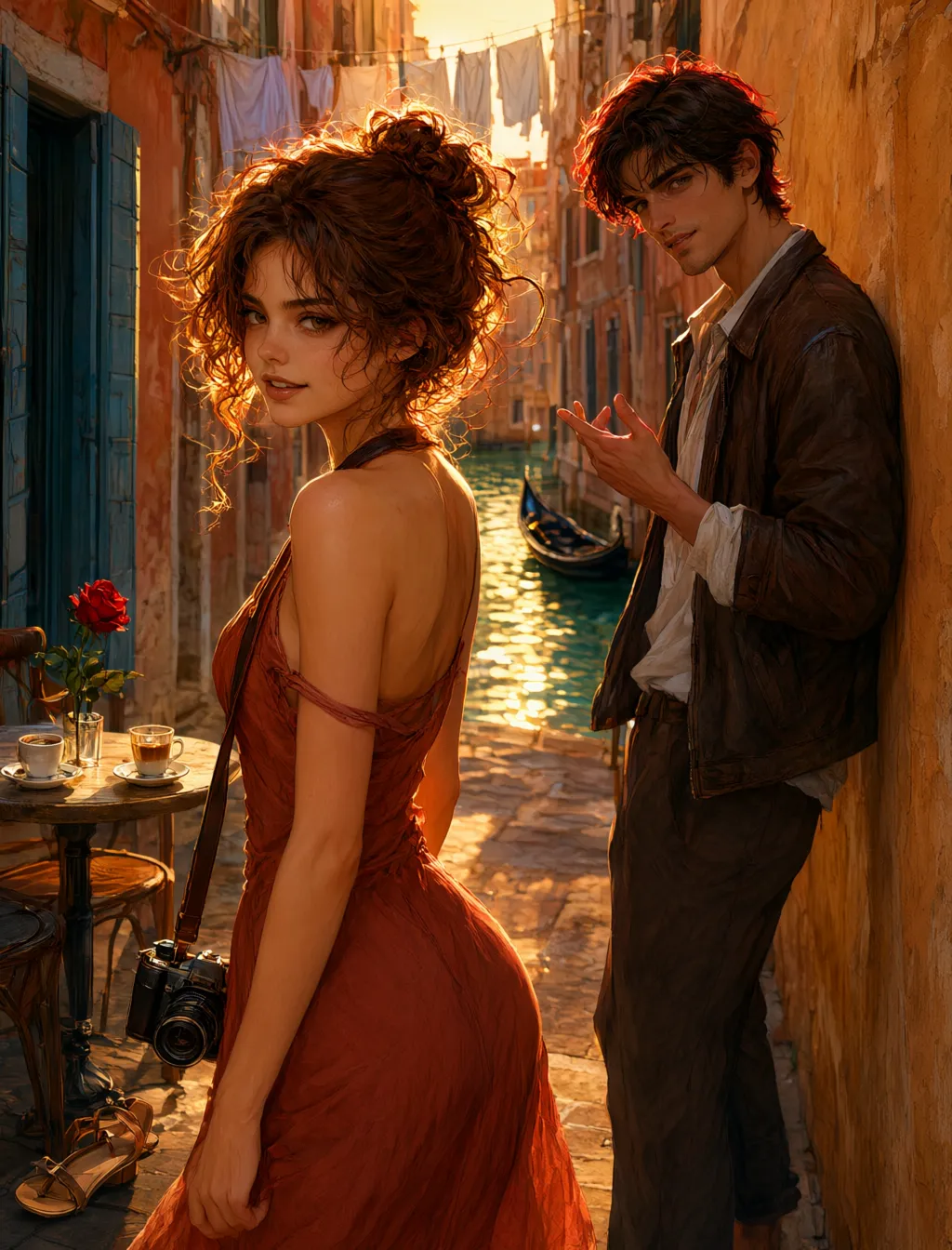
Matteo Ricci was standing in the doorway like he owned it, like he'd been born in it, like the seminar room had been waiting for him to arrive. His leather jacket was unzipped over a dark shirt, his hair falling across his forehead in that way I remembered too well, and his hands were shoved in his pockets with an ease that felt like a dare. His eyes found mine across the room, and he smiled—slow, deliberate, a cat at a mousehole.
I looked away. Too fast. I felt the heat crawl up my neck, and I hated it, hated that he could do that with a single look, hated that I'd been watching the door like a lovesick fool and he'd walked through it like a punchline.
He wasn't a student. He wasn't carrying a bag, or a notebook, or any of the props of someone who belonged here. He just walked down the aisle between the rows of desks, past the sleeping boy, past the territorial girls with their backpacks, and dropped into the back row with the kind of casual sprawl that suggested he'd been sitting there for years. His legs stretched out, long and lazy, one ankle crossed over the other. He didn't take out a pen. He didn't take out anything. He just sat there, watching.
The professor hadn't noticed. He was still fiddling with his slides, muttering about light and shadow, and the rest of the room was settling into the usual pre-lecture murmur. I was the only one who knew. The only one who could feel the weight of those gray-green eyes on the back of my neck like a hand pressed there.
I had choices. I could leave. I could stand up, walk out, find another seminar, another building, another city. The door was still open. He'd said he'd follow if I ran, and I'd told myself I wasn't the kind of girl who ran—but that was before, in a bar, with liquid courage in my veins and the night hiding my face.
This was daylight. Fluorescent. Real.
I didn't leave. I turned back to my notebook, uncapped my pen, and wrote Don't look for him in a hand that wasn't quite steady. Then I wrote it again, smaller, as if the repetition could make it true.
The professor dimmed the lights. The first slide clicked up on the screen—a Caravaggio, all stark light and brutal shadow, a saint's face half-emerging from darkness. "Chiaroscuro," he said, and the word hung in the air like a bell. "The art of the contrast. The moment where light meets dark and both become something new."
I should have been taking notes. I should have been absorbing every word, filing it away for the essay I'd have to write, the exam I'd have to pass. Instead I was counting the seconds between breaths, feeling the prickle at the back of my neck, the certainty that he was still watching me the way he'd watched me in Venice—like I was a painting he was trying to understand.
Another slide. Another saint. Another dramatic slash of light across a tortured face. The professor's voice droned on, and I wrote down contrast and tenebrism and the moment where light meets dark, and underneath it all I was thinking: he's still here. He's still looking.
I didn't turn around. I wouldn't give him that. I kept my eyes on the screen, on the Caravaggio, on the way the light carved the saint's face out of nothing, and I felt the minutes stretch like taffy, slow and sticky and impossible to escape.
The girl next to me—the one with the laptop bag—leaned over. "Do you know him?" she whispered, nodding toward the back row.
"No," I said, too quickly. "He's nobody."
She gave me a look I couldn't read, then shrugged and turned back to her screen. I could feel him smiling. I could feel it without looking, the way you can feel the sun on your skin even with your eyes closed.
The professor moved on to another slide. A Madonna, this time, her face half in shadow, her eyes cast down. "Notice how the light draws the eye," he said. "Notice where the artist wants you to look."
I knew exactly where he was looking. I could feel it, a physical weight, a pressure at the base of my skull. I shifted in my seat, crossed my legs, uncrossed them. I tucked a curl behind my ear. I did everything except turn around, and I knew he was enjoying every second of it—the fidgeting, the heat, the way I couldn't sit still under his gaze.
"Contrast," the professor said, and I wrote it down again, the pen scratching against the paper. "The tension between two opposing forces. The friction that creates meaning."
I thought: that's us. That's him and me. And then I hated myself for thinking it, for turning an art history lecture into a metaphor for a boy I didn't even know.
The slide clicked. Another saint, another slash of light. The professor's voice picked up, warming to his subject, and the room settled into that particular rhythm of a lecture that's found its groove. I let myself breathe. Let myself believe, for a moment, that I could just sit here and take notes and pretend he wasn't there.
And then the professor asked the question.
"What is the purpose of chiaroscuro?" he said, turning from the screen to face the room. "Why did Caravaggio choose to paint his saints this way? What does the contrast do?"
The room went quiet. The kind of quiet that happens when no one wants to be the first to speak, when everyone's suddenly very interested in their notebooks or their phones or the ceiling tiles. I knew the answer. I'd known it since I was sixteen, since the first time I'd seen a Caravaggio in a textbook and felt something click into place in my chest.
But I didn't raise my hand. I didn't want to be seen. I didn't want to give him anything—not my voice, not my answer, not the satisfaction of watching me perform.
The silence stretched. The professor looked around the room, eyebrows raised. "Anyone?"
And then, from the back row, a voice I knew too well. Low, amused, laced with something that felt like a dare.
"She knows the answer."
Every head in the room turned. Every single one. The girl with the laptop bag looked at me. The sleeping boy woke up. The professor's eyebrows climbed higher, and his gaze landed on me, expectant, curious.
And I felt the heat flood my face as I turned, slowly, to face the boy in the back row.
Matteo was leaning back in his chair, arms crossed, that lazy smile still playing at the corner of his mouth. His eyes met mine, and there was something in them—not a question, not a challenge, but a certainty. Like he'd known I'd know the answer. Like he'd known all along.
The silence in the room had teeth. I could feel every pair of eyes on me, a dozen small weights pressing against my skin, but the heaviest was his—that gray-green gaze that had been tracking me since Venice, since before I even knew his name. The professor cleared his throat, a sound like paper being crumpled. "Miss...?"
"Chen," I said, and my voice came out steadier than I felt. "Amara Chen."
I stood up. I didn't plan it—my body just moved, pushing back from the table, the chair scraping against the linoleum in a way that made the girl with the laptop bag wince. I could feel Matteo watching me, could feel the amusement radiating off him like heat off a stove, and I hated that I was giving him exactly what he wanted. A performance. A show.
"Chiaroscuro isn't about the light," I said, and the words came out before I could stop them. "It's about the absence of it. Caravaggio doesn't paint his saints to show you their holiness—he paints them to show you the dark they're emerging from. The contrast doesn't illuminate. It isolates." I gestured at the slide, at the saint's face half-carved from shadow. "Look at him. He's alone in that darkness. The light isn't saving him—it's exposing him."
The room was silent. I could hear the fluorescent lights humming, a sound I'd barely noticed before, and the distant clatter of someone in the hallway dropping a book. The professor was staring at me with an expression I couldn't quite read—surprise, maybe, or the particular stillness of someone reassessing what they thought they knew.
"That's—" he started, then stopped. "That's remarkably perceptive, Miss Chen."
I sat down. My hands were shaking, just a little, and I pressed them flat against the laminate table to still them. The rough edge bit into my palm, a grounding kind of pain, and I focused on that instead of the weight of his gaze on the back of my neck. I didn't turn around. I wouldn't give him the satisfaction.
But I could feel him. I could feel the shift of his weight in the chair behind me, the lazy confidence of a boy who'd gotten exactly what he wanted. And I could feel something else, too—a heat that had nothing to do with embarrassment and everything to do with the way his voice had cut through the room like a blade.
The professor moved on, his voice picking up where it had left off, but I wasn't listening anymore. I was staring at the Caravaggio on the screen, at the saint's face emerging from the dark, and I was thinking: he knew. He knew I'd know the answer. He knew I couldn't resist.
The girl next to me leaned over again. "That was impressive," she whispered. "Who is he, really?"
"I don't know," I said, and it was the truest thing I'd said all day. "I don't know anything about him."
She didn't look convinced. I didn't blame her. I didn't convince myself.