
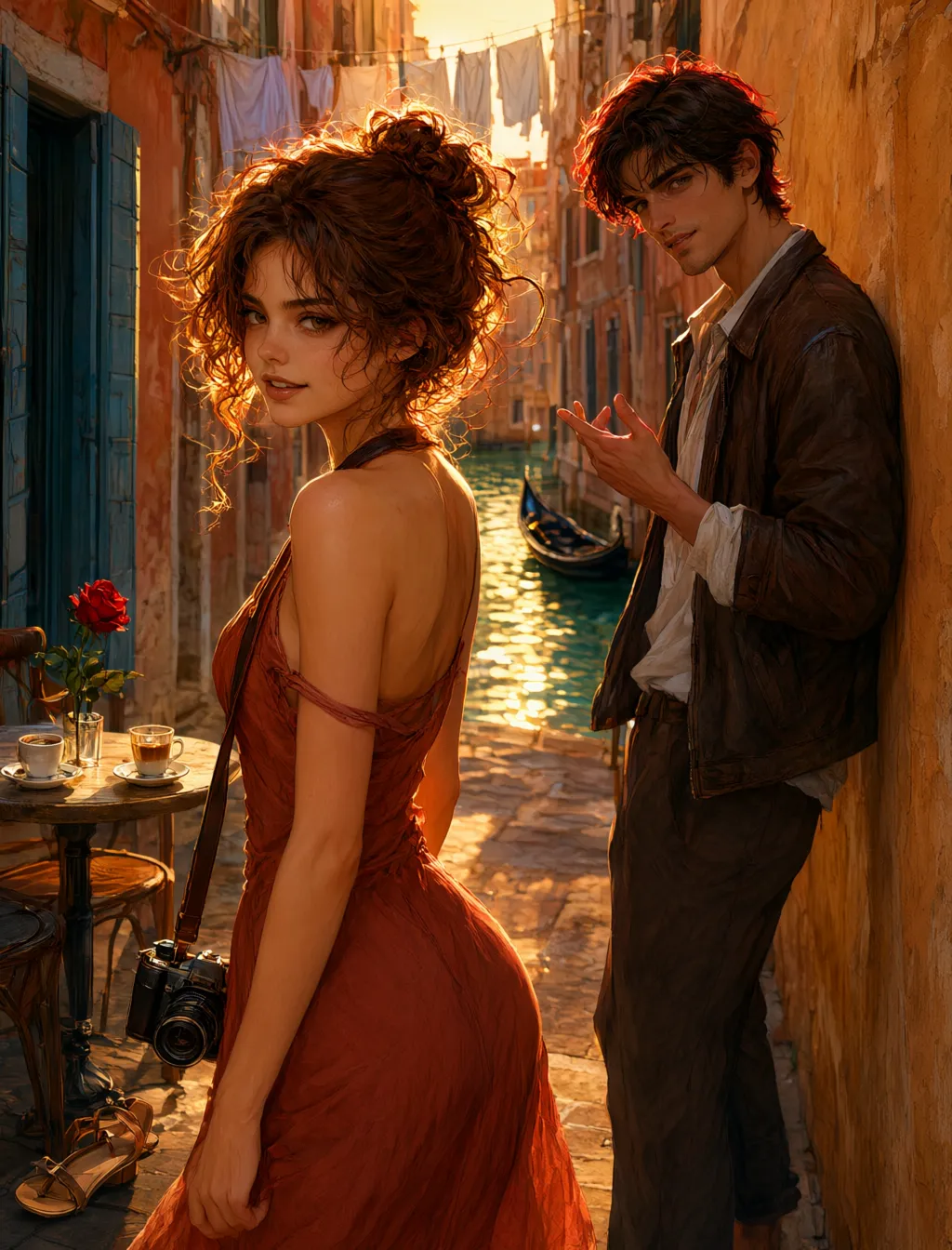
The plane tilted over the lagoon and Amara pressed her forehead to the cold window, watching Venice assemble itself from the haze below—a scatter of terracotta rooftops rising out of water like something that had decided not to sink. She'd spent four months saving for this. Two hundred and eleven days of double shifts at the campus coffee cart, of saying no to concerts and cheap flights home, of her mother's voice on the phone asking if she was sure, really sure, sweetheart, and now here it was. The city. The whole ridiculous, impossible, floating city.
She stepped off the plane into air that smelled different than she'd expected. Not romantic. Not cinematic. Just warm and slightly damp, with an undertone of jet fuel and salt, and she loved it immediately, the way you love a thing before it's done anything to deserve it.
Her suitcase wheels caught on the gangway joint and she yanked it free, camera strap already settling into its familiar groove against her collarbone—the weight of it a comfort, a way of holding the world at a small, safe distance. She'd read somewhere that photographers hide behind their lenses. She'd read a lot of things.
The airport was a blur of marble floors and echoing announcements in a language she'd studied for two years but still understood too slowly, words arriving at her a beat late, like subtitles lagging behind the picture. She followed the signs for the bus to Piazzale Roma, dragging her suitcase through the crowd with the particular determination of someone who'd memorized the route but not the texture of it—the way the light fell, the way people moved, the way her own heart hammered against her ribs like she was about to do something brave.
She was. She was about to do the bravest thing she'd ever done, which was exist in a place where no one knew her name.
The express bus shuddered across the causeway and Amara pressed her face to the glass like a child at an aquarium. The lagoon glittered on both sides, impossibly flat, impossibly bright, and then the city rose up out of it—not gradually, not politely, but all at once, a sudden vertical tangle of domes and bell towers and laundry strung between windows like flags of surrender to the sun. She forgot to breathe. She forgot she had ever breathed differently.
Piazzale Roma was chaos in the best way—buses hissing, tourists swirling, pigeons claiming the pavement like they owned it, which they did. She hauled her suitcase through the crowd and stopped dead at the edge of the Grand Canal, where a vaporetto was pulling away from its dock with a low diesel groan, churning green water into white. The city opened in front of her like a held breath released. She reached for her camera, raised it, lowered it. Some things you don't photograph. Some things you just stand in.
She didn't notice him. That's important.
She didn't notice the dark-haired boy leaning against the railing at the far end of the dock, the one with the leather jacket and the restless hands, the one who'd been staring at the same view every day of his life and had stopped seeing it years ago—until she stepped off the bus with her wild chestnut hair escaping its ponytail and her sundress catching the wind, and the city rearranged itself around her like a lock finding its key.
She didn't see him go still. Didn't see his gray-green eyes track her as she moved to the water's edge, craning her neck at the dome of Santa Maria della Salute like it was the first impossible thing she'd ever laid eyes on. Didn't see the way his mouth curved, not quite a smile, something sharper and softer at once.
She didn't see any of it. She was too busy falling in love with a city that didn't know her name.
She did see the vaporetto schedule, and the realization that she'd missed the last direct boat to Padua by eleven minutes. She stood there, phone in hand, the screen's glow washing out the afternoon, and felt the first small crack in her composure—the gap between the plan she'd made and the city's indifference to it.
She'd have to take the train. The train station was—she checked the map, rotated it, checked it again—across the bridge, past the church, over the water. She could do that. She'd walked farther in New York on a bad day.
She dragged her suitcase across the Ponte degli Scalzi, wheels clattering over stone, and the heat hit her in a wave—the particular Venetian humidity that turns the air into a wet blanket, that makes your sundress stick to your hips and your hair curl into something feral. She didn't care. Every bridge was a small revelation. Every narrow alley promised something. She passed a bakery and the smell of fresh bread and coffee stopped her mid-stride, and she stood there in the middle of the foot traffic like a fool, breathing it in, thinking: this is real. This is my life now.
She didn't notice the boy who'd followed her across the bridge at a careful distance, hands in his jacket pockets, watching her get lost in a way that looked like joy. He'd seen a thousand tourists do the same dance—map out, map rotate, head tilt, wonder. But she was different. She wasn't checking the city off a list. She was tasting it. And he couldn't look away.
The train station was cooler than the street, all high ceilings and echoing announcements, and she found the platform for Padua with ten minutes to spare. She sat on a bench, camera in her lap, and tried to remember how to breathe normally. The platform filled with students—backpacks, headphones, the particular careless confidence of people who knew exactly where they were going. She wasn't one of them. She was the girl with the suitcase and the map and the slightly-too-fast heartbeat.
The train slid in with a screech of brakes and she found a seat by the window, pressing her forehead to the glass again as Venice slid past—the backside of it now, the laundry and the rust and the peeling paint, the parts the postcards don't show. She loved those parts more. She always did.
The train cut inland through flat green farmland, and the city shrank behind her until it was just a smudge of gold on the horizon, and she felt something loosen in her chest that she hadn't known was tight. The boy who'd watched her from the dock stood on the platform and watched the train go, and he didn't know her name, and she didn't know his, and for a long moment he just stood there with his hands in his pockets, feeling the shape of something he couldn't name.
Padua was different. Padua was red brick and cobblestones and the weight of five hundred years of students who'd walked the same streets, argued in the same cafés, fallen in love in the same shaded corners of the same ancient courtyards. The taxi dropped her at a narrow building on a street that smelled of coffee and jasmine, and she stood on the sidewalk with her suitcase and her camera and the particular terror of meeting people who would see her every day for the next four months.
The door was heavy. The stairs were steep. The apartment was on the third floor, and by the time she reached it, she was sweating through her sundress and second-guessing every life choice that had led her here.
She knocked. The door swung open.
The girl on the other side was tall and freckled, with red hair pulled into a messy bun and the kind of open, immediate smile that made Amara's shoulders drop an inch. "You must be Amara! I'm Lucy. I got here yesterday. I've already claimed the top bunk, hope that's okay, and I found this café around the corner that does the best—" She stopped, tilted her head. "You look like you just survived something. Come in. There's wine."
Amara stepped inside and the door closed behind her, and the city of Padua settled around her like a coat that was still too big, but warming.
The apartment was small and slanted and perfect—wooden beams, a window that looked out over a tangle of rooftops, a kitchen with mismatched plates and a bowl of lemons that someone had left as a welcome. The other roommate, a quiet girl from Seoul named Jisoo, was unpacking in the corner, and she looked up and gave Amara a small, shy wave that said everything about the months ahead without saying anything at all.
They drank the wine. They ate bread and cheese from the café around the corner. They talked in the particular way of people who'd just met and already understood something about each other—that they were all here for the same reason, all running from the same thing, all hoping the distance would do what the proximity couldn't.
Later, when the others had gone to bed, Amara stood at the open window and looked out at the rooftops of Padua, at the swallows cutting through the last of the light, at the city that was not Venice and not New York and not anywhere she'd ever been. Her camera hung at her side, unused. She didn't reach for it.
She just stood there, breathing in the jasmine and the diesel and the smell of someone else's cooking drifting up from the street below, and she thought: I did it. I'm here. This is mine now.
She didn't know that across the city, in a café he'd been going to since he was a boy, a dark-haired boy with gray-green eyes was sitting with an espresso he wasn't drinking, thinking about a girl he'd seen for exactly eleven minutes—long enough to memorize the way her curls escaped their binding, the way she'd stood at the edge of the Grand Canal like she was deciding whether to jump in or just drown in it, the way she'd missed her boat and laughed at herself, not annoyed, just amused, like the city was playing a joke on her and she was delighted to be in on it.
He didn't know her name. He didn't know where she was going. But the train had left, and she'd been on it, and he'd stood on the platform long enough for the platform to feel like a place he was waiting in rather than passing through.
He'd see her again. He didn't know how he knew that. He just knew it the way you know a storm is coming—a pressure in the air, a change in the light, a restlessness in his hands that hadn't been there that morning.
Amara closed the window and went to bed in a room that smelled of lemons and strangers, and she slept the deep, dreamless sleep of someone who has finally arrived somewhere they were meant to be.
The alarm came too early and too bright, a rectangle of Venetian sunlight that had followed her even here, through the train and the taxi and the heavy front door, as if the city wasn't done with her yet. Amara rolled over and found her phone on the floor where she'd dropped it, the screen showing a message from her program coordinator with a map attachment and a time and a building name she couldn't pronounce. Her first day of orientation. Her first day of being a student in a country that wasn't hers.
She dressed in the dark so she wouldn't wake the others—a linen shirt she'd bought at a thrift store in Brooklyn and jeans that had seen better days—and she stood at the bathroom mirror for a long moment, staring at the girl looking back at her. The same wild curls, the same honey-brown eyes, the same slightly-too-serious mouth. She looked the same. She felt different. She felt like a version of herself that hadn't been invented yet.
The streets of Padua in the morning were a different animal than Venice. Quieter. More honest. The coffee shops were full of old men reading newspapers and students hunched over laptops, and the light came down through the narrow gaps between buildings in long golden shafts that made the dust motes visible. Amara walked with her phone in her hand, following the map, and she let herself get lost twice on purpose just to feel the unfamiliarity of it—the way the streets didn't follow any grid she knew, the way the names were all vowels and music.
She found the building eventually. A grand old palazzo with peeling frescoes and a courtyard full of bicycles, and she stood at the entrance for a moment, watching the other students stream past her with the easy confidence of people who'd done this before. They all seemed to know each other already. They all seemed to know where they were going. She was the only one standing still, and for a moment the old familiar panic rose up in her throat—the feeling of being the observer, the one with the camera, the one who watches instead of being watched.
She squared her shoulders. She walked in.
Orientation was a blur of names and handshakes and people asking her where she was from in accents that made her own voice feel too flat, too American. She said "New York" and watched their faces do the predictable thing—the polite interest, the slight wariness, the assumption that she was loud and fast and brash. She didn't correct them. She let them think what they wanted. She was too busy trying to remember the layout of the building, the location of the lecture halls, the name of the professor who'd be teaching her Venetian art history seminar on Tuesdays and Thursdays.
The seminar was in a room with tall windows and a view of a garden that had probably been there for four hundred years, and she took a seat in the back row, close to the door, the way she always did. The professor was a small woman with silver hair and a voice that carried, and she talked about the Venetians' relationship with light the way other people talked about love—with reverence, with hunger, with the particular intensity of someone who'd spent their whole life looking at something and still hadn't finished seeing it.
Amara took notes. She filled the margins with questions she was too shy to ask out loud. And at the end, when the professor asked if anyone had questions, she opened her mouth before she could stop herself and asked about the use of chiaroscuro in early Venetian painting, and the professor's eyes lit up, and for a moment she felt like she'd said the right thing in the right room at the right time.
The feeling lasted until she got back to the apartment and found a note on the kitchen table in Lucy's handwriting: Went to the market. Jisoo's cooking tonight. Don't be late. She stood there with the note in her hand, and she realized she'd already started to belong to something. Already started to be expected somewhere. Already started to be someone that other people waited for.
She wasn't sure how she felt about that. It had been a long time since anyone had waited for her.
She went to the market. She bought bread and tomatoes and a hunk of cheese that the vendor insisted on wrapping in paper with a flourish, and she stood at the edge of the square with her arms full of food and watched the swallows wheel overhead and thought about how strange it was to be happy in a place where no one knew her name. How strange to feel like she was becoming someone new, someone she hadn't met yet, someone who might be braver than the girl who'd left New York with a suitcase and a camera and a heart full of fear.
She walked back to the apartment slowly, taking the long way, memorizing the streets, the way the light fell, the way the city felt like it was holding its breath for her arrival. She didn't know that across town, in a lecture hall at a different university, a dark-haired boy with gray-green eyes was staring out the window instead of at the board, thinking about a girl he'd seen for exactly eleven minutes on a dock in Venice, and wondering if he'd ever see her again.
She didn't know that he'd already started looking.
She just walked home through the golden light of a Paduan afternoon, her arms full of bread and cheese and the particular sweetness of a day that had gone better than she'd expected, and she thought: this is the beginning of something. I don't know what. But it's the beginning.
The apartment smelled like sesame oil and garlic before she even got the key in the lock. Amara pushed the door open with her shoulder, bread and cheese still cradled against her chest, and found Jisoo at the stove, stirring something in a pan that sizzled and spat, while Lucy chopped vegetables at the counter with the particular violence of someone who'd been volunteered for the job.
"You're late," Lucy said, not looking up. "We started the wine without you."
"I took the long way." Amara set the bread and cheese on the table, which was already covered in bowls and plates and a bottle of red wine that was mostly gone. "I was memorizing the streets."
"That's either very romantic or very suspicious." Lucy pointed the knife at her. "Which is it?"
"Both." Amara grabbed a glass and poured herself wine, and Jisoo turned from the stove with a shy smile and said something that Lucy translated as "dinner in five minutes, sit down, you look tired."
She sat. She drank. She let the warmth of the apartment and the wine and the two strangers who were becoming something other than strangers wash over her, and she thought: this is the beginning. She'd thought it on the dock in Venice and on the train and in the taxi and standing at the window last night with the jasmine and the diesel and the swallows. She'd thought it so many times it was starting to feel like a superstition, like saying it enough would make it true.
Jisoo's cooking was better than anything Amara had eaten in weeks—a spicy stew she couldn't name but didn't want to stop eating, and they ate until their plates were clean and the wine was gone and the light outside had turned from gold to amber to the particular blue of early evening in a city that didn't know her name.
"There's this bar," Lucy said, pushing her plate away. "Near the Duomo. A guy in my Italian class mentioned it. Said it's where everyone goes." She looked at Amara with that open, immediate smile. "You in?"
Amara hesitated. The couch was soft. The wine had made her sleepy. But the camera was still unused on the hook by the door, and the streets were still unlearned, and the girl she was becoming was supposed to be braver than the one who'd left New York.
"Give me ten minutes," she said.
The bar was called something she couldn't pronounce and she didn't try. It was tucked into a narrow alley off a square she hadn't seen yet, and it spilled out onto the cobblestones with tables and mismatched chairs and the low hum of voices in a dozen languages. Strings of lights crisscrossed overhead, and the air smelled of beer and cigarettes and the particular scent of a place where people came to be seen.
Lucy found them a table near the back, close to the bar, and Jisoo ordered something pink that came with a tiny umbrella, and Amara ordered a beer because it seemed like the honest choice. She sat with her back to the wall, the way she always did, watching. The camera hung at her side, unused. She didn't reach for it.
The bar filled up quickly. Students, mostly—the same careless confidence she'd seen on the platform, the same easy laughter. A group of boys at the next table was arguing about something in Italian, fast and loud, and she caught a few words, then lost them, then caught them again. She was starting to understand the shape of the language, the rhythm of it, the way it rose and fell like the tide.
And then the door opened.
She didn't notice him at first. That's important—or it would be, later, when she told the story to herself and tried to figure out exactly when it had started to go wrong. She noticed the group of people who came in together, laughing, jostling, the particular energy of a pack that had been together all evening. She noticed the way heads turned toward them, the way the bartender raised a hand in greeting, the way the noise level ticked up a notch like a radio finding a frequency.
And then she noticed him.
He was tall and lean, with dark hair that fell over his forehead and a leather jacket that looked like it had been worn for years, not bought to look that way. He was laughing at something someone had said, his head tipped back, his hands moving in the way of someone who talked with his whole body, and then he turned, and his eyes swept the room, and they landed on her.
Gray-green. Storm-colored. The kind of eyes that looked like they'd seen a thousand things and judged most of them.
He stopped laughing.
For a moment—a single, suspended moment—he just looked at her. Not the way strangers look at each other in a bar, not the way men look at women they find attractive, but the way you look at something you recognize but can't place, something that tugs at the back of your mind like a word on the tip of your tongue.
And then his mouth curved, not quite a smile, something sharper and softer at once, and he said something to the people around him and started walking toward her.
Amara's hand tightened around her beer. She didn't know why. She didn't know him. She'd never seen him before in her life.
He stopped at the edge of her table, hands in his jacket pockets, and looked down at her with those storm-colored eyes, and she felt something shift in her chest—a door opening, a lock turning, a thing she couldn't name and didn't want to.
"You missed your boat," he said.
The words landed like a stone in still water.
"What?"
"The vaporetto. To Padua." He tilted his head, studying her. "You missed it by eleven minutes. I was there."
Amara stared at him. Her heart was doing something complicated in her chest, a rhythm she didn't recognize, and she could feel Lucy looking at her, and Jisoo, and the whole bar seemed to have narrowed to the space between them.
"You were there," she repeated.
"I was." He didn't smile. His eyes didn't leave hers. "You stood at the edge of the Grand Canal and stared at the city like you were deciding whether to jump in or just drown in it. And then you missed your boat and laughed at yourself, and I thought—" He stopped. Shook his head. "I thought you were the most beautiful thing I'd ever seen."
The table went very quiet.
Amara felt her face heat, a flush climbing from her collarbone to her cheeks, and she hated it—hated that he could do that with a few words, hated that she couldn't stop it, hated the way her hand was still tight around her beer like it was the only thing keeping her anchored.
"That's a very smooth line," she said, and her voice came out steadier than she felt. "Did you practice it, or does it just come naturally?"
His eyes narrowed, just slightly, and the almost-smile on his mouth sharpened into something more real.
"It's not a line."
"It's a line." She set down her beer and folded her arms. "You followed me across the bridge. You watched me get on a train. You're telling me you remember the exact minute I missed a boat, and you expect me to believe it's not a line?"
"I don't expect you to believe anything." He pulled out the chair across from her and sat down, uninvited, sprawling in it like he owned it. "I'm just telling you what happened. You can do with it what you want."
Lucy made a small sound that might have been a laugh or a gasp, and Amara shot her a look that said don't you dare, and Lucy pressed her lips together and looked away, but her shoulders were shaking.
"You don't even know my name," Amara said.
"No." He leaned forward, elbows on the table, and his eyes were the color of the lagoon on a stormy day, gray-green and unreadable. "But I know you're American. I know you're studying art history—you asked about chiaroscuro in your seminar this morning, and the professor looked at you like you'd hung the moon. I know you take the long way home because you're still learning the city, and you let yourself get lost on purpose because you like the feeling of not knowing where you are."
Amara's mouth opened. Closed. Opened again.
"How do you know—" She stopped. Swallowed. "How do you know what I asked in my seminar?"
He shrugged, a lazy roll of his shoulders that did something complicated to the line of his jacket. "Padua is a small city. I know people."
"You know people who were in my seminar?"
"I know people who know people." He smiled, and it was the kind of smile that was equal parts challenge and invitation, the kind of smile that made her want to argue with him just to prove she could. "I told you. I've been looking for you."
Lucy made the sound again, louder this time, and Amara kicked her under the table.
"That's creepy," Amara said, and her voice was steady but her hands were not, and she pressed them flat against her thighs to make them stop. "That's actually creepy. You followed me across a bridge and watched me get on a train and then you tracked down people who were in my seminar—"
"I didn't track down anyone." He leaned back, spreading his hands. "I was at the university today. I heard someone talking about the American girl who asked about chiaroscuro. I put it together."
"You put it together."
"It wasn't hard." His eyes swept over her, quick and assessing, and she felt it like a physical thing, like a hand brushing her skin. "You're not exactly forgettable."
The flush was back, hotter this time, and she hated him for it. Hated the way he could sit there across from her, all dark hair and leather jacket and the particular arrogance of someone who'd never been told no in his life, and make her feel like she was the one who'd been caught.
"I don't even know your name," she said again, and it came out sharper than she meant it to, a blade she hadn't intended to draw.
"Matteo." He said it like it should mean something to her, and the way it rolled off his tongue, the way the vowels curved and the consonants landed, she felt it in her chest like a struck note. "Matteo Ricci. And you are—"
"None of your business."
He laughed. It was a real laugh, not the sharp almost-smile he'd worn before, and it changed his face entirely—softened it, opened it, made him look younger and more dangerous at once.
"Fair enough," he said. "But I'll find out eventually."
"Is that a threat?"
"It's a promise."
They stared at each other across the table, and the air between them felt charged, electric, the way the air feels before a storm. Amara could feel Lucy and Jisoo watching, could feel the whole bar watching, could feel the weight of his gaze like a hand on her skin, and she thought: this is a mistake. This is the kind of boy who collects girls like souvenirs. This is the kind of boy who will break my heart and not even notice.
"I should go," she said, and she stood up, and the chair scraped against the cobblestones with a sound that felt too loud, too final.
Matteo stood too, quick and fluid, and for a moment they were face to face—close enough that she could smell him, leather and something else, something warm and male and specific to him. His eyes dropped to her mouth, just for a second, and then came back up, and she saw something flicker in them—something that made her breath catch in her throat.
"Don't run," he said, and his voice was lower now, quieter, meant only for her. "I'll only follow."
Amara's heart was hammering against her ribs, a wild drumbeat she couldn't control, and she could feel the heat of him through the space between them, could feel the pull of him like gravity, and she hated it, hated him, hated the way her body was betraying her.
"Then I guess you'll be doing a lot of walking," she said, and she turned and walked out of the bar without looking back.
The night air hit her like a slap, cool and sharp, and she stood on the cobblestones for a moment, breathing hard, her hands shaking at her sides. She could hear the noise of the bar behind her, muffled now, and she could feel the weight of his gaze on her back through the door, and she knew—she knew—that this wasn't over.
She walked home fast, not taking the long way, not letting herself get lost. The streets were darker now, the golden light gone, replaced by the blue of a city settling into night, and she kept her head down and her hands in her pockets and tried to slow her heart.
She didn't know his name was Matteo Ricci, and that he was the kind of boy who collected girls like souvenirs, and that he'd been looking for her since the moment she'd stepped off the bus in Venice with her wild chestnut hair escaping its ponytail and her sundress catching the wind.
She didn't know any of it.
But she knew the way his eyes had looked when he'd said her name—no, not her name, he didn't know her name—the way his eyes had looked when he'd said he'd been looking for her, and she knew the way her heart had answered, a door opening, a lock turning, a thing she couldn't name and didn't want to.
She walked into the apartment and closed the door behind her and stood in the dark hallway for a long moment, breathing, her hand still on the doorknob, her heart still hammering.
She didn't know she'd see him again.
But she knew it the way you know a storm is coming—a pressure in the air, a change in the light, a restlessness in her hands that hadn't been there that morning.